AHPRA-Compliant Dental SEO: Keywords, Item Numbers, Phrases
This guide sets out a compliant dental SEO structure for Australian practices, built on treatment categories and ADA item numbers. It adds a list of outcome phrases to check against Ahpra advertising guidelines before a page goes live.
 Vikas Thakur Founder, Perth 9 min read Fact checked
Key takeaways
- A 2023 audit in the Australian Dental Journal found 85% of 192 general dental practice websites breached at least one advertising requirement, and a 2020 audit in the Australasian Orthodontic Journal found 82.3% of 147 specialist orthodontist Facebook pages breached the National Law in one or more domains
- Ahpra’s guidelines bar advertising that creates an unreasonable expectation of beneficial treatment. In our view, outcome phrases such as “smile makeover” or “perfect smile” are the ones to check first (Ahpra does not list these phrases by name)
- Dental has a published item-number schedule, The Australian Schedule of Dental Services and Glossary, which gives procedure-based keyword ideas such as item 118 (external bleaching) and items 526 and 536 (direct adhesive veneers)
Dental has a published schedule of item numbers for dental services. The catch is the rules. Ahpra’s advertising guidelines apply to dental practices, and a page built to rank can become a page that draws a complaint if its copy promises a result. This guide covers a compliant keyword structure, the item-number angle, and a list of outcome phrases to check before a brief goes near a content management system.
Two Audits Show Dental Marketing Has a Compliance Problem
Building an SEO strategy on the wrong keywords is a regulatory risk as well as a ranking one, and two published audits found breaches in the samples they reviewed.
A 2023 study in the Australian Dental Journal reviewed 192 general dental practice websites against 17 criteria across five domains, based on Ahpra’s advertising guidelines and section 133 of the National Law. It found 85% were non-compliant with at least one requirement. Of the websites reviewed, 52% displayed false and misleading information, 33.9% created unrealistic expectation of benefit and 11.5% used written testimonials. We cover that study in 85% of Dental Websites Breach AHPRA Ad Rules.
A 2020 study in the Australasian Orthodontic Journal reviewed the Facebook pages of 147 specialist orthodontist practices in Australia, representing 288 specialist orthodontists. It found 82.3% breached the Law in one or more of five domains, with use of testimonials the domain most commonly contravened (76.9%). We cover it in 82.3% of Orthodontist Facebook Pages Broke AHPRA Law.
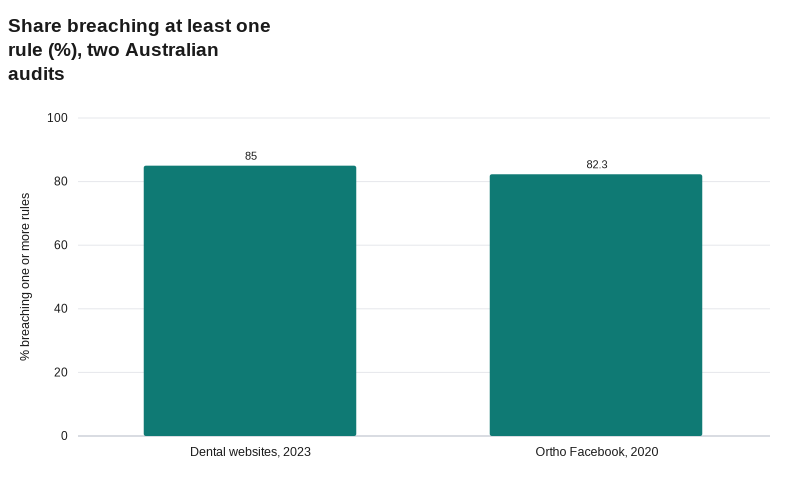
Source: Jensen et al., Australian Dental Journal, 2023 and Meade and Dreyer, Australasian Orthodontic Journal, 2020, seen 24 November 2026. Percent of 192 general dental practice websites and of 147 specialist orthodontist Facebook pages that breached at least one advertising requirement. The two audits used different samples and criteria, so the bars are not a like-for-like comparison.
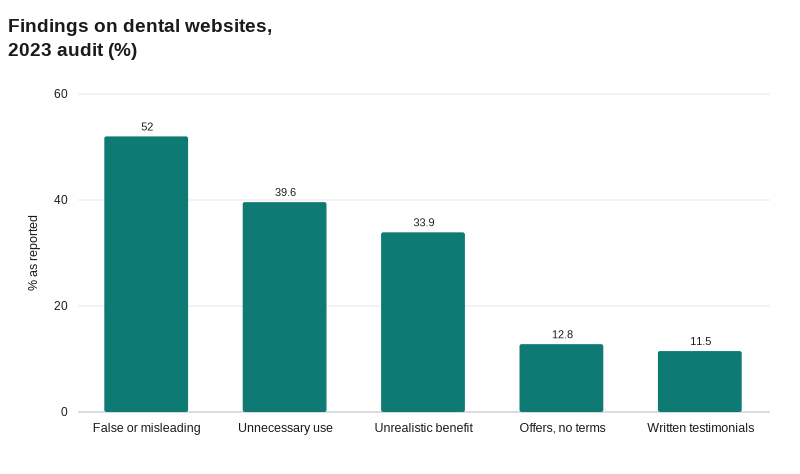
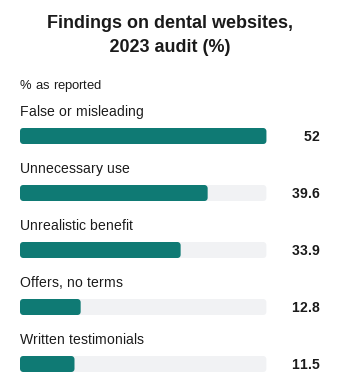
Source: Jensen et al., Australian Dental Journal, 2023, abstract, seen 24 November 2026. Percentages as the abstract reports them for the 192 general dental practice websites reviewed (“Of these websites”); a site can fall in more than one category.
Two audits of two different channels both found most of what they looked at in breach of at least one rule. They are not a measure of every dental practice today, but they are a reason to check each page against the current rules.
Takeaway: The audited breaches appeared on both websites and social media, so a compliance check belongs on every channel, not only the website.
Outcome Phrases Every Dental SEO Brief Should Check First
Cosmetic dental results are visually dramatic, which makes outcome language an easy trap. The National Law, in section 133 as quoted in Ahpra’s advertising guidelines, says a person must not advertise a regulated health service in a way that “creates an unreasonable expectation of beneficial treatment”. The same page says “before and after” images have the potential to be misleading or deceptive and should be used with care, and it also lists testimonials as an advertising breach. The Dental Board of Australia hosts the same guidelines for dental practitioners and states that Ahpra and the National Boards cannot approve advertising.
The Ahpra guidelines page we read does not list these phrases by name. The table below is our own view of phrases to review, not an Ahpra list.
| Outcome phrase to review (our view) | Why we flag it | Category-style alternative |
|---|---|---|
| “Smile makeover” | Implies a transformation result | “Cosmetic dental treatment consultation” |
| “Hollywood smile” | Implies a specific outcome | “Porcelain veneers” |
| “Perfect smile” / “Dream smile” | Promises an outcome | “Veneer consultation” |
| “Whiter teeth in 60 minutes” | Promises a result and a timeframe | “In-chair professional teeth whitening” |
| “Straighter teeth without anyone knowing” | Promises an outcome | “Clear aligner orthodontic treatment” |
| “Get the smile you have always wanted” | Promises an outcome | “Cosmetic dentistry services” |
In our view, a title tag built around “Hollywood smile Perth” carries the same kind of risk as body copy that makes the same promise, because Ahpra’s definition of advertising covers “all forms of verbal, printed and electronic communication” that promotes a regulated health service. Whether a specific phrase breaches the law depends on the full advertisement and is a question for legal advice. Our full rule summary is in AHPRA advertising rules for cosmetic dentistry.
Takeaway: A phrase that sells well in a keyword tool is not automatically safe, so check each outcome phrase against the guidelines before it goes in a title tag.
ADA Item Numbers as a Keyword Category
Dental practices work from a published schedule of item numbers. The Australian Schedule of Dental Services and Glossary (13th edition, 2022, published by the Australian Dental Association) assigns an item number and a descriptor to each dental service it lists. An item number names a procedure, which in our view makes it a more factual keyword than an outcome phrase. A page that uses one still needs the rest of its copy checked.
| Item number(s) | Schedule descriptor (13th edition) |
|---|---|
| 011 | Comprehensive oral examination |
| 012 | Periodic oral examination |
| 118 | Bleaching, external - per tooth |
| 119 | Bleaching, home application |
| 526 | Adhesive restoration - veneer - anterior tooth - direct |
| 536 | Adhesive restoration - veneer - posterior tooth - direct |
| 661 to 691 | Implant-related items (the schedule’s implant prosthesis section) |
Source: The Australian Schedule of Dental Services and Glossary, 13th edition, 2022, seen 24 November 2026. Descriptors are quoted from the schedule; the schedule is published by the Australian Dental Association, and the PDF copy linked here is hosted on adpa.com.au, the site of the Australian Dental Prosthetists Association.
An example page title is “Direct Composite Veneers (Items 526 and 536): What the Item Numbers Mean”. In our view, a page like this answers a research-stage question without claiming or implying an outcome. If an existing dental site is not sure whether its item-number pages drift into outcome language, ClinicCode checks every page against the current rules and flags what needs to change.
Takeaway: An item-number page can describe a procedure without promising a result, but the copy around the code still has to be checked.
Compliant Local SEO: Google Business Profile for Dental Practices
Local search is part of how a patient finds a practice, and in our view it needs the same compliance care as the website. Ahpra’s guidelines say advertising includes “all forms of verbal, printed and electronic communication” that promotes a regulated health service, and that social media is often used to advertise one.
In our view, a compliant Google Business Profile for a dental practice uses category-level service names (porcelain veneers, professional teeth whitening, dental implants) rather than outcome-driven copy, and keeps the business description to factual practitioner and practice information. Because Ahpra says care should be taken with before and after images, we would also leave them out of posts and photo galleries unless the practice has checked them against the guidelines.
Practitioner credential detail can sit on the profile and the website both: qualifications, Ahpra registration, professional memberships and years in practice. In our view, that is factual information a patient can verify rather than a promise of a result.
Takeaway: A compliant Google Business Profile replaces outcome claims with information a patient can verify.
Compliance Content as a Link Opportunity
In our view, an accurate compliance resource, covering item numbers, outcome phrases to review and the current before-and-after guidance, is the kind of page other practices and industry publications may choose to link to. We have no data in this post on how often that happens, so treat it as a hypothesis to test rather than a result.
ClinicCode builds cosmetic clinic and dental websites from category-safe language. In our view, writing compliant copy at the start is simpler than retrofitting it onto an outcome-driven site later.
Takeaway: Compliance content is a separate asset from booking pages, and it is worth measuring on its own.
Measuring Dental SEO Progress
We have no external benchmark for organic enquiries, rankings or cost per booking for Australian dental practices, so this post does not give target ranges. Instead, track these against the practice’s own starting point:
- Organic consultation enquiries per month, from the booking form and phone tracking
- Ranking positions for treatment-category terms in the practice’s main suburb
- Organic traffic to item-number and treatment-education pages
- Google Business Profile calls and enquiries per month
In our view, item-number and treatment-education pages are worth tracking separately from the homepage, because a specific procedure question sits closer to a booking than a broad category search.
Takeaway: Set a baseline first, then compare each month against the practice’s own numbers rather than someone else’s.
The Source Pages
Screenshots of the pages cited in this post, taken on 24 November 2026 and framed on the passage each one supports.
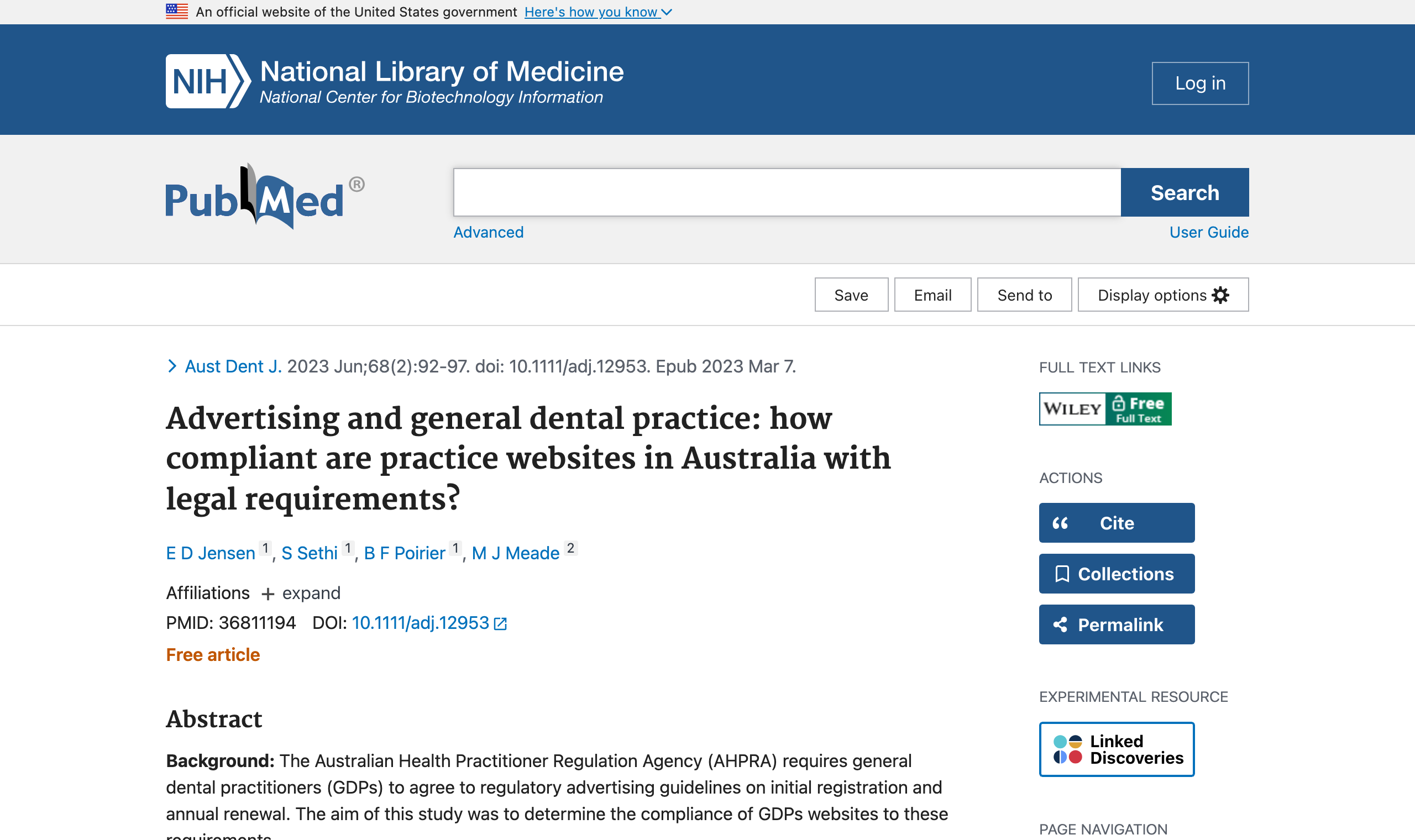
Source: Jensen et al., Australian Dental Journal, 2023 (PubMed), screenshot taken 24 November 2026.
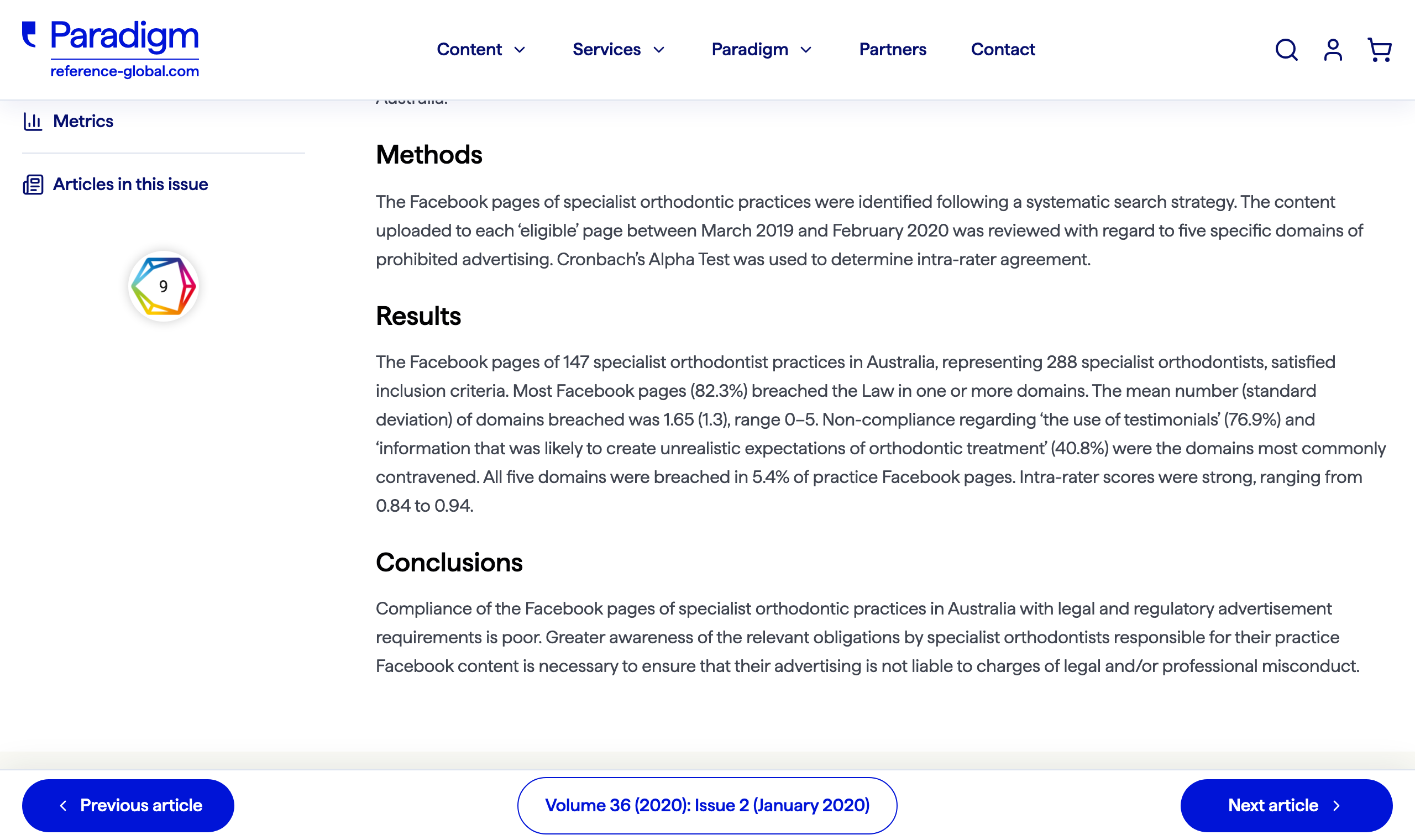
Source: Meade and Dreyer, Australasian Orthodontic Journal, 2020, screenshot taken 24 November 2026.
Build a Dental SEO Strategy That Passes an AHPRA Review
ClinicCode builds SEO strategies for Australian dental and cosmetic dentistry practices that start compliant instead of getting audited into compliance later. Item-number content, category-safe treatment pages, and a Google Business Profile written without outcome claims.
Related reading:
- 85% of Dental Websites Breach AHPRA Ad Rules: the full study breakdown behind the website compliance figures
- 82.3% of Orthodontist Facebook Pages Broke AHPRA Law: the social media compliance data in full
- AHPRA Advertising Rules for Cosmetic Dentistry Australia: the rules and compliant alternatives, in detail
- Dental Marketing Statistics Australia: market size, patient spend, and penalty data
- Cosmetic Clinic SEO Australia 2026: the equivalent compliant SEO playbook for injectables and cosmetic medicine clinics
Vikas Thakur
Founder, Perth. 16 years of experience from working at TPG, iiNet and Monadelphous, now helping Australian clinics keep their websites, ads and online presence AHPRA compliant.