Study: 85% of 192 Dental Websites Failed an Ahpra Ad Rule
A peer-reviewed 2023 study of 192 Australian dental practice websites found 85% were non-compliant with at least one Ahpra advertising requirement.
 Vikas Thakur Founder, Perth 7 min read Fact checked
Key takeaways
- 85% of 192 Australian general dental practitioner (GDP) websites were non-compliant with at least one legal or regulatory advertising requirement, in a peer-reviewed study published in 2023 (Jensen et al., Australian Dental Journal, PubMed abstract)
- 52% displayed false and misleading information, the largest category
- 39.6% encouraged indiscriminate and unnecessary use of health services
- 33.9% created unrealistic expectation of benefit
- 12.8% had offers and inducements without clear terms and conditions
- 11.5% used written testimonials, which section 133(1)(c) of the National Law prohibits in advertising a regulated health service
- The sample was drawn from every state and territory in proportion to the total Ahpra registrant distribution, and scored against 17 criteria across 5 domains
Eighty-five per cent. That is the share of 192 Australian dental practice websites that did not meet at least one legal advertising requirement, according to a peer-reviewed study in the Australian Dental Journal (volume 68, issue 2, 2023). The practices were checked against Ahpra’s advertising guidelines and section 133 of the Health Practitioner Regulation National Law.
This post covers where the sites failed, what each category means, and what to check on your own website. One limit up front: the figures come from the study’s published abstract, so we report what the abstract states and nothing more.
The Study: 192 Websites, Five Compliance Domains
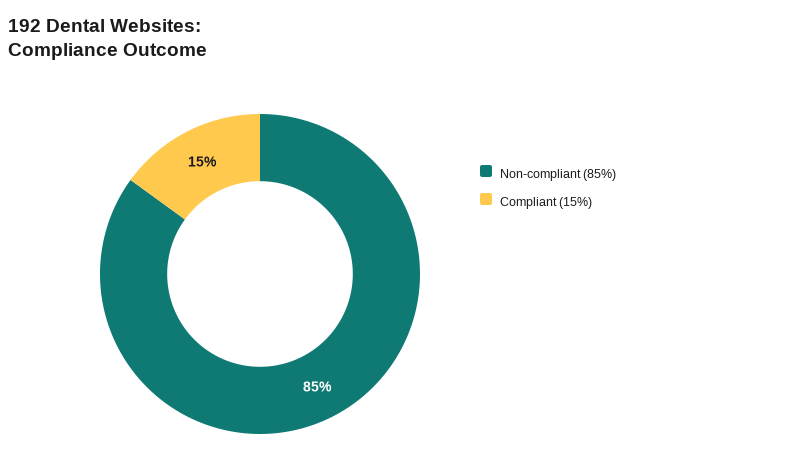
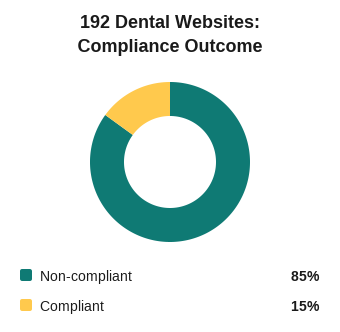
Source: Jensen et al. (2023), PubMed abstract. The 85% non-compliant figure is the abstract’s. The 15% is our arithmetic (100 minus 85).
The abstract describes the method this way: a representative sample of GDP websites from each state and territory, based on the total Ahpra registrant distribution. Compliance was assessed across five domains made up of 17 criteria, drawn from Ahpra’s guidelines for advertising a regulated health service and section 133 of the National Law. Inter-rater reliability was estimated using Fleiss’s Kappa.
The authors’ conclusion was that more than 85% of GDP websites in Australia did not comply with the legal and regulatory requirements on advertising. They called for a multi-stakeholder approach involving Ahpra, professional dental bodies and dental registrants.
Takeaway: This was a defined set of 17 criteria, not a loose opinion, and most of the sampled dental websites still failed at least one.
Where Dental Websites Broke the Rules
The five domains match the five things Ahpra’s advertising guidelines say advertising must not do. The guidelines page lists them as: be false, misleading or deceptive; offer a gift, discount or other inducement unless the terms and conditions are also stated; use testimonials or purported testimonials; create an unreasonable expectation of beneficial treatment; or directly or indirectly encourage the indiscriminate or unnecessary use of regulated health services.
| Breach category (study wording) | % of websites |
|---|---|
| False and misleading information | 52% |
| Indiscriminate and unnecessary use of health services | 39.6% |
| Unrealistic expectation of benefit | 33.9% |
| Offers and inducements without clear terms | 12.8% |
| Written testimonials | 11.5% |
Source: Jensen et al. (2023), PubMed abstract. Percentages are of the 192 websites reviewed.
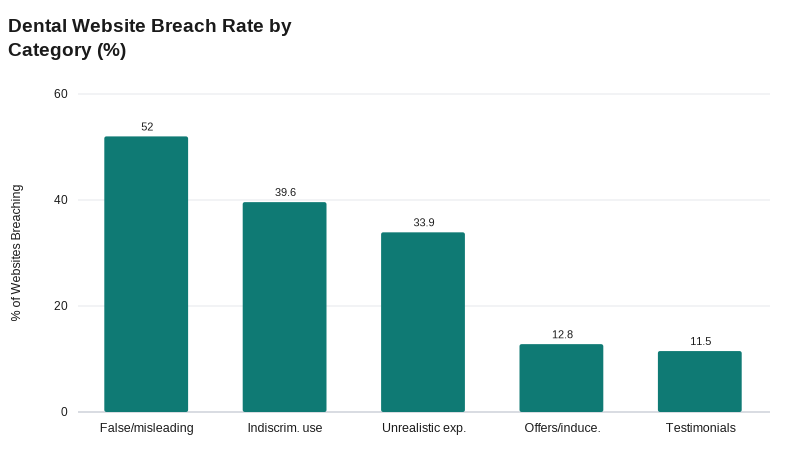
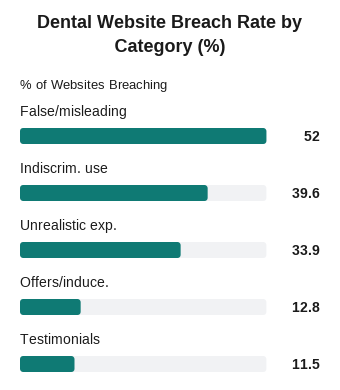
Source: Jensen et al. (2023), PubMed abstract.
The abstract does not say whether a site could appear in more than one category, but the five percentages add to well over 100%, so many sites must have breached more than one.
Testimonials were the lowest category at 11.5%. The rule itself is not new or soft. The guidelines quote section 133(1)(c) of the National Law, which prohibits advertising a regulated health service in a way that “uses testimonials or purported testimonials”, and they give patient stories, success stories and fake testimonials as examples.
Takeaway: The biggest category in this study was false and misleading information, which is ordinary marketing copy that goes further than anyone can support.
Dentists Sit Under the Same Advertising Rules
The advertising guidelines were developed jointly by the National Boards, which include the Dental Board of Australia, under section 39 of the National Law. They apply to advertisers of regulated health services generally. So the same section 133 tests apply to a dental practice’s veneer page as to any other regulated health service advertiser.
We have not re-audited dental websites against any later version of the rules, and the study does not tell us what the figure would be today. Treat 85% as a 2023 result for a sample of 192 sites, not a current count. Our guide to Ahpra advertising rules for cosmetic dentistry covers the detail for cosmetic work.
Takeaway: The study is a snapshot of one sample, but the five rules it tested are the same ones in the current guidelines page.
What to Check on a Dental Website
Compliance does not mean a bare website. Each check below comes from the guidelines page:
- Testimonials. Remove testimonials and purported testimonials from your advertising, such as patient stories and success stories. Section 133(1)(c) prohibits them.
- Offers. If you advertise a discount, gift or other inducement, state the terms and conditions alongside it.
- Claims. Claims about a service need acceptable evidence. The guidelines list study types that generally will not count, including anecdotal evidence based on observations in practice and before and after studies with few or no controls.
- Outcome language. Avoid wording that creates an unreasonable expectation of beneficial treatment.
- Before and after images. The guidelines say care should be taken because they can mislead. They are “less likely to be misleading” when the images are as similar as possible in content, camera angle, background, framing and exposure, and when posture, clothing and make-up are consistent.
- Verifiable information. Practitioner qualifications, what a procedure involves and how long it takes are facts a patient can check.
Most practice owners do not know which of these their site misses until someone reads it line by line. If you want that done, ClinicCode can review your site against the current guidelines and list what needs to change.
Takeaway: Compliant dental marketing leans on facts a patient can verify instead of outcome claims.
The Cost of Getting This Wrong
Ahpra’s guidelines page says the 2022 National Law amendments raised the maximum penalty per offence for an individual from $5,000 to $60,000, and for a body corporate from $10,000 to $120,000. It adds that “as of July 2024 these increased penalties now apply in all jurisdictions, including Western Australia.”
The page does not reconcile its own statements. Footnote 3 to the penalty section of the same guidelines says: “In Western Australia different penalties apply. In the case of an individual the maximum penalty is $30,000, or in the case of a body corporate $60,000.” That footnote is attached to the penalties for unlawful use of a protected title (up to three years’ imprisonment for an individual), not to advertising offences. If you practise in WA, check the current position with Ahpra or your legal adviser.
These are maximums per offence, not typical outcomes. We found no source in this research that says how a regulator counts offences across a whole website, so we will not estimate that here.
Takeaway: The maximum penalties are high enough that a review of your ad copy costs far less than finding out through a complaint, though the actual penalty in any case is for a court to decide.
How ClinicCode Builds Compliant Dental Websites
ClinicCode is an Ahpra-compliance specialist for Australian cosmetic clinics and dental practices. Every site we build starts from the current advertising guidelines, so a practice does not have to choose between a website that converts and one that passes review.
If you want the fixes, the compliant rebuild and the ongoing ad management handled as one service, our compliance work is built for regulated health clinics and dental practices.
Data sources: Jensen, E. D., Sethi, S., Poirier, B. F. and Meade, M. J. (2023), “Advertising and general dental practice: how compliant are practice websites in Australia with legal requirements?”, Australian Dental Journal, 68(2), pp. 92-97 (PubMed abstract); Ahpra, Guidelines for advertising a regulated health service (page reviewed 2 September 2025).
ClinicCode builds Ahpra-compliant websites for Australian cosmetic clinics and dental practices. Contact us to discuss a compliant rebuild.
Vikas Thakur
Founder, Perth. 16 years of experience from working at TPG, iiNet and Monadelphous, now helping Australian clinics keep their websites, ads and online presence AHPRA compliant.