Up to $120,000 Per Offence: Dental Marketing Statistics Australia
Ahpra’s maximum is $120,000 per advertising offence for a body corporate. A 2023 study of 192 Australian dental sites found about 85% breached a requirement.
 Vikas Thakur Founder, Perth 8 min read Fact checked
Key takeaways
- Ahpra says the maximum financial penalty per advertising offence rose to $60,000 for an individual and $120,000 for a body corporate (Ahpra advertising guidelines). Section 1.4 of the same page still lists $5,000 and $10,000 for advertising breaches, and its $60,000 and $120,000 paragraph, with imprisonment of up to three years for an individual, covers unlawful use of a protected title
- A peer-reviewed 2023 study in the Australian Dental Journal reviewed 192 general dental practice websites and found about 85% did not comply with at least one legal or regulatory advertising requirement (Jensen et al., 2023)
- The study abstract reports 52% displayed false or misleading information and 39.6% encouraged unnecessary use of services, introduced with “Of these websites” (same study)
- The Australian Dental Association’s 2025 Consumer Survey, with more than 25,000 Australians, reported 60% of respondents said social media influenced their decision to pursue cosmetic dental procedures (ADA)
- Around $13.2 billion was spent on dental services in Australia in 2023-24, and $8.0 billion (61%) of it was paid by patients directly (AIHW)
Ahpra’s advertising guidelines put the maximum penalty for an advertising offence at $120,000 for a body corporate. A 2023 Australian Dental Journal study found about 85% of 192 Australian dental practice websites missed at least one advertising requirement. Australian patients paid $8.0 billion of dental spending directly in 2023-24, per the AIHW.
This post pulls together the numbers that matter for anyone marketing a dental practice in Australia: what non-compliant marketing can cost, how common breaches are, where cosmetic demand starts, and what patients spend. Each figure links to the page we read it on. Start with the compliance numbers, because they carry the sharpest financial teeth.
What an Ahpra Breach Can Cost
Every dentist registered in Australia sits under the same National Law as cosmetic medicine clinics, so the same advertising offence provisions apply to a dental practice’s Facebook ad as to a cosmetic clinic’s Instagram post.
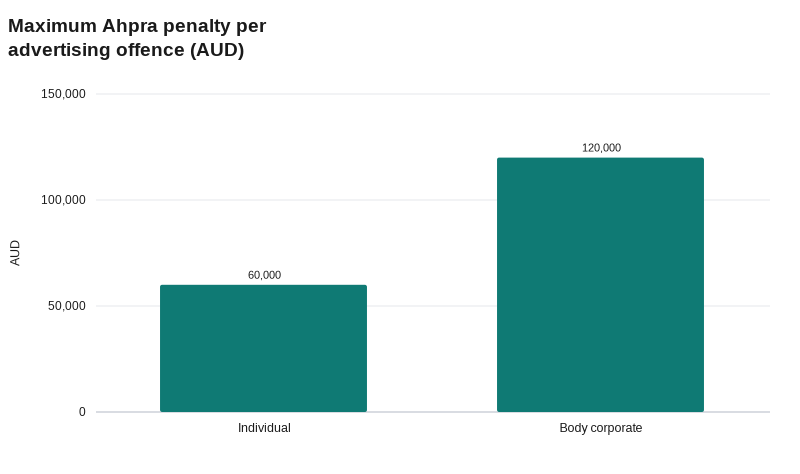
| Who | Maximum penalty per advertising offence | Before the 2022 amendment |
|---|---|---|
| Individual | $60,000 | $5,000 |
| Body corporate | $120,000 | $10,000 |
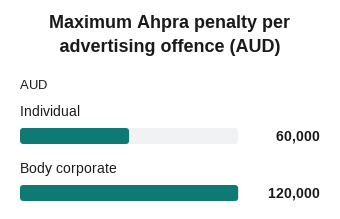
Source: Ahpra, Guidelines for advertising a regulated health service, the “Increased maximum penalty for advertising offences” section: “For an individual, the maximum financial penalty per offence increased from $5,000 to $60,000, and for a body corporate the maximum financial penalty per offence increased from $10,000 to $120,000.”
The same Ahpra page also says: “As of July 2024 these increased penalties now apply in all jurisdictions, including Western Australia.” Ahpra’s advertising guidelines page still carries footnote 3, which gives Western Australia maxima of $30,000 for an individual and $60,000 for a body corporate against the unlawful use of a protected title offence, and the page does not reconcile it with its statement that the higher penalties apply in all jurisdictions, including Western Australia, as of July 2024. Section 1.4 of that page still lists the old $5,000 and $10,000 figures for advertising breaches, and gives $60,000, $120,000 and imprisonment of up to three years for an individual only for unlawful use of a protected title. Confirm the current position with Ahpra. The penalty is stated per offence, so a site with several non-compliant elements can raise more than one issue. Ahpra’s page does not say how many offences a given website would be counted as, so treat that as a question for your legal adviser.
Source: Ahpra, Guidelines for advertising a regulated health service.
Takeaway: The penalty is set per offence, so an unaudited website with several problem points carries more risk than one flat fine suggests.
About 85% of Sampled Dental Websites Missed a Requirement
A peer-reviewed study by Jensen, Sethi, Poirier and Meade was published in the Australian Dental Journal in 2023 (volume 68, issue 2, pages 92-97). It reviewed 192 general dental practice websites across Australian states and territories. About 85% did not comply with at least one of the legal and regulatory requirements relating to advertising.
| Issue found on the websites | Share reported |
|---|---|
| Did not comply with at least one requirement | About 85% |
| False or misleading information | 52% |
| Encouraged unnecessary use of services | 39.6% |
Source: Jensen ED et al., Australian Dental Journal, 2023;68(2):92-97 (Europe PMC record).
The categories overlap, because one website can have more than one issue. False or misleading content led the list at 52%. The abstract introduces the issue shares with “Of these websites” and does not say whether the base is all 192 sites or only the non-compliant ones, so read the issue shares as reported. Content like this can be produced by accident.
The 192 sites are a sample of general dental practice websites, not every dental website in Australia, and the study measured them against the rules in force at the time. Our breakdown of the Ahpra advertising rules for cosmetic dentistry covers what a compliant page can still say.
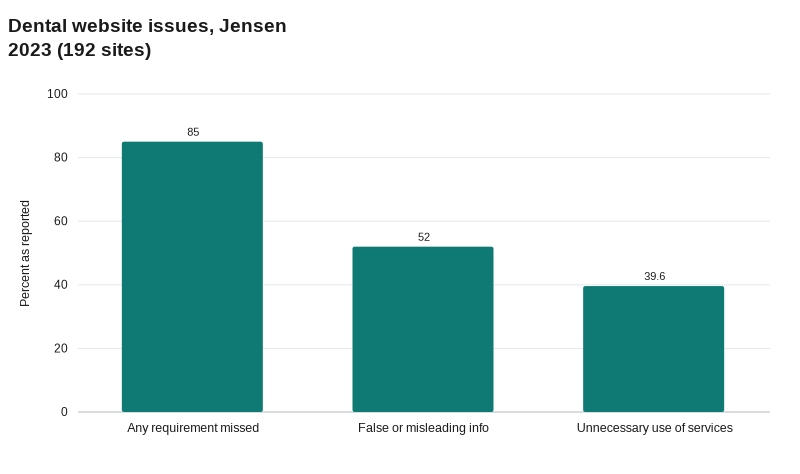
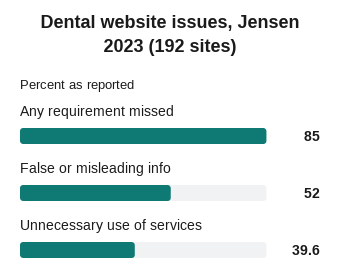
Source: Jensen ED et al., Australian Dental Journal, 2023 (Europe PMC record). The abstract reports the first figure as “about” or “more than” 85%.
Takeaway: The commonest problem in the sample was ordinary sales copy that drifted into unverifiable or misleading claims.
Where Cosmetic Dental Demand Starts
The ADA’s 2025 Consumer Survey, covering more than 25,000 Australians and published 31 July 2026, reported 60% of respondents said social media had influenced their decision to pursue cosmetic dental procedures (ADA).
That matters for marketing. A prospective patient who clicks from a social post to a practice website lands on a page Ahpra’s advertising guidelines apply to. A page that leans on outcome language the social post got away with carries the exposure.
| Metric | Figure | Source |
|---|---|---|
| Respondents influenced by social media on cosmetic dental decisions | 60% | ADA 2025 Consumer Survey, more than 25,000 Australians |
| Dental websites with at least one advertising issue (sample of 192) | About 85% | Jensen et al., 2023 |
| Maximum penalty per offence, body corporate | $120,000 | Ahpra advertising guidelines |
Takeaway: Demand for cosmetic dental work often starts on social media, in a channel the practice does not control. The website it lands on next is where compliant marketing has to do the work.
The Market Behind the Marketing
The AIHW reports that “In 2023-24, around $13.2 billion was spent on dental services in Australia,” and that “Most of this expenditure ($8.0 billion, or 61%) was paid by patients directly” (AIHW, Oral health and dental care in Australia). The AIHW also says the number of registered dentists in Australia increased from around 15,800 in 2014 to around 21,000 in 2024 (AIHW, dental workforce).
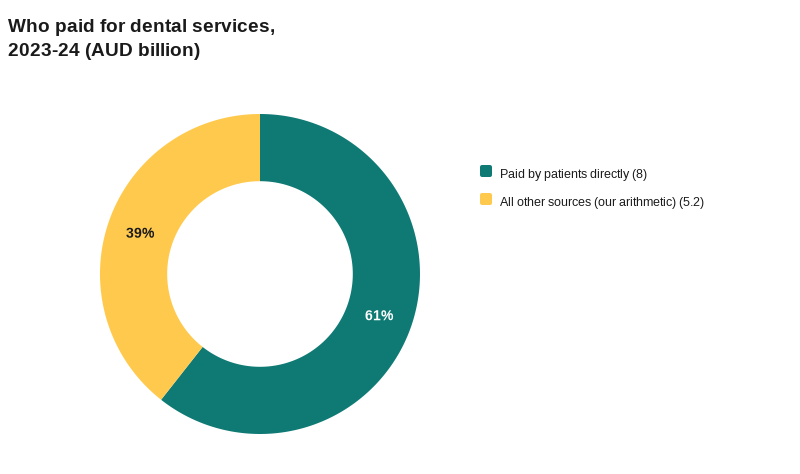
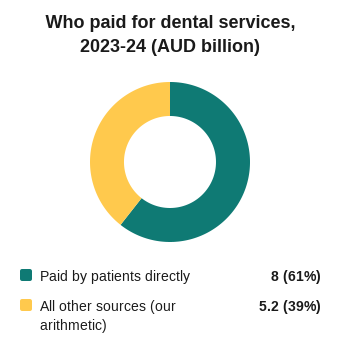
Source: AIHW, Oral health and dental care in Australia. “All other sources” is our arithmetic: $13.2 billion total minus $8.0 billion paid by patients directly.
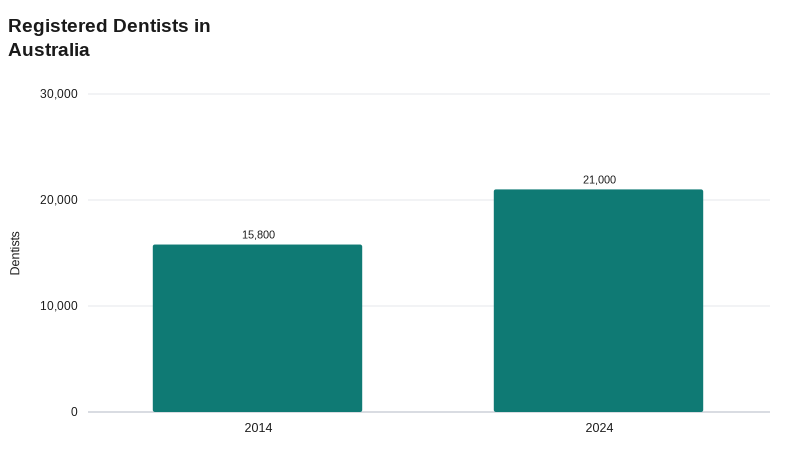
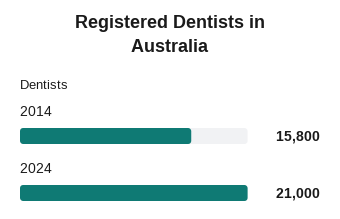
Source: AIHW, Oral health and dental care in Australia, dental workforce. Figures are the AIHW’s rounded “around” values.
Patients pay most dental costs themselves, which is why price transparency and trust signals carry weight in this category.
Takeaway: With the AIHW reporting more than half of dental spending paid directly by patients, marketing has to work on trust and transparency, not only visibility.
What Compliant Dental Marketing Looks Like in Practice
None of this means dental marketing has to go quiet. It means the persuasive weight shifts from patient quotes to information a prospective patient can verify before booking.
- Practitioner credential pages. Qualifications, training and clinical approach, all factual and checkable, not claims of being “the best.”
- Process content, not outcome content. What happens during a veneer fitting, how clear aligners work from consult to completion, how long whitening takes.
- Transparent indicative pricing. A visible price range sets expectations before someone books a consultation.
- No testimonials. Section 133(1)(c) of the National Law prohibits advertising that “uses testimonials or purported testimonials about the service or business” (Ahpra advertising guidelines). Check Ahpra’s guidance on before-and-after images before publishing any.
Most practices do not know which of these areas their current site gets wrong until someone checks it against the current rules. ClinicCode can flag what needs fixing before a competitor, or a patient complaint, does it for you.
Takeaway: Compliant dental marketing can still persuade. It uses verifiable facts instead of outcome claims.
How ClinicCode Builds for Australia’s Dental Market
ClinicCode is an Ahpra-compliance specialist building websites for cosmetic clinics and dental practices across Australia. Every site starts from the current advertising guidelines, so growth and compliance are never a trade-off a practice has to make on its own.
For practices that want the fixes, the compliant rebuild and ongoing compliant ad management as one service, ClinicCode’s compliance fixes and compliant rebuild is built for regulated dental and cosmetic clinics. Get in touch to talk through where your current marketing sits against the numbers above.
Data sources: Ahpra, Guidelines for advertising a regulated health service; Jensen ED et al., Australian Dental Journal, 2023;68(2):92-97; Australian Dental Association, 2025 Consumer Survey, published 31 July 2026; AIHW, Oral health and dental care in Australia and dental workforce. Pages read in November 2026.
Vikas Thakur
Founder, Perth. 16 years of experience from working at TPG, iiNet and Monadelphous, now helping Australian clinics keep their websites, ads and online presence AHPRA compliant.