104.8M Ads Blocked: Cosmetic Dentist Google Ads Rules [2026]
Google blocked or removed 104.8 million ads under its Healthcare and Medicines advertising policy in 2024, the exact policy category cosmetic dentistry ads sit inside. AHPRA and the Dental Board add a second, separate set of restrictions on top of it. This guide covers the compliant headline and description structures, the ADA item-code angle that clears both reviewers, and the landing page checks a dental Google Ads account needs before it goes live.
 Vikas Thakur Founder, Perth 11 min read Fact checked
Key takeaways
- Google blocked or removed 104.8 million ads worldwide under its Healthcare and Medicines advertising policy in 2024, and restricted a further 106.6 million, per Google’s 2024 Ads Safety Report (published 16 April 2025). Cosmetic dentistry ads sit inside that exact policy category.
- In Australia specifically, Google removed 205.7 million ads and suspended 841,000 advertiser accounts across all policy categories in 2024, the same report’s country-level breakdown.
- General dentistry Google Ads cost a median $7.03 cost per click and $84.77 cost per lead in the 12 months to September 2025, per LocaliQ’s Healthcare Search Ads Benchmarks (published 13 January 2026, n=3,542 US search campaigns).
- Emergency dentistry converts faster: 8.89% against general dentistry’s 7.74%, the same LocaliQ dataset.
- “Smile makeover,” “Hollywood smile,” and “perfect smile” fail two separate reviewers at once: AHPRA’s advertising guidelines ban the outcome claim outright, and Google’s own Healthcare and Medicines policy independently restricts unsubstantiated treatment claims.
- ADA item numbers, 583/582 for porcelain veneers, 526/536 for composite veneers, 118/119 for whitening, fit inside a 30-character Google Ads headline and describe a procedure code, not a result, clearing both reviewers on the first pass.
- A Google Ads healthcare-policy account suspension applies to every campaign in the account at once, not just the ad that triggered it, and Google does not require prior warning before suspending.
- A compliant headline is not a compromise. ClinicCode checks the landing pages behind a dental Google Ads account against the current rules before an ad ever gets flagged.
Google blocked or removed 104.8 million ads under its Healthcare and Medicines policy in 2024, per its own Ads Safety Report. Cosmetic dentistry advertising sits inside that exact category. AHPRA and the Dental Board of Australia apply a second, separate set of restrictions on top of it.
Here is what makes dental different from every other health vertical running paid search. A dental practice clears Google’s review easily enough with factual copy. The harder problem is AHPRA and the Dental Board, who ban outcome-claim language Google does not always catch on its own: smile makeover, Hollywood smile, perfect smile. Miss that second layer and the ad that survived Google’s review still gets a practice reported. This guide covers the headline and description structures that clear both reviewers, the ADA item-code angle unique to dental, and the landing page checks that stop a compliant ad from pointing at a non-compliant page.
Two Rulebooks, One Dental Google Ads Account
A dental Google Ads campaign in Australia answers to two separate reviewers, and they do not check for the same things.
| Rule | AHPRA / Dental Board | Google Ads Policy |
|---|---|---|
| Outcome claims (“smile makeover”, “perfect smile”) | Banned outright | Restricted (unsubstantiated claims) |
| Testimonials in ad copy | Banned outright | Banned (deceptive endorsements policy) |
| Before/after comparisons | Banned outright | Restricted (cosmetic procedures category) |
| Certification to run the ad | Not required by AHPRA | Required only for prescription drug, telemedicine, or health insurance ad types |
| Clinical procedure descriptions | Permitted | Permitted |
| ADA item numbers in copy | Permitted, treated as factual | Permitted |
| Pricing shown clinically | Permitted with conditions | Permitted |
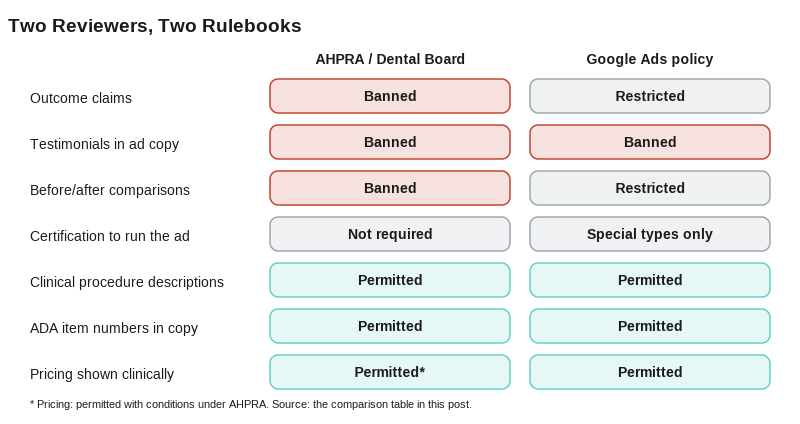
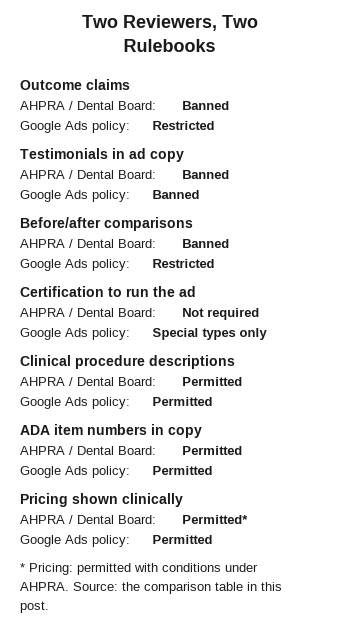
The gap that catches most practices: general dental service ads, veneers, whitening, implants, do not need Google’s special healthcare certification. That requirement is reserved for prescription drug services, telemedicine consultations, and health insurance ads. A dental practice can run a fully Google-approved campaign and still be in breach, because Google’s certification check was never the relevant gate. AHPRA’s rules apply regardless of whether Google asked for certification at all. The full banned-phrase list and what replaces each phrase sits in our guide to AHPRA advertising rules for cosmetic dentistry.
Takeaway: Passing Google’s review and passing AHPRA’s review are two different checks, and clearing one says nothing about the other.
What Google’s 104.8 Million Ad Blocks in 2024 Mean for a Dental Account
Google’s 2024 Ads Safety Report, its annual public accounting of ad policy enforcement, put a number on how much of its ad platform gets stopped every year: 5.1 billion bad ads blocked or removed globally, 9.1 billion more restricted. Healthcare and Medicines was the ninth most-enforced blocking category and the sixth most-enforced restriction category, ahead of alcohol and copyright in both.
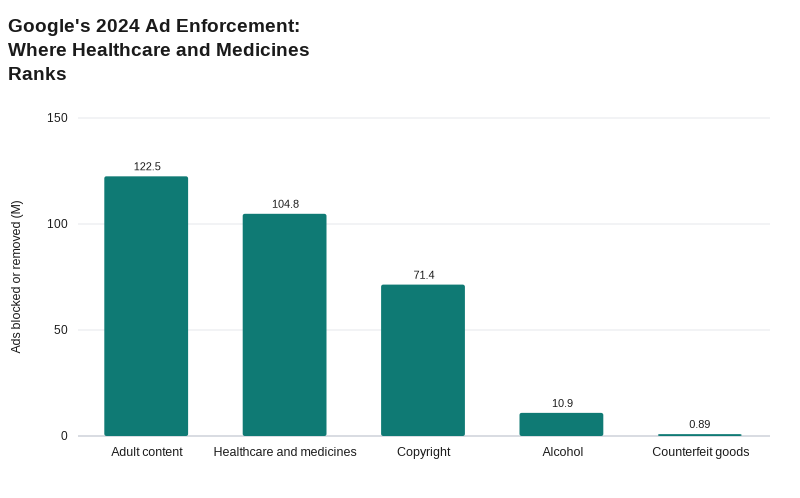
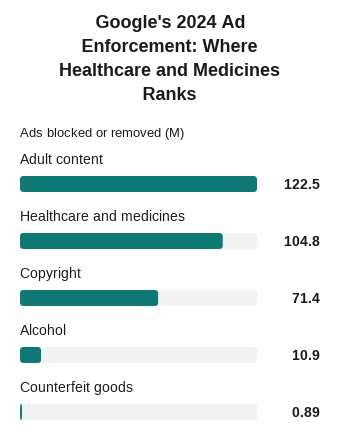
Google does not publish a dental-only breakdown inside that figure. What it does confirm is the policy family dental ads are reviewed under, and the scale of enforcement inside it. In Australia alone, Google removed 205.7 million ads and suspended 841,000 advertiser accounts across every policy category in 2024, the report’s own country-level insight for this market.
The restricted-ads side tells a similar story. Restriction is Google’s lighter-touch action: the ad can still run, but only under extra conditions or to a narrower audience.
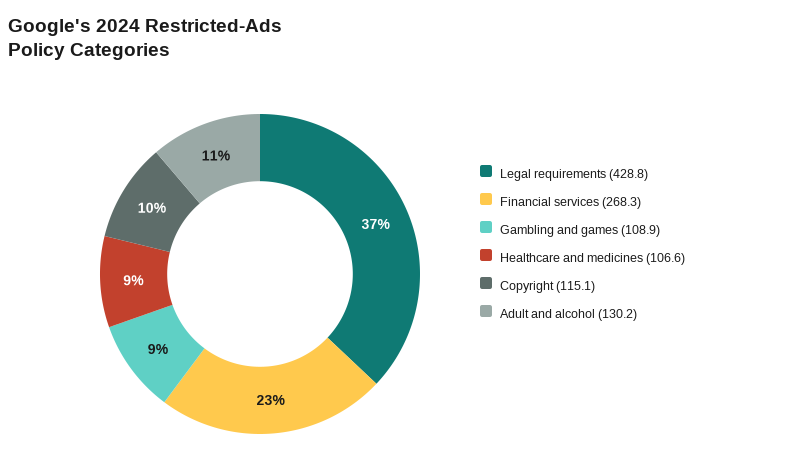
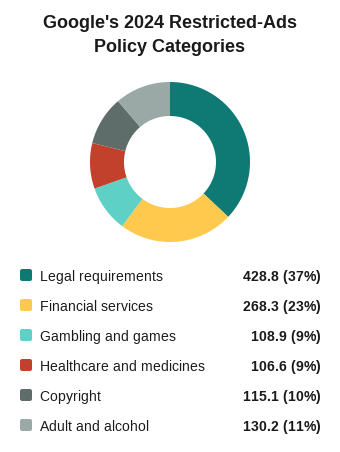
For a dental practice, the practical reading is simple. Healthcare and Medicines sits in the top half of both enforcement lists, well ahead of categories most advertisers assume are riskier. Ad copy for veneers or whitening is reviewed inside a policy family Google actively enforces at scale, not a quiet corner of the platform.
Takeaway: Dental Google Ads copy is not reviewed lightly just because it is not a prescription drug ad. It sits inside one of Google’s nine most-enforced advertiser policy categories.
The Headline and Description Test: Outcome Claims That Fail Both Reviewers
A Google Ads headline gives 30 characters. A description gives 90. Outcome-claim phrases are popular precisely because they are short and punchy, which is exactly why they fit the character limit and exactly why they fail both reviewers at once.
| Non-compliant headline (chars) | Why it fails | Compliant alternative (chars) |
|---|---|---|
| “Get Your Hollywood Smile” (25) | AHPRA outcome claim + Google unsubstantiated claim | “Porcelain Veneers Perth” (24) |
| “Smile Makeover Experts” (23) | AHPRA outcome claim | “Cosmetic Dentistry Consult” (27) |
| “Your Dream Smile Awaits” (24) | AHPRA outcome claim + implied result | “Veneer Consultation Perth” (26) |
| “Whiter Teeth, Guaranteed” (25) | AHPRA outcome claim + Google guarantee-language restriction | “Professional Teeth Whitening” (29) |
| “Patients Love Their New Smile” (30) | AHPRA testimonial ban + Google deceptive endorsement policy | “In-Chair Whitening, Book Today” (31, fits description) |
The pattern holds across every row. A headline that names the procedure and the location clears both reviewers. A headline that names or implies the outcome fails both, because AHPRA bans the claim regardless of truth and Google flags the same language as unsubstantiated under its own healthcare policy, independently of AHPRA’s rules existing at all.
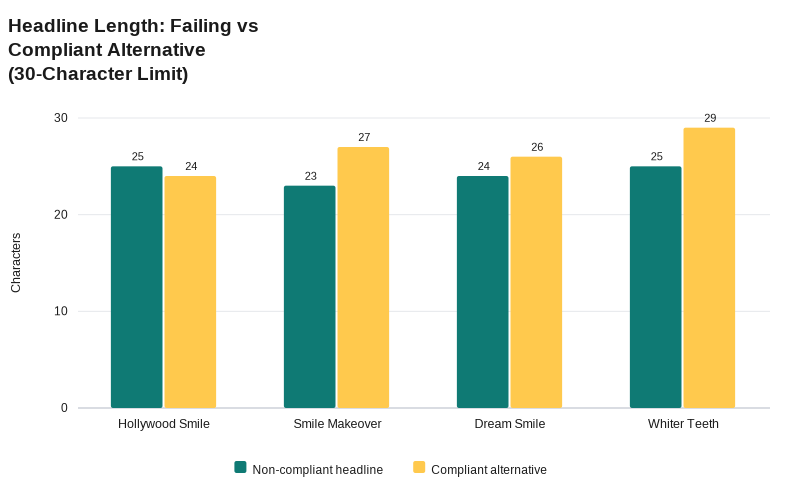
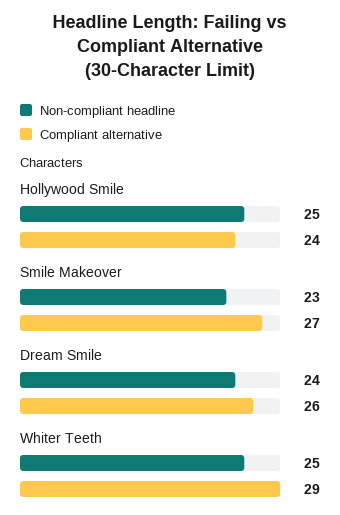
The test that actually works: read the headline back and ask whether it describes what happens in the chair or what the patient is left with afterward. The first is a clinical description. The second is an outcome claim, and it fails before a human reviewer even sees it.
Takeaway: The highest click-through headline in a keyword tool and the highest-risk headline in a compliance review are, almost every time, the exact same six words.
ADA Item Codes: The Compliant Keyword Google’s Reviewers Never Flag
Cosmetic medicine clinics running injectable ads have no public fee-schedule code a patient can search directly. Dental practices do, and it is the one keyword category built into Google Ads headlines that carries close to zero compliance risk on either side.
| Item Number(s) | Treatment | Fits 30-char headline? | Why it’s safe |
|---|---|---|---|
| 583 / 582 | Porcelain veneers | Yes: “Veneers (Item 583/582) Perth” | Names a procedure code, not a result |
| 526 / 536 | Composite veneers | Yes: “Composite Veneers, Item 526” | Names a material and code |
| 118 | In-chair whitening | Yes: “In-Chair Whitening, Item 118” | Category term, not a brand |
| 119 | Take-home whitening | Yes: “Take-Home Whitening, Item 119” | Category term, not a brand |
| 661-691 | Dental implants | Yes: “Dental Implants (661-691)” | Procedure code range |
An item number describes what happened at a fee-schedule level, not what the patient looks like afterward, so neither AHPRA’s outcome-claim ban nor Google’s unsubstantiated-claims policy has anything to catch. It also matches real search intent: patients increasingly search item numbers directly while checking a health fund rebate through HICAPS before they book, which means an item-code headline is not a compliance workaround, it is the phrase the patient already typed.
Takeaway: Item-code ad copy is the rare case where the safest phrase and the highest-intent phrase are the same headline.
Landing Page and Extension Compliance for Dental Google Ads
A compliant headline pointing at a non-compliant landing page is still a breach. AHPRA’s definition of advertising covers everything the ad leads to, not just the 30 characters Google displays in the search result.
Every element a dental Google Ads account touches needs the same check applied to it:
| Ad account element | Compliant? |
|---|---|
| Landing page with a “Results” or before/after gallery | No |
| Google reviews widget showing treatment outcomes | No |
| Sitelinks reading “See Our Smile Transformations” | No |
| Landing page with item-code pricing and booking form | Yes |
| Callout extensions naming AHPRA registration | Yes |
| Structured snippets listing procedure categories | Yes |
| Remarketing audiences segmented by treatment type only, not outcome | Yes |
Sitelinks, callouts, and structured snippets all fall inside AHPRA’s advertising definition the same way the headline does, and a practice cleaning up its headlines while leaving an old “Smile Gallery” sitelink live is still exposed. If an existing account is not sure which of its landing pages, extensions, or remarketing audiences are drifting into outcome language, ClinicCode checks every page a dental Google Ads account sends traffic to against the current rules and flags exactly what needs to change before an ad gets reported.
Takeaway: A Google Ads account is only as compliant as its least-checked sitelink.
Building a Compliant Dental Google Ads Campaign
A dental practice running paid search in 2026 is paying close to the top of Google’s entire cost table to do it. General dentistry and emergency dentistry price differently enough that a single blended campaign wastes budget on the wrong intent.
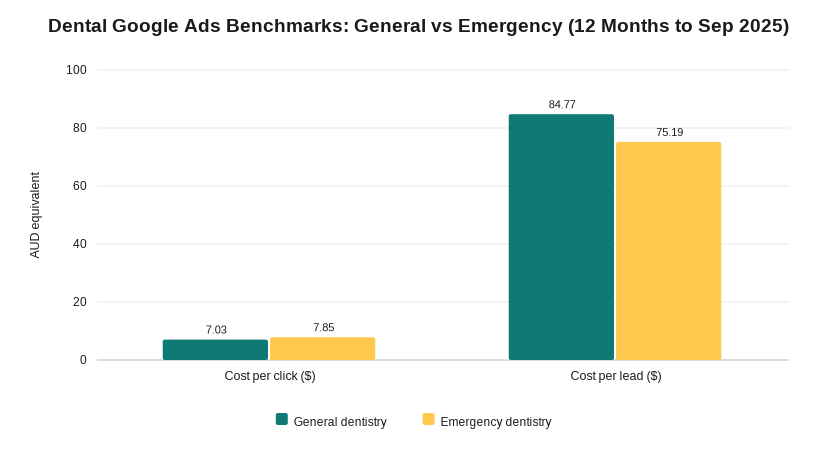
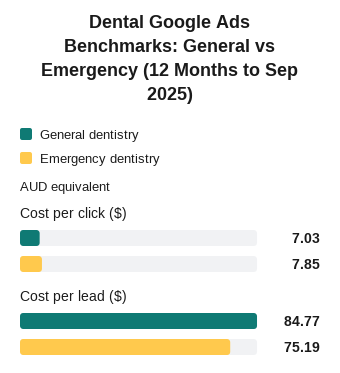
Source: LocaliQ, “Healthcare Search Ads Benchmarks,” published 13 January 2026, based on 3,542 US search advertising campaigns running 1 October 2024 to 30 September 2025. Figures are US-based medians, used here as a directional benchmark; no equivalent Australian dataset breaks dental out at this resolution.
Emergency dentistry costs more per click but less per lead, because a patient searching “emergency dentist” is already deciding, while a patient searching “veneers” is still comparing. A campaign structure that reflects that:
Campaign 1: General dentistry (category terms). Keywords built around procedure names, no outcome language, negative-keyword list excluding any competitor brand terms.
Campaign 2: Item-code long-tail. Keywords built around ADA item numbers, landing pages showing HICAPS rebate information, the lowest-risk campaign in the account.
Campaign 3: Emergency dentistry. Separate budget and bidding, higher intent, ad copy focused on availability and booking speed rather than treatment outcomes.
Campaign 4: Cosmetic dentistry, compliance-checked. The highest-risk campaign in the account, veneers and whitening keywords sit here, every headline checked against the banned-phrase table above before it goes live.
Takeaway: A blended dental campaign spends emergency-intent budget on comparison-shopping clicks, and a compliant campaign structure fixes both the cost problem and the compliance problem at once.
What a Healthcare-Policy Suspension Actually Costs a Dental Practice
Google’s healthcare and medicines policy enforcement does not work like a warning system. Per Google’s own advertiser policy documentation, an account found in violation can be suspended on detection, without prior notice, and the suspension applies to every campaign in the account, not only the ad that triggered it.
That is the detail most dental practices miss when they think about compliance risk. A practice running four campaigns, general, item-code, emergency, and cosmetic, loses all four the moment one cosmetic headline slips past internal review and gets caught by Google’s enforcement. The compliant campaigns stop earning leads for exactly as long as the non-compliant one takes to get resolved, and Google’s own healthcare and medicines category was enforced 104.8 million times in 2024 alone, which is the scale of scrutiny a reinstatement request is competing against.
The cheaper fix sits earlier in the process. Every headline checked against the AHPRA banned-phrase table before it goes live costs nothing. Every account suspended after the fact costs the entire account’s lead flow until it clears review.
Takeaway: The risk in a dental Google Ads account is never isolated to one ad. It is the whole account, every time.
Get a Dental Google Ads Account That Passes Both Reviews
ClinicCode builds and fixes Google Ads accounts for Australian cosmetic dentistry practices as part of our managed marketing service for AHPRA-regulated practices. We write headline and description copy that clears Google’s healthcare and medicines review and AHPRA’s advertising guidelines at the same time, structure campaigns around the item-code and emergency-intent splits above, and audit landing pages before an ad account is ever exposed.
Every cosmetic clinic and dental website ClinicCode builds starts from category-safe language rather than retrofitting compliance onto an outcome-driven site after a complaint, because the audit-and-rebuild path always costs more than starting compliant.
Book a call with ClinicCode about compliant Google Ads
ABN: 918 7857 0066.
This post covers Google Ads and AHPRA advertising compliance for cosmetic dentistry as at November 2026. It is general information only, not legal advice. Google’s advertising policies and AHPRA’s guidelines change periodically. Verify current requirements at support.google.com/adspolicy and ahpra.gov.au before launching campaigns. Consult a registered health law practitioner for specific legal advice about your practice’s advertising.
Vikas Thakur
Founder, Perth. 16 years of experience from working at TPG, iiNet and Monadelphous, now helping Australian clinics keep their websites, ads and online presence AHPRA compliant.