82.3% of Orthodontist Facebook Pages Breached the National Law
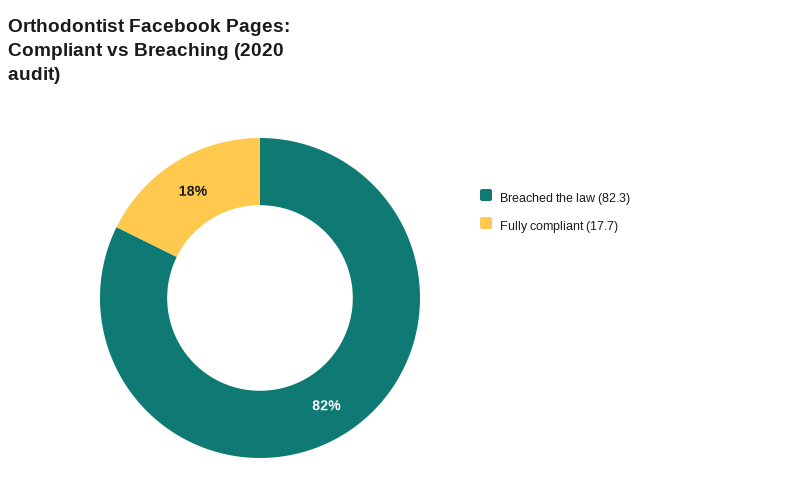
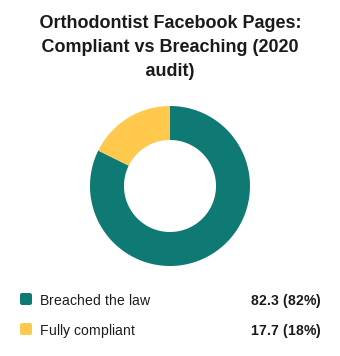
82.3% of 147 Australian specialist orthodontic practices had Facebook pages that breached the National Law in at least one advertising domain.
 Vikas Thakur Founder, Perth 10 min read Fact checked
Key takeaways
- 82.3% of the Facebook pages of 147 Australian specialist orthodontic practices breached the National Law in one or more of five advertising domains, in a peer-reviewed audit by Meade and Dreyer in the Australasian Orthodontic Journal (2020 abstract)
- 76.9% of pages breached the testimonials domain, the most commonly breached. Section 133(1)(c) of the National Law prohibits using testimonials in advertising a regulated health service (Ahpra advertising guidelines)
- 40.8% of pages breached the domain for information likely to create unrealistic expectations of treatment, the second most common
- The mean number of domains breached was 1.65 per page across all pages audited (standard deviation 1.3, range 0 to 5), and 5.4% of pages breached all five
- Content was posted between March 2019 and February 2020, so the audit says nothing direct about pages today. A separate 2023 audit of 166 orthodontist practice websites found 80.7% breached the Law in one or more domains (PubMed)
- Ahpra states a maximum financial penalty of $60,000 per offence for an individual and $120,000 for a body corporate, and says these apply in all jurisdictions including Western Australia from July 2024. Footnote 3 on the same page lists WA at $30,000 and $60,000, but it is attached to the protected-title offence, so check the current wording
82.3% of the specialist orthodontic practice Facebook pages in a 2020 audit breached the Health Practitioner Regulation National Law in one or more domains. The audit, by Maurice Meade and Craig Dreyer and published in the Australasian Orthodontic Journal, covered 147 practices representing 288 specialist orthodontists (abstract). Testimonials were the most commonly breached domain at 76.9%. Information likely to create unrealistic expectations of treatment came second at 40.8%.
That data covers content posted between March 2019 and February 2020, so it is a snapshot, not a picture of today. A later study of orthodontist practice websites, led by Meade, found 80.7% of 166 websites breached the Law in one or more domains (PubMed). Different channel, different year, similar result. We found no evidence that a page left unchecked since then is safer. This post covers what the audit found, why orthodontic content is exposed to these domains, and what a compliant content calendar and website structure can look like.
What the Meade and Dreyer Audit Found
The researchers identified specialist orthodontic practice Facebook pages through a systematic search. They reviewed the content each eligible page uploaded between March 2019 and February 2020 against five domains of prohibited advertising.
| Metric | Figure |
|---|---|
| Pages breaching at least one domain | 82.3% |
| Pages with no breach (our arithmetic: 100% minus 82.3%) | 17.7% |
| Mean domains breached per page, all pages audited | 1.65 (SD 1.3, range 0 to 5) |
| Pages breaching all five domains | 5.4% |
| Practices audited | 147 (288 specialist orthodontists) |
Source: Meade and Dreyer, “Facebook legal and regulatory advertising compliance by specialist orthodontic practices: a cross-sectional survey”, Australasian Orthodontic Journal, 2020, abstract. The 17.7% row is our subtraction, not a figure the abstract states.
Fewer than one in five of the pages audited had no breach. That is the pattern across the practices in this audit, not a handful of outliers.
Source: Meade and Dreyer, Australasian Orthodontic Journal, 2020, abstract. The 17.7% slice is our arithmetic (100% minus 82.3%).
Takeaway: About four in five audited pages breached the law in at least one domain, so social compliance deserves the same attention as any other marketing risk.
The Five Domains Orthodontists Keep Breaching
Section 133 of the National Law lists five things advertising of a regulated health service must not do. Ahpra’s guidelines set them out: be false, misleading or deceptive; offer a gift, discount or other inducement unless the terms and conditions are stated; use testimonials; create an unreasonable expectation of beneficial treatment; or encourage the indiscriminate or unnecessary use of regulated health services (Ahpra). The audit scored each page against these five domains. Its abstract reports figures for two.
| Domain | Share of audited pages breaching it | Illustrative example (ours) |
|---|---|---|
| Testimonials | 76.9% | A patient story or success story used in a post |
| Unrealistic expectations | 40.8% | A post that promises or implies a specific result |
| False or misleading content | Not reported in the abstract | An overstated claim about treatment |
| Offers without clear terms | Not reported in the abstract | A discount post with no terms and conditions |
| Unnecessary treatment | Not reported in the abstract | Content that pushes treatment beyond clinical need |
Source: breach shares from the Meade and Dreyer 2020 abstract; domain wording from Ahpra’s advertising guidelines. The examples column is ours, not the study’s.
Ahpra’s guidelines describe section 133(1)(c) as prohibiting advertising that uses testimonials or purported testimonials, “such as for example, patient stories and experiences, success stories, or fake testimonials”. The same page draws limits. Comments about customer service or communication style that do not refer to a clinical aspect of treatment are not considered testimonials. Reviews on third-party sites the practice does not control are not the practice’s responsibility to remove. On a practice’s own business social media, Ahpra says the clinic owner or practitioner is responsible and may need to disable the reviews function.
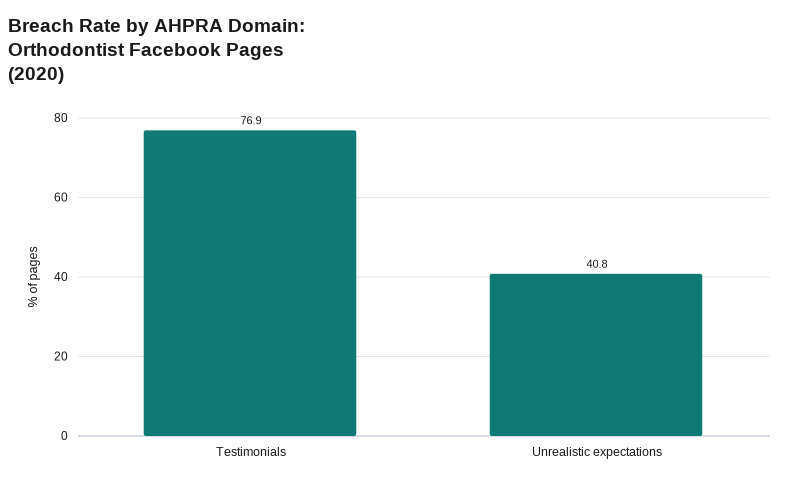
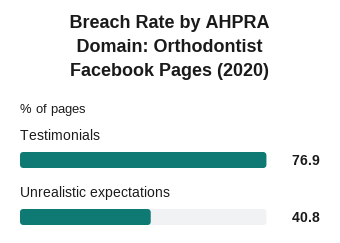
Source: Meade and Dreyer, Australasian Orthodontic Journal, 2020, abstract.
Takeaway: Testimonials and unrealistic-expectation claims were the two most commonly breached domains, and both sit inside the content orthodontic practices post most often.
For how the National Law’s prohibitions apply to dental advertising, our AHPRA advertising rules for cosmetic dentistry guide walks through each one.
Why Orthodontic Content Is Exposed
Orthodontic marketing leans on visual outcomes. That is where Ahpra’s guidelines are cautious. They say “before and after” images “have the potential to be misleading or deceptive” and “may cause a member of the public to have unreasonable expectations of a successful outcome”. They add that such images are less likely to be misleading if they are as similar as possible in content, camera angle, background, framing and exposure, if lighting and contrast are consistent, if any alteration is explained, and if the treatment is the only visible change (Ahpra).
The same guidelines list “an unreasonable expectation of outcomes or recovery time” as an example of a breach of the unreasonable-expectation domain, which is why timeframe promises in captions deserve a second look. Ahpra states penalties per offence, so one page can carry more than one exposure.
| Penalty (per offence) | Maximum | Source wording |
|---|---|---|
| Individual | $60,000 | Ahpra advertising guidelines |
| Body corporate | $120,000 | Ahpra advertising guidelines |
| Protected title, individual | $60,000 (or up to three years imprisonment, or both) | Ahpra advertising guidelines, section 1.4 |
| Western Australia, footnote 3 (protected title) | $30,000 individual, $60,000 body corporate | Footnote 3 on the same page |
Source: Ahpra advertising guidelines. The page also says: “As of July 2024 these increased penalties now apply in all jurisdictions, including Western Australia”. Footnote 3 on that page lists the lower WA amounts, but it is attached to the protected-title penalties, and the page does not reconcile the two statements, so treat the current Ahpra wording as the authority.
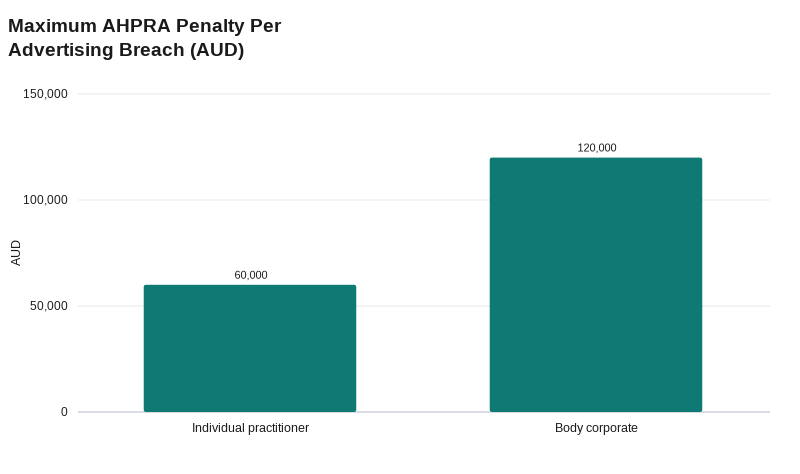
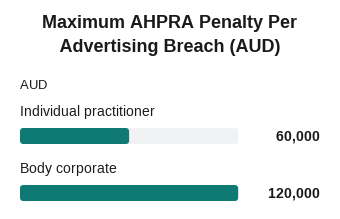
Source: Ahpra advertising guidelines. Western Australia: see footnote 3 above.
Takeaway: Penalties are per offence and the rules cover advertising of a regulated health service generally, so social and website content are best reviewed together.
Running an unaudited page against these rules is a risk most practices would not knowingly take. ClinicCode can check a practice’s existing Facebook, Instagram and website content against all five domains and flag which posts and pages need to change.
What a Compliant Orthodontist Content Calendar Looks Like
The fix is not to stop posting. It is to swap the two most commonly breached content types, testimonials and outcome claims, for content that still earns engagement. This calendar is our suggestion, not an Ahpra-approved template. Ahpra says it cannot approve advertising.
| Week | Content type | Why it fits the rules |
|---|---|---|
| 1 | Process explainer (how a fitting appointment works) | Educational, no outcome claim |
| 2 | Practice and team post | No treatment claim |
| 3 | General patient education (retainer care, diet tips) | Informational, not promotional |
| 4 | Appliance comparison (clear aligners and braces, facts only) | Balanced, no “better” or “faster” claims |
A few rules keep every post inside that structure:
- No patient stories, success stories or testimonials in your own posts. Ahpra says section 133(1)(c) prohibits using them in advertising. If your page has a reviews function, Ahpra says disabling it may be how you comply.
- No promised timeframes or outcomes. Ahpra gives an unreasonable expectation of outcomes or recovery time as an example of a breach.
- Before-and-after photos follow Ahpra’s conditions. Similar framing, background and lighting, and any alteration explained.
- Discount or offer posts state their terms and conditions. Ahpra’s wording is that offers must not be made “unless the terms and conditions of the offer are also stated”.
Takeaway: Replacing testimonials and timeframe claims with process, education and comparison content targets the two domains the study found most often breached, without emptying the content calendar.
Structuring the Website So Social Doesn’t Compound the Breach
A compliant Facebook feed pointing at a non-compliant landing page just moves the problem. The ad click is only step one. The page it lands on is advertising too, and the 2023 audit of orthodontist websites found 80.7% of 166 sites breached the Law in one or more domains (PubMed).
A website built for orthodontic marketing under these rules needs three things a generic template rarely has out of the box:
- Dedicated landing pages for each campaign, built without testimonial widgets, star-rating plugins or auto-pulled Google review feeds, so a paid campaign cannot undo what the content calendar fixed.
- Before-and-after galleries that follow Ahpra’s image conditions, with no editorial selection that implies a typical or guaranteed outcome.
- No outcome-timeframe language repeated on-site, so a compliant Facebook post does not link to a landing page promising a result in its hero copy.
This is the build discipline behind our AHPRA-compliant website builds for cosmetic clinics: compliance built into the layout and copy from the first draft, not retrofitted later.
Takeaway: A compliant social calendar and a compliant website are one project, because every ad and post sends traffic to a page that is itself advertising.
Quick Compliance Checklist
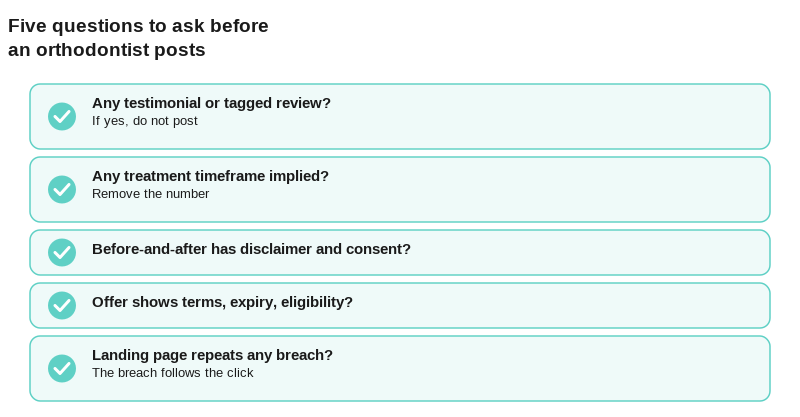
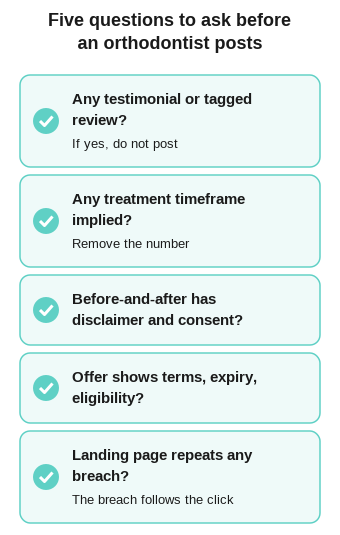
Before the next post goes live, run it against these five questions:
- Does it feature any testimonial, patient story or “in their words” quote? If yes, don’t post it.
- Does it name or imply a treatment timeframe (“6 months”, “by summer”)? If yes, remove it.
- Do before-and-after images follow Ahpra’s conditions (similar framing and lighting, alterations explained)?
- Does an offer or discount post state its terms and conditions in the post itself?
- Does the landing page the post links to repeat any of the above? If yes, the problem followed the click.
Clearing all five questions is a sensible start, not a guarantee. Ahpra says it cannot approve advertising, so the legal responsibility stays with the advertiser.
Want a practice’s Facebook feed and website checked against all five advertising domains in one pass? Book a website strategy call and get a written list of what needs to change.
Vikas Thakur
Founder, Perth. 16 years of experience from working at TPG, iiNet and Monadelphous, now helping Australian clinics keep their websites, ads and online presence AHPRA compliant.