Ahpra Advertising Complaints 2025/26 and the Penalty Caps
Ahpra says a court can order a body corporate to pay up to $120,000 per advertising offence, and an individual up to $60,000. This guide sets out what Ahpra published about complaints, outcomes and the September 2025 cosmetic advertising guidelines.
 Vikas Thakur Founder, Perth Updated Nov 23, 2026 10 min read Fact checked
Key takeaways
- The maximum penalty a court can order for an advertising offence is $60,000 for an individual and $120,000 for a body corporate, per offence (Ahpra, Advertising and the law). Ahpra’s advertising guidelines page still carries footnote 3, which gives Western Australia maxima of $30,000 for an individual and $60,000 for a body corporate against the unlawful use of a protected title offence, and the page does not reconcile it with its statement that the higher penalties apply in all jurisdictions, including Western Australia, as of July 2024.
- Ahpra says the higher maximums apply in all jurisdictions, including Western Australia, from July 2024. Before the 2022 amendment the caps were $5,000 and $10,000 (Ahpra advertising guidelines)
- In 2025/26 Ahpra’s advertising compliance team received 1,140 complaints about advertising, 136 of them about the advertising of cosmetic procedures (Ahpra annual report 2025/26)
- Of 315 lower-risk cases where Ahpra asked a practitioner to correct their advertising, 295 (93.7%) did so and needed no further intervention
- Any person or organisation can make a complaint about the advertising of a regulated health service (Ahpra)
- The Ahpra cosmetic advertising guidelines were issued on 2 September 2025. They prohibit testimonials and allow before and after images only under set conditions (Ahpra)
- The penalty applies per offence. We found nothing on the Ahpra pages we read that says how many offences a given set of ads would count as, so treat the exposure table below as our arithmetic, not a prediction
Under the National Law, a court can order an advertiser to pay a penalty for each advertising offence, and the figures are maximums.
That is the first thing to get straight. The second is the unit: the penalty is per offence, not per complaint.
Here’s what is published: $60,000 for an individual, such as a registered health practitioner, and $120,000 for a body corporate. In our view, a clinic that trades as a company should plan around the company figure.
This guide covers the maximum penalties, the complaint numbers Ahpra published for 2025/26, how Ahpra handles a complaint, and what its September 2025 guidelines say about cosmetic advertising. It is general information, not legal advice.
How Big Is the Actual Risk?
Ahpra’s 2025/26 annual report is the newest edition and gives the latest published complaint figures.
| Metric | Figure | Source |
|---|---|---|
| Complaints about advertising received, 2025/26 | 1,140 | Ahpra annual report 2025/26 |
| Referred to the Criminal Offences Litigation Unit | 444 | Ahpra annual report 2025/26 |
| Lower-risk complaints about registered practitioners, retained by the advertising compliance team | 696 | Ahpra annual report 2025/26 |
| Complaints about advertising of cosmetic procedures | 136 | Ahpra annual report 2025/26 |
| Maximum penalty per offence, individual | $60,000 | Ahpra, Advertising and the law |
| Maximum penalty per offence, body corporate | $120,000 | Ahpra, Advertising and the law |
Source: Ahpra annual report 2025/26, Health regulation (page reviewed 29 October 2026) and Ahpra, Advertising and the law, seen 24 November 2026. Counts are complaints; penalties are AUD.
Read the 444 carefully. Ahpra describes them as complaints about corporate entities or unregistered persons, or assessed as serious risk, and says only 67 of the 444 were about the advertising of regulated health services. The rest were about specialist title use or people holding themselves out as registered practitioners.
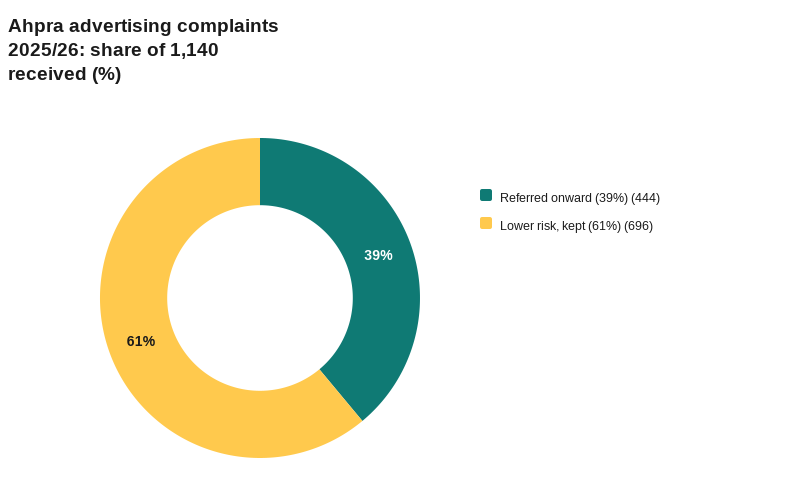
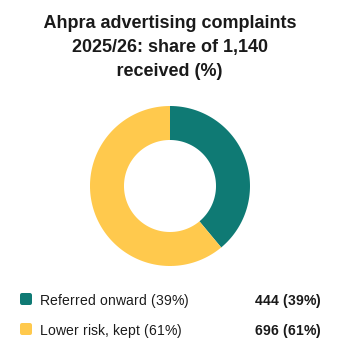
Source: Ahpra annual report 2025/26, Health regulation, seen 24 November 2026. Percent of the 1,140 complaints about advertising received in 2025/26 (our arithmetic: 444 and 696 divided by 1,140). “Referred onward” means referred to the Criminal Offences Litigation Unit; “Lower risk, kept” means retained by the advertising compliance team.
The penalty caps rose in 2022
Ahpra’s advertising guidelines page says the National Law was amended in 2022 and the maximum financial penalty per advertising offence rose from $5,000 to $60,000 for an individual and from $10,000 to $120,000 for a body corporate. Ahpra’s Advertising and the law page says the increased penalties apply in all jurisdictions, including Western Australia, as of July 2024.
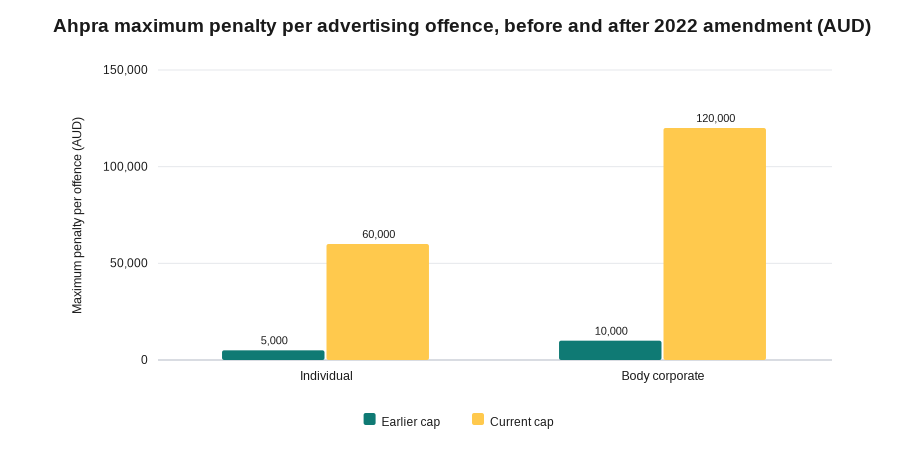
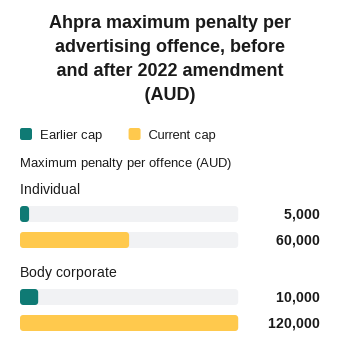
Source: Ahpra, Advertising guidelines (earlier and current caps) and Ahpra, Advertising and the law, seen 24 November 2026. Maximum financial penalty per offence in AUD.
What Triggers an Ahpra Complaint
Ahpra says any person or organisation can make a complaint about the advertising of a regulated health service. Its complaint page lists the kinds of advertising it can consider. Advertising of regulated health services must not:
- be false, misleading or deceptive
- offer a gift, discount or inducement unless the terms and conditions of the offer are also stated
- use testimonials or purported testimonials
- create an unreasonable expectation of beneficial treatment, or directly or indirectly encourage the indiscriminate or unnecessary use of regulated health services
The same page says Ahpra cannot consider complaints about the advertising of medicines such as Botox or medical devices. It points those to the Therapeutic Goods Administration (TGA). That is a separate regulator with its own rules, so a clinic can face both.
What the cosmetic advertising guidelines say
The Guidelines for advertising higher risk non-surgical cosmetic procedures carry a date of issue of 2 September 2025. Ahpra’s 2025/26 annual report says the guidance came into effect in September 2025. They cover procedures such as dental veneers, cosmetic injectables such as botulinum toxin and dermal fillers, thread lifts and hair transplants.
| Topic | What the guidelines say |
|---|---|
| Testimonials | The National Law prohibits testimonials and purported testimonials, including patient stories and success stories. Advertising of higher risk cosmetic procedures must not use them. |
| Before and after images | Images must be genuine (actual patients of that practitioner who had the advertised procedure), must not be edited or enhanced, must be as similar as possible in lighting, angle and framing, and must carry a prominent warning that outcomes are only relevant to that patient. |
| Which image comes first | The most prominent or first image should be the before image or a combined image. Ahpra says an after image as the most prominent image may create unrealistic expectations. |
| Outcome and benefit claims | Advertising must not mislead on how long an effect takes to appear or lasts, and must not claim psychological or social benefit that acceptable evidence cannot support. |
| Prices | Cost information must be clear, easily understood, accurate and honest. Price lists for injectables must also comply with TGA requirements. |
| Titles and taglines | Terms in taglines, hashtags and similar that advertise the practitioner or their abilities in a way that may mislead or create unrealistic expectations must not be used. |
Source: Ahpra, Guidelines for advertising higher risk non-surgical cosmetic procedures (date of issue 2 September 2025; page reviewed 14 October 2025), seen 24 November 2026. Summarised, not quoted in full; read the guidelines before changing live copy.
Ahpra says the guidelines apply only to advertising of higher risk cosmetic procedures, because other cosmetic procedures are lawfully provided and advertised by non-registered individuals. Check which category a treatment falls into.
How Ahpra Handles an Advertising Complaint
Ahpra’s page on how it manages advertising complaints describes four steps: review, assess, action and escalation. Ahpra last reviewed that page in February 2021, so check it for changes.
- Review. Ahpra reviews the advertising to work out whether it relates to a regulated health service, identify any unlawful advertising and identify who the advertiser is.
- Assess. If the advertising is not compliant, Ahpra does a risk assessment. It considers previous complaints made about the advertiser and whether they have a history of non-compliant advertising.
- Action. Ahpra says most cases start with a letter telling the advertiser their advertising breaches the National Law and requiring them to correct it within 30 days. In most cases, if the advertiser corrects it, Ahpra closes the matter.
- Escalation. If a registered practitioner does not correct their advertising, Ahpra may propose conditions on their registration that prohibit advertising. If the advertiser is not a registered practitioner, Ahpra may prosecute. Very serious breaches that put the public at significant risk of harm may be prosecuted even if the advertising is corrected.
Source: Ahpra, How we manage advertising complaints, page reviewed February 2021, seen 24 November 2026.
What happened in 2025/26
Of the 696 lower-risk complaints Ahpra retained, it assessed 315 cases as needing corrective action and asked the practitioners to correct their advertising. 295 practitioners (93.7%) corrected it, so no further intervention was needed. Where practitioners did not correct their advertising, National Boards imposed conditions on the registration of nine practitioners and cautioned eight. Three more had action proposed but corrected their advertising first.
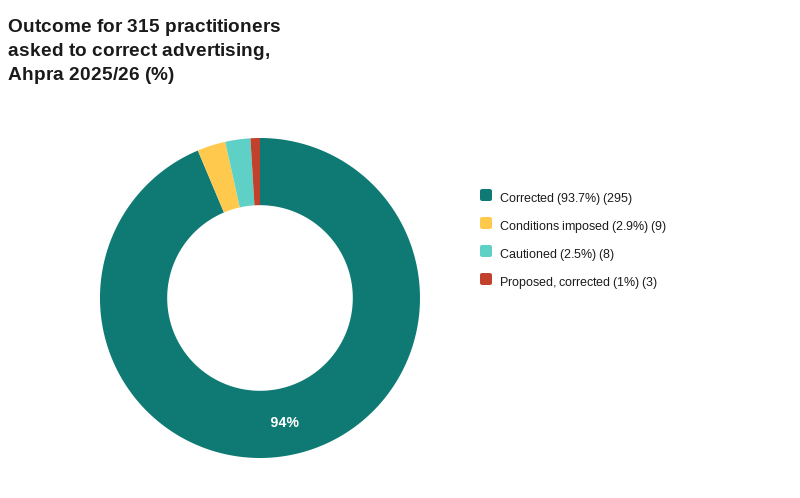
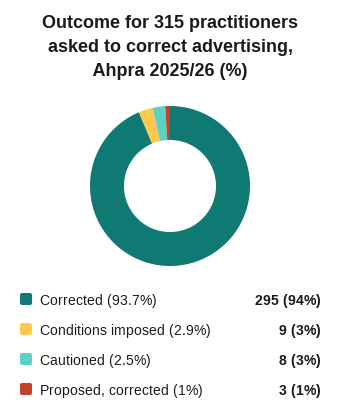
Source: Ahpra annual report 2025/26, Health regulation, seen 24 November 2026. Percent of the 315 cases assessed as needing corrective action; the 2.9%, 2.5% and 1% shares are our arithmetic (9, 8 and 3 divided by 315, rounded).
These are results for registered practitioners in lower-risk cases. Ahpra’s figures do not tell you how a case against a body corporate or an unregistered person would go, because those complaints are referred to a different unit.
How the Per-Offence Exposure Adds Up
Ahpra says a court may order an advertiser to pay a penalty for each offence. The pages we read do not say how many offences a particular ad, post or landing page counts as, and a court decides that. The table below is therefore a ceiling calculation, not a forecast.
| Number of offences | Body corporate maximum (our arithmetic) |
|---|---|
| 1 | $120,000 |
| 2 | $240,000 |
| 5 | $600,000 |
| 10 | $1,200,000 |
Source: our arithmetic, number of offences multiplied by the $120,000 body corporate maximum per offence from Ahpra, Advertising and the law, seen 24 November 2026. AUD. These are theoretical maximums; we found no published Ahpra data on penalties actually ordered against cosmetic clinics.
How to Protect the Clinic Now
In our view, the most direct step is to audit your own advertising against the guidelines before anyone reports it (see the AHPRA Compliance Audit Checklist). The audit should cover:
- All current Google Ads and Meta Ads copy
- Website landing pages that receive traffic from advertising
- Instagram, Facebook, and TikTok posts (paid and organic)
- Google Business Profile posts and Q&A
- Email marketing copy (subject lines and body)
- Any printed material that counts as advertising under the National Law
Ahpra’s cosmetic guidelines say content on public and private social media profiles may constitute advertising if it relates to a regulated health service. Ahpra’s enforcement strategy says the person or entity who controls the advertising is the advertiser and is responsible for compliance, and that advertisers must check content developed by others on their behalf.
The Source Pages
Screenshots of the pages cited in this post, taken on 24 November 2026 and framed on the passage each one supports.
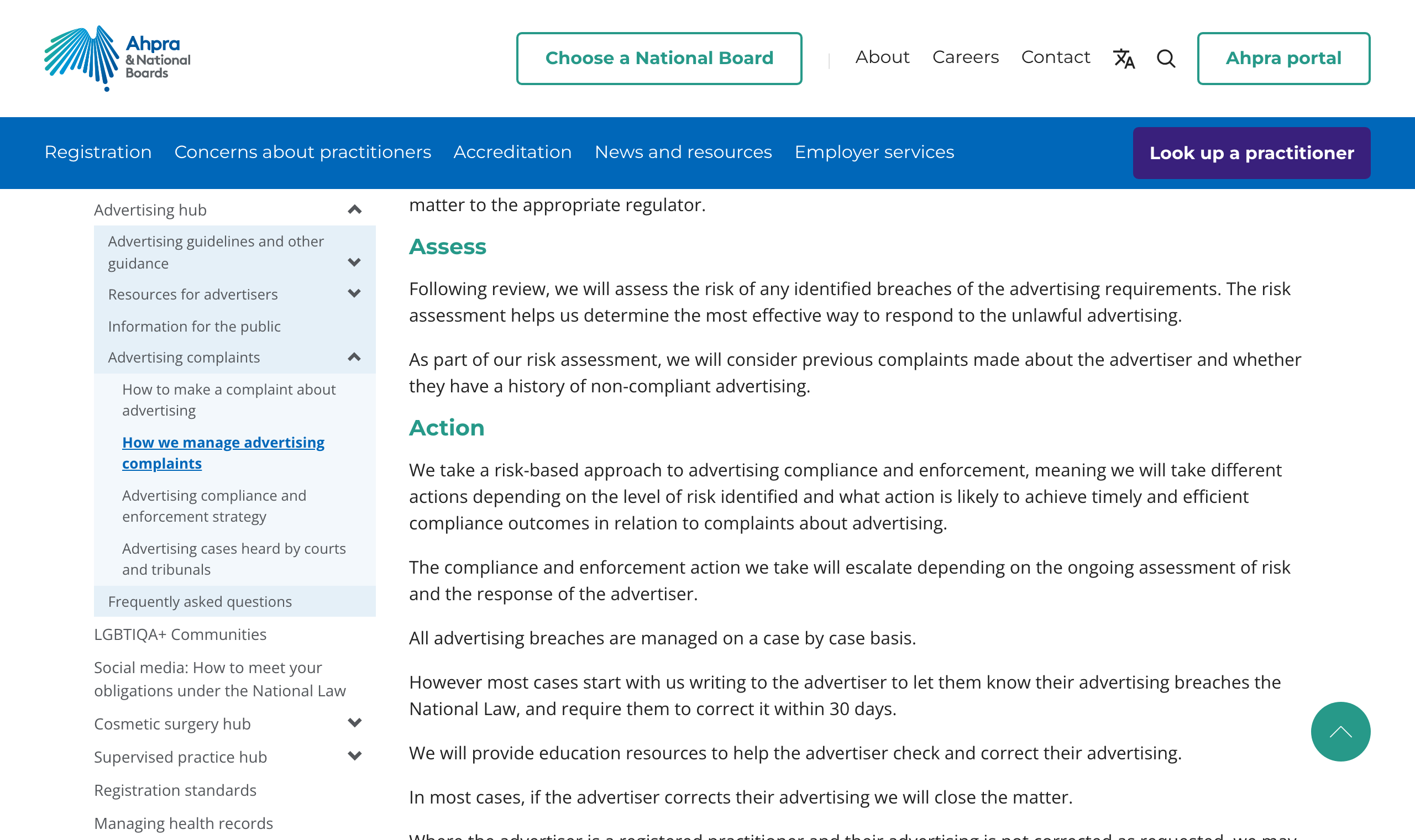
Source: Ahpra, How we manage advertising complaints, screenshot taken 24 November 2026.
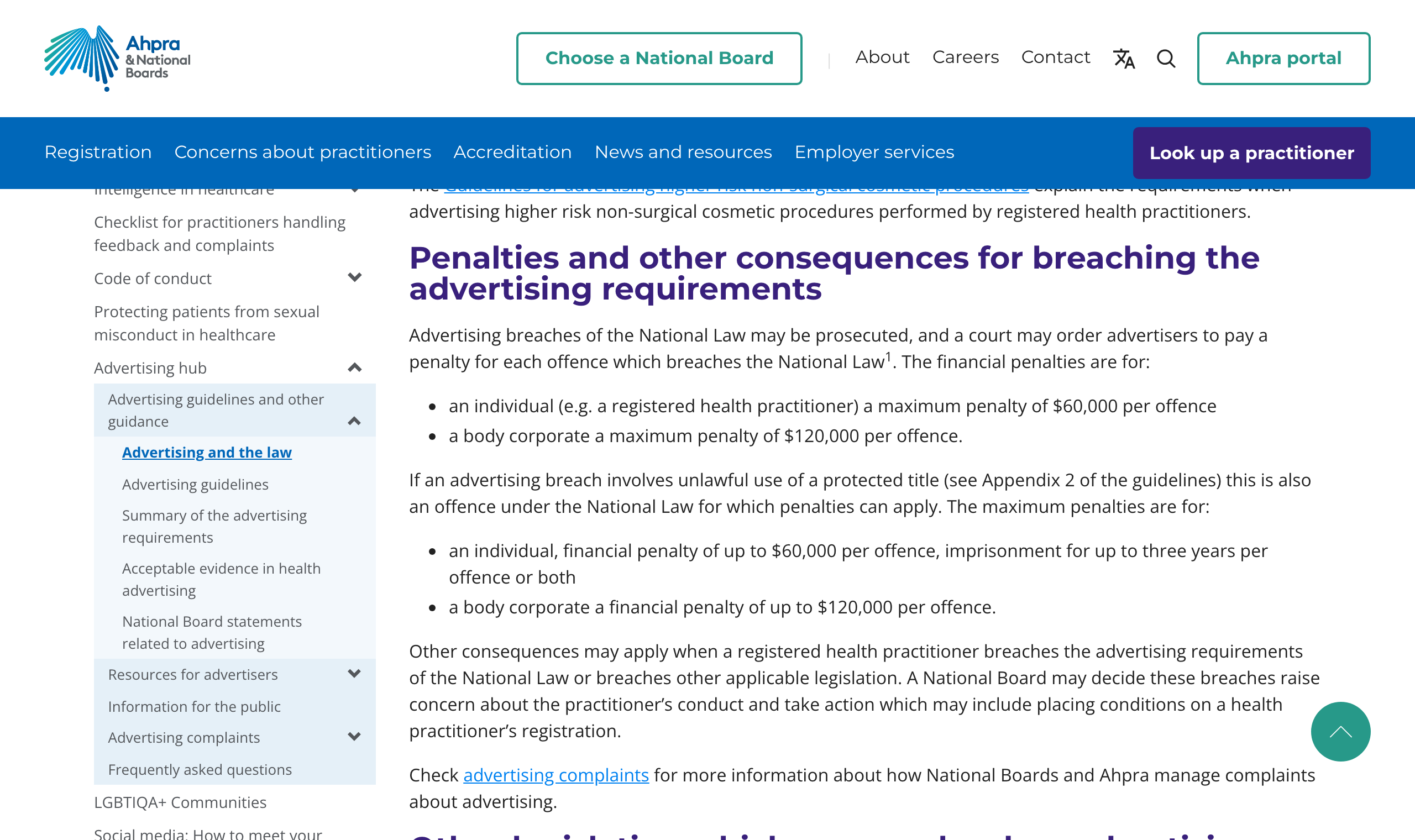
Source: Ahpra, Advertising and the law, screenshot taken 24 November 2026.
Get Your Website Checked for Compliance
ClinicCode fixes cosmetic clinic websites for AHPRA advertising compliance, tying each change to the specific rule it addresses.
Related reading:
- The Complete AHPRA Advertising Guidelines for Cosmetic Clinics: the full compliance framework
- AHPRA Compliance Audit Checklist: step-by-step self-audit guide
- What a Full AHPRA Compliance Audit Costs: audit cost vs penalty exposure
- AHPRA Social Media Rules for Cosmetic Clinics: channel-specific penalty risk on Instagram, Facebook, TikTok
- AHPRA Treatment Naming on Your Clinic Website: substance naming breaches explained
- AHPRA Before and After Advertising Rules: before/after imagery restrictions in detail
- Cosmetic Clinic Marketing Australia: AHPRA-compliant strategy overview
For paid advertising compliance specifically, book a call.
Vikas Thakur
Founder, Perth. 16 years of experience from working at TPG, iiNet and Monadelphous, now helping Australian clinics keep their websites, ads and online presence AHPRA compliant.