How to Report a Cosmetic Clinic to AHPRA: 81% Close in 6 Months
Ahpra closed 81.1% of notifications within six months in 2024/25. Here is how the complaint process works, and why it regulates practitioners, not clinics.
 Vikas Thakur Founder, Perth 10 min read Fact checked
Key takeaways
- Ahpra received 13,327 notifications about health practitioners nationally in 2024/25, up 19.0% on the year before
- 81.1% of all notifications were closed within six months of receipt, and Ahpra says the average time to complete a notification is the lowest recorded since the scheme began
- Of the notifications closed in 2024/25, 1.4% resulted in the practitioner losing their registration or being disqualified from applying for registration
- 72.8% of notifications were made by patients, their families or representatives, or other members of the public
- 146 (1.0%) of notifications were anonymous, even though anonymous reporting is allowed
- Ahpra tries to finish its assessment in 60 days in most cases, and says most notifications are closed within 90 days
- Ahpra says it regulates individual practitioners, not organisations, so a complaint about a clinic as a business is one it cannot consider
- The Cosmetic Surgery Hotline (1300 361 041) is a separate channel, staffed Monday to Friday 9am to 5pm AEST
Ahpra closed 81.1% of its notifications within six months in the 2024/25 financial year, according to its Ahpra Annual Report 2024/25, Notifications chapter, tabled in Parliament on 13 November 2025. It received 13,327 notifications that year. Of the notifications it closed, 1.4% resulted in the practitioner losing their registration or being disqualified from applying for registration.
Most people searching for how to report a cosmetic clinic assume they are complaining about a business. They are not. Ahpra regulates individual registered practitioners, not the clinics, hospitals or health centres they work in. That one fact changes what a complaint can achieve, who it names, and where it needs to be sent.
This guide covers how the process works: who can raise a concern, what Ahpra can and cannot consider, how long it takes, what happens at the end, and what it means for a clinic’s own website.
AHPRA Regulates Practitioners, Not Clinics
Ahpra’s how to raise a concern page lists “Complaints about a health service or organisation” under “Complaints we can’t consider”, with clinic, community health centre, hospital and mental health service as examples. Its words: “Ahpra regulates individual practitioners, not organisations.”
The same page lists “fees and charges”, “health record access or correction” and “dissatisfaction with the level of service you received” as other complaints about a registered practitioner that Ahpra does not take, and points those to your local health complaints organisation.
For a clinic, this matters commercially as well as procedurally. Ahpra notifications are about registered health practitioners, so each practitioner named on a clinic’s website could be the subject of one. A clinic that wants to know where its own exposure sits can start by talking to ClinicCode about a review of its site and the practitioners listed on it.
Takeaway: You cannot report “a clinic” to Ahpra. You report a named, registered practitioner, and the clinic is only in scope indirectly, through the practitioners who work there.
Who Can Raise a Concern, and How
Ahpra’s page sets out three steps. First, talk to the practitioner or health service if that feels safe. Ahpra calls this “often the quickest and easiest way to have your concern resolved”. Second, find the best place to report, which depends on the state or territory, what the concern is about and the type of practitioner (Ahpra regulates 16 professions). Third, raise the concern with Ahpra by completing its online form or calling 1300 419 495. Ahpra also treats unlawful advertising and claiming to be registered when you are not as offences that can be reported.
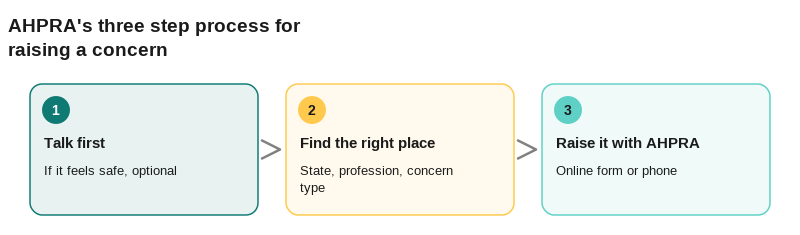
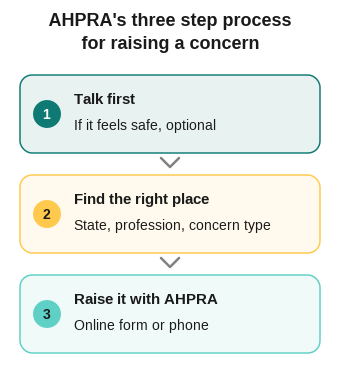
Source: Ahpra, How to raise a concern about a health practitioner.
Notifications are not limited to patients. The 2024/25 annual report breaks down who lodged them nationally.
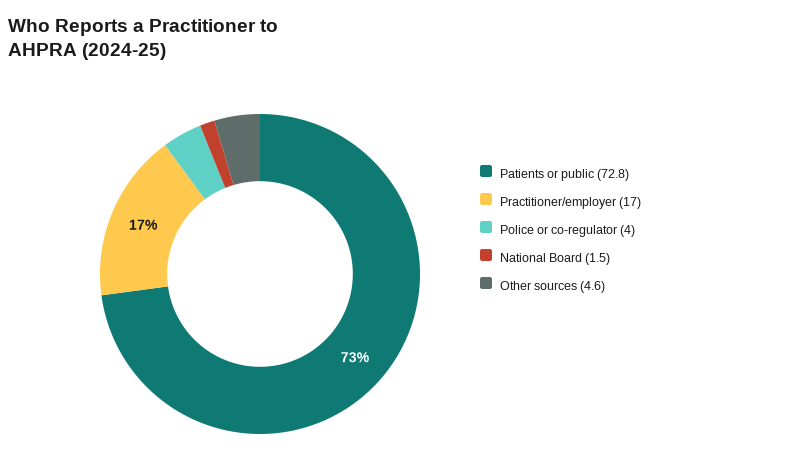
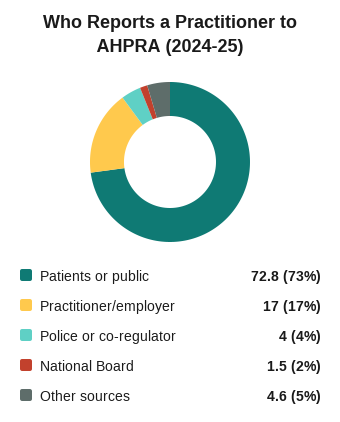
Source: Ahpra Annual Report 2024/25, Notifications chapter, “Who makes notifications?”. Ahpra describes the 4% group as police, government or co-regulators, and the 4.6% group as other sources including education providers, self-notifications and anonymous notifiers.
Patients, their families or representatives, or other members of the public made 72.8% of notifications. Health practitioners and employers made a further 17%.
Takeaway: Most notifications come from patients and the public, but practitioners, employers, police, co-regulators and National Boards also lodge them.
How Long the Process Takes
Ahpra’s timeframes page says: “In most cases, we try to finish the assessment process within 60 days and most notifications are closed within 90 days.” It adds that timing depends on the complexity of the matter and how long it takes to gather information. The 2024/25 national figures are below.
| Metric | Figure (2024/25, national) |
|---|---|
| Notifications received | 13,327 (up 19.0%) |
| Notifications closed | 12,086 (up 8.3%) |
| Closed within six months of receipt | 81.1% of all notifications |
| Made anonymously | 146 (1.0%) |
| Made by patients, families, representatives or the public | 72.8% |
| Closed with loss or disqualification of registration | 1.4% of notifications closed |
| Mandatory notifications received | 1,542 (up 32%), 11.6% of notifications received |
Source: Ahpra Annual Report 2024/25, Notifications chapter. All rows are national totals across all professions Ahpra regulates.
Ahpra says the average time to complete a notification is the lowest recorded since the start of the scheme. It also says a new decision-making process for low-risk notifications reduced the time to complete those matters by more than 30 days on average.
Takeaway: The process has stated targets of 60 and 90 days, and nationally 81.1% of notifications closed within six months. Individual matters can take longer.
What Happens to a Complaint
Per the annual report, 3,353 notifications were retained by, or referred to, a health complaints organisation, which is 27.7% of all notifications Ahpra completed. A further 2,379 (19.7%) notifications received did not require referral and closed through early determination with no further action. Around 40% of notifications were managed through a “strengthening practice” approach, and 17% of these were closed without regulatory action because the practitioner showed the steps they had taken to reflect on and improve their practice.
At the serious end, 192 practitioners were referred to a tribunal in 2024/25, an 18.3% decrease on the year before. Of the notifications closed, 1.4% resulted in the practitioner losing their registration or being disqualified from applying for registration.
Takeaway: The annual report describes a spread of outcomes, from no further action through to tribunal referral. Loss of registration was a small share of closed notifications.
Reporting Anonymously or Confidentially
Ahpra’s anonymity page says notifications can be made anonymously, meaning it does not record your name as the notifier, and that it may assign a pseudonym. It asks anyone who wants to be anonymous or confidential to explain why when they first contact Ahpra. It also warns that it may be difficult, and sometimes impossible, to assess or manage a concern without your name and contact details, and that an anonymous notifier cannot be given updates. By law Ahpra must tell a registered practitioner when a notification is made about them. “Mandatory notifications cannot be made anonymously.”
For cosmetic surgery, Ahpra’s cosmetic surgery complaints page says patients can make confidential complaints and that Ahpra will not tell the practitioner the name of the person who complained.
In 2024/25, 146 of the 13,327 notifications (1.0%) were anonymous.
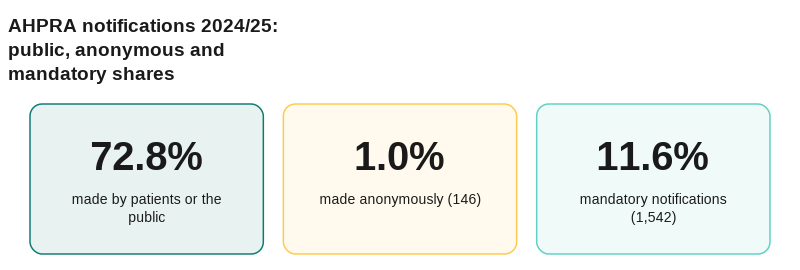
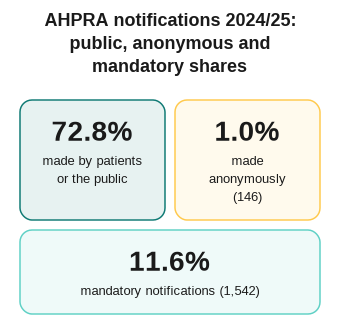
Source: Ahpra Annual Report 2024/25, Notifications chapter. The 11.6% is mandatory notifications as a share of notifications received.
Takeaway: Anonymity is allowed, but it can limit what Ahpra can do with a concern. Only 1.0% of notifications in 2024/25 were anonymous.
Employer Obligations: Mandatory Notifications
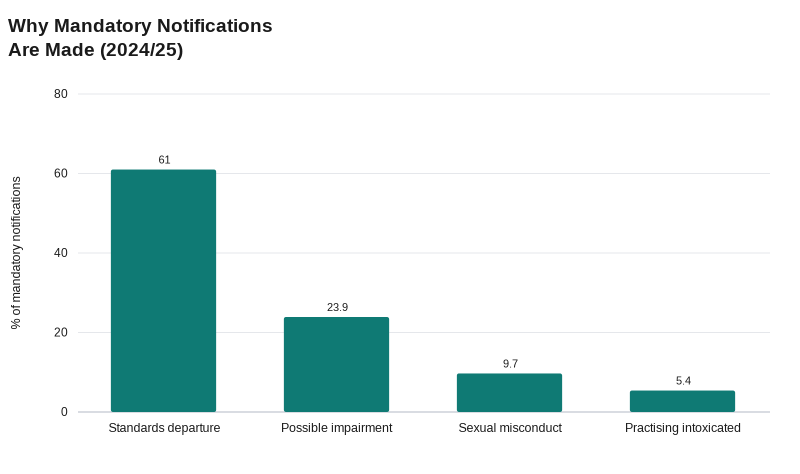
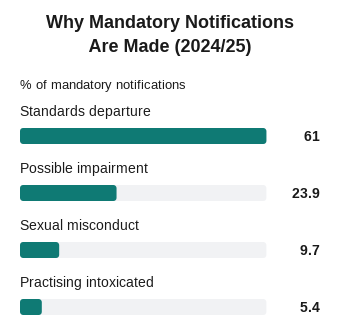
The annual report says that in certain circumstances practitioners and employers must tell Ahpra if they think a practitioner’s conduct, performance or health places patients at risk. Ahpra received 1,542 mandatory notifications nationally in 2024/25, 32% more than the year before, making up 11.6% of notifications received. Of these, 40% (617) were about nurses and 32.6% (503) about medical practitioners.
Source: Ahpra Annual Report 2024/25, Notifications chapter, “Mandatory notifications”.
A departure from professional standards was the most common reason, followed by a possible impairment, sexual misconduct and practising while intoxicated.
Takeaway: A clinic that employs registered practitioners should read Ahpra’s mandatory notification guidance, because the duty applies to practitioners and employers in the circumstances Ahpra describes.
A Note on What Isn’t Published
Ahpra’s Cosmetic Surgery Hotline, 1300 361 041, is run by a specialised team supporting the Cosmetic Surgery Enforcement Unit. Per its cosmetic surgery hub, the team is available Monday to Friday 9am to 5pm AEST, and concerns can be lodged confidentially.
Every figure in the table above is a national total across Ahpra’s regulated professions. We did not find a cosmetic-clinic-specific breakdown of notification volume, closure time or outcomes in the annual report chapter we read. National figures should not be read as cosmetic-sector figures.
Takeaway: National Ahpra figures describe the whole regulated health workforce, not cosmetic clinics specifically.
What This Means for Your Clinic’s Website
Because Ahpra deals with individual practitioners, not businesses, it helps to identify each practitioner you advertise clearly and accurately, so a patient can check their registration on Ahpra’s register. Ahpra’s own page on lodging concerns lists unlawful advertising among the offences it can act on. What your website may say about a procedure is governed by Ahpra’s separate advertising rules, not the notifications process covered here.
Takeaway: A clinic’s website is part of how a patient finds and checks the practitioner, so it should be accurate and clear about who is treating them.
FAQ
Can I report a cosmetic clinic to AHPRA anonymously?
Yes, though it may limit what Ahpra can do. Ahpra says it may be difficult, and sometimes impossible, to assess a concern without your details. In 2024/25, 146 of 13,327 notifications (1.0%) were anonymous. Mandatory notifications cannot be anonymous.
How long does an AHPRA complaint about a cosmetic clinic take?
Ahpra tries to finish its assessment within 60 days in most cases and says most notifications are closed within 90 days. Nationally in 2024/25, 81.1% of all notifications closed within six months of receipt.
Can I report a clinic itself, or only a specific practitioner?
Only a specific registered practitioner. Ahpra says it regulates individual practitioners, not organisations, and lists complaints about a clinic as ones it cannot consider. Fees, service level and record access go to your local health complaints organisation.
Is there a dedicated line for cosmetic surgery complaints?
Yes. Ahpra’s Cosmetic Surgery Hotline, 1300 361 041, is staffed Monday to Friday 9am to 5pm AEST. Concerns can be lodged confidentially, and you can also submit a concern online.
Get an AHPRA Compliance Check Before a Complaint Finds One
ClinicCode fixes cosmetic clinic websites against Ahpra’s advertising rules.
Talk to us about your clinic’s compliance and websiteSources and References
Ahpra - Annual Report 2024/25, Notifications chapter: national totals, timeframes, outcomes and mandatory notification figures
Ahpra - How to raise a concern: the three steps and what Ahpra cannot consider
Ahpra - How long does the notification process take: the 60 and 90-day targets
Ahpra - Can I be anonymous: anonymous notifications and mandatory notifications
Ahpra - Cosmetic surgery complaints: hotline number and confidential complaints
Ahpra - Cosmetic surgery hub: hotline hours (Monday to Friday, 9am to 5pm AEST)
Related reading:
- Cosmetic Surgery Hotline: 514 Calls in a Year Revealed: the hotline’s own published call and enforcement figures
- AHPRA Compliance Audit Checklist: a practical checklist for reviewing your own site
- AHPRA Advertising Guidelines for Cosmetic Clinics: what your website is and is not allowed to claim
For a full review of your clinic’s website and every practitioner listed on it, see clinic website design or talk to us about your clinic’s marketing.
Vikas Thakur
Founder, Perth. 16 years of experience from working at TPG, iiNet and Monadelphous, now helping Australian clinics keep their websites, ads and online presence AHPRA compliant.