Ahpra Cosmetic Advertising Rules: Up to $120,000 Per Offence
Ahpra’s cosmetic advertising guidelines were issued on 2 September 2025, and this guide covers testimonials, images, prices and penalties. Here is how to check your own ads.
 Vikas Thakur Founder, Perth Updated Jul 6, 2026 13 min read Fact checked
Key takeaways
- Ahpra’s Guidelines for advertising higher risk non-surgical cosmetic procedures carry a date of issue of 2 September 2025 and sit on top of the broader advertising guidelines.
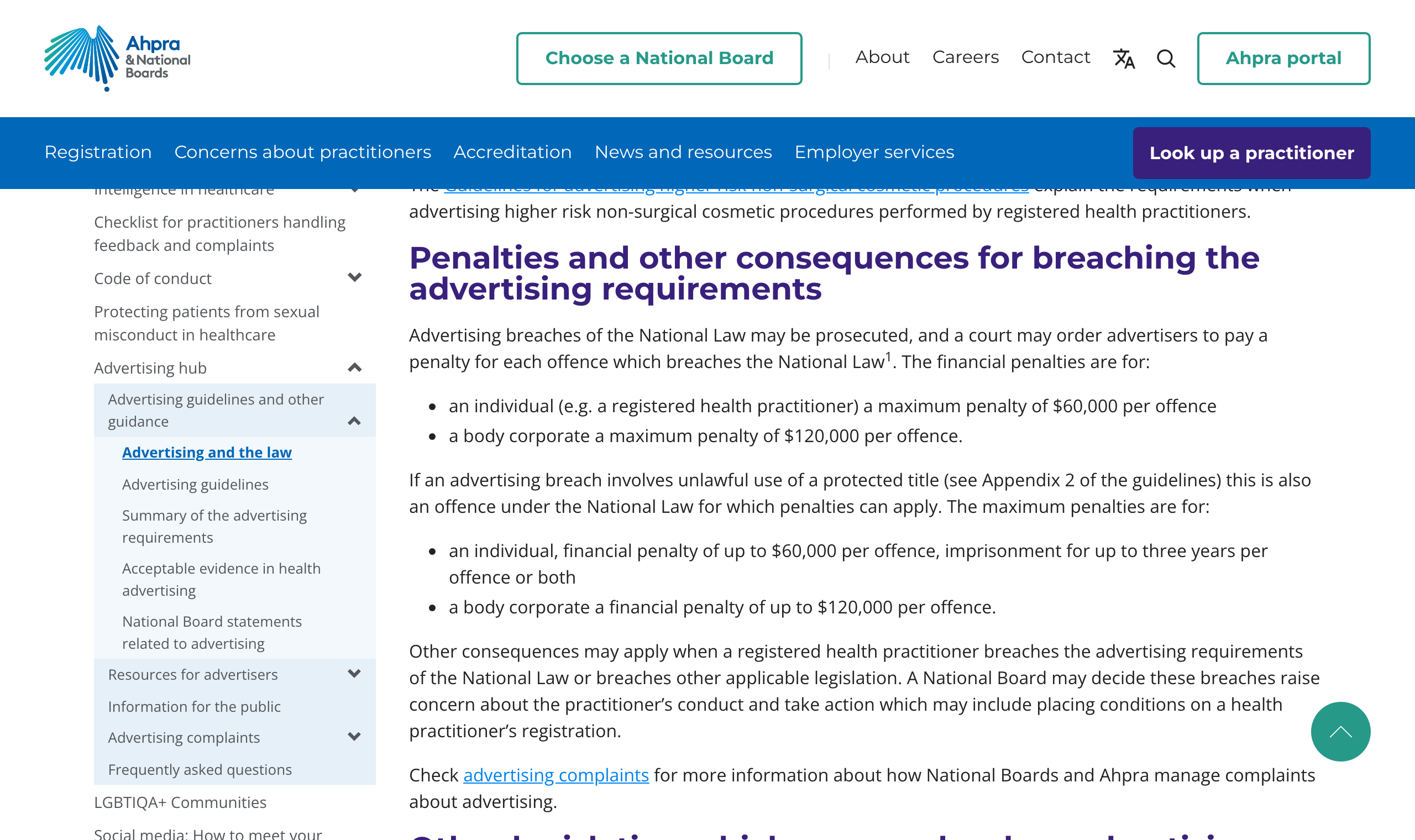
- Ahpra’s Advertising and the law page gives a maximum penalty of $60,000 per offence for an individual and $120,000 per offence for a body corporate.
- Testimonials in advertising are prohibited by section 133 of the National Law. That is not new in 2025, but the cosmetic guidelines spell out how it applies, including re-sharing or interacting with reviews.
- Before and after images are not banned outright by the cosmetic guidelines. They are allowed only if they meet a list of conditions (genuine images, similar conditions, no editing, a prominent warning).
- Naming prescription-only injectables, directly or by trade name, nickname or hashtag, is a separate problem under the TGA’s rules.
- The guidelines treat websites, social media, signage and directory listings alike: all of them can be advertising.
Ahpra’s cosmetic procedure advertising guidelines carry a date of issue of 2 September 2025, and Ahpra’s news release of 2 September 2025 says the new guidelines “are in effect from today”. They apply to anyone advertising higher risk non-surgical cosmetic procedures performed by registered health practitioners, and the examples Ahpra gives include cosmetic injectables, dermal fillers and dental veneers.
Ahpra says a court may order a maximum of $60,000 per offence for an individual and $120,000 per offence for a body corporate.
This guide sets out what the Ahpra and TGA pages say. It is a marketing guide, not legal advice.
What the penalties are
Ahpra’s Advertising and the law page says advertising breaches of the National Law may be prosecuted, and a court may order a penalty for each offence. The maximum financial penalties it lists are:
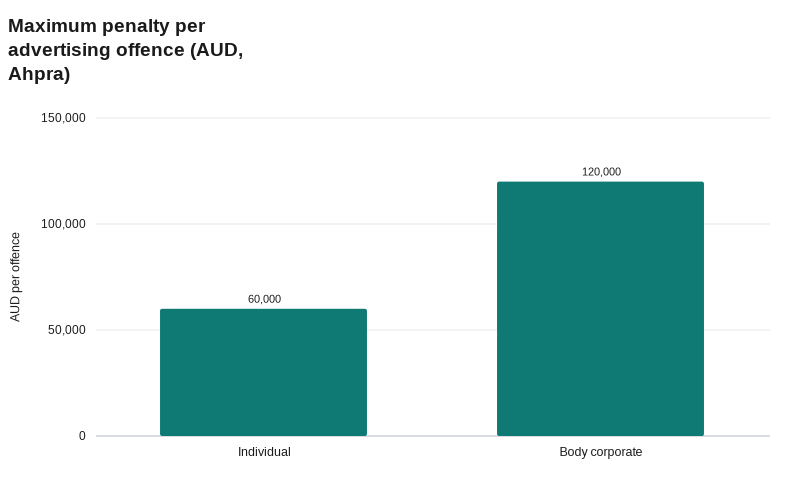
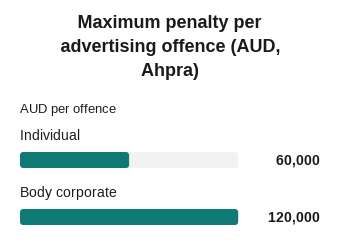
Source: Ahpra, Advertising and the law, page reviewed 2 September 2025, seen 24 November 2026. Figures are maximum penalties per offence in Australian dollars.
Three points from that page matter for a clinic:
- Ahpra says the 2022 amendment to the National Law increased the maximum penalty for advertising offences, and that from July 2024 the increased penalties apply in all jurisdictions, including Western Australia.
- Ahpra’s advertising guidelines page still carries footnote 3, which gives Western Australia maxima of $30,000 for an individual and $60,000 for a body corporate against the unlawful use of a protected title offence, and the page does not reconcile it with its statement that the higher penalties apply in all jurisdictions, including Western Australia, as of July 2024. Ask a health law solicitor if you are unsure which applies to you.
- Penalties are only one consequence. The page also says a National Board may take action on a practitioner’s registration, which may include conditions.
Our arithmetic, not an Ahpra figure: if three separate offences each reached the body corporate maximum, the total would be 3 x $120,000 = $360,000. How offences are counted, and what a court actually orders, is for the court.
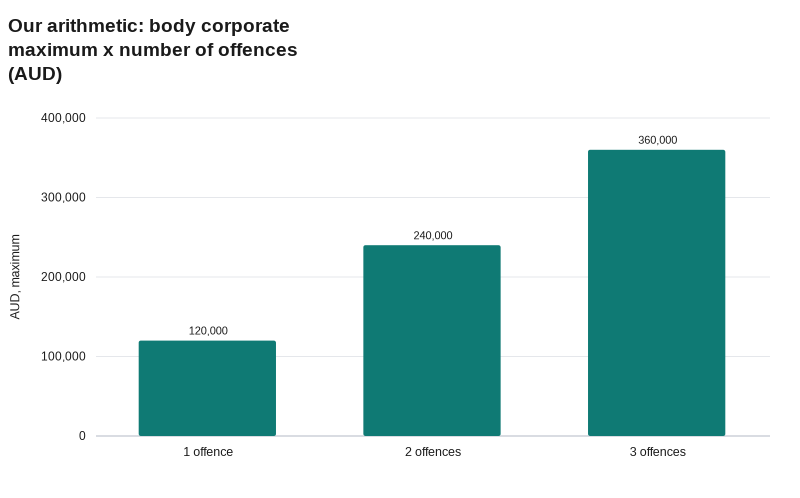
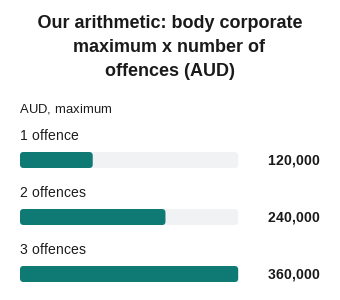
Source: our arithmetic on the $120,000 body corporate maximum per offence from Ahpra, Advertising and the law, seen 24 November 2026. Figures are theoretical maximums in AUD, not typical outcomes.
What the rules say
| Topic | What the sources say |
|---|---|
| Testimonials | The National Law (section 133) prohibits testimonials or purported testimonials about a regulated health service or business. The cosmetic guidelines apply this to higher risk cosmetic procedures. |
| Before and after images | Allowed only if they meet conditions, such as genuine images of the practitioner’s own patients, similar conditions, no editing or filters, and a prominent warning. |
| Prescription-only products | The TGA says an advertisement cannot refer directly or indirectly to prescription-only substances or their trade names, including nicknames and hashtags. |
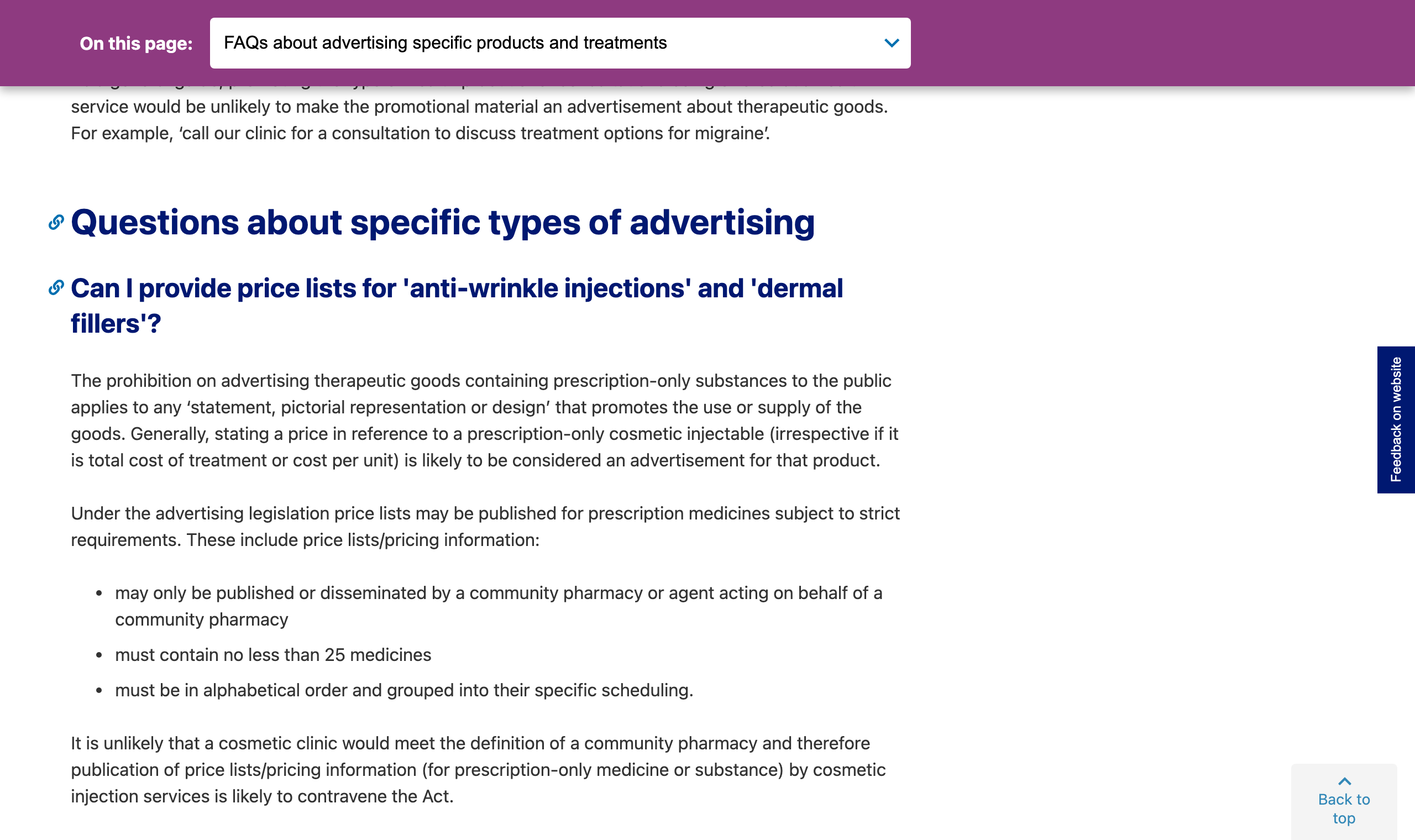
| Price lists for injectables | The TGA says stating a price for a prescription-only cosmetic injectable is likely to be treated as an advertisement for that product. |
| What counts as advertising | Ahpra says it includes websites, social media content that relates to a regulated health service, signage, flyers and directory listings. |
Source: Ahpra, Cosmetic procedure advertising guidelines (date of issue 2 September 2025) and TGA, advertising health services and cosmetic injections FAQ, seen 24 November 2026.
The guidelines say that where they differ from the broader Guidelines for advertising a regulated health service, advertisers should follow the more specific guidance.
Testimonials and reviews
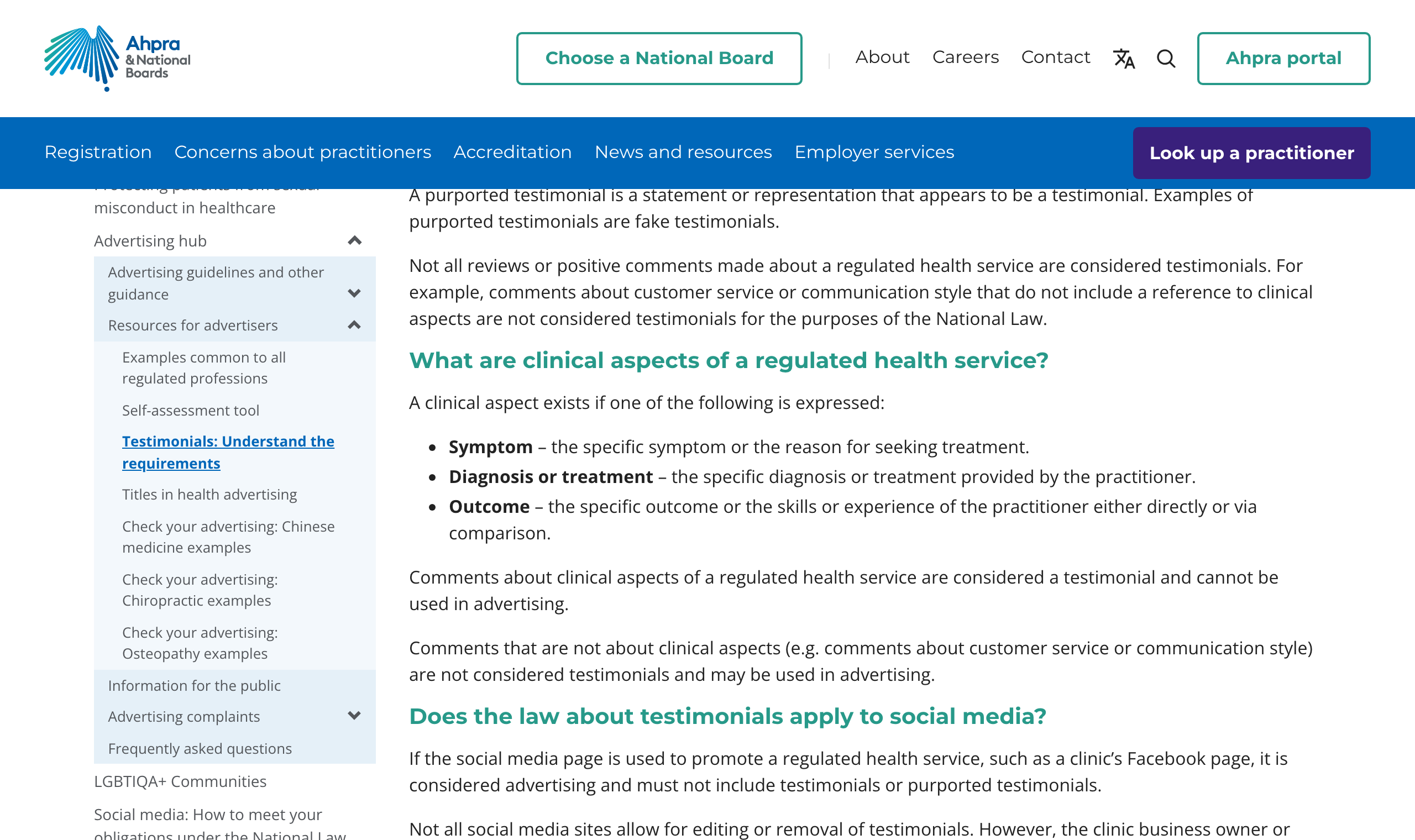
The cosmetic guidelines say advertising of higher risk cosmetic procedures must not use testimonials. They define a clinical aspect broadly: any positive statement about the experience of, the reason for or the outcome of the procedure, or about the skills or experience of the practitioner.
A practitioner is treated as having used a testimonial where they:
- publish one in print, on a website, on social media or inside the clinic, including through time-limited formats such as Stories
- link to testimonials on third-party advertising
- re-share patient stories or posts that recommend the procedure or practitioner
- interact with a review on a third-party site or social page, such as liking or responding to it
The nuance on reviews: the guidelines say the prohibition does not affect patients posting reviews or members of the public using review sites. The broader guidelines say advertisers are not responsible for removing testimonials on platforms they do not control, but should take care if they engage with reviews on third-party sites. The cosmetic guidelines suggest disabling reviews, comments or tagging on your own social pages to reduce the risk.
Before and after images
In our view this is a point that is easy to get wrong. The cosmetic guidelines do not ban before and after images. They set conditions for using them. The ones listed include:
- both images are genuine, of actual patients who had the advertised procedure from that practitioner
- the first or most prominent image is either the before image or a combined image, not the after image
- the images are as similar as possible in lighting, angle, background, framing, posture, clothing and makeup
- no editing or enhancement, including filters, retouching or grey-scaling
- the after image states how long after the procedure it was taken
- a prominent warning that the outcome applies only to that patient and does not necessarily reflect other patients’ results
- no images of people under 18, and separate informed consent from the patient to use their image in advertising
The same section also says captions must not idealise or minimise risk, with examples such as “more natural”, “ideal”, “perfect” and “instant”, and that advertising must not use emojis to signal an emotional reaction to an image.
Be careful with testimonial overlap. The guidelines say a testimonial’s clinical aspect can include linking to images showing outcomes, and that patient reactions such as thumbs up or crying with happiness must not be captured. An image with a patient quote is a different risk from a plain, conditioned before and after pair. Get advice before relying on outcome images at all.
Prescription-only products and generic names
Ahpra’s rules sit next to the TGA’s. The TGA’s FAQ says advertisers cannot refer, directly or indirectly, to prescription-only substances or to the trade names of prescription-only goods, including acronyms, nicknames, abbreviations and hashtags.
It also says that educational content which is likely to promote the use or supply of therapeutic goods must not refer to prescription-only goods, including in generic terms such as “dermal fillers treatments” or “anti-wrinkle injections”. A disclaimer that the information is for education only does not fix this. The TGA does not publish a list of acceptable substitute terms, so describe the consultation you offer rather than the product.
On price, the TGA says stating a price in reference to a prescription-only cosmetic injectable, whether total cost or per unit, is generally likely to be treated as an advertisement for that product. It adds that price lists for prescription medicines may be published only under strict requirements, which include being published by or for a community pharmacy.
What cosmetic clinics can still advertise
The rules are restrictive. They are not a blanket ban. In our view, four types of content are the safest starting point:
1. Service descriptions without outcome claims
Ahpra says advertising must not imply any desired outcome can be obtained (it gives “perfect pout” as unacceptable) and must make clear that individual results vary. Describe what the appointment involves, who conducts it and how long it takes, and leave out the result.
2. Practitioner credentials, stated accurately
Ahpra says claims about qualifications and experience must be accurate, and that a practitioner who is referenced as performing higher risk cosmetic procedures should be shown with their registration details, including registration number. Acronyms must not be used alone without explanation, and terms such as “specialises” are misleading if the practitioner does not hold specialist registration in that area.
3. Realistic risk and recovery information
The guidelines say advertising must give accurate, realistic information about risks and recovery, and that full risk information must be easy to find, for example by linking to it from a social post. Words such as “gentle”, “simple”, “safe”, “quick” or “easy” should not be used without clear information about risks.
4. Booking and practical information
Opening hours, location and how to book are practical information and make no outcome claim. In our view, a price for a consultation is the kind of information that is less likely to raise the TGA’s price concern than a price for a named injectable, but the TGA FAQ does not address consultation fees directly, so check before you publish one. Ahpra also says cost information must be clear, accurate and honest.
Illustrative non-compliant and safer wording
These are examples we wrote to show the principles above. They are not Ahpra’s examples and are not a guarantee of compliance.
| Ad element | Risky wording | Safer direction |
|---|---|---|
| Hero headline | “Transform your look with our expert injectors” | “Cosmetic consultations in [suburb], Perth” |
| Social proof | A screenshot of a five-star review | Practitioner profile with qualifications and registration details |
| Treatment description | “Get the glowing skin our clients rave about” | A plain description of the appointment and a link to risk information |
| Instagram caption | “Before and after: perfect lips” | Information about what to expect at a consultation, with a link to risks |
| Google Ad headline | A product trade name plus a per-unit price | Clinic name, location and “Book a consultation” |
| Website button | “Book your glow-up today” | “Book a consultation” |
Source: our own illustrative wording, based on Ahpra, Cosmetic procedure advertising guidelines and the TGA FAQ, seen 24 November 2026.
How to audit your existing advertising
Work through each channel. Ahpra says the person who controls the advertising is responsible for it, including content produced by staff or a marketing agency on your behalf.
1. Website
- Remove testimonials and patient quotes from treatment pages
- Check every before and after image against the conditions above, or remove it
- Check treatment copy for outcome claims and for idealising words such as “perfect” and “instant”
- Check for trade names and generic injectable terms the TGA says to avoid
- Make sure any practitioner named has their registration details shown
2. Instagram, Facebook and TikTok
- Review past posts for testimonials, re-shares and replies to reviews
- Look at Stories and reels: the guidelines say time-limited formats still count
- Check for emojis on images, entertainment-style edits such as music or comedic voice-overs, and lifestyle-shot imagery, which the guidelines list as features likely to trivialise procedures
- In our view, archive rather than delete content you remove, so you keep a record
3. Google Ads
- Review headlines and descriptions for outcome language and trade names
- Check any price shown against the TGA’s position on prescription-only injectables
4. Google Business Profile and review sites
- You generally cannot control what patients post, and the guidelines say patients are free to do so
- Do not reproduce, link to, like or reply to positive reviews about treatment
- Consider whether you can disable review or comment features on pages you control
What happens if someone complains
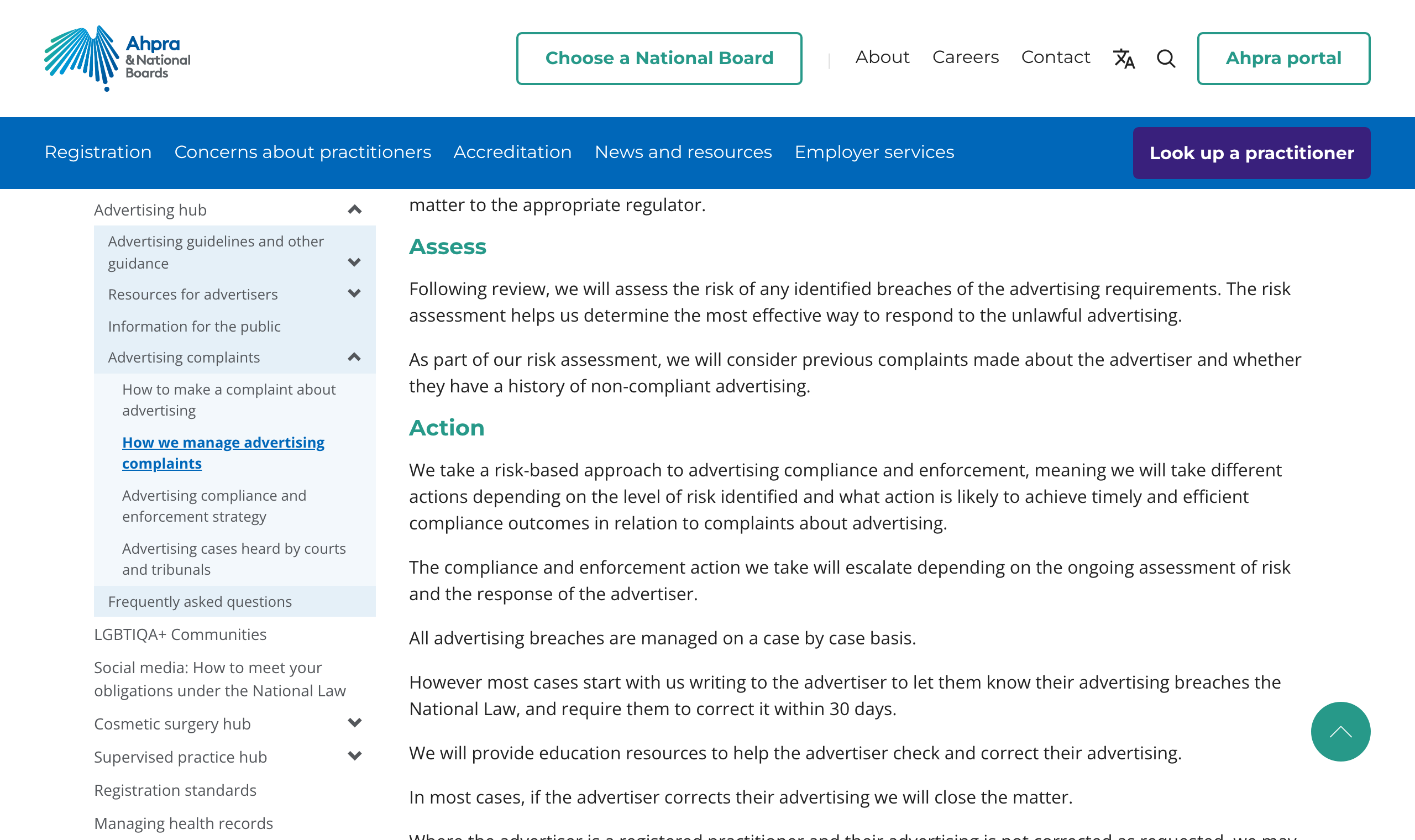
Ahpra’s How we manage advertising complaints page describes three steps: review, assess, and action.
- Ahpra reviews the advertising to check whether it complies and to identify the advertiser.
- If it is not compliant, Ahpra does a risk assessment that considers previous complaints and any history of non-compliant advertising.
- Ahpra takes action that depends on the level of risk and on who controls the advertising.
The page says most cases start with Ahpra writing to the advertiser to say the advertising breaches the National Law and requiring it to be corrected within 30 days. In most cases, if the advertiser corrects it, Ahpra closes the matter. A registered practitioner who does not correct may face proposed conditions prohibiting advertising. A non-registered advertiser who does not correct may be prosecuted. Very serious breaches that put the public at significant risk of harm may be prosecuted even after correction.
Source: Ahpra, How we manage advertising complaints, page reviewed 9 February 2021, seen 24 November 2026. This page is older than the 2025 guidelines, so check Ahpra’s current complaints pages as well.
In our view, if you receive a notice from Ahpra, speak to a health law solicitor before you respond.
Building a compliant marketing system
If your growth relied on testimonials and outcome images, you need other ways to build trust. Three that sit within the rules as we read them:
Strategy 1: Careful education content Ahpra describes good practice advertising as balanced, accurate and informative. The TGA warns that educational content which promotes prescription-only goods is still advertising, so keep education about the consultation, safety, risks and recovery rather than about named products.
Strategy 2: Practitioner credentials A practitioner profile that documents qualifications, registration details and professional memberships gives readers trust signals without a testimonial, provided each claim is accurate.
Strategy 3: Consultation-first booking When advertising cannot promise outcomes, the consultation becomes the place where options, risks and suitability are discussed. The TGA itself notes that whether a prescription-only medicine is appropriate should be discussed in a consultation with an appropriately trained practitioner.
The Source Pages
Screenshots of the pages cited in this post, taken on 24 November 2026 and framed on the passage each one supports.
Source: Ahpra, Advertising and the law, screenshot taken 24 November 2026.
Source: TGA, advertising health services and cosmetic injections FAQ, screenshot taken 24 November 2026.
Source: Ahpra, How we manage advertising complaints, screenshot taken 24 November 2026.
Source: Ahpra, Testimonials: Understand the requirements, screenshot taken 24 November 2026.
Next Step for Your Clinic
AHPRA compliance fixes and compliant marketing campaign setup are exactly what ClinicCode handles for Perth cosmetic clinics.
If you are unsure whether your current advertising meets the 2025 guidelines, book a call. We fix your website, active social content, and Google Ads account wording before AHPRA has a reason to look.
Vikas Thakur
Founder, Perth. 16 years of experience from working at TPG, iiNet and Monadelphous, now helping Australian clinics keep their websites, ads and online presence AHPRA compliant.