AHPRA Before and After Advertising Rules: 2025 Guide
Ahpra’s guidelines issued on 2 September 2025 set rules for before and after images in higher risk cosmetic procedure advertising. Here is what they say and how to audit your content.
 Vikas Thakur Founder, Perth Updated Jun 14, 2026 11 min read Fact checked
Key takeaways
- Ahpra’s Guidelines for advertising higher risk non-surgical cosmetic procedures give a date of issue of 2 September 2025 and include a section on before and after images
- The most prominent or first image seen must be the “before” image or a combined image of both
- Images must be of actual patients who had the procedure from that health practitioner, and must not be edited or enhanced
- Outcome images need a prominent warning that the result is only relevant for that patient
- The “after” image should say how long after the procedure it was taken
- Images of people under 18 must not be used
- Advertising on social media must be identified as “adult content”
- The maximum penalty is $60,000 per offence for an individual and $120,000 per offence for a body corporate, per Ahpra. Ahpra’s advertising guidelines page still carries footnote 3, which gives Western Australia maxima of $30,000 for an individual and $60,000 for a body corporate against the unlawful use of a protected title offence, and the page does not reconcile it with its statement that the higher penalties apply in all jurisdictions, including Western Australia, as of July 2024.
Ahpra’s advertising guidelines page says that in 2022 the National Law was amended and the maximum financial penalty per offence increased from $5,000 to $60,000 for an individual and from $10,000 to $120,000 for a body corporate.
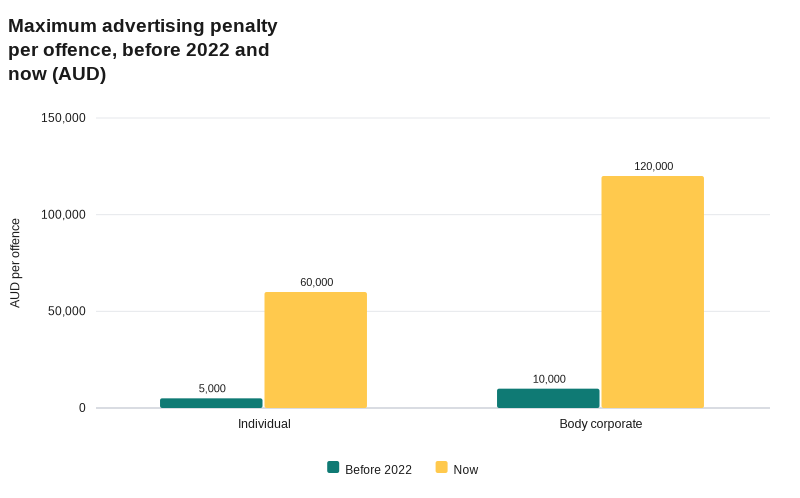
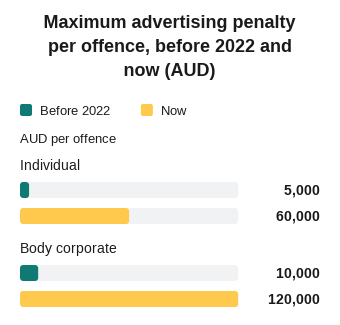
Source: Ahpra, Advertising guidelines, section on the increased maximum penalty, seen 25 November 2026.
In Brief
Ahpra’s guidelines for advertising higher risk non-surgical cosmetic procedures carry a date of issue of 2 September 2025. They apply to registered health practitioners, to people who are not registered health practitioners, and to businesses that advertise these procedures. This post covers the before and after image rules, what to remove, and how to audit what you have already published.
You have seen the Instagram post. A single split-panel photo. Left side: lips that look thin. Right side: lips that look plump. A clinic logo in the corner.
Under Ahpra’s guidelines, whether that post is acceptable depends on which side the viewer sees first, whether the patient is real, whether the image was edited, and whether the right warning sits on it.
Ahpra does not ban before and after images outright. It sets conditions. If your clinic advertises a higher risk procedure, check every image against them.
This post sets out those conditions, what to show instead, and how to audit your existing content. It is general information, not legal advice.
What Ahpra Issued in 2025
The guidelines are published on Ahpra’s cosmetic procedure advertising guidelines page, which gives a date of issue of 2 September 2025. Ahpra’s Advertising and the law page says the guidelines “will come into effect on 2 September 2025”. Trade publication Aesthetic Medical Practitioner reports that Ahpra announced the guidelines on 3 June 2025.
They were developed by National Boards under section 39 of the Health Practitioner Regulation National Law. They apply to “registered health practitioners”, “individuals who are not registered health practitioners”, and “business, partnerships and corporate entities”.
That scope matters if you run marketing for a clinic. The guidelines say any person who authorises the advertising of services is responsible for it, including “the owner of the business and any person in control of the advertising”.
Advertising is wide. Ahpra’s page lists websites, social media, flyers, office signs, shopfronts and directory listings. It also says content on “public and private social media profiles or groups” may be advertising if it relates to a regulated health service.
Source: Ahpra, Cosmetic procedure advertising guidelines and Advertising and the law; Aesthetic Medical Practitioner, article of 2 July 2025. Pages viewed 25 November 2026.
What Counts as a Higher Risk Procedure
The before and after rules apply to advertising of higher risk non-surgical cosmetic procedures. Ahpra’s page says the examples “include but are not limited to” the following.
| Procedure group | Ahpra’s wording |
|---|---|
| Dental work | Dental veneers |
| Injectables | Cosmetic injectables such as botulinum toxin and dermal fillers (also known as soft tissue fillers) |
| Fat reduction | Injection lipolysis |
| Lifting | Thread lifts |
| Veins | Sclerotherapy and microsclerotherapy |
| Blood-derived products | Procedures involving platelet rich plasma, biotherapy or injections of any products derived from the patient’s blood |
| Hair | Hair transplants |
The list is not exhaustive. If your clinic advertises any of these, the image rules below apply to that content.
Source: Ahpra, Cosmetic procedure advertising guidelines, section “What are higher risk non-surgical cosmetic procedures?”. Page viewed 25 November 2026.
What the Guidelines Require for Before and After Images
The relevant section is headed “Use of images including ‘before and after’ images”. It says it applies to “all images advertising higher risk cosmetic procedures”. Here is what it requires.
Put the “before” image first
The guidelines require “presenting images so that the most prominent or first image seen is either a combined or composite of both the ‘before’ and ‘after’ images or the ‘before’ image”. They add: “Advertising where the ‘after’ image is the most prominent image may create unrealistic expectations.”
In our view, that rules out a carousel that opens on the result, a reel that opens on the finished look, and a website banner built around an “after” shot.
Use genuine patients only
Both images must be genuine. Ahpra defines that as “actual patients who have had the procedure being advertised performed by that health practitioner”.
In our view, if a practitioner leaves your clinic, their patient images should come out of your advertising, because the clinic can no longer say that practitioner performed the procedure on the patient shown.
Do not edit or enhance
Ahpra says images “must not be edited or enhanced, for example through the use of filters, retouching, grey-scaling and similar techniques”. It also lists “airbrushed, soft-filter or modified images” as misleading, and the use of models or celebrities where it is not established that they had the procedure.
Match the conditions
The two images must be “as similar as possible in content, lighting (including the use of flash lighting), camera angle, background, framing and exposure, posture, clothing, and makeup”.
Add the warning and the timing
All images that show outcomes “must include a prominent warning that the outcomes shown are only relevant for this patient and do not necessarily reflect the results other patients may experience”. The “after” image “should specify how long after the higher risk cosmetic procedure the image was taken”.
No images of people under 18
The guidelines say “Images of people under 18 years of age must not be used in advertising of higher risk cosmetic procedures.”
Identify social media advertising as adult content
The guidelines say advertising of higher risk cosmetic procedures in social media “must be identified as ‘adult content’ to prevent young people from accessing content about these procedures on a social media platform”. Check each platform’s age-restriction settings.
Get separate, documented consent
Practitioners must have “fully informed consent from patients, separate from the consent to the higher risk cosmetic procedure, to use their image in any advertising”. They must also document the consent and remove an image promptly where possible when a patient withdraws it.
| Requirement | What the guidelines say |
|---|---|
| Image order | Before image, or a combined image, is the most prominent or first seen |
| Authenticity | Actual patient, procedure performed by that practitioner |
| Editing | No filters, retouching or grey-scaling |
| Warning | Prominent, result relevant only to this patient |
| Timing | After image should say how long after the procedure |
| Age | No images of people under 18 |
| Social media | Identified as adult content |
Source: Ahpra, Cosmetic procedure advertising guidelines, section “Use of images including ‘before and after’ images”. Page viewed 25 November 2026.
Images can be testimonials
The same page says the ban on testimonials in higher risk cosmetic advertising “can include linking to images showing outcomes of a procedure”. It also says re-sharing patient posts that are positive statements about the procedure or practitioner counts as using a testimonial. So an outcome image captioned with a patient’s words is a second problem, not a fix.
What to Show Instead
If you would rather not manage the image conditions, build content that does not depend on outcome photos. In our view, three formats work.
- Procedure education. Explain what the procedure involves, the risks and the recovery. Ahpra says advertising “must provide accurate, realistic and educative information about risks or potential risks” and must “include realistic information about recovery time and the recovery experience”.
- Credentials. If advertising references a specific person as performing these procedures, it “must include information about the health practitioner’s registration details, including their registration number”.
- Clear risk information. Ahpra says full information about risks “can be easily found within advertising”. On social media, it says to direct people to it by a link or directions to the relevant part of your website.
Avoid the language the guidelines flag. They say minimising terms such as “gentle”, “simple”, “safe”, “quick” or “easy” should not be used without clear information about risks. They also list “perfect”, “ideal”, “instant” and “more natural” as caption terms that idealise procedures.
Source: Ahpra, Cosmetic procedure advertising guidelines, sections on risk, recovery and idealising procedures, and on titles and claims. Page viewed 25 November 2026.
Auditing Your Existing Content
We found no grandfathering provision on the guidelines page we read on 25 November 2026. In our view, treat any live content as in scope. Ahpra’s definition of advertising covers anything that “promotes and seeks to attract a person” to a regulated health service, and it does not turn on when the content was published.
Where to audit
Ahpra’s list of advertising forms is a useful checklist.
- Your website, including service pages and any gallery
- Social media profiles, including stories, which Ahpra says count for testimonials even when “published in a time restricted way”
- Flyers, office signs and shopfront signage
- Directory listings
- Business cards and announcement cards
- Any content from influencers or ambassadors you have an arrangement with. Ahpra says advertisers who arrange this are responsible for the content delivered
What to do with content that fails
In our view, remove it rather than hide it. Ahpra says content on private social media profiles or groups can still be advertising, so a private setting is not a clear fix.
Keep a record of what you removed, where, and when. That is our practical suggestion, not an Ahpra requirement.
Check the other regulators too
Where a procedure involves a therapeutic good or a prescription-only medicine, such as cosmetic injectables, Ahpra says advertisers must also meet TGA requirements. It also says advertisers must comply with the Australian Consumer Law.
Source: Ahpra, Cosmetic procedure advertising guidelines, sections “What is considered to be advertising?”, “Who is responsible for advertising?” and “How do these guidelines interact with other legislation?”. Page viewed 25 November 2026.
The Penalty Structure
Ahpra’s Advertising and the law page says advertising breaches of the National Law “may be prosecuted, and a court may order advertisers to pay a penalty for each offence”.
| Type of entity | Maximum penalty per offence |
|---|---|
| Individual, for example a registered health practitioner | $60,000 |
| Body corporate | $120,000 |
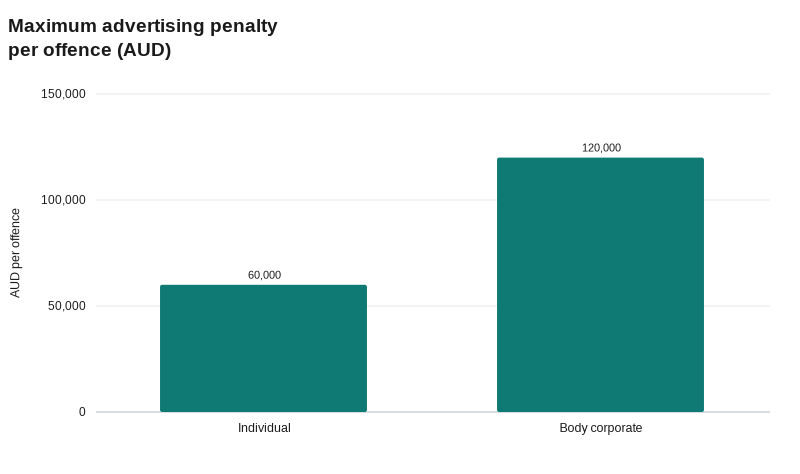
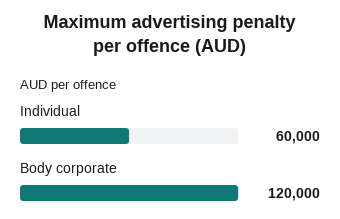
Source: Ahpra, Advertising and the law, seen 25 November 2026.
Ahpra’s advertising guidelines page still carries footnote 3, which gives Western Australia maxima of $30,000 for an individual and $60,000 for a body corporate against the unlawful use of a protected title offence, and the page does not reconcile it with its statement that the higher penalties apply in all jurisdictions, including Western Australia, as of July 2024.
The page adds that where a breach involves unlawful use of a protected title, an individual can face up to three years’ imprisonment per offence, or both. It also says a National Board may decide a breach raises concern about the practitioner’s conduct and take action “which may include placing conditions on a health practitioner’s registration”.
The guidelines add that “Serious or repeated failure to meet these guidelines may have consequences for a health practitioner’s registration”.
Source: Ahpra, Advertising and the law (page reviewed 2/09/2025 per the page) and Advertising guidelines, footnote 3. Pages viewed 25 November 2026.
The Fastest Path to Compliance
In our view, adding a disclaimer to an image that shows the “after” first does not fix it. The guidelines treat order and warning as separate requirements.
Work through each channel. Remove content that cannot meet the conditions. For content you keep, check each requirement in the table above.
Then add a sign-off step so every new post is checked against the guidelines before it goes live.
If you want a second set of eyes on your clinic’s advertising, get in touch through our contact page.
The Source Pages
Screenshots of the pages cited in this post, taken on 25 November 2026 and framed on the passage each one supports.
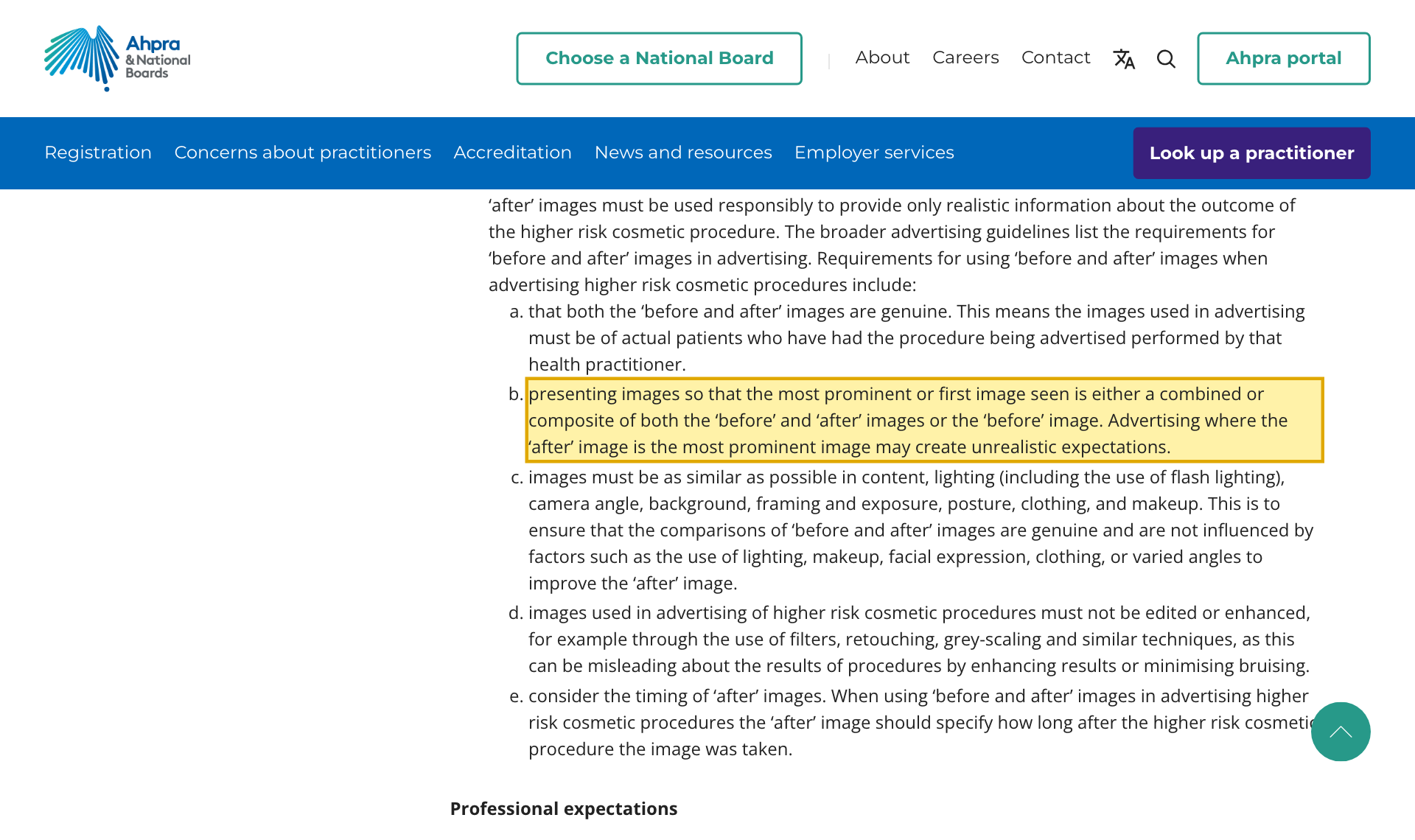
Source: Ahpra, advertising higher risk cosmetic procedures, screenshot taken 25 November 2026.
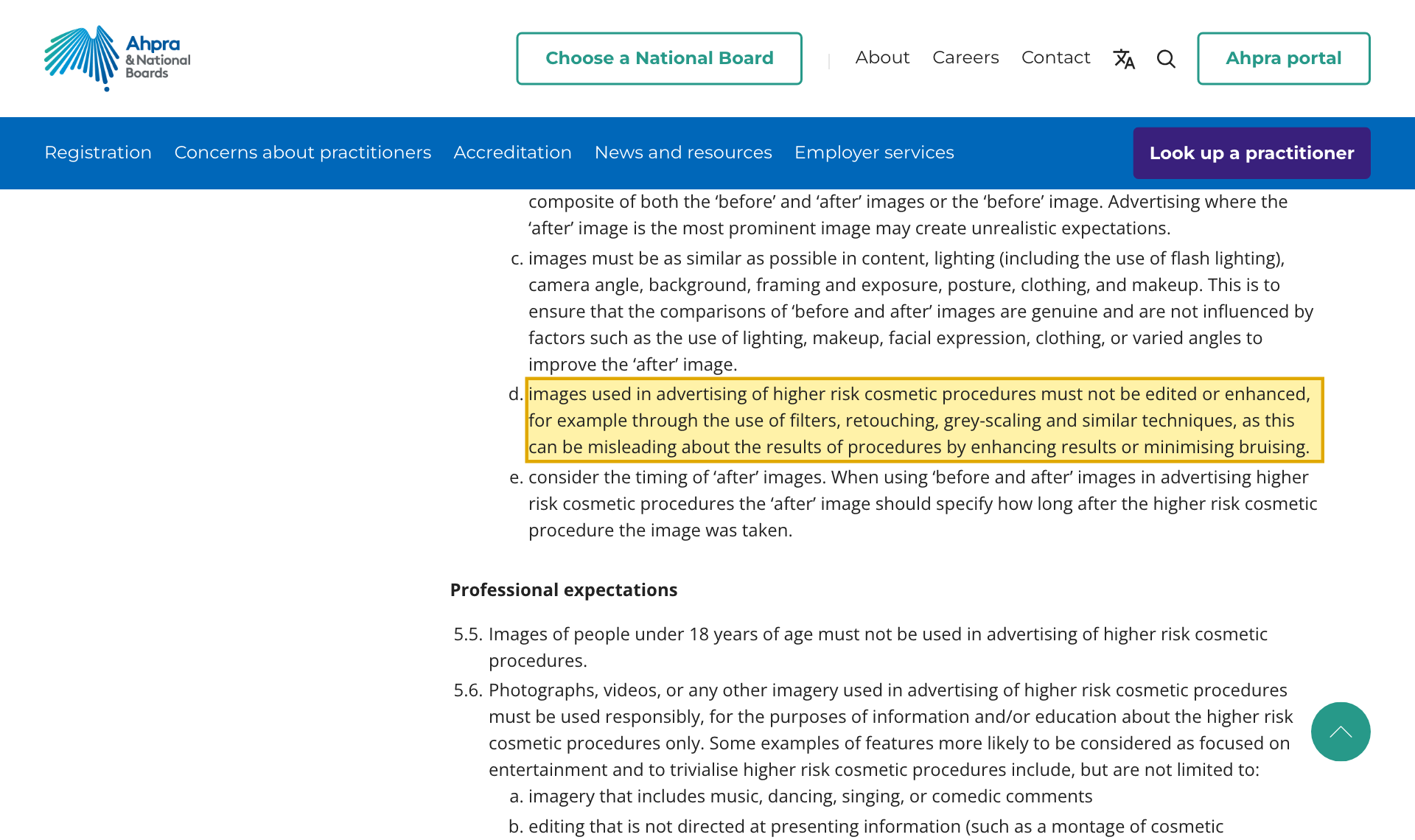
Source: Ahpra, advertising higher risk cosmetic procedures, screenshot taken 25 November 2026.
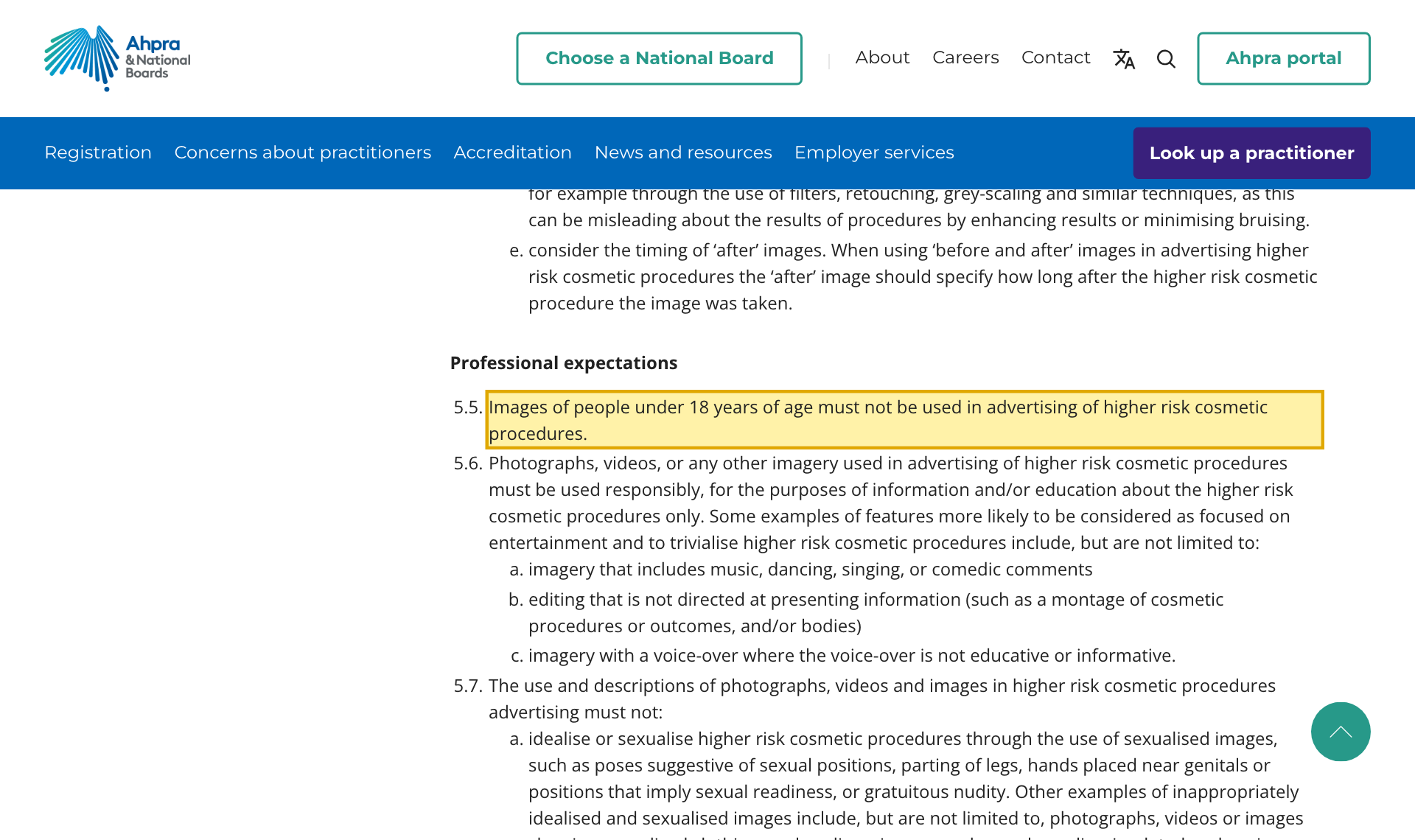
Source: Ahpra, advertising higher risk cosmetic procedures, screenshot taken 25 November 2026.
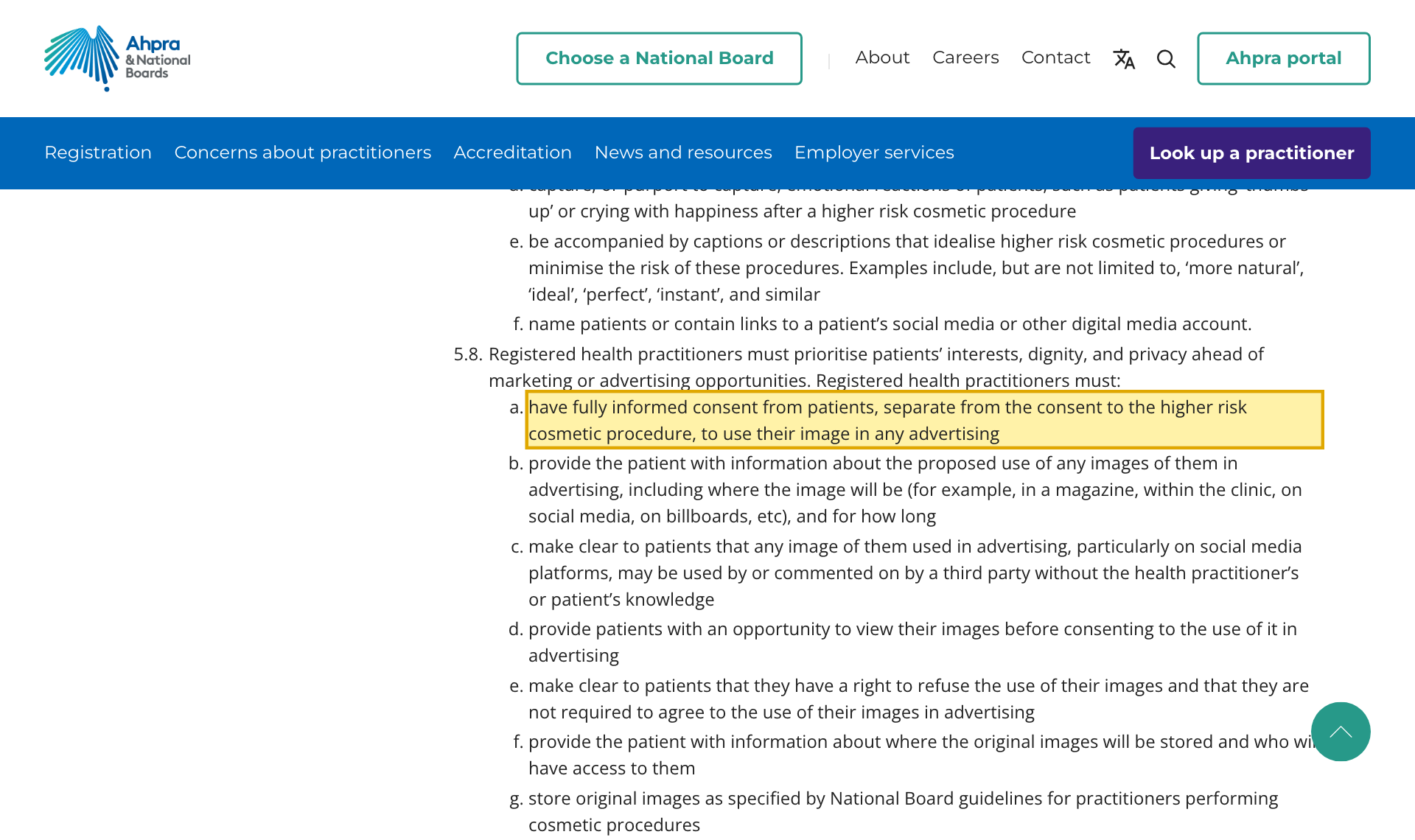
Source: Ahpra, advertising higher risk cosmetic procedures, screenshot taken 25 November 2026.
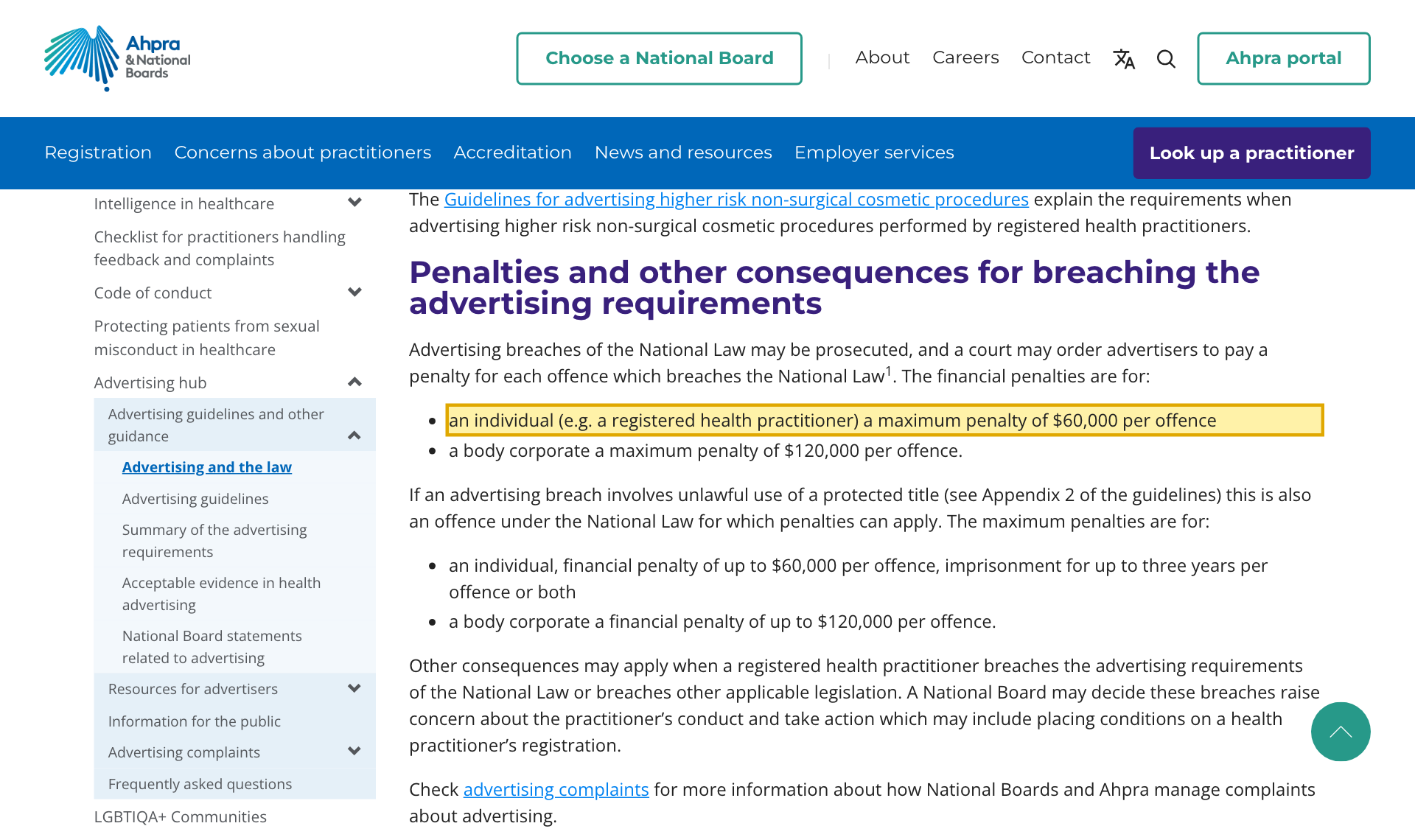
Source: Ahpra, Advertising and the law, screenshot taken 25 November 2026.
Sources and References
- Ahpra, Cosmetic procedure advertising guidelines: Guidelines for advertising higher risk non-surgical cosmetic procedures, viewed 25 November 2026
- Ahpra, Advertising and the law, viewed 25 November 2026
- Ahpra, Advertising guidelines, viewed 25 November 2026
- Aesthetic Medical Practitioner, Ahpra: New cosmetic guidelines to ‘futureproof’ system, 2 July 2025, viewed 25 November 2026
Vikas Thakur
Founder, Perth. 16 years of experience from working at TPG, iiNet and Monadelphous, now helping Australian clinics keep their websites, ads and online presence AHPRA compliant.