$120,000 Ahpra Penalty: What a Compliance Audit Covers
Ahpra’s maximum penalty for an advertising offence is $60,000 for an individual and $120,000 for a body corporate, per offence. This guide sets out what a compliance audit covers channel by channel, and what drives its cost.
 Vikas Thakur Founder, Perth Updated Nov 23, 2026 7 min read Fact checked
Key takeaways
- Ahpra’s guidelines state a maximum penalty of $60,000 per offence for an individual and $120,000 per offence for a body corporate
- Ahpra says these increased penalties apply in all jurisdictions, including Western Australia, from July 2024
- Ahpra describes itself as a risk-based regulator, so action escalates with the risk to the public
- An audit covers five channels: website, social media, paid ads, Google Business Profile and email
- Audit cost depends on how many pages, posts, campaigns and templates carry advertising. We have not published a price list because we found no public benchmark we could cite.
- Ongoing review of new content is cheaper than a one-off clean-up of years of old content
Cosmetic clinic owners often think about Ahpra compliance as a cost centre. The penalty case is the obvious one. The less obvious case is that compliant marketing keeps working when a rule is enforced or a complaint arrives.
This guide explains what the penalty exposure is, what a full audit covers and what makes one audit cost more than another.
The penalty side of the comparison
Ahpra’s advertising guidelines set out the figures. They say that “For an individual, the maximum financial penalty per offence increased from $5,000 to $60,000” and that “for a body corporate the maximum financial penalty per offence increased from $10,000 to $120,000”. They also say: “As of July 2024 these increased penalties now apply in all jurisdictions, including Western Australia.” Ahpra’s advertising guidelines page still carries footnote 3, which gives Western Australia maxima of $30,000 for an individual and $60,000 for a body corporate against the unlawful use of a protected title offence, and the page does not reconcile it with its statement that the higher penalties apply in all jurisdictions, including Western Australia, as of July 2024. Confirm the current position with Ahpra.
These are maximums per offence. They are not a price list and not what a clinic will be fined. Ahpra says it is “a risk-based regulator” that “will only take regulatory action where there is a risk to the public”, and that “Compliance and enforcement action will escalate depending on the ongoing assessment of risk and whether the advertiser is willing to comply.”
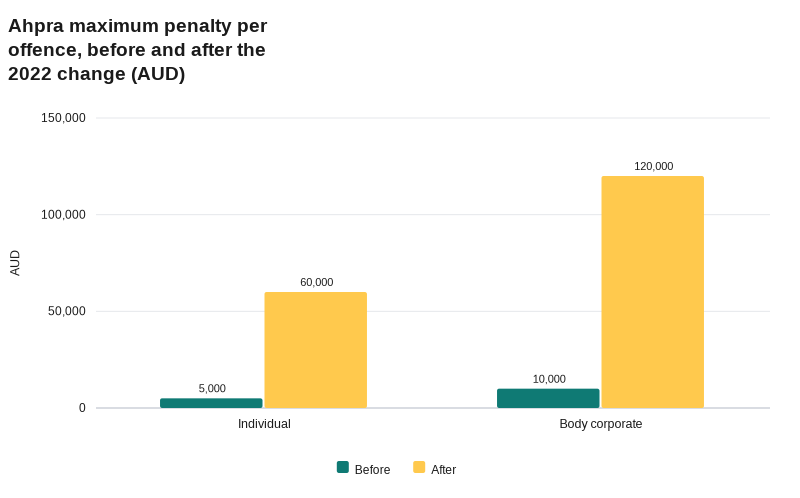
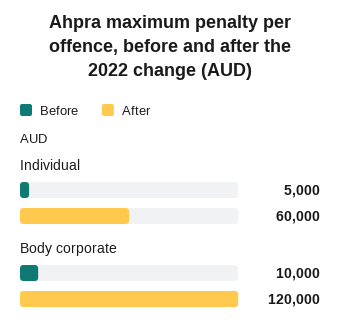
Source: Ahpra, Guidelines for advertising a regulated health service. The guidelines page says the increased penalties apply in all jurisdictions, including Western Australia, as of July 2024.
Because the maximum is per offence, the exposure adds up with the number of offences. This chart is our arithmetic only: $120,000 multiplied by the number of offences. It is a ceiling, not a forecast.
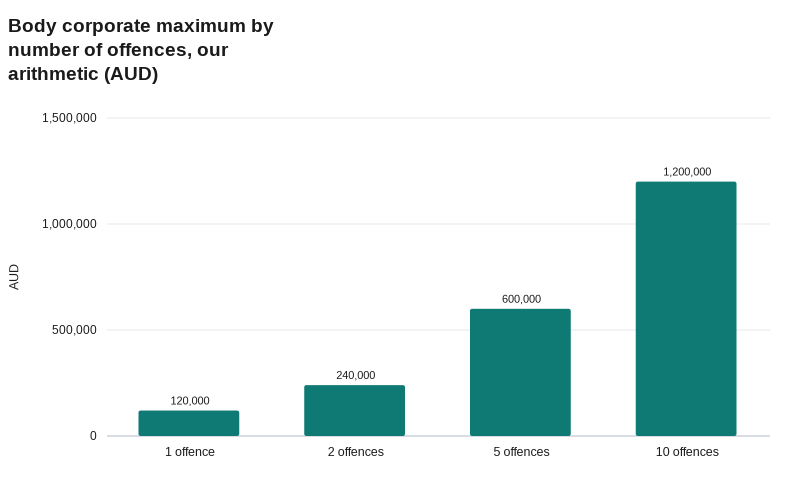
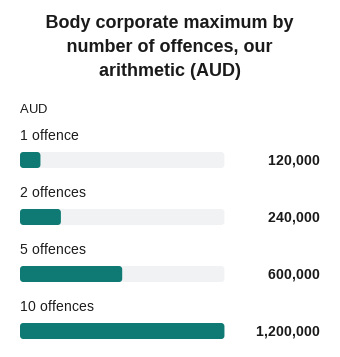
Source: our arithmetic, $120,000 per offence from Ahpra, Guidelines for advertising a regulated health service.
The Cost Components of a Full Compliance Audit
A full audit for a cosmetic clinic covers five channel categories. Cost in each depends on content volume and how complex the fixes are. The testimonial rule is one of the most common checks. Ahpra’s guidelines say the National Law “specifically prohibits advertising a regulated health service in a way that uses testimonials or purported testimonials.”
Website audit
A website audit reviews every page for advertising content: treatment pages, about pages, practitioner bios, blog posts, FAQ content and landing pages. It checks for testimonial blocks, before and after imagery, outcome language, Schedule 4 substance names and urgency language.
Typical output: a spreadsheet listing each breach by page, URL, element type and the rule breached, with a priority rating (high, medium, low) based on visibility and complaint risk.
What drives cost: the number of pages that carry advertising content.
Social media audit
A social media audit reviews existing posts across Instagram, Facebook, TikTok and other active platforms, including archived before and after Stories in Highlights.
Typical output: a list of non-compliant posts with screenshot evidence, breach type, publish date and a recommendation (delete, archive or edit).
What drives cost: how many years of history and how many platforms.
Paid advertising audit
A paid advertising audit reviews current Google Ads, Meta Ads and other campaigns for non-compliant copy in headlines, descriptions, landing pages and creative.
Typical output: an account-level report with each non-compliant element flagged, plus replacement copy.
What drives cost: account size and the number of active campaigns.
Google Business Profile audit
Posts, service listings, business descriptions, Q and A responses and owner replies to reviews all need review. This is often folded into a broader website or social audit.
Email marketing audit
Email templates, active sequences and past campaigns count as advertising if they promote regulated health services. Clinics with established lists and automated sequences have more to review.
What Remediation Involves
Finding breaches is one step. Fixing them is another, and the effort depends on the fix.
| Breach type | Remediation approach | Who does the work |
|---|---|---|
| Social media post containing before and after | Delete or archive the post | Clinic |
| Instagram Highlights with non-compliant content | Delete specific Stories from Highlights | Clinic |
| Website testimonial block | Remove block, replace with practitioner credential section | Designer and copywriter |
| Website outcome language throughout treatment pages | Rewrite treatment pages with compliant copy | Copywriter, scales with page count |
| Google Ads with non-compliant headlines | Rewrite ad copy, update responsive ad assets | Ads specialist |
| URL slugs containing substance names (/botox-perth/) | New compliant URL plus 301 redirect | Developer |
| GBP service listings with substance names | Edit service names in the GBP dashboard | Clinic |
| Email sequences with outcome language | Rewrite sequences | Copywriter, scales with length |
Source: ClinicCode’s own project workflow. No prices are shown because we found no public benchmark to cite.
Ongoing Compliance
Compliance is not a one-time project. New content is published, campaigns change and the guidelines can be revised. Ongoing compliance needs a regular review.
Monthly scope:
- Review new social media content before it is scheduled
- Review new Google Ads or Meta Ads copy before it goes live
- Review new website pages and blog posts
- Review Google Business Profile posts
A clinic can do this in-house with a senior staff member, Ahpra’s advertising guidance and a healthcare lawyer for borderline cases, or outsource it to an Ahpra-aware agency. Ask for a quote based on your own content volume.
Why Compliant Marketing Pays Back
Compliance avoids the penalty exposure. It also gives you a content base you can keep using.
- Educational content can rank. Compliant educational content about treatment categories, Ahpra rules and consultation processes avoids testimonials and outcome claims. That is our view of the safest content to build on, not a sourced finding.
- Compliant ads avoid rework. Rewriting ads after a disapproval or complaint costs time and interrupts campaigns.
- No forced shutdown. A clinic with compliant marketing is less likely to pull every campaign when a complaint arrives or a rule changes.
The Comparison That Matters
The decision is not “audit or no audit”. The decision is whether you find the problems on your timeline or whether a complaint does.
Ahpra says its action escalates with risk and with whether the advertiser is willing to comply. A clinic that fixes a problem promptly is in a different position from one that ignores a notice.
The audit puts the clinic in control of the timeline. A complaint puts Ahpra in control.
Get in Touch About Compliance Fixes
ClinicCode fixes Ahpra advertising compliance for cosmetic clinics. Book a call and we will go through the highest-priority risks on your website and top-level social media presence and scope the fixes from there.
Related reading:
- AHPRA Advertising Fines Australia: penalties and how exposure accumulates
- AHPRA Compliance Audit Checklist: what a self-conducted audit covers
- AHPRA Social Media Rules for Cosmetic Clinics: social media audit scope
- AHPRA Treatment Naming on Your Clinic Website: website naming audit detail
- Cosmetic Clinic Marketing Australia: the marketing strategy that runs after compliance is established
- The Complete AHPRA Advertising Guidelines for Cosmetic Clinics: the regulatory framework underpinning all audit work
Vikas Thakur
Founder, Perth. 16 years of experience from working at TPG, iiNet and Monadelphous, now helping Australian clinics keep their websites, ads and online presence AHPRA compliant.