Skin Cancer Clinic Ads Face the Same $120K AHPRA Penalty Cap
Section 133 of the National Law sets the same $60,000 and $120,000 maximum penalties for a skin cancer clinic’s advertising as for a cosmetic clinic’s. Skin cancer diagnosis is not named in Ahpra’s September 2025 cosmetic guidelines, so the general testimonial and before/after rules apply.
 Vikas Thakur Founder, Perth 11 min read Fact checked
Key takeaways
- Under section 133 of the National Law, the maximum penalty for advertising that uses testimonials or creates an unreasonable expectation of beneficial treatment is $60,000 for an individual and $120,000 for a body corporate
- Taking or using a protected title without registration (sections 113 and 115) is a separate offence with the same dollar maxima, plus up to three years imprisonment (or both) for an individual
- Ahpra’s advertising guidelines page still carries footnote 3, which gives Western Australia maxima of $30,000 for an individual and $60,000 for a body corporate against the unlawful use of a protected title offence, and the page does not reconcile it with its statement that the higher penalties apply in all jurisdictions, including Western Australia, as of July 2024.
- Ahpra’s cosmetic procedure advertising guidelines, issued 2 September 2025, apply to higher risk non-surgical cosmetic procedures. The page does not mention skin cancer
- The testimonial prohibition in section 133(1)(c) applies to advertising any regulated health service, skin cancer clinics included
- Ahpra says advertisers are not responsible for removing testimonials on third-party platforms they do not control, but engaging with them may count as using a testimonial
$120,000. That is the maximum penalty in the Act for advertising that uses testimonials or creates an unreasonable expectation of beneficial treatment, where the advertiser is a body corporate. It applies to a skin cancer clinic as it does to a cosmetic clinic. Section 133 of the National Law sets it at $60,000 for an individual and $120,000 for a body corporate. A separate offence, taking or using a protected title without registration, carries the same dollar maxima plus up to three years imprisonment for an individual. Ahpra’s September 2025 cosmetic guidelines do not mention skin cancer, so in our view the general advertising rules are the ones to build a skin cancer clinic’s website around. This guide sets out which rules bind that website, which may not, and what the penalty maximums are.
The $120,000 Maximum Applies to a Skin Cancer Clinic Too
Section 133 of the Health Practitioner Regulation National Law, current as at 10 April 2026 in the Queensland legislation text, lists a maximum penalty of “$60,000” for an individual and “$120,000” for a body corporate. Ahpra’s advertising guidelines page gives the same figures per offence and says: “In 2022, the National Law was amended and one of the changes was to increase the maximum penalty for advertising offences.” It adds that “As of July 2024 these increased penalties now apply in all jurisdictions, including Western Australia.” The $30,000 and $60,000 figures in footnote 3 on that page are listed against the protected-title offence, and the page does not reconcile them with the advertising maximums.
Section 133(1) covers advertising that is false or misleading, offers an inducement without terms and conditions, uses testimonials, creates an unreasonable expectation of beneficial treatment, or encourages indiscriminate or unnecessary use of regulated health services. A separate offence is taking or using a protected title, such as a specialist title, without the registration the National Law requires (sections 113 and 115). The Act sets the same $60,000 and $120,000 maximums for it and adds three years imprisonment for an individual. That imprisonment option is not part of the section 133 penalty.
| Offence | Individual maximum | Body corporate maximum |
|---|---|---|
| Advertising offences (s133) | $60,000 | $120,000 |
| Protected title (ss113 and 115) | $60,000 or 3 years imprisonment, or both | $120,000 |
Source: Health Practitioner Regulation National Law Act 2009 (Qld), current as at 10 April 2026, seen 24 November 2026. Figures are the maximum penalty in AUD per the Act text.
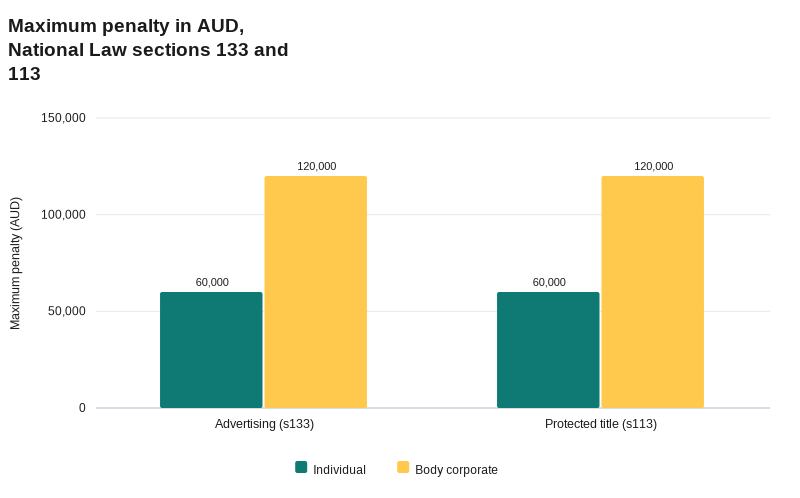
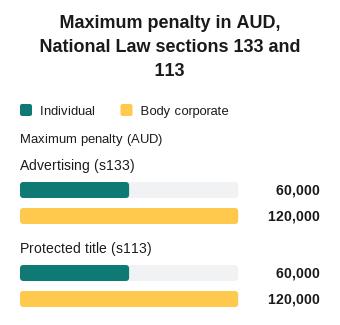
Source: Health Practitioner Regulation National Law Act 2009 (Qld), seen 24 November 2026. Maximum monetary penalty in AUD; the protected-title offence also carries up to 3 years imprisonment for an individual, which the chart does not show.
Takeaway: The Act’s dollar maximum for an advertising offence is the same for a skin cancer clinic as for a cosmetic clinic. Whether a given page would reach the maximum is a matter for a court, not a figure we can predict.
Does the September 2025 Cosmetic Crackdown Even Cover Skin Cancer Clinics?
Ahpra’s Guidelines for advertising higher risk non-surgical cosmetic procedures show a date of issue of 2 September 2025. They define these procedures as “non-surgical procedures undertaken to revise or change the appearance, colour, texture, structure or position of bodily features with the dominant purpose of achieving what the patient perceives to be a more desirable appearance”. The page’s examples include dental veneers, cosmetic injectables such as botulinum toxin and dermal fillers, injection lipolysis, thread lifts, sclerotherapy and microsclerotherapy, platelet rich plasma procedures and hair transplants. Those are Ahpra’s own terms for the guidelines, not names for a clinic to use in its advertising.
The page does not mention skin cancer. In our view, a skin check, biopsy or lesion excision is done to identify or remove disease, not to achieve a more desirable appearance, so the dominant purpose test does not look aimed at it. That is our reading, not an Ahpra statement. The practical risk sits with a mixed menu: a mole check for diagnosis is a different service from a cosmetic pigmentation or scar treatment sold at the same appointment.
ClinicCode can check a clinic’s full treatment menu against both guideline sets and flag which page falls under which rulebook.
Takeaway: Skin cancer diagnosis and treatment is not named in the September 2025 cosmetic guidelines, but any cosmetic service sold alongside it should be checked against them.
What the General Advertising Rules Still Ban
Section 133 applies to advertising any regulated health service, defined in the Act as a service provided by, or usually provided by, a health practitioner. A clinic offering skin checks falls inside that wording whether or not the cosmetic guidelines apply to it.
The testimonial prohibition in section 133(1)(c) applies. Ahpra’s advertising guidelines say a clinical aspect exists where a testimonial expresses a symptom or reason for seeking treatment, a diagnosis or treatment, or an outcome or the practitioner’s skills. “The mole check picked up something my last three doctors missed” expresses an outcome, so it is the kind of statement that would be a testimonial in a skin cancer clinic’s advertising. Comments about customer service or communication style that do not refer to clinical aspects are not considered testimonials.
Ahpra says advertisers are “not responsible for removing (or trying to have removed) testimonials published on platforms they do not control”, but a provider “should take care if they choose to engage with reviews on a third-party site as this may be considered using a testimonial to advertise a regulated health service”.
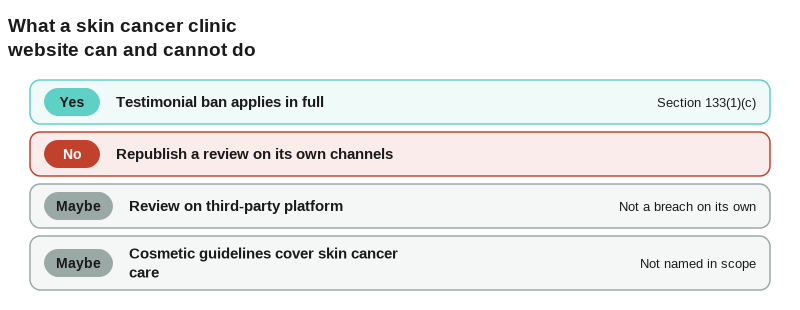
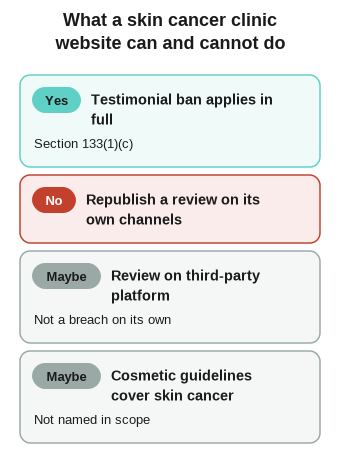
Source: our summary of the Ahpra advertising guidelines and the cosmetic procedure guidelines, seen 24 November 2026; the “Maybe” labels are our reading, not Ahpra’s.
On before and after images, the general guidelines list advertising that may breach section 133 where it is not clear how the advertised treatment caused the benefit shown, or the images are not genuine or have been edited or enhanced. They say these images are less likely to be misleading if they are as similar as possible in content, camera angle, background, framing and exposure, and if there is an explanation when images have been altered. On wording, they say that using words such as “safe”, “effective”, “risk-free” or “pain-free” without acknowledging possible adverse reactions may create an unreasonable expectation of beneficial treatment.
| Topic | Cosmetic procedure guidelines (Sept 2025) | General advertising guidelines and s133 |
|---|---|---|
| Skin cancer diagnosis or treatment | Not mentioned on the page | Applies to any regulated health service |
| Testimonials | Must not be used | Prohibited by s133(1)(c) |
Source: Ahpra cosmetic procedure advertising guidelines and Ahpra advertising guidelines, seen 24 November 2026. Qualitative comparison, no figures.
Takeaway: The testimonial prohibition, the before/after image cautions and the $60,000/$120,000 maximums sit in the general rules, which apply to a skin cancer clinic’s website whether or not the September 2025 cosmetic guidelines do.
Why Accuracy Matters Here
The Australian Bureau of Statistics reports 1,582 deaths from melanoma and other malignant neoplasms of skin (ICD-10 C43-C44) among Australian males in 2025, out of 98,762 male deaths from all causes. Our arithmetic: 1,582 divided by 98,762 is about 1.6%. The ABS marks 2025 causes of death data as preliminary and subject to revision. This guide reports the male figure from the ABS male table and does not estimate a combined total for both sexes.
Source: ABS, Causes of Death, Australia, 2025, “Top 20 leading causes of death, males” table, released 27 October 2026, seen 24 November 2026. Counts of male deaths registered in 2025.
Takeaway: Skin cancer is a serious health topic, which is a reason for a clinic’s website to stick to accurate, testimonial-free information.
What This Means for Your Clinic’s Website
With testimonials and outcome claims off the table, in our view the pages that earn their place explain the service: what a full skin check involves, how a dermatoscope differs from a naked eye check, what happens if a lesion is flagged, and how a clinic decides when a check should repeat. Practitioner credentials, registration and training are statements of fact about the practitioner rather than testimonials, though they must still be accurate and not misleading.
ClinicCode builds AHPRA-compliant clinic websites around this structure: education-first treatment pages, credential-led practitioner profiles, and a booking flow built around clear information rather than outcome claims.
Takeaway: Under these rules, pages that explain the service are safer than pages that promise the outcome.
The Source Pages
Screenshots of the pages cited in this post, taken on 24 November 2026 and framed on the passage each one supports.
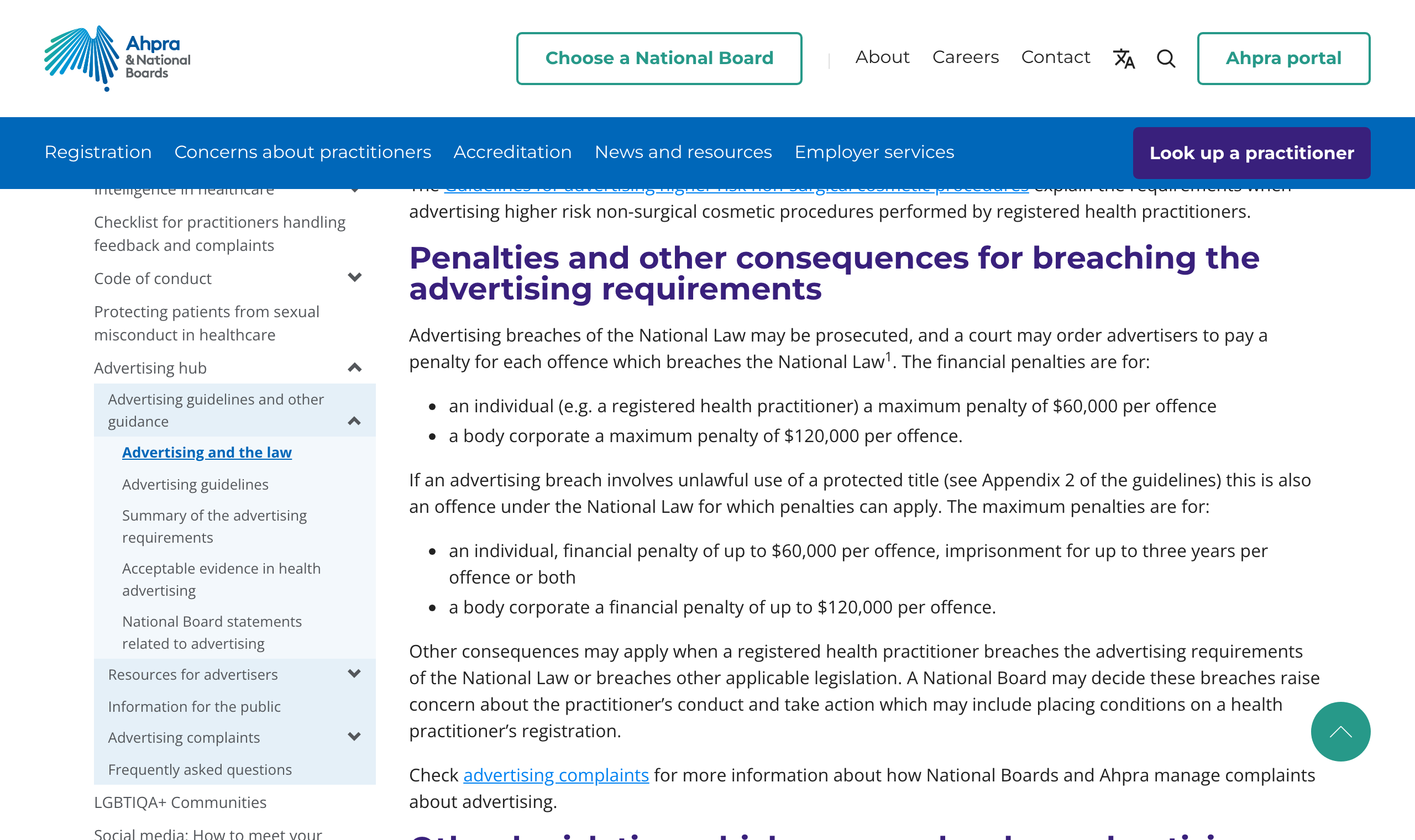
Source: Ahpra, Advertising and the law, screenshot taken 24 November 2026.
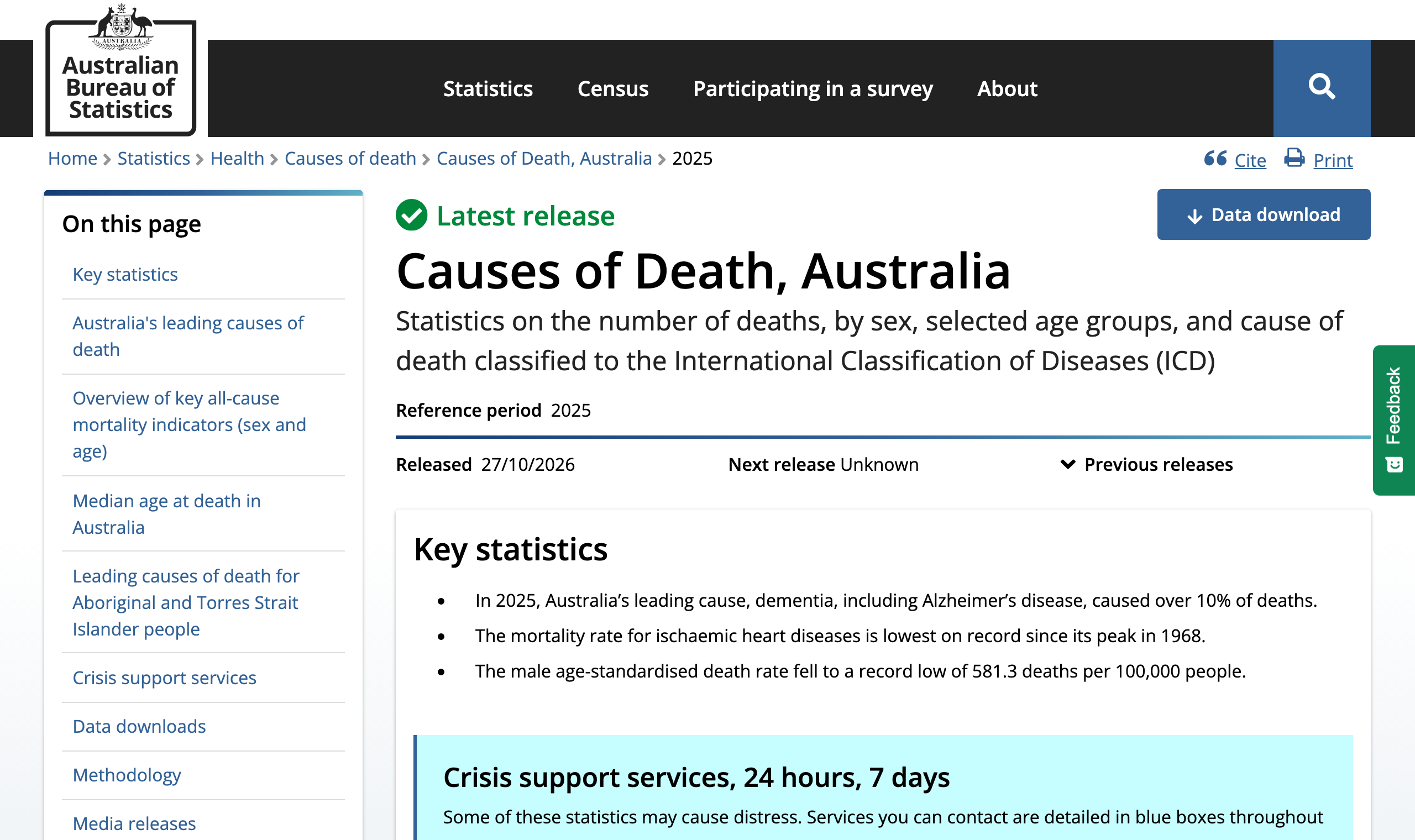
Source: ABS, Causes of Death, Australia, 2025, screenshot taken 24 November 2026.
FAQ
Does Ahpra’s September 2025 cosmetic procedure advertising guidelines apply to skin cancer treatment?
The guidelines apply to higher risk non-surgical cosmetic procedures, which they define by their dominant purpose, achieving what the patient perceives to be a more desirable appearance. Named examples include botulinum toxin and dermal fillers, thread lifts and sclerotherapy. The guidelines page does not mention skin cancer. In our view, diagnosing or removing a skin cancer is not done for that purpose, so the general advertising guidelines are the safer starting point. A clinic that also sells cosmetic treatments should treat that service line separately.
What is the actual maximum Ahpra fine for a standard advertising breach?
Section 133 of the Health Practitioner Regulation National Law sets the maximum penalty for advertising that, for example, uses testimonials or creates an unreasonable expectation of beneficial treatment at $60,000 for an individual and $120,000 for a body corporate. Ahpra’s advertising guidelines page gives the same maxima per offence and says the higher penalties apply in all jurisdictions, including Western Australia, from July 2024. The $30,000 and $60,000 figures in footnote 3 on that page are listed against the protected-title offence, not ordinary advertising offences, and the page does not reconcile the two.
Is the $60,000 to $120,000 penalty figure the same for a protected-title offence?
The dollar maxima match. Taking or using a protected title or a specialist title without being registered, under sections 113 and 115 of the National Law, carries up to $60,000 or three years imprisonment (or both) for an individual and up to $120,000 for a body corporate. Section 133 advertising offences list only the dollar maxima in the Act text, with no imprisonment.
Can a skin cancer clinic display patient reviews or testimonials on its website?
Not if they refer to a clinical aspect, meaning a symptom, a diagnosis or treatment, or an outcome. Section 133(1)(c) prohibits testimonials in advertising a regulated health service, not only a cosmetic one. Ahpra says advertisers are not responsible for removing testimonials on platforms they do not control, but that engaging with reviews on a third-party site may be considered using a testimonial to advertise.
Get Your Skin Clinic’s Website Checked Against Both Rulebooks
ClinicCode fixes skin cancer and skin clinic websites against both AHPRA guideline sets.
Sources and References
Queensland Legislation - Health Practitioner Regulation National Law Act 2009, current as at 10 April 2026: section 133 (advertising, $60,000/$120,000 maximum penalty) and sections 113 and 115 (protected and specialist titles, same maximum plus imprisonment for an individual)
Ahpra, Guidelines for advertising a regulated health service (date of issue 14 December 2020): penalties, testimonials, before/after images, unreasonable expectation of benefit
Ahpra, Guidelines for advertising higher risk non-surgical cosmetic procedures (date of issue 2 September 2025): dominant purpose definition and examples
Australian Bureau of Statistics, Causes of Death, Australia, 2025 (released 27 October 2026): male deaths from melanoma and other malignant neoplasms of skin
Related reading:
- AHPRA Binds 16 Professions: GP and Skin Clinic Ad Rules
- Before and After Photos: AHPRA Rules
- AHPRA Testimonial Rules
For a website built around what AHPRA’s rules actually allow you to say, see clinic website design or talk to us about your clinic’s marketing.
Vikas Thakur
Founder, Perth. 16 years of experience from working at TPG, iiNet and Monadelphous, now helping Australian clinics keep their websites, ads and online presence AHPRA compliant.