AHPRA Advertising Complaint: What to Do First on Your Website
Ahpra says most advertising complaints start with a letter and 30 days to correct the content, not an overnight takedown. Here is the process Ahpra describes, what to check on the build, and the one section 133 prosecution we found.
 Vikas Thakur Founder, Perth 14 min read Fact checked
Imagine it is a Tuesday morning and an email from Ahpra lands in the practice manager’s inbox. It names your website and says the advertising breaches the National Law. Ahpra’s own page says most cases start this way: a letter requiring the advertiser to correct the advertising within 30 days. Knowing the process before it happens is the difference between a quiet CMS edit and a much longer problem.
Ahpra says most advertising complaints about a clinic or dental practice start with a letter and a 30-day correction window, not an instant fine. Below: what Ahpra’s own pages say about the process, what we would check on your build, and the one section 133 prosecution we found reported.
Key takeaways
- Ahpra says “most cases start with us writing to the advertiser to let them know their advertising breaches the National Law, and require them to correct it within 30 days” (How we manage advertising complaints).
- Ahpra says that in most cases, if the advertiser corrects their advertising, it closes the matter.
- Ahpra gives maximum penalties of $60,000 per offence for an individual and $120,000 per offence for a body corporate (Advertising and the law). Ahpra’s advertising guidelines page still carries footnote 3, which gives Western Australia maxima of $30,000 for an individual and $60,000 for a body corporate against the unlawful use of a protected title offence, and the page does not reconcile it with its statement that the higher penalties apply in all jurisdictions, including Western Australia, as of July 2024.
- Ahpra investigated about 360 notifications about non-surgical cosmetic procedures between September 2022 and March 2025, with about 300 closed (Ahpra’s 3 June 2025 announcement).
- Ahpra’s advertising guidelines for higher risk non-surgical cosmetic procedures carry a date of issue of 2 September 2025. Medical practitioners also have the Medical Board of Australia’s cosmetic guidelines, issued 1 July 2023.
- A chiropractor, Hance Limboro, was fined $29,500 in 2017 after pleading guilty to 13 unlawful advertising charges (Medical Republic, 17 February 2017).
What AHPRA says happens after a complaint
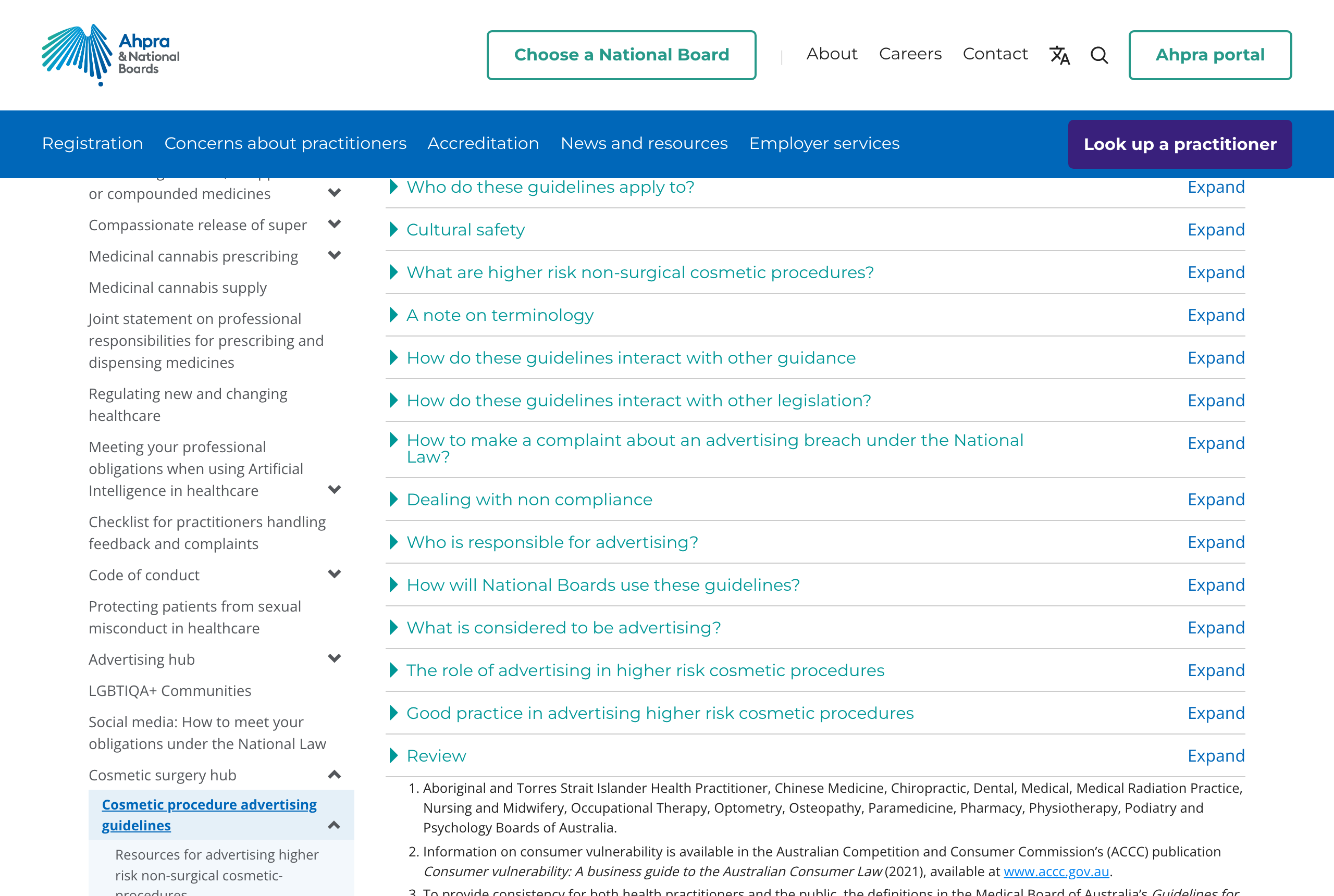
The advertising guidelines page above has an expandable section headed “How to make a complaint about an advertising breach under the National Law?” and another headed “Dealing with non compliance”. It says the Boards and Ahpra can deal with inappropriate advertising through “Board disciplinary processes” and by “prosecuting those who breach the advertising provisions in the National Law, via the court system, when prosecution guidelines are met” (Ahpra cosmetic procedure advertising guidelines).
Ahpra’s page on how it manages advertising complaints sets out three steps. It reviews the advertising, assesses the risk, then takes action. It takes “a risk-based approach to advertising compliance and enforcement”, and “all advertising breaches are managed on a case by case basis”.
Ahpra’s advertising compliance and enforcement strategy describes how that risk assessment sorts matters:
- Lower risk. Ahpra writes to the advertiser to say the advertising is non-compliant, provides resources, and sets a timeframe. On its complaints page, Ahpra says most cases require correction within 30 days.
- Medium risk or repeated non-compliance. Where a practitioner has not corrected their advertising or has a history of non-compliant advertising, “the practitioner will receive a show cause letter proposing to impose conditions on their registration restricting the practitioner’s ability to advertise their services”, with a further timeframe to amend the advertising.
- High risk. The strategy says “certain high-risk matters will be identified as suitable for prosecution or disciplinary action from the outset”. It also says continued non-compliance after conditions are imposed “may result in referral to a tribunal”.
Ahpra also says that as part of the risk assessment it considers previous complaints about the advertiser. It says a complaint of interest to another regulator, such as the Therapeutic Goods Administration or the Australian Competition and Consumer Commission, may be referred to that regulator.
Two sets of cosmetic guidelines sit alongside this. Ahpra’s advertising guidelines for higher risk non-surgical cosmetic procedures carry a date of issue of 2 September 2025 and list dental veneers among their examples of higher risk cosmetic procedures. They also say that “the definitions in the Medical Board of Australia’s Guidelines for registered medical practitioners who advertise cosmetic surgery have informed these guidelines”. The page lists separate guidelines for registered health practitioners who perform non-surgical cosmetic procedures “(except for medical practitioners)”, and medical practitioners have the Medical Board of Australia’s Guidelines for registered medical practitioners who perform cosmetic surgery and procedures, with a date of issue of 1 July 2023. If your practice is run by a cosmetic physician or surgeon rather than a nurse or dentist, check which document applies to the person named on your registration.
Takeaway: On Ahpra’s own description, a breach letter starts a correction deadline, and the first deadline is the one to protect.
What that means for your website build
Ahpra’s pages do not say how specific a breach letter will be about the exact page, line or embed. In our view, plan for someone on your team to translate a plain-English description into a technical fix, inside the window, in a way that stays fixed. Ahpra’s strategy says it will advise “how and whether compliance will be checked, such as an audit”, so assume the fix may be checked.
A few build-specific points, all in our view:
- Keep evidence before you edit. Commit or export the live version first, then edit in place, so your CMS revision history shows when the fix went live.
- Audit every third-party embed, not just your own copy. Review widgets and auto-pulled social feeds can bring back content you removed. Ahpra lists “uses testimonials or purported testimonials” among the section 133 offences, so a live feed that republishes testimonials is a risk.
- Check captions and alt text as well as body copy. They are text on your site, and a quick visual scan misses them.
- If a page comes down, take it down cleanly. A 410 Gone response and removal from
sitemap.xmlis tidier than a silent 404 or an unlinked page that is still live. - Document the fix with dated screenshots. Removing content from your site does not remove copies held by others, such as search engine caches or web archives.
- Check the booking flow for higher risk procedures. The advertising guidelines say advertising of higher risk cosmetic procedures “must not be targeted or directed at people under the age of 18 years”, and that images of people under 18 must not be used.
Takeaway: In our view, the fix has to be live and dated, not just drafted.
The complaint escalation ladder
| Risk tier | What Ahpra says it sends | Correction window | What changes in your build (our view) | If not corrected |
|---|---|---|---|---|
| Lower risk | Letter naming the breach, with education resources | 30 days in most cases | Edit the flagged claim, testimonial or caption; check related pages for the same issue | For a registered practitioner, Ahpra may propose conditions on registration which prohibit advertising |
| Medium risk or repeated non-compliance | Show cause letter proposing advertising conditions | A further stated timeframe | Audit every URL, embed and social feed linked from the site | Conditions imposed; continued non-compliance may lead to referral to a tribunal |
| High risk | Prosecution or disciplinary action may be identified from the outset | Not stated | Get legal advice and preserve evidence; this is not a CMS edit | Court or disciplinary outcome |
Source: Ahpra, Advertising compliance and enforcement strategy and How we manage advertising complaints, seen 25 November 2026. The “What changes in your build” column is our view.
Where a breach can come back
These are two patterns we would check for, described in general terms. They are not real clinics.
Cosmetic clinic. A homepage social feed or gallery that republishes client posts. If a post includes a testimonial or a results claim, the site can carry it again after you remove it. In our view, a static, pre-approved image set removes that risk.
Cosmetic dentistry. A reviews widget on a veneer page. Ahpra’s guidelines name “dental veneers” as an example of a higher risk cosmetic procedure, and section 133 lists testimonials among the offences. In our view, a widget that renders reviews unfiltered is the part to check first.
Takeaway: In our view, finding every place a breaching pattern can silently reappear is harder than the edit itself.
What to check on your own site before day 30
- Every third-party review or testimonial widget, for testimonials and results language
- Before-and-after gallery captions and image alt text, not just visible headings
- Any influencer or user-generated content embedded or linked
- Booking widget copy and imagery for higher risk procedures, against the under-18 rules above
- Your site’s search cache and web archive copies, which you cannot remove by deleting a page
- CMS version history or git commits enabled, so a fix has a provable date
- Sitemap and status codes for any page pulled down: a 410, not a silent 404 or an orphaned live page
- Which guideline applies to your registration: Ahpra’s cosmetic guidelines for your profession, or the Medical Board’s 2023 guidelines for medical practitioners
Between September 2022 and March 2025, Ahpra says it investigated about 360 notifications related to non-surgical cosmetic procedures, with about 300 of these closed. It also says over 1500 calls have been made to its cosmetic surgery hotline. Ahpra says complaints about these procedures can lead to “cautions, conditions imposed on registration or an undertaking from the practitioner”. The complaints covered medical practitioners, nurses, midwives, dentists, psychologists and Chinese medicine practitioners.
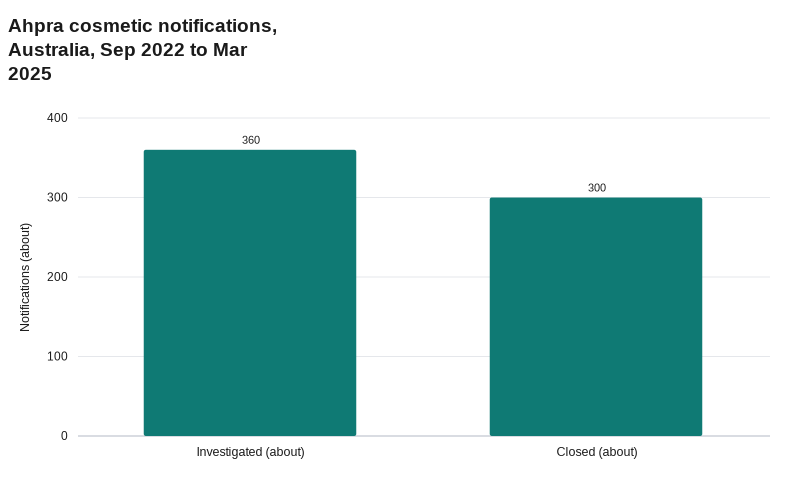
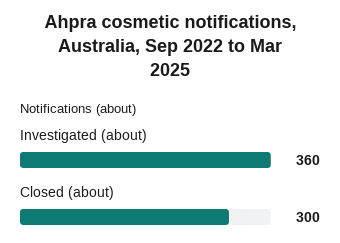
Source: Ahpra, Booming billion-dollar cosmetic industry on notice with new cosmetic procedures guidelines, 3 June 2025, seen 25 November 2026. Figures are Ahpra’s rounded “about” numbers for non-surgical cosmetic procedure notifications nationally.
Takeaway: The figures show that most investigated notifications in that period had closed, but Ahpra’s page does not say how they closed.
Does AHPRA enforce this?
Ahpra’s Advertising and the law page says section 133 of the National Law makes it an offence to advertise a regulated health service in a way that is false, misleading or deceptive, that offers an inducement without stating the terms and conditions, that uses testimonials or purported testimonials, that creates an unreasonable expectation of beneficial treatment, or that directly or indirectly encourages the indiscriminate or unnecessary use of regulated health services.
The same page gives maximum penalties of $60,000 per offence for an individual and $120,000 per offence for a body corporate. Ahpra’s advertising guidelines page still carries footnote 3, which gives Western Australia maxima of $30,000 for an individual and $60,000 for a body corporate against the unlawful use of a protected title offence, and the page does not reconcile it with its statement that the higher penalties apply in all jurisdictions, including Western Australia, as of July 2024. Older commentary quotes lower amounts: a 2017 Hall & Wilcox article gave $5,000 for an individual and $10,000 for a body corporate. Ahpra’s page says the 2022 amendment raised them from $5,000 to $60,000 and from $10,000 to $120,000.
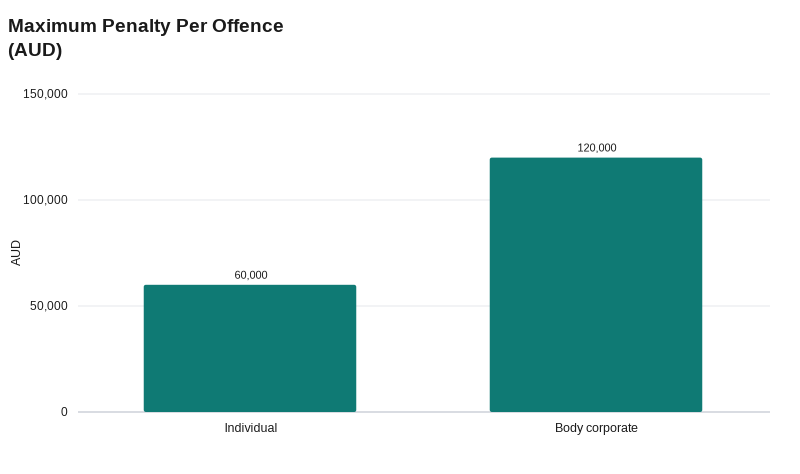
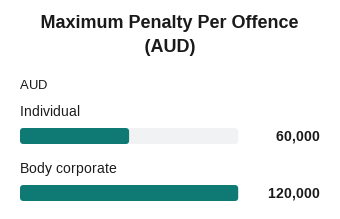
Source: Ahpra, Advertising and the law, seen 25 November 2026. Maximum penalty per offence, Australia.
Medical Republic reported in February 2017 that New South Wales chiropractor Hance Limboro pleaded guilty to 13 charges of unlawful advertising in the Downing Centre local court in Sydney and was fined $29,500. The report says the charges involved advertisements that claimed chiropractic treatment as a cancer cure, and that he was fined for using testimonials. Hall & Wilcox adds that he was ordered to pay Ahpra’s legal costs. Ahpra had brought the charges.
This is not a cosmetic clinic case, and it predates the 2025 guidelines and the 2022 penalty increase, so it cannot tell you how a modern cosmetic breach would be penalised. It shows that Ahpra has prosecuted section 133 offences to a conviction. We did not find a publicly reported section 133 prosecution specific to cosmetic clinic or dental advertising since September 2025, and we are not implying one exists.
Takeaway: The law has been used in court at least once, and Ahpra’s own page says it can be prosecuted. Whether your content is a breach is a question for a lawyer, not a CMS filter.
Where this gets hard
Ahpra says all advertising breaches are managed case by case, so the 30-day window described above is where “most cases start”, not a guaranteed ceiling for every case. The pages we reviewed give no total time for a complaint.
Whether a specific five-star review counts as a section 133 testimonial is a judgement call for Ahpra and, eventually, a court or tribunal. In our view, no CMS filter or lint rule fully automates that call. Whether your specific website content, review widget or booking flow breaches section 133 is a question for your medical defence organisation or your lawyer, not a web development team working from a blog post.
Status
Ahpra’s announcement of 3 June 2025 said its cosmetic guidelines would “come into effect on 2 September 2025”, and its advertising guidelines page carries a date of issue of 2 September 2025. The penalty figures above are as stated on Ahpra’s pages seen on 25 November 2026. This is not legal advice.
Frequently Asked Questions
How long does an Ahpra advertising complaint take?
Ahpra says advertising breaches are managed case by case. Most cases start with a letter that requires the advertiser to correct the advertising within 30 days, and in most cases Ahpra closes the matter if the advertiser corrects it. The pages we reviewed do not give a total time for a complaint.
Do I need to take my clinic website offline after an AHPRA advertising complaint?
Ahpra’s page says most cases start with a letter requiring the advertiser to correct the advertising within 30 days. It does not say the whole website must come down. Whether taking content down is the right call for your situation is a question for your lawyer or medical defence organisation.
What is the maximum fine for breaching AHPRA’s advertising rules?
Ahpra’s advertising pages give a maximum of $60,000 per offence for an individual and $120,000 per offence for a body corporate. Ahpra’s advertising guidelines page still carries footnote 3, which gives Western Australia maxima of $30,000 for an individual and $60,000 for a body corporate against the unlawful use of a protected title offence, and the page does not reconcile it with its statement that the higher penalties apply in all jurisdictions, including Western Australia, as of July 2024.
Need a hand with your website?
If you want a second pair of eyes on how this applies to your own site, request a callback and we will talk it through.
The Source Pages
Screenshots of the pages cited in this post, taken on 25 November 2026 and framed on the passage each one supports.
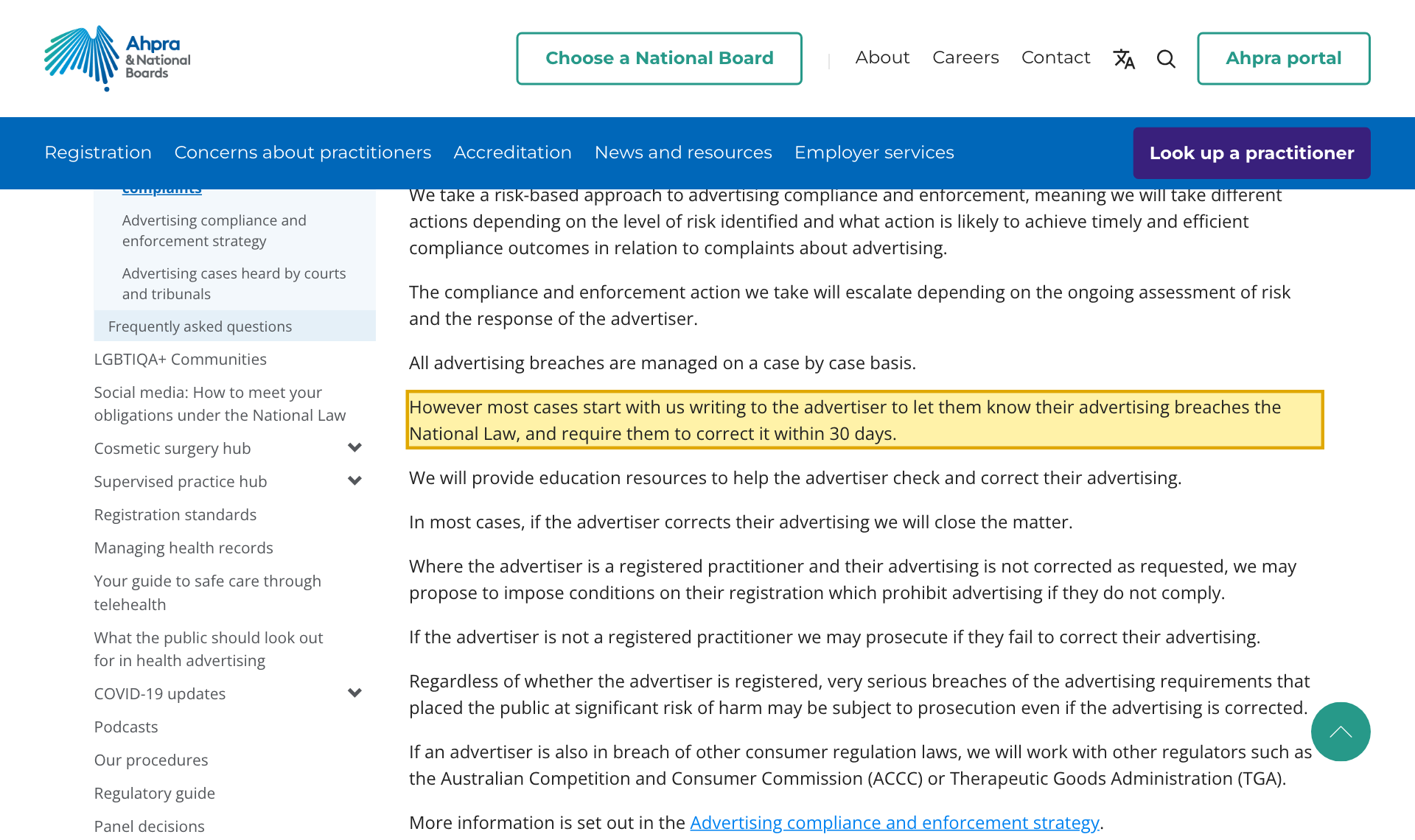
Source: Ahpra, How we manage advertising complaints, screenshot taken 25 November 2026.
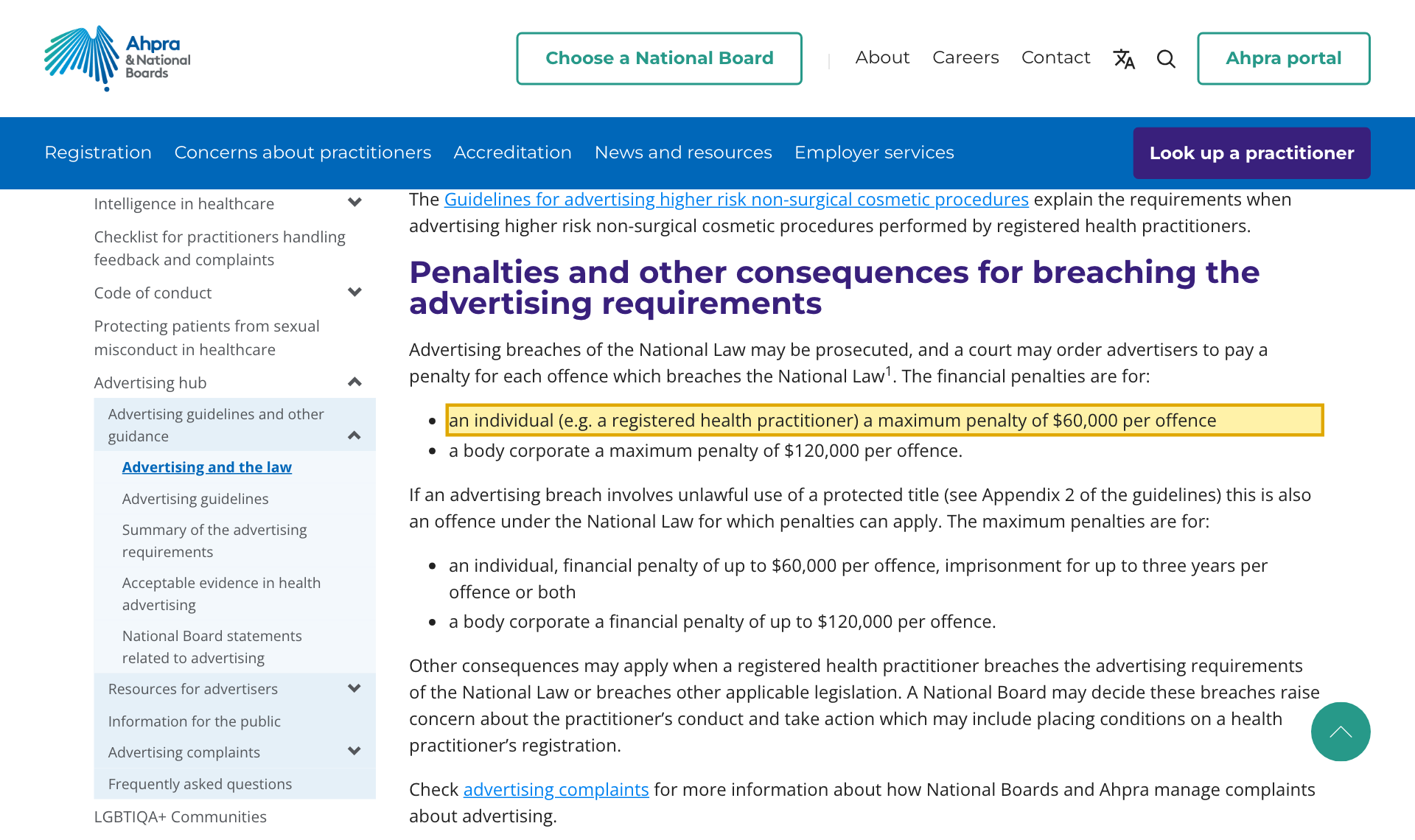
Source: Ahpra, Advertising and the law, screenshot taken 25 November 2026.
Sources and References
- Ahpra, Advertising higher risk non-surgical cosmetic procedures, ahpra.gov.au. Date seen 25 November 2026.
- Ahpra, How we manage advertising complaints, ahpra.gov.au. Date seen 25 November 2026.
- Ahpra, Advertising compliance and enforcement strategy, ahpra.gov.au. Date seen 25 November 2026.
- Ahpra, Booming billion-dollar cosmetic industry on notice with new cosmetic procedures guidelines, ahpra.gov.au, 3 June 2025. Date seen 25 November 2026.
- Medical Board of Australia, Guidelines for registered medical practitioners who perform cosmetic surgery and procedures, medicalboard.gov.au, date of issue 1 July 2023. Date seen 25 November 2026.
- Ahpra, Advertising and the law, ahpra.gov.au. Date seen 25 November 2026.
- Ahpra, Advertising guidelines, ahpra.gov.au. Date seen 25 November 2026.
- Hall & Wilcox, Healthcare advertising: Understanding AHPRA’s strategy to compliance and enforcement, hallandwilcox.com.au, 13 June 2017. Date seen 25 November 2026.
- Medical Republic, Chiropractor fined over cancer cure claims, medicalrepublic.com.au, 17 February 2017. Date seen 25 November 2026.
Last reviewed: 25 November 2026.
Vikas Thakur
Founder, Perth. 16 years of experience from working at TPG, iiNet and Monadelphous, now helping Australian clinics keep their websites, ads and online presence AHPRA compliant.