Ahpra Testimonial Ban: Penalty Cap Rose to $120K in 2022
Ahpra says the maximum penalty per advertising offence is $60,000 for an individual and $120,000 for a body corporate. The testimonial ban itself sits in section 133 of the National Law.
 Vikas Thakur Founder, Perth 12 min read Fact checked
Key takeaways
- The testimonial ban sits in section 133 of the Health Practitioner Regulation National Law, which makes it an offence to advertise a regulated health service using testimonials or purported testimonials, alongside four other grounds
- Ahpra’s Advertising and the law page gives a maximum of $60,000 per offence for an individual and $120,000 for a body corporate. The caps were $5,000 and $10,000 before the 2022 amendment
- Ahpra’s cosmetic procedure guidelines carry a date of issue of 2 September 2025 and the announcement says they strengthen the ban on testimonials from social media influencers
- A testimonial is a recommendation or positive statement about a clinical aspect of a service: a symptom, a diagnosis or treatment, or an outcome
- Comments about customer service or communication style that do not refer to clinical aspects are not testimonials and may be used in advertising
- Engaging with positive reviews on third-party sites, for example by liking, re-sharing or responding, may count as using a testimonial
- Ahpra says most advertising cases start with a letter requiring correction within 30 days
- Ahpra says the higher penalties apply in all jurisdictions, including Western Australia, as of July 2024
Ahpra’s Advertising and the law page gives a maximum penalty of $60,000 per offence for an individual and $120,000 for a body corporate. The cap was $5,000 and $10,000 before a 2022 amendment to the National Law. Testimonials are one of the grounds in section 133 of the Health Practitioner Regulation National Law. What Ahpra announced on 2 September 2025 was a set of cosmetic procedure guidelines that, in its words, strengthen the ban on testimonials from social media influencers. The testimonial ban itself is not new to those guidelines, and treating it as new is how a review widget already live on your site can become a breach. This guide sets out what counts as a testimonial, what the current penalty looks like, and what it means for the reviews and social proof on your clinic’s website.
What changed on 2 September 2025
Ahpra’s cosmetic procedure advertising guidelines carry a date of issue of 2 September 2025 and were developed by National Boards under section 39 of the National Law. They set out the obligations of any person or business that advertises higher risk non-surgical cosmetic procedures, so marketing staff and agencies are covered as well as the practitioner.
Ahpra’s announcement says the advertising changes require real images, require a warning that results may vary for other patients where images are used, and “strengthen the ban on the use of testimonials from social media influencers”. It describes the guidelines as strengthening safeguards across the industry, not as creating a testimonial ban from scratch.
Source: Ahpra, cosmetic procedure advertising guidelines and Ahpra news, 2 September 2025, seen 24 November 2026.
Takeaway: The testimonial ban did not start on 2 September 2025. The cosmetic guidelines added a tighter rule for influencer and ambassador arrangements on top of a prohibition that already applied to advertising a regulated health service.
What counts as a testimonial under Ahpra’s rules
Ahpra’s enforcement strategy says section 133 makes it a criminal offence to advertise a regulated health service in a way that is false, misleading or deceptive; offers a gift, discount or other inducement without stating the terms and conditions; uses testimonials or purported testimonials; creates an unreasonable expectation of beneficial treatment; or encourages the indiscriminate or unnecessary use of regulated health services.
Ahpra’s testimonial guidance defines a testimonial as a recommendation or positive statement about the clinical aspects of a regulated health service used in advertising. A clinical aspect exists if a symptom, a diagnosis or treatment, or an outcome (including the skills or experience of the practitioner, directly or by comparison) is expressed. Comments about clinical aspects cannot be used in advertising. Comments that are not about clinical aspects, such as customer service or communication style, are not testimonials and may be used in advertising.
Our illustrative examples, applying that test:
| Comment | Testimonial under section 133? |
|---|---|
| “The team explained everything and the clinic was spotless.” | No, customer service only |
| “My lips have never looked this natural, best result in Perth.” | Yes, outcome and comparison |
| “Reduced my frown lines completely, so happy with the result.” | Yes, outcome claim |
Source: Ahpra, Testimonials: Understand the requirements, seen 24 November 2026. The three comments are our own examples, not quotes from Ahpra.
A compliance review from ClinicCode checks every testimonial, review widget, and social proof element on your site against this test.
Ahpra’s testimonial guidance says advertisers do not have to remove, or try to remove, a review on a website or social media page they do not control. It also says advertisers should take care if they choose to engage with reviews on third-party websites, as this may be considered using a testimonial to advertise. The cosmetic guidelines say testimonials are also considered used where a practitioner links to testimonials on third-party advertising, re-shares patient posts that are positive statements about the procedure, or interacts with a review by liking or responding to it. For a clinic’s own social media page, the testimonial guidance says the owner or practitioner who controls it is responsible, and that this may be achieved by disabling the reviews and testimonials functions. Selectively editing reviews is a separate risk: Ahpra says it has the potential to be false, misleading or deceptive.
Source: Ahpra, Testimonials: Understand the requirements and Ahpra, cosmetic procedure advertising guidelines, seen 24 November 2026.
Takeaway: The test is whether the comment refers to a clinical aspect of the treatment or only to the service experience. Exposure also extends to how a clinic’s account engages with reviews published elsewhere, not only what it publishes directly.
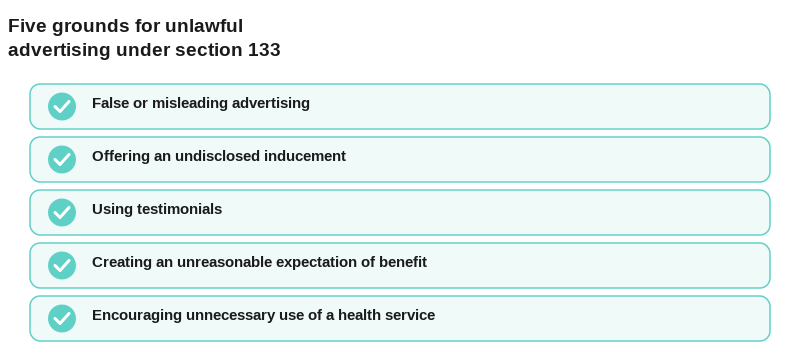
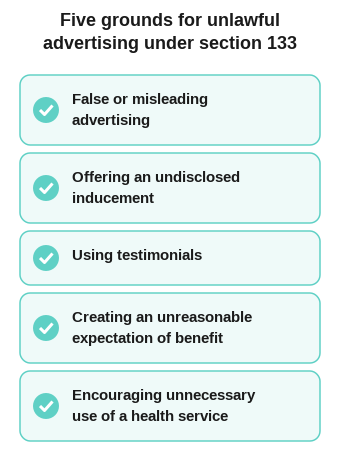
Source: Ahpra, Advertising compliance and enforcement strategy, seen 24 November 2026. The diagram paraphrases the five section 133 grounds listed there.
The maximum penalty rose in 2022
Ahpra’s Advertising and the law page says a court may order an advertiser to pay a penalty for each offence, with a maximum of $60,000 for an individual (for example a registered health practitioner) and $120,000 for a body corporate. It notes that in 2022 the National Law was amended to increase the maximum penalty for advertising offences. Ahpra’s advertising guidelines say the 2022 amendment raised the caps from $5,000 to $60,000 for an individual and from $10,000 to $120,000 for a body corporate.
Source: Ahpra, Advertising and the law (current caps) and Ahpra, Advertising guidelines (pre-2022 caps), seen 24 November 2026. Figures are maximum penalties per offence in Australian dollars.
Ahpra’s enforcement strategy says the earlier penalties applied to one-off instances of unlawful advertising, while ongoing breaches may be treated as separate offences. Ahpra says the higher penalties apply in all jurisdictions, including Western Australia, as of July 2024, so the same caps apply to clinics there. Ahpra’s advertising guidelines page still carries footnote 3, which gives Western Australia maxima of $30,000 for an individual and $60,000 for a body corporate against the unlawful use of a protected title offence, and the page does not reconcile it with its statement that the higher penalties apply in all jurisdictions, including Western Australia, as of July 2024.
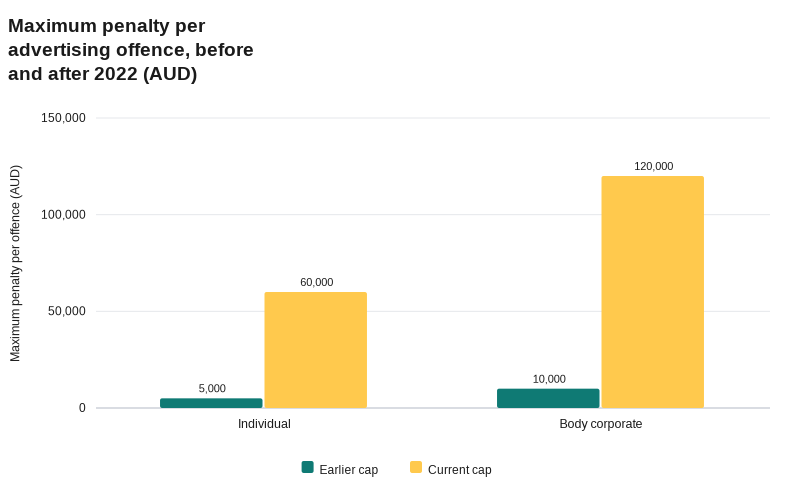
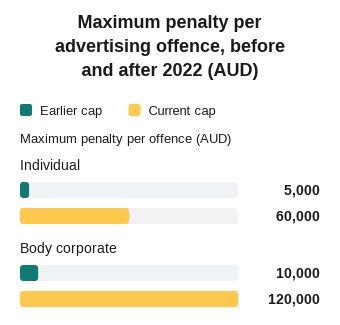
Source: Ahpra, Advertising and the law and Ahpra, Advertising guidelines, seen 24 November 2026. Maximum penalty per offence in Australian dollars.
Takeaway: The maximum penalty per advertising offence rose from $5,000 and $10,000 to $60,000 and $120,000, and Ahpra says ongoing breaches may be treated as separate offences.
How many of these are live on your site right now?
We count every testimonial, widget and re-shared post, and tell you which provision each one falls under.
How Ahpra manages advertising complaints
Ahpra’s complaints process says that once it receives a complaint it reviews the advertising, assesses the risk of any breaches, and takes risk-based action. It says most cases start with a letter telling the advertiser that their advertising breaches the National Law and requiring them to correct it within 30 days.
Ahpra says most cases start with a 30-day correction letter
Complaint received, advertising reviewed, risk assessed
In most cases, a letter requiring the advertiser to correct within 30 days
Possible conditions on registration, or prosecution of a non-practitioner advertiser
Ahpra says that in most cases, if the advertiser corrects their advertising, it will close the matter. If a registered practitioner does not correct it, Ahpra may propose conditions on their registration prohibiting advertising. If the advertiser is not a registered practitioner, it may prosecute. Very serious breaches that placed the public at significant risk of harm may be prosecuted even if the advertising is corrected.
Source: Ahpra, How we manage advertising complaints, seen 24 November 2026.
Takeaway: In our view, the 30-day window starts only after Ahpra has reviewed the advertising and written to the advertiser, so the safer course is to check your pages before a complaint arrives.
What this means for your clinic’s website
The testimonial rule does not just affect a dedicated reviews page. It touches every treatment landing page that quotes a patient, every Instagram highlight with a re-shared story, and every review widget embedded on a homepage. In our view, a website for a cosmetic clinic should keep credentials, procedure education and recovery information separate from anything that reads as a positive statement about outcomes.
Safe to publish
- Practitioner credentials and registration
- Procedure education and recovery information
- Comments about service or communication only
Audit before it goes live
- Embedded Google or Facebook review widgets
- Patient quotes on treatment landing pages
- Re-shared influencer and ambassador stories
- Open comment sections on clinic-owned pages
In our view, auditing a page against this rule before it goes live is simpler than removing a testimonial section after a corrective notice arrives. Pages built around procedure education and credentials avoid the testimonial question, though they must still meet the other section 133 grounds and the cosmetic guidelines.
Takeaway: In our view, the safest cosmetic clinic landing pages are built on credentials and procedure information, not on quoted outcomes, because that content does not refer to a patient’s outcome.
The Source Pages
Screenshots of the pages cited in this post, taken on 24 November 2026 and framed on the passage each one supports.
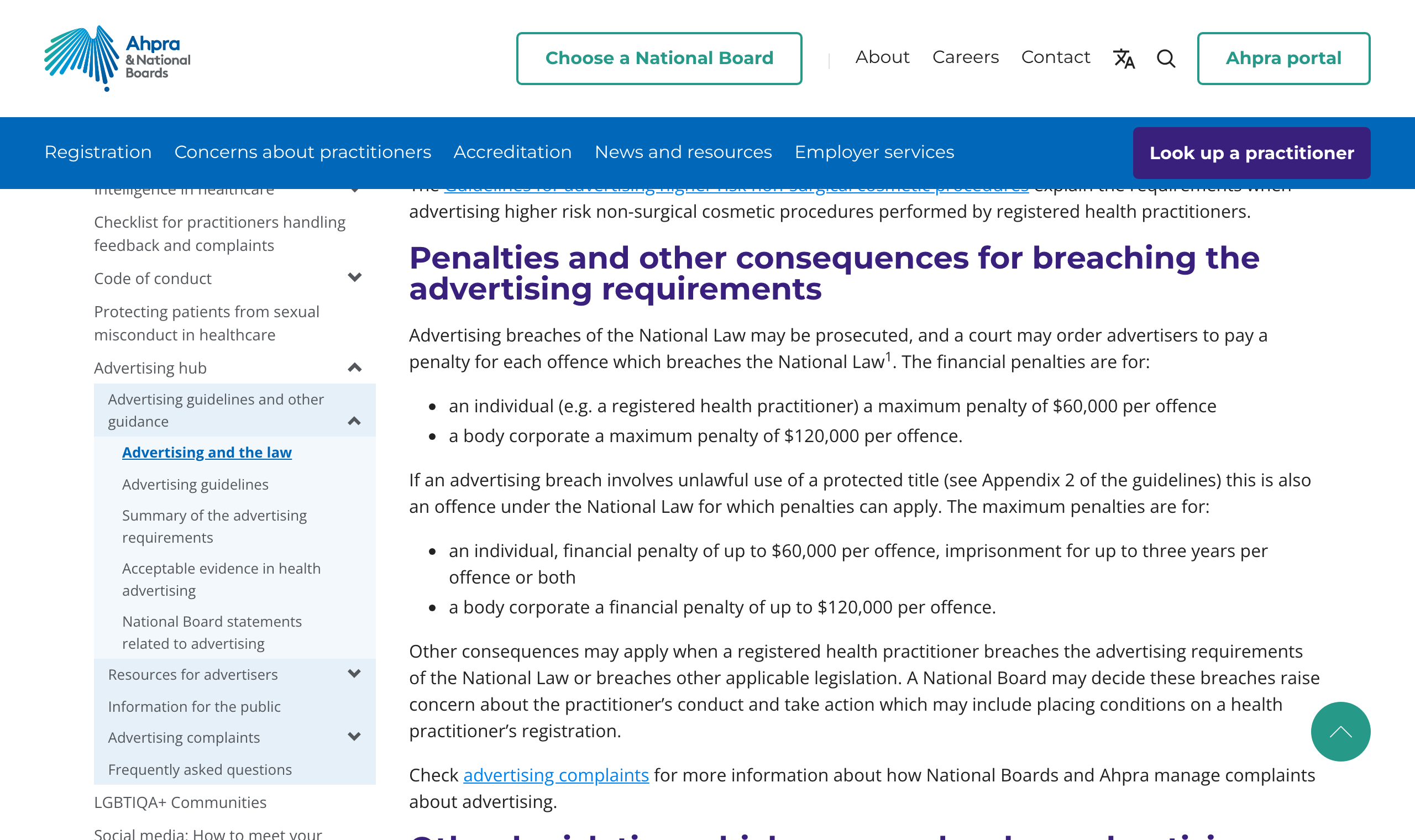
Source: Ahpra, Advertising and the law, screenshot taken 24 November 2026.
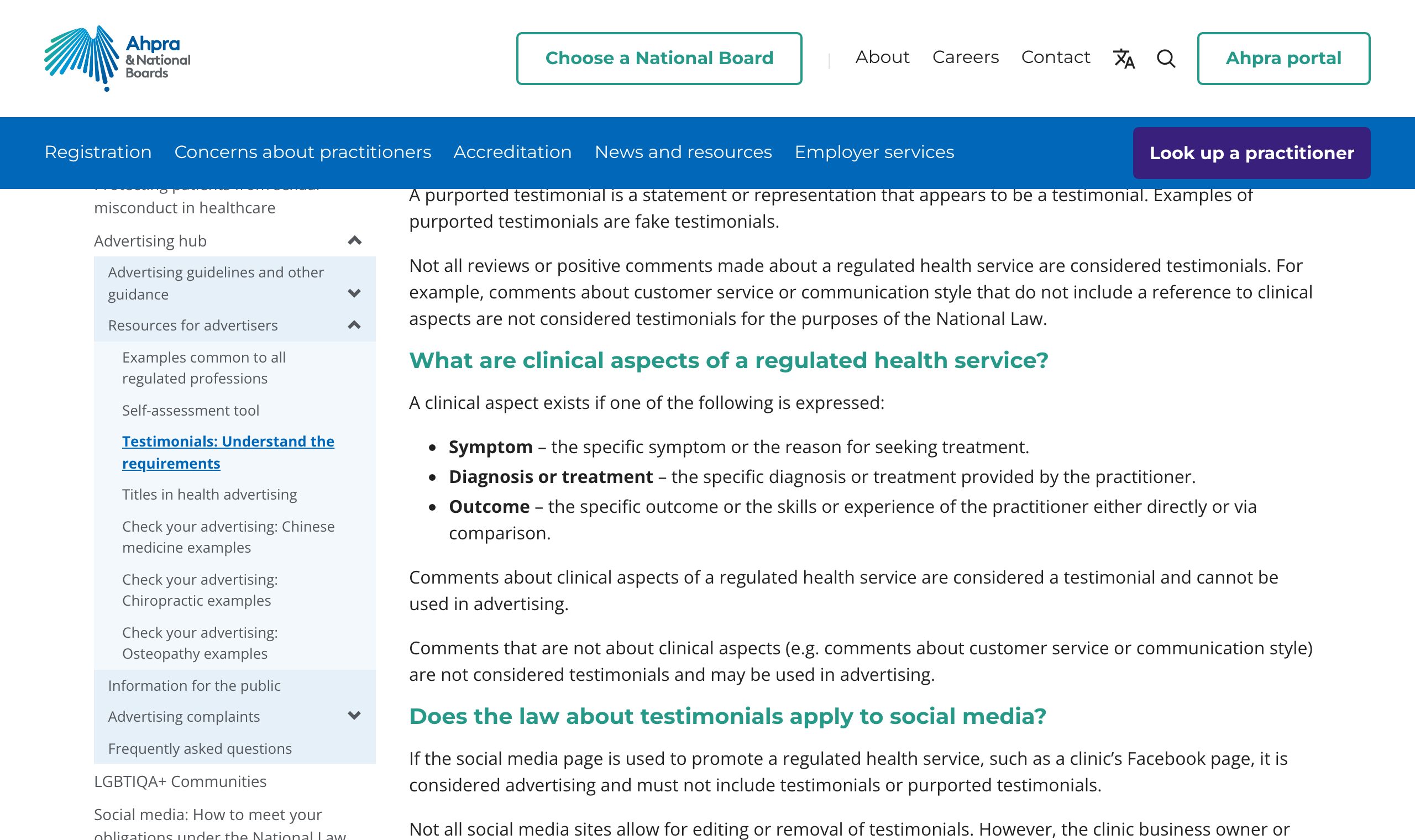
Source: Ahpra, Testimonials: Understand the requirements, screenshot taken 24 November 2026.
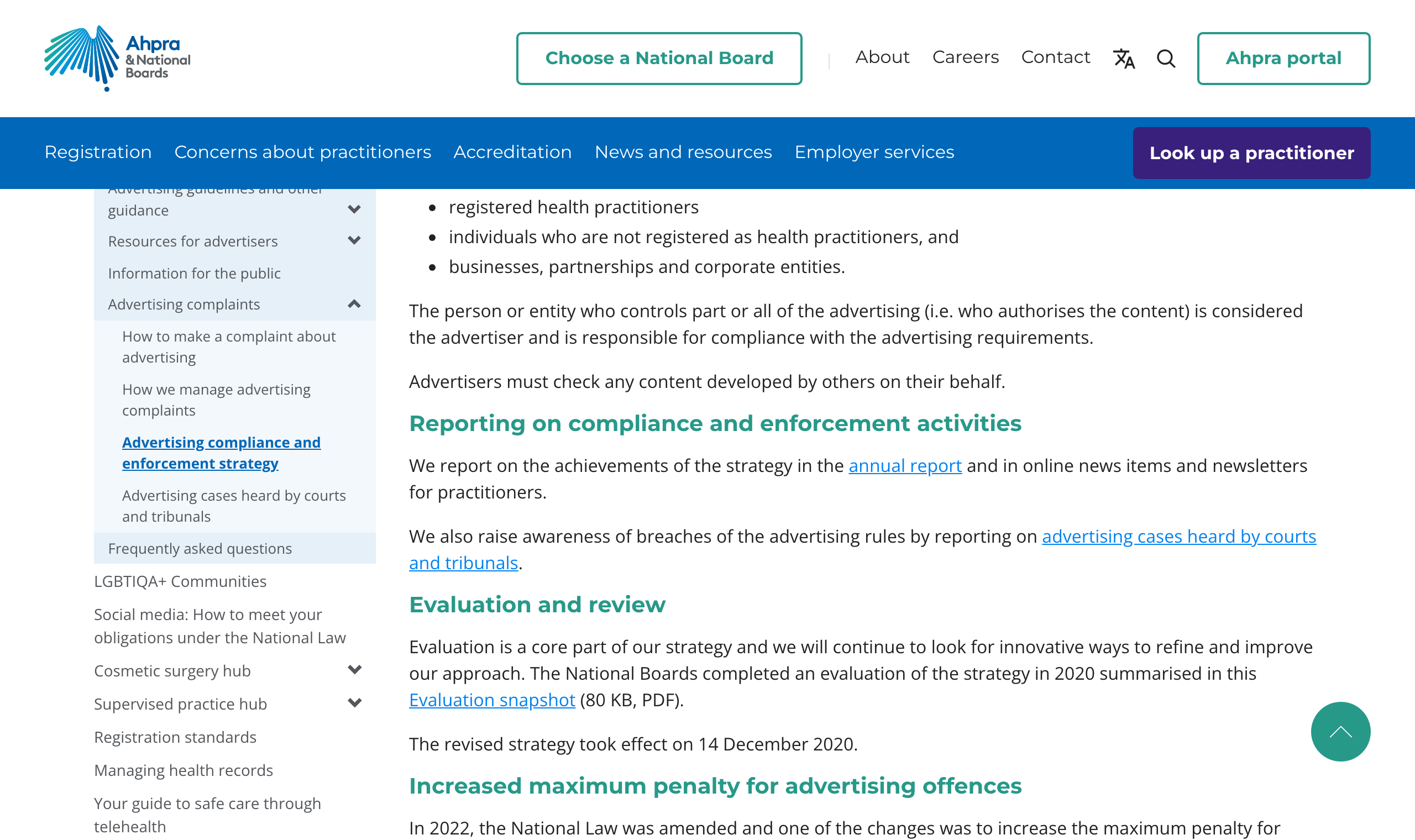
Source: Ahpra, Advertising compliance and enforcement strategy, screenshot taken 24 November 2026.
FAQ
Was the testimonial ban on cosmetic clinic advertising new in September 2025?
No. The National Law already prohibited testimonials in advertising a regulated health service. Ahpra’s announcement says its cosmetic procedure guidelines, in effect from 2 September 2025, strengthen the ban on testimonials from social media influencers.
What exactly counts as a testimonial under Ahpra’s rules?
Ahpra defines a testimonial as a recommendation or positive statement about the clinical aspects of a regulated health service used in advertising. A clinical aspect is a symptom, a diagnosis or treatment, or an outcome (including the practitioner’s skills or experience, directly or by comparison). Comments about customer service or communication style that do not refer to clinical aspects are not testimonials and may be used in advertising.
What is the maximum penalty for using a testimonial in cosmetic clinic advertising?
Ahpra’s Advertising and the law page gives a maximum of $60,000 per offence for an individual and $120,000 for a body corporate. A 2022 amendment to the National Law raised the caps from $5,000 and $10,000. Ahpra says the higher penalties apply in all jurisdictions, including Western Australia, as of July 2024.
Does liking or re-sharing a positive patient review count as using a testimonial?
It can. Ahpra’s testimonial guidance says advertisers should take care if they choose to engage with reviews on third-party websites, as this may be considered using a testimonial to advertise. Its cosmetic guidelines list re-sharing patient posts and liking or responding to a patient’s post as examples.
Get your testimonials checked against the rules
ClinicCode fixes cosmetic clinic websites, review widgets, and social media accounts against the current testimonial rules.
- The clinical aspect test applied to every page: does it refer to a symptom, diagnosis, treatment or outcome?
- Maximum penalties per offence in view: $60,000 for an individual, $120,000 for a body corporate
- Every review widget, Instagram highlight and re-shared post listed for review
- Western Australia included, since Ahpra says the higher caps apply there as of July 2024
Sources and references
Ahpra news, 2 September 2025 - New guidelines for cosmetic procedures: real images, results-may-vary warning, strengthened ban on influencer testimonials
Ahpra, advertising higher risk non-surgical cosmetic procedures - date of issue 2 September 2025, testimonials, influencers and ambassadors, liking and re-sharing
Ahpra, Testimonials: Understand the requirements - definition of a testimonial, clinical aspects, third-party reviews, social media
Ahpra, Advertising and the law - $60,000 and $120,000 maximum penalties per offence, 2022 amendment, all jurisdictions from July 2024
Ahpra, Advertising compliance and enforcement strategy - section 133 grounds, ongoing breaches treated as separate offences
Ahpra, Advertising guidelines - 2022 amendment, caps raised from $5,000 and $10,000
Ahpra, How we manage advertising complaints - review, risk assessment, 30-day correction letter, escalation
Related reading:
- Ahpra Assessed 380 Advertising Complaints in 2022/23: the enforcement volume behind these penalties
- AHPRA Before and After Advertising Rules: the imagery-specific companion rule
- Ahpra Advertising Complaints 2025/26 and the Penalty Caps: the penalty caps and complaint figures
- Clinic Website Design: compliant website builds for Ahpra-regulated clinics
For websites and ad accounts that stay inside the testimonial rules from day one, talk to us about your clinic’s marketing.
Vikas Thakur
Founder, Perth. 16 years of experience from working at TPG, iiNet and Monadelphous, now helping Australian clinics keep their websites, ads and online presence AHPRA compliant.