AHPRA Binds 16 Professions: GP and Skin Clinic Ad Rules
Ahpra’s advertising rules bind all 16 regulated health professions, not only cosmetic injectors, with the same testimonial ban and the same maximum penalties. Penalties are up to $60,000 per offence for an individual and $120,000 for a body corporate. Higher risk procedures carry extra image rules.
 Vikas Thakur Founder, Perth 13 min read Fact checked
Key takeaways
- Ahpra works with 15 National Boards that regulate 16 registered health professions in Australia, from medical practitioners to podiatrists (Ahpra, advertising guidelines). The advertising requirements apply to any person or business advertising a regulated health service, so there is no cosmetic-injector-only carve-out.
- Ahpra’s advertising compliance team assessed 775 complaints about advertising in 2024/25 (Ahpra annual report 2024/25). Separately, Ahpra’s report shows 12,744 of the 22,658 notifications nationally in 2024/25 were about medical practitioners (the profession GPs are registered under), about 56.2% by our arithmetic (12,744 divided by 22,658), more than any other profession (Table 12, annual report 2024/25, full report PDF).
- The testimonial ban sits in section 133(1)(c) of the Health Practitioner Regulation National Law and applies to every regulated health service advertiser, not only cosmetic clinics (Ahpra, advertising guidelines).
- Ahpra’s Guidelines for advertising higher risk non-surgical cosmetic procedures took effect on 2 September 2025. Their examples include dental veneers, injectables, injection lipolysis, thread lifts, sclerotherapy and hair transplants, and the list is “not limited to” those (Ahpra, higher risk cosmetic procedure advertising).
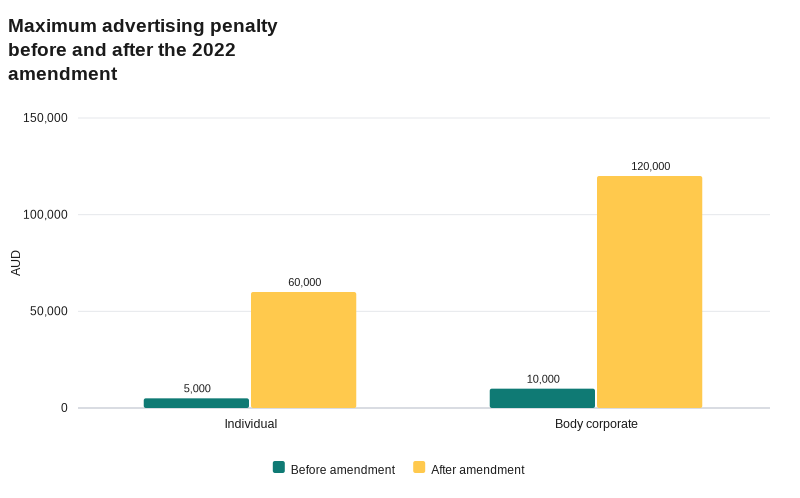
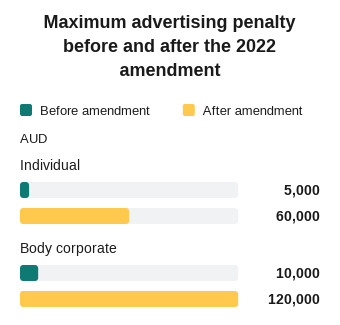
- The maximum penalty for an advertising offence is $60,000 per offence for an individual and $120,000 for a body corporate, up from $5,000 and $10,000 after the 2022 National Law amendment (Ahpra, advertising guidelines). Ahpra’s advertising guidelines page still carries footnote 3, which gives Western Australia maxima of $30,000 for an individual and $60,000 for a body corporate against the unlawful use of a protected title offence, and the page does not reconcile it with its statement that the higher penalties apply in all jurisdictions, including Western Australia, as of July 2024.
- Of the 775 advertising complaints, 419 were lower-risk complaints about registered health practitioners, about 54.1% by our arithmetic (419 divided by 775) (Ahpra annual report 2024/25).
- Of the practitioners Ahpra contacted about non-compliant advertising, 74% corrected it early, so further intervention was not required (Ahpra annual report 2024/25).
Every skin clinic running a before-and-after gallery on Instagram and every GP practice reposting a Google review that mentions a patient’s treatment outcome is publishing advertising that Ahpra can assess. The maximum a court can order is $60,000 per offence for an individual and $120,000 for a body corporate (Ahpra, Advertising and the law).
Ahpra and its National Boards regulate 16 health professions in Australia. The advertising provisions in the Health Practitioner Regulation National Law do not carve out an exception for general practice, cosmetic dermatology, or laser and skin clinics.
It is easy to assume the 2025 cosmetic advertising guidelines were a cosmetic-injector problem. They were not only that. Medical practitioners were the subject of more Ahpra notifications in 2024/25 than any other regulated profession: 12,744 of 22,658 (Table 12, annual report 2024/25, full report PDF).
Here is which rules bind GPs, skin cancer clinics, cosmetic dermatologists and laser clinics, and where clinics may be assuming an exemption that Ahpra’s own material does not give them.
Why This Isn’t a “Cosmetic Injector” Problem
The National Law that Ahpra administers sets one registration and advertising framework for 16 regulated health professions: Aboriginal and Torres Strait Islander health practice, Chinese medicine, chiropractic, dental, medical, medical radiation practice, midwifery, nursing, occupational therapy, optometry, osteopathy, paramedicine, pharmacy, physiotherapy, podiatry and psychology (Table 12, annual report 2024/25, full report PDF lists all 16).
GPs are registered under the Medical Board of Australia, one of Ahpra’s 15 National Boards (Ahpra, advertising guidelines). Dermatologists, cosmetic physicians and skin cancer doctors are also medical practitioners. Dental practitioners, including cosmetic dentists who offer skin or laser treatments, sit under a separate board with the same advertising provisions attached.
Ahpra’s Summary of the advertising requirements says the requirements apply to any person or business that advertises a regulated health service, including registered practitioners, individuals who are not registered, and businesses, partnerships and corporate entities (Ahpra, Summary of the advertising requirements). The test does not turn on clinic size or on whether you sell cosmetic injectables.
Ahpra’s own notification data shows how many concerns reach medical practitioners. Medical practitioners, the profession GPs and cosmetic doctors sit under, were the subject of more notifications in 2024/25 than any other regulated profession.
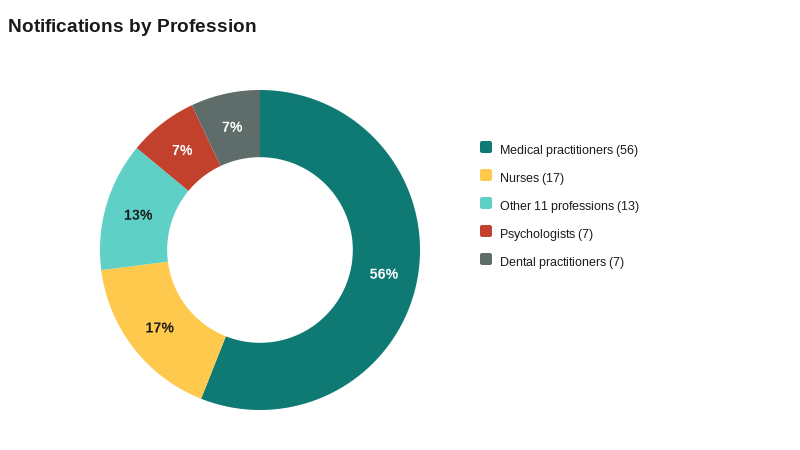
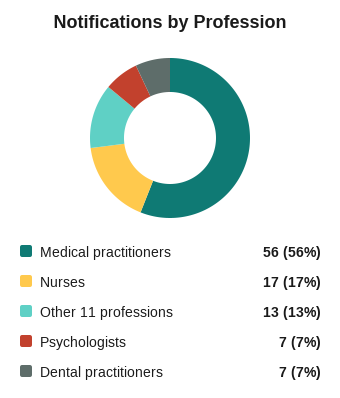
Ahpra recorded 22,658 notifications across the 16 regulated professions in 2024/25. This figure covers all notifications, not only advertising complaints. Medical practitioners accounted for 12,744, about 56% by our arithmetic, ahead of nurses (3,872), psychologists (1,549) and dental practitioners (1,544). The “Other 11 professions” slice is the remainder, 2,949, by our arithmetic. Source: Ahpra annual report 2024/25, full report PDF, Table 12.
Takeaway: GPs sit inside the profession with the most notifications in the National Scheme. Treating the advertising rules as loosely applied to general practice is the opposite of what Ahpra’s numbers suggest.
The Testimonial Ban Is Not Cosmetic-Specific
A common misconception: that the September 2025 guidelines invented the testimonial ban. They did not.
Section 133(1)(c) of the National Law prohibits advertising a regulated health service in a way that “uses testimonials or purported testimonials about the service or business”, such as patient stories and experiences or success stories (Ahpra, advertising guidelines, section 4.3). It applies to every regulated health service, in cosmetic and non-cosmetic practice alike.
The rule catches a review or quote that talks about clinical care. A GP clinic that reposts a Google review reading “Dr Chen finally diagnosed what three other doctors missed” (a hypothetical example) is using a patient story in its advertising. A skin cancer clinic quoting a patient saying “the mole removal healed perfectly” has the same problem.
What Ahpra says the prohibition does not affect: patients sharing information, expressing their views online or posting reviews on review platforms (Ahpra, higher risk cosmetic procedure advertising). The risk sits with your own advertising, including reposting those reviews on your website or social channels.
| Advertising element | Applies to cosmetic clinics | Applies to GPs and skin clinics |
|---|---|---|
| Testimonial ban (s.133(1)(c)) | Yes | Yes |
| Image and before/after rules for higher risk cosmetic procedures | Yes | Yes, if the clinic advertises those procedures |
| Maximum penalty per offence, $60,000 individual / $120,000 body corporate | Yes | Yes |
Source: Ahpra, advertising guidelines; Ahpra, higher risk cosmetic procedure advertising.
Takeaway: If a GP clinic’s marketing has screenshotted a Google review mentioning a diagnosis or outcome, that content is the kind of testimonial the National Law prohibits, whether or not the clinic sells cosmetic treatments.
For a full breakdown of what changed for cosmetic clinics in 2025, see our guide to Ahpra’s cosmetic clinic advertising guidelines. GPs and skin clinics operate under the same National Law provisions.
What “Higher Risk Non-Surgical Cosmetic Procedures” Covers
The Guidelines for advertising higher risk non-surgical cosmetic procedures took effect on 2 September 2025 (Ahpra, higher risk cosmetic procedure advertising). The name suggests a narrow scope. The definition is broader than injectables.
Ahpra describes higher risk cosmetic procedures as non-surgical procedures that usually need a registered health practitioner: they are restricted to particular professions, require an authorisation only certain practitioners hold, or need anatomical, physiological or pharmacological knowledge to perform safely. Ahpra adds that they “may involve penetration of the deeper dermis by chemicals, lights, lasers, heat or cold” (Ahpra, higher risk cosmetic procedure advertising).
The examples Ahpra names are not a closed list. It says they “include but are not limited to”:
| Procedure category | Example named by Ahpra |
|---|---|
| Dental | Dental veneers |
| Injectables | Botulinum toxin and dermal fillers |
| Fat dissolving | Injection lipolysis |
| Lifting | Thread lifts |
| Vascular treatment | Sclerotherapy and microsclerotherapy |
| Blood-derived | Procedures involving platelet rich plasma, biotherapy or blood-derived injections |
| Hair | Hair transplants |
Source: Ahpra, higher risk cosmetic procedure advertising.
Laser, peel and body contouring services are not named in that list, so whether a given skin clinic treatment counts as higher risk depends on how it fits Ahpra’s definition. We found no Ahpra statement naming laser hair removal or chemical peels, so do not assume they are in or out. Check each treatment against the definition above, and read the guidelines themselves if you are unsure.
The guidelines do not ban before and after images outright. They set requirements: both images must be genuine and of actual patients, similar in lighting, angle and framing, not edited or filtered, and the after image should say how long after the procedure it was taken. Advertising of these procedures must not use testimonials, and images must carry a prominent warning that results apply only to that patient (Ahpra, higher risk cosmetic procedure advertising).
Skin cancer treatment itself (excision, cryotherapy for lesions, biopsy) is a medical service rather than a cosmetic procedure in the usual sense, so the higher risk cosmetic guidelines may not reach it. It is still subject to the general testimonial ban in section 133. A skin cancer clinic that also offers cosmetic services should keep that content separate, because those pages may sit inside the 2025 cosmetic guidelines.
Takeaway: The test is the procedure being advertised, not the name on the clinic door. Calling yourself a “skin clinic” rather than a “cosmetic clinic” does not change which Ahpra rules apply to what you publish.
What GPs and Skin Clinics Can Still Advertise
The rules restrict misleading, testimonial-based and outcome-driven marketing. They do not ban marketing altogether. Four categories are generally safer:
1. Service descriptions without outcomes. Describe the mechanism, not the result. “CO2 laser resurfacing uses controlled thermal energy to treat the skin’s surface layer” describes a method. “CO2 laser resurfacing gives you flawless, glowing skin” promises a result.
2. Factual treatment information. Clinical facts about how a treatment works and what recovery involves are fine, provided the copy avoids outcome promises and misleading image framing.
3. Pricing and booking information. Stating a price or how to book is commercial information. It states a fact, not a promised result. Check any discount or offer against Ahpra’s rule that offers must state their terms and conditions (Ahpra, advertising guidelines).
4. Practitioner qualifications. A GP or nurse’s registration, training and professional memberships can be advertised accurately. Vague claims such as “our award-winning skin expert” with no named award are a risk, because advertising must not be misleading.
Reviewing every page, post and ad against these four categories flags which content needs to change before Ahpra’s advertising compliance team finds it first. If you would rather ClinicCode run that review for you, get in touch.
The 2024/25 Enforcement Numbers
Ahpra’s advertising compliance team assessed 775 complaints about advertising in 2024/25. The breakdown matters more than the headline figure, because it shows how Ahpra triages these matters.
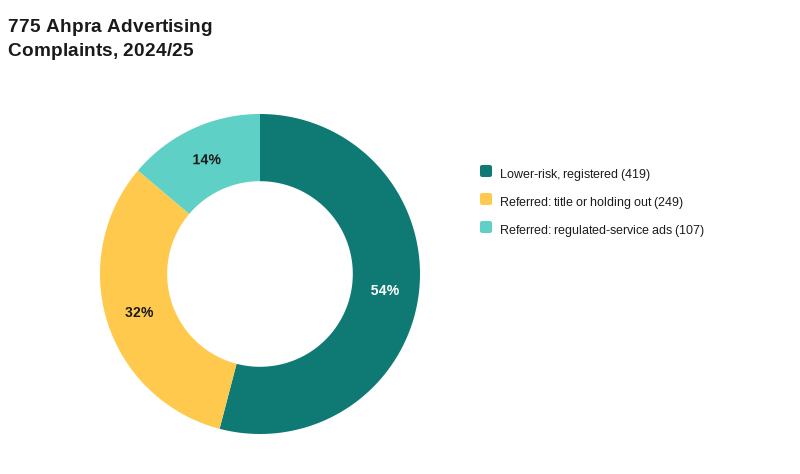
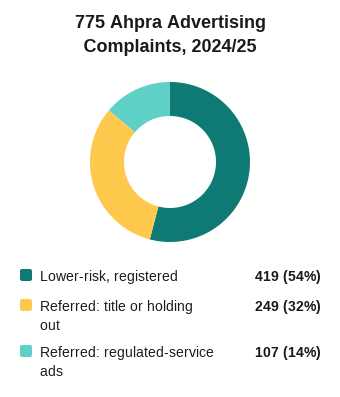
Of the 775 advertising complaints Ahpra’s compliance team assessed in 2024/25, 419 were lower-risk complaints about registered health practitioners. The other 356 were about corporate entities or unregistered persons, or assessed as serious-risk, and were referred to Ahpra’s Criminal Offences Unit. Of those 356, 107 were about advertising of regulated health services, and the remainder (249, our arithmetic) were about specialist title use or individuals holding out as registered health practitioners. Source: Ahpra annual report 2024/25, Feature stories.
Further figures from the same report put the deterrence picture in context:
| Metric | 2024/25 figure |
|---|---|
| Practitioners contacted about non-compliant advertising who corrected it early | 74% |
| Practitioners audited whose advertising remained non-compliant after a chance to correct | 86 |
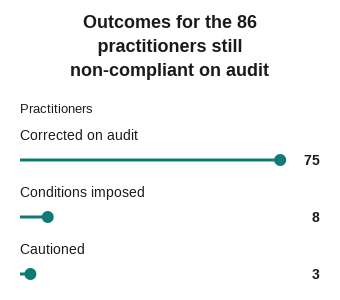
| Of those 86: corrected afterwards / conditions imposed / cautioned | 75 corrected, 8 conditions, 3 cautioned |
| Maximum penalty per offence, individual / body corporate | $60,000 / $120,000 |
Source: Ahpra annual report 2024/25, Feature stories; Ahpra, Advertising and the law. Ahpra says the increased penalties apply in all jurisdictions, including Western Australia, as of July 2024 (Ahpra, Advertising and the law, footnote 1).
The penalty increase is recent. In 2022 the National Law was amended to raise the maximum advertising penalty per offence from $5,000 to $60,000 for an individual and from $10,000 to $120,000 for a body corporate (Ahpra, advertising guidelines). By our arithmetic ($60,000 divided by $5,000, and $120,000 divided by $10,000) that is twelve times the previous maximum. These are maximum penalties a court may order, not typical outcomes, and the increase applies to every regulated profession, GPs and skin clinics included.
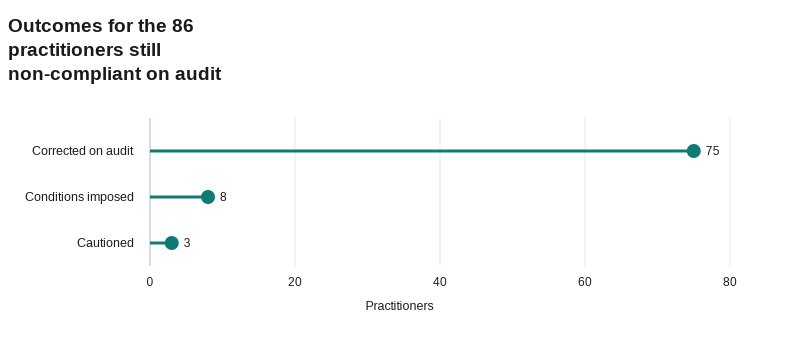
Source: Ahpra annual report 2024/25, Feature stories.
Takeaway: Ahpra’s usual first response is to contact the advertiser and give them a chance to correct it. 74% of those contacted corrected early. The maximum financial exposure for a practice that does not correct has risen twelvefold (our arithmetic) since the 2022 amendment.
Source: Ahpra, advertising guidelines.
Auditing Your GP or Skin Clinic’s Advertising
Work through each channel in order:
1. Website treatment pages. Search for outcome language: “flawless”, “glowing”, “confidence”, “transform”. For any procedure that fits Ahpra’s higher risk definition, check every before and after image against the requirements above, and remove any that fail.
2. Google reviews and testimonials. Remove any reproduced review that mentions a symptom, diagnosis, treatment or outcome from your own website and social channels. Patients can still post reviews on review platforms, but you cannot republish them in your advertising.
3. Instagram and Facebook. Check before and after posts for laser, peel, filler or injectable content against the image requirements. Keep a record of what you change. Audit captions on educational posts for outcome language.
4. Google Ads and Meta Ads. Review headlines and descriptions for outcome claims. Check the TGA’s rules on naming prescription-only medicines in advertising, because Ahpra points advertisers to the TGA for therapeutic goods.
5. Google Business Profile. Check the business description and posts. They are advertising of your service and are frequently overlooked.
ClinicCode does this work for Perth clinics through our compliance fix and build service. Book a call if you want us to do it on your site.
Building a Compliant Marketing System
Clinics that built their marketing around testimonials and before/after content need a replacement conversion mechanism, not just a content removal exercise.
Education-first content. Detailed, medically accurate guides to how laser resurfacing, chemical peels or skin checks work build authority without outcome claims. This is the strategy behind the Ahpra-compliant website builds we run for cosmetic and skin clinics.
Credential-led practitioner pages. A GP or nurse’s training, qualifications and professional memberships are a trust signal that stays available once testimonials are off the table.
Consultation-first funnels. When advertising cannot promise results, the consultation becomes the conversion point. A low-friction booking flow for an initial consultation is a compliant alternative to an outcome-promise ad.
This is the marketing system ClinicCode builds for Perth GP-owned skin clinics, cosmetic dermatology practices and laser clinics through our compliance fix and build service.
Next Step for Your Practice
If your GP clinic, skin clinic or laser studio has been advertising with before/after galleries, reposted reviews and “transform your skin” copy, it may be sitting on non-compliant content right now, whether or not a single injectable is on the treatment menu.
ClinicCode fixes GP, dermatology and skin clinic websites and social channels for Ahpra advertising compliance across all 16 regulated professions, not only cosmetic injectables. We replace the non-compliant elements across your site, social content and ad accounts with compliant wording, one by one.
Vikas Thakur
Founder, Perth. 16 years of experience from working at TPG, iiNet and Monadelphous, now helping Australian clinics keep their websites, ads and online presence AHPRA compliant.