Medical-Grade Skincare Clinic Marketing: AHPRA Rules 2026
Skincare clinics sit in a specific AHPRA compliance zone: some services are regulated, some are not, and the rules differ by practitioner registration type. This guide covers compliant marketing for clinics that sell prescription-adjacent products and regulated treatments alongside unregulated facials and peels.
 Vikas Thakur Founder, Perth 9 min read Fact checked
Key takeaways
- A skincare clinic’s Ahpra compliance obligation depends on what it advertises and who delivers it. Ahpra says anyone (a person, business or company) who advertises a regulated health service must follow the advertising rules of the National Law (Ahpra advertising guidelines, section 3.2). Calling the clinic “medical” or not does not change that
- Cosmetic nurses and other registered practitioners bring the advertising rules to the services they provide
- Prescription-only medicines cannot be advertised to the public. The TGA lists prescription-only medicines and substances as something that cannot be advertised to the general public
- Non-prescription treatments such as facials and enzyme peels are less likely to be a regulated health service, but where a registered practitioner is involved the clinic should assume the rules apply
- The Ahpra guidelines for higher risk cosmetic procedures do not ban before and after images outright. They set conditions: the images must be genuine, must not be edited or enhanced, and need a prominent warning that the outcome applies only to that patient
- Testimonials are a different matter: the National Law prohibits them in advertising a regulated health service
- Educational skincare content is a low-risk channel, because it explains science and process without making outcome claims
The “medical-grade” label creates a compliance paradox for Australian skincare clinics. Clinics add “medical” to their branding to justify premium pricing and differentiate from beauty salons. But the more a clinic presents as medical, the more likely Ahpra views its advertising as subject to the same rules as a cosmetic medicine clinic.
A clinic with an aesthetician who performs facials and sells over-the-counter skincare is in a different position from a clinic where a registered nurse works under a prescriber. In our reading, the second clinic’s advertising of services connected to that nurse’s practice sits inside the Ahpra rules. Ahpra’s test is whether you advertise a regulated health service, so check each service rather than assuming the staff title decides it.
This guide maps the compliance landscape. It is general information, not legal advice.
Who Is Subject to Ahpra Rules
Ahpra’s guidelines say that anyone who advertises a regulated health service is an advertiser and must comply with the advertising requirements of the National Law (Ahpra advertising guidelines, section 3.2). The practical application for skincare clinics is below. It is our summary, so confirm borderline services with a healthcare lawyer.
| Practitioner Type | Ahpra Registered? | Advertising Rules Apply? |
|---|---|---|
| Aesthetician / beauty therapist | No | Depends on whether the service advertised is a regulated health service |
| Dermal therapist (without Ahpra registration) | No | Depends on whether the service advertised is a regulated health service |
| Cosmetic registered nurse | Yes | Yes, for services performed by that nurse |
| Cosmetic GP or doctor | Yes | Yes, for services performed by that doctor |
| Dermal clinician (Ahpra-registered) | Yes | Yes |
| Dermatologist | Yes | Yes |
A clinic that employs both aestheticians and registered nurses is subject to Ahpra rules for the registered nurses’ services. The safest approach: apply Ahpra’s advertising standards to all clinic marketing, regardless of which practitioner delivers each service. This is simpler to maintain and avoids the risk of Ahpra viewing the whole clinic’s advertising as connected to the registered practitioner.
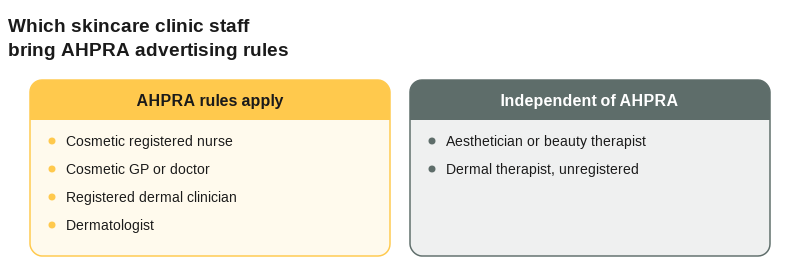
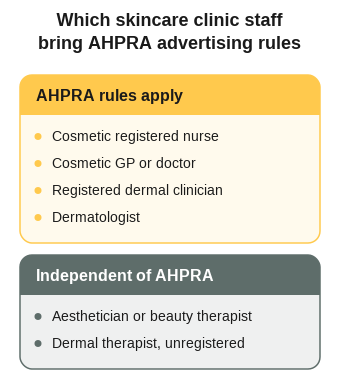
The diagram is a simplification. Whether an unregistered therapist’s service falls under the rules depends on whether it is a regulated health service, so treat the safest approach above as the default.
Prescription Skincare Products: The Prescription-Only Issue
Many medical-grade skincare clinics prescribe or supply prescription-strength skincare products. The TGA says prescription-only medicines and substances cannot be advertised to the public, and its guidance on health services says advertising must not refer to specific prescription medicines, including terms that act as substitutes, or represent that people could obtain a prescription for them through the service (TGA: advertising health services that involve therapeutic goods).
| Product type | Advertising position |
|---|---|
| Prescription-only skincare actives | Do not name the product or substance, or promise a prescription, in promotion |
| Compounded prescribed actives | Treat the same way as prescription-only products |
| Non-prescription cosmetic skincare | The prescription advertising restrictions do not apply, but general advertising law and the Ahpra rules for any regulated service still do |
For clinics that prescribe these products, the compliance implication: you cannot advertise “Tretinoin prescriptions available” (see Ahpra Treatment Naming rules) or “Get a Retin-A prescription online”. You can describe the service as “prescription skincare consultation” or “prescription-strength active skincare”. Check the status of each product with the TGA guidance above or a pharmacist before you write the copy.
Before/After for Skin Treatments: What Is Permitted
This is the most nuanced area of compliance for skincare clinics. Ahpra’s guidelines for advertising higher risk non-surgical cosmetic procedures, which are in effect from 2 September 2025, and cover procedures such as cosmetic injectables, platelet rich plasma procedures and procedures using lasers, lights, chemicals, heat or cold to penetrate the deeper dermis (Ahpra: Advertising higher risk non-surgical cosmetic procedures). Skin treatments span a wide risk range.
What Ahpra requires if you use before and after images for a higher risk cosmetic procedure (source):
- Both images must be genuine, meaning actual patients who had the procedure from that practitioner
- Images must not be edited or enhanced, and must not give a misleading impression of the outcome
- A prominent warning that the outcome shown is only relevant for this patient and does not necessarily reflect other patients’ results
- Responsible use, so that only realistic information about the outcome is shown
The position is less clear for:
- Non-invasive facials and peels performed by unregistered aestheticians
- Non-prescription topical treatments
- Acne treatment programmes where results are functional (clearing a medical condition) rather than cosmetic
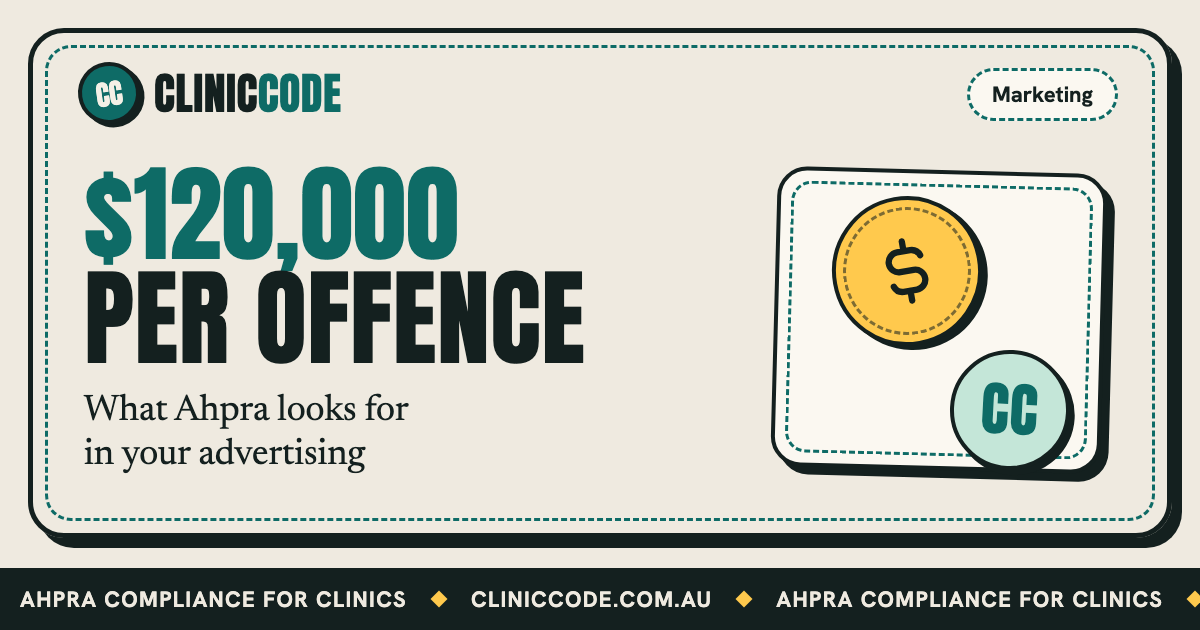
The conservative position: do not use before/after for any skin treatment result in advertising unless a healthcare lawyer has confirmed it for your treatment and practitioner. The risk of being wrong is a court-ordered penalty of up to $60,000 per offence for an individual and $120,000 per offence for a body corporate (footnote 1 on that page says these higher penalties apply in all jurisdictions, including Western Australia, as of July 2024). The conservative position protects the clinic.
Maximum financial penalty per advertising offence under the National Law
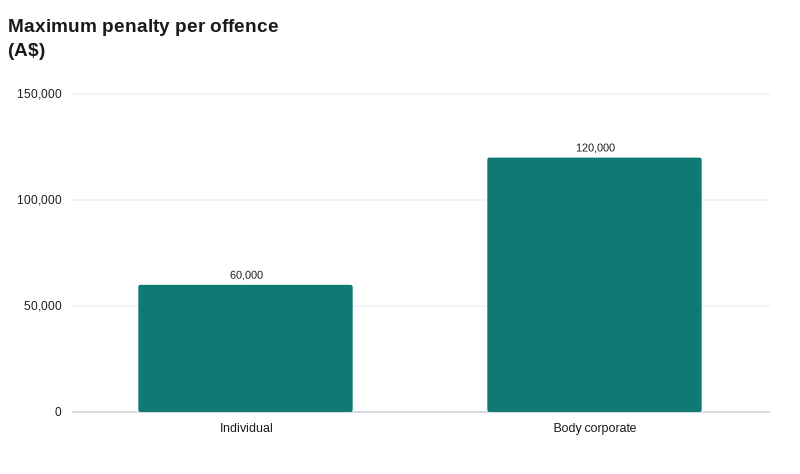
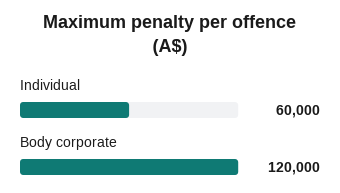
Source: Ahpra, Advertising and the law.
For clinics that want to use clinical photography to demonstrate treatment outcomes, get specific legal advice from a healthcare lawyer on the specific treatment type and practitioner context.
Compliant Skincare Clinic Marketing Channels
SEO-driven skincare education content
Skincare education content is, in our view, one of the lower-risk marketing channels for medical-grade skin clinics. The compliance case: educational content that explains how ingredients work, what different treatments address, and how to choose a treatment pathway does not make outcome claims. It describes science and processes.
There is an organic search opportunity in questions patients ask, such as “best treatment for melasma Australia” or “how long does laser resurfacing take to heal”. We have not sized the search volume here, so check it in a keyword tool before you commit to a content plan.
Content that ranks:
- “What is medical-grade skincare? The difference from spa treatments”
- “Treating melasma in Australia: treatment options and what to expect”
- “Prescription skincare consultation: what happens, who can prescribe”
- “Laser vs IPL for skin pigmentation: a clinical comparison”
Practitioner credential positioning
For clinics with registered practitioners, credential content is the primary trust signal. Detailed practitioner pages covering qualifications in dermatology or cosmetic medicine, specialisation areas, and approach to diagnosis and treatment. Keep any title or claim about qualifications accurate, because Ahpra’s guidelines cover titles and claims about training, qualifications and experience (Ahpra: higher risk cosmetic procedures guidelines).
Skincare consultation funnel
The skincare consultation is a different entry point from a cosmetic procedure consultation. Patients who book a skin consultation have a specific concern (acne, pigmentation, ageing). A marketing funnel that identifies the concern, provides educational content about it, and offers a consultation is a compliant structure when the copy stays educational and avoids outcome promises.
Structure:
- Educational blog content targeting the skin concern
- Internal links to a consultation landing page
- Consultation page describes the process (not the outcome)
- Follow-up sequence that continues the education
Revenue Strategy for Skincare Clinics
Skincare clinics typically earn from more than one stream: consultations, treatment programmes and skincare products. We have not found a published Australian benchmark for average annual spend per patient at medical-grade skincare clinics, so work from your own practice management data rather than an industry figure.
The revenue streams worth tracking separately:
| Revenue Stream | Role in the mix | Repeat pattern |
|---|---|---|
| Initial consultation | Entry point and assessment | Once, then review visits |
| Treatment programme | Clinical results over a course of visits | Repeat visits through the year |
| Prescription skincare product | Ongoing active treatment | Regular refills |
| Supplementary non-prescription skincare | Add-on to the clinical programme | Periodic repurchase |
A prescribed skincare programme can act as a retention engine. Patients on one return to maintain the prescription and review progress, which creates a recurring relationship from a consultation model. The size of that effect is something to measure in your own clinic.
Compliance Checklist for Skincare Clinic Marketing
For clinics that want to self-audit before engaging a formal compliance review:
- Website treatment pages: any before/after imagery meets Ahpra’s conditions (genuine, unedited, prominent warning) or is removed
- Website treatment pages: no testimonials from patients
- Website treatment pages: no outcome language (“clear skin”, “say goodbye to pigmentation”)
- Prescription product pages: no brand or generic names of prescription-only substances in promotional context
- Social media: no before/after skin treatment posts unless they meet the same conditions
- Social media: no patient testimonial posts
- Instagram Highlights: no archived before/after Stories
- Google Business Profile: no prescription-only substance names in services or posts
- Google Ads: no outcome language, no substance names
- Email marketing: no outcome language in subject lines or body
Get a Skincare Clinic Marketing Strategy
ClinicCode builds compliant marketing strategies for Australian medical-grade skincare clinics. Educational SEO content, Ahpra-compliant social media frameworks, practitioner credential pages, and consultation funnel design.
Related reading:
- Ahpra Treatment Naming on Your Clinic Website: prescription skincare naming rules
- Ahpra Social Media Rules for Cosmetic Clinics: before/after and testimonial rules on Instagram and TikTok
- Ahpra Compliance Audit Checklist: full advertising audit including skincare clinic channels
- What a Full Ahpra Compliance Audit Costs: compliance investment guide
- Cosmetic Clinic Patient Retention Australia: prescription skincare as a recurring revenue and retention tool
- The Complete Ahpra Advertising Guidelines for Cosmetic Clinics: the full compliance framework
Vikas Thakur
Founder, Perth. 16 years of experience from working at TPG, iiNet and Monadelphous, now helping Australian clinics keep their websites, ads and online presence AHPRA compliant.