Cosmetic Clinic Patient Retention Without Testimonials: Australia 2026
Australian cosmetic clinics cannot use testimonials in advertising, so repeat bookings need other drivers. This guide covers post-treatment follow-up, practitioner continuity, membership models and educational content, and says plainly where no official Australian retention figure exists.
 Vikas Thakur Founder, Perth Updated Jun 16, 2026 8 min read Fact checked
Key takeaways
- No official Australian body publishes a repeat-booking rate for cosmetic clinics. Any retention benchmark you see quoted should come with a named, linked source.
- The testimonial rule is not new. Section 133(1)(c) of the National Law prohibits advertising a regulated health service with testimonials, as Ahpra’s advertising guidelines set out.
- Your own retention rate is the number that matters. Work it out from your booking system before you compare yourself with anyone.
- Practitioner continuity, compliant follow-up, prepaid packages and educational content can all be used without testimonials.
- Internal patient surveys are a measurement tool. Keep them out of your advertising.
What the data is and is not
This post does not contain a benchmark rebooking rate, a lifetime value figure or a revenue uplift for Australian cosmetic clinics, because we could not find an official or peer-reviewed Australian source for any of them. Earlier versions of this post carried such figures. They had no published source, so they are gone.
What remains is a set of practices, the rule that shapes them, and a worked example you can redo with your own numbers.
Patient acquisition cost is the usual reason to look at retention: a returning patient does not need another ad click. Check what your own clinic pays per new patient, then compare it with what your own booking data says about repeat visits.
What the testimonial rule actually says
Ahpra’s advertising guidelines state that “Section 133(1)(c) of the National Law specifically prohibits advertising a regulated health service in a way that uses testimonials or purported testimonials.” The guidelines took effect on 14 December 2020 after a review by the National Boards, so this is not a recent change.
Two points from the same guidelines matter for retention:
- The National Law does not define “testimonial”. Ahpra treats it as a positive statement, and says testimonials are recommendations or positive statements about the clinical aspects of a service. Feedback on customer service or communication style, with no reference to clinical aspects, is not treated as a testimonial.
- The prohibition applies to advertisers. The guidelines say patients can still share views and post reviews on review platforms.
This post is not legal advice. Check the current guidelines and, if unsure, ask Ahpra or your professional body. Old social-proof tactics such as showcasing glowing patient comments about results are off the table, so retention has to come from the experience and from clear, factual communication.
Work out your own retention rate first
Most clinics track new bookings and revenue but not how many first-time patients come back. Pull one number from your booking system:
- Take every patient whose first treatment was 12 months ago or more.
- Count how many of them booked again within 12 months of that first visit.
- Divide the second number by the first.
That is your 12-month rebooking rate. Re-run it every quarter. Because no official Australian benchmark exists, your own trend is the only fair comparison.
Illustrative example
This example uses made-up inputs to show how the arithmetic works. Assume 100 first-time patients and an average returning-visit value of $500. These are assumptions, not clinic data.
| Rebooking rate | Returning patients (of 100) | Returning-visit revenue |
|---|---|---|
| 40% | 40 | $20,000 |
| 50% | 50 | $25,000 |
| 60% | 60 | $30,000 |
Each 10 percentage point rise adds 10 returning patients and $5,000 in this example (10 x $500).
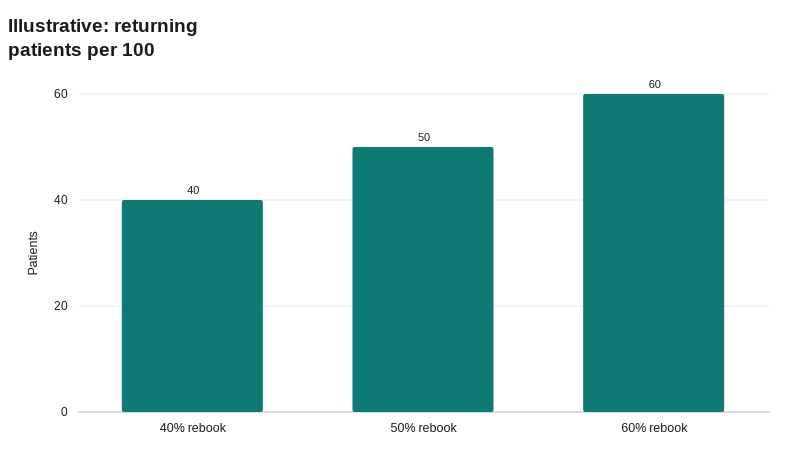
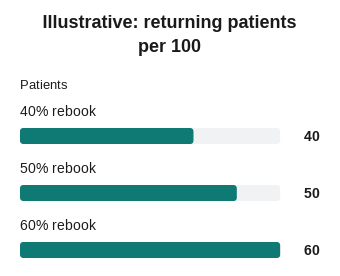
The chart shows how many of 100 first-time patients return at each assumed rebooking rate.
Source: illustrative arithmetic from the assumptions stated above, not clinic or survey data.
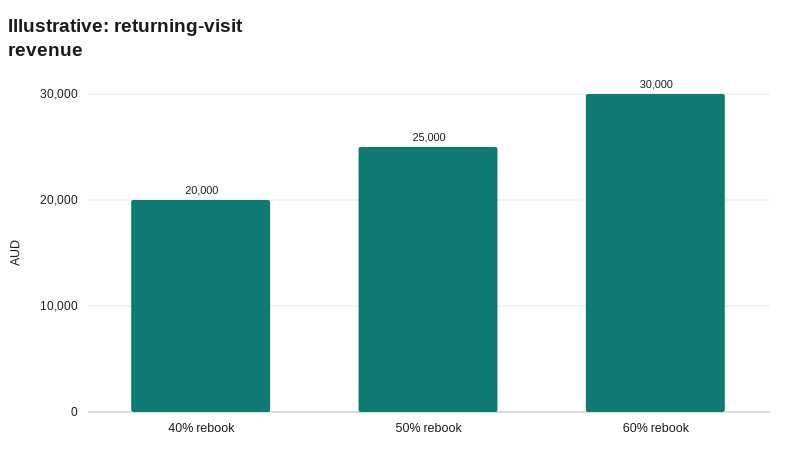
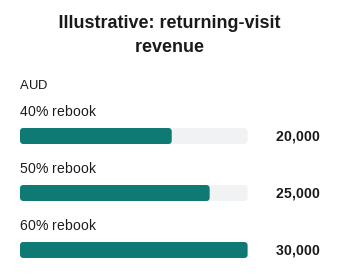
The chart shows the revenue from those returning patients at $500 per visit, as assumed above.
Source: illustrative arithmetic from the assumptions stated above, not clinic or survey data.
Practitioner continuity
Many patients choose a clinic because of a particular injector or clinician. There is no Australian study we can cite on how much continuity changes churn, so treat this as a practice to test in your own data, not a promised result.
A continuity programme formalises what happens naturally in clinics where patients return to the same person:
- Initial consultation with the practitioner the patient will see going forward.
- Booking system preference that routes returning patients to their primary practitioner.
- Transition protocol for when that practitioner is unavailable. Tell patients in advance rather than on arrival.
- Handover documentation if a patient is transferred: treatment history, technique notes and any clinical observations.
This needs a booking system that records patient-to-practitioner assignments and a front desk that honours them. Compare your rebooking rate for patients who see one practitioner with those who do not.
Compliant post-treatment follow-up
Follow-up is the most direct retention mechanism. Keep it factual and clinical.
Rules to keep in mind:
- Avoid outcome language (“Hope you’re loving the results” is outcome language), because it can read as a claim about results.
- Avoid urgency or scarcity language. The Ahpra advertising guidelines say advertising “may be unlawful” when it creates a sense of urgency linked to a person’s health suffering with no clinical indication, and give “for a limited time only” as an example of a phrase that can do so.
- Educational content focus.
- No requests for testimonials for use in your advertising.
An example sequence for injectable treatments. Timings are a suggestion for you to adjust, not a tested schedule:
| Timing | Channel | Content |
|---|---|---|
| Few days after | SMS | Aftercare reminder: “A quick check-in from [Clinic]. If you have questions about your recovery, call us on [number]. Aftercare instructions: [link].” |
| About a week | Educational: a description of the process and what the practitioner told the patient at the visit. No outcome claims. | |
| Around a month | Clinical: “Your practitioner will advise when a review or follow-up appointment suits you. Call us or book online at [link].” | |
| Later | Educational: “Understanding when to rebook: a guide to treatment maintenance for [treatment type],” using the interval your practitioner recommends. |
The difference between compliant and non-compliant follow-up is describing a process versus claiming an outcome. “Your appointment is booked for next week” is process. “You’re looking amazing” is an outcome claim.
Membership and prepaid packages
A prepaid package moves rebooking from something the patient has to remember to something already paid for. A possible structure is a 12-month plan covering a set number of treatments, as agreed in consultation with the practitioner.
Compliance checks before you publish a package:
- No testimonials or outcome claims in the description.
- Check before naming any prescription medicine or brand in advertising. The Ahpra advertising guidelines list the Therapeutic Goods Advertising Code, administered by the TGA, as a separate set of rules, so read the TGA’s current advertising rules too.
- Avoid urgency or scarcity language (see the Ahpra wording above).
- Any discount is a commercial decision for the clinic. Check the current Ahpra and TGA advertising rules before you advertise one, and do not use discounts as a hook.
- Do not promise a number of treatments the practitioner has not assessed as clinically appropriate for that patient.
We have no sourced Australian figure for how often members renew compared with ad-hoc patients. Track it yourself: members renewing for a second year divided by members whose first year ended.
Educational content as a retention channel
Without testimonials, education does the work of helping a patient decide to come back. A patient who understands how a treatment works, what it does not do, and what the practitioner’s usual review interval is can make a confident decision.
Content that supports rebooking:
- Treatment combination guides: what complements a primary treatment, described factually.
- Timing guides: a maintenance calendar that tells patients to follow their practitioner’s advice.
- What to expect articles: the appointment process and aftercare, with no outcome claims.
- Seasonal content: “Preparing for summer: what to ask at a consultation.”
This content has to follow the advertising rules too, so run each piece against Ahpra’s guidelines before you publish.
Measurement framework
Set your own targets from your own baseline. These are the measures worth tracking:
| Metric | How to track |
|---|---|
| 12-month rebooking rate | Booking system: share of patients with a first treatment 12+ months ago who booked again within 12 months |
| Average visits per patient per year | Total visits divided by unique patients |
| Revenue per patient over 3 years | Total revenue from a patient cohort divided by the number of patients in it |
| Package take-up rate | Packages sold divided by eligible patients offered one |
| Follow-up email open rate | Your email platform’s report on follow-up messages |
| Internal patient satisfaction score | Internal survey, never published and never used in advertising |
Ahpra’s guidelines say a testimonial is a positive statement about clinical aspects used in advertising. An internal survey that stays inside the clinic is not advertising. Keep it that way: do not quote scores or comments on your website, social media or in ads.
Build a retention system for your clinic
ClinicCode builds follow-up sequences, booking setups for practitioner continuity, package pages and educational content for Australian cosmetic clinics, written to the advertising rules.
Related reading:
- Cosmetic Clinic Website Booking Conversion Australia: converting first-time visitors to booked consultations
- Cosmetic Clinic Patient Acquisition Cost Australia: acquisition cost context for retention ROI calculation
- Cosmetic Clinic Marketing Australia: full marketing strategy overview
- Cosmetic Clinic SEO Australia 2026: organic traffic as a retention channel via educational content
- AHPRA Social Media Rules for Cosmetic Clinics: compliant content strategy for ongoing patient engagement
- AHPRA Advertising Guidelines for Cosmetic Clinics: the compliance framework all retention communications must follow
Sources and References
- Ahpra, Guidelines for advertising regulated health services: used for section 133(1)(c) of the National Law, the meaning of testimonial and clinical aspects, the 14 December 2020 effective date and the point that patients may post reviews on review platforms.
Vikas Thakur
Founder, Perth. 16 years of experience from working at TPG, iiNet and Monadelphous, now helping Australian clinics keep their websites, ads and online presence AHPRA compliant.