Allied Health Advertising Rules: $60K and $120K Per Offence
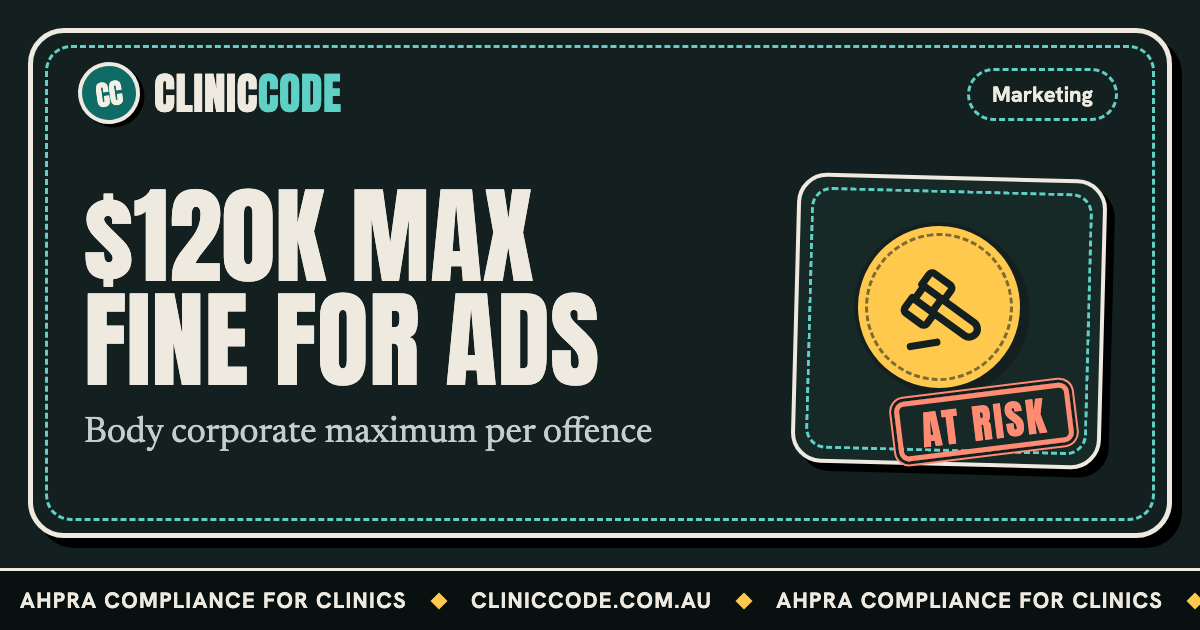
Ahpra says the maximum advertising fine is $60,000 per offence for an individual and $120,000 for a body corporate. As of July 2024 it says the higher penalties apply in all jurisdictions, including Western Australia. The same advertising requirements apply to any person or business that advertises a regulated health service, not only cosmetic clinics.
 Vikas Thakur Founder, Perth 9 min read Fact checked
Key takeaways
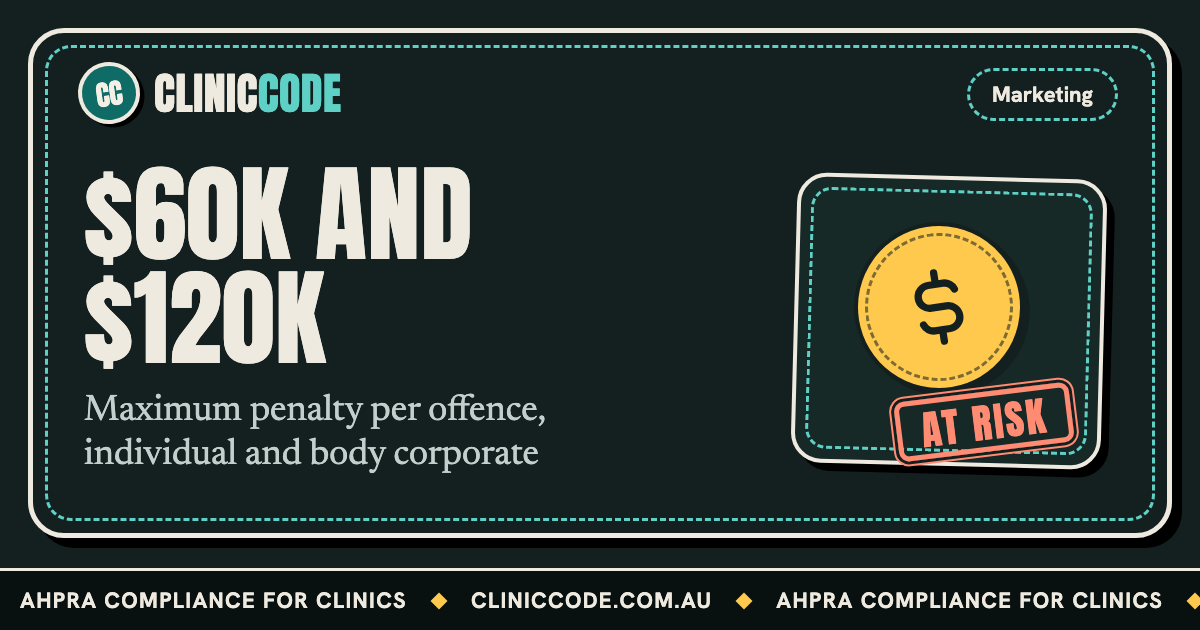
- Ahpra says the maximum financial penalty for an advertising offence is $60,000 per offence for an individual and $120,000 per offence for a body corporate
- Those maximums were raised from $5,000 and $10,000 in a 2022 National Law amendment, and Ahpra says they apply in all jurisdictions, including Western Australia, as of July 2024
- Unlawful use of a protected title is a separate offence, with up to three years’ imprisonment as well as a fine for an individual
- The requirements apply to any person or business that advertises a regulated health service, and advertisers must check content others produce on their behalf
- Ahpra’s summary page lists 13 requirement headings (our count), from accuracy to time-limited offers
- The revised advertising guidelines took effect on 14 December 2020
Ahpra says the maximum financial penalty for an advertising offence is $60,000 per offence for an individual, such as a registered health practitioner, and $120,000 per offence for a body corporate. Before the 2022 National Law amendment the maximums were $5,000 and $10,000. Ahpra says that as of July 2024 the increased penalties apply in all jurisdictions, including Western Australia.
None of this is specific to cosmetic clinics. Ahpra says the requirements apply to any person or business that advertises a regulated health service. This guide sets out what Ahpra’s pages say about the advertising requirements, and what they mean for the website copy, landing pages and enquiry forms of an allied health or dental practice.
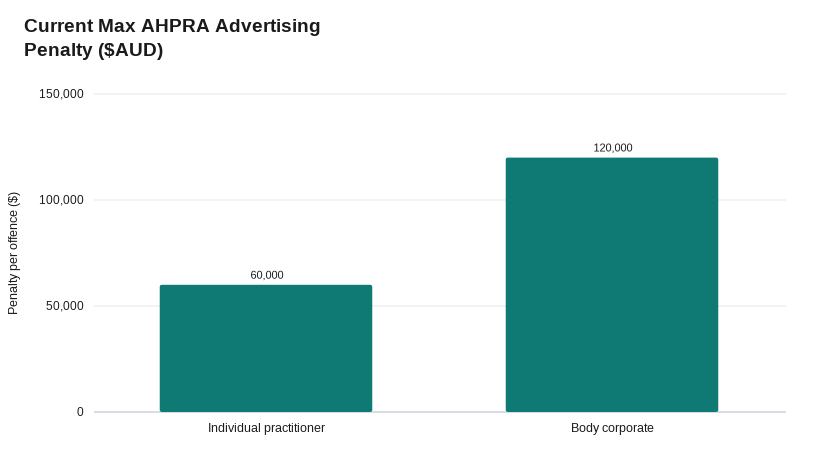
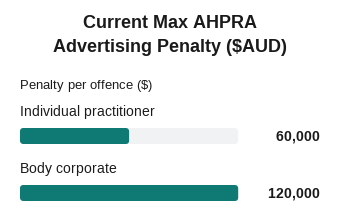
Source: Ahpra, Advertising and the law, seen 24 November 2026. Figures are the maximum financial penalty per offence, in AUD.
What Section 133 Actually Bans
Ahpra’s Advertising and the law page says section 133 of the National Law states that a person must not advertise a regulated health service, or a business that provides one, in a way that:
- is false, misleading or deceptive, or is likely to be
- offers a gift, discount or other inducement to attract a person, unless the advertisement also states the terms and conditions of the offer
- uses testimonials or purported testimonials about the service or business
- creates an unreasonable expectation of beneficial treatment, or
- directly or indirectly encourages the indiscriminate or unnecessary use of regulated health services
The Guidelines for advertising a regulated health service further explain these requirements. Ahpra says the guidelines were developed jointly by the National Boards, and that the revised version took effect on 14 December 2020. The summary page also points to two narrower sets of guidelines: the Medical Board’s guidelines for cosmetic surgery, and the guidelines for advertising higher risk non-surgical cosmetic procedures. Ahpra’s announcement of the non-surgical cosmetic guidelines says they apply to all regulated professions.
Takeaway: The testimonial ban, the misleading-claims ban and the inducement rule sit in the National Law itself. The cosmetic guidelines are an extra layer for cosmetic work, not the source of those rules.
The Penalty Increase, and Western Australia
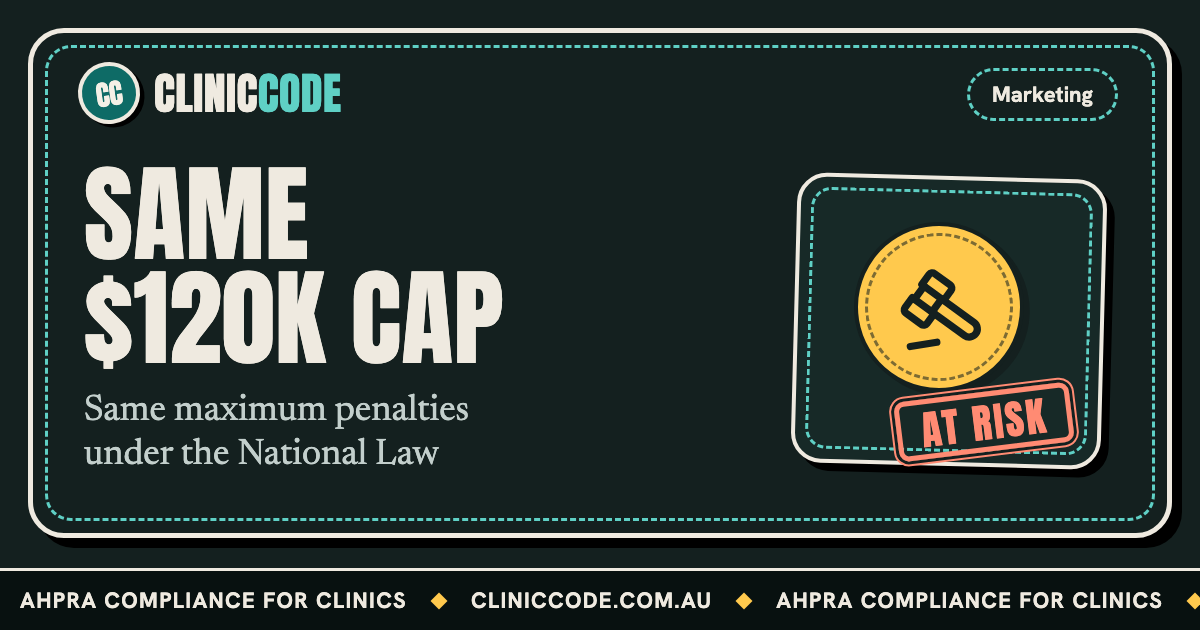
Ahpra’s guidelines page says that in 2022 the National Law was amended and one change was to increase the maximum penalty for advertising offences. For an individual the maximum per offence went from $5,000 to $60,000, and for a body corporate from $10,000 to $120,000. By our arithmetic ($60,000 / $5,000 and $120,000 / $10,000), each is a 12-fold increase.
The same page says that as of July 2024 these increased penalties apply in all jurisdictions, including Western Australia.
There is a second, separate offence: unlawful use of a protected title. Ahpra’s Advertising and the law page says an individual faces a financial penalty of up to $60,000 per offence, imprisonment of up to three years per offence, or both, and a body corporate faces up to $120,000 per offence. Ahpra’s advertising guidelines page still carries footnote 3, which gives Western Australia maxima of $30,000 for an individual and $60,000 for a body corporate against the unlawful use of a protected title offence, and the page does not reconcile it with its statement that the higher penalties apply in all jurisdictions, including Western Australia, as of July 2024. The footnote hangs off the protected-title paragraph, not off ordinary advertising offences.
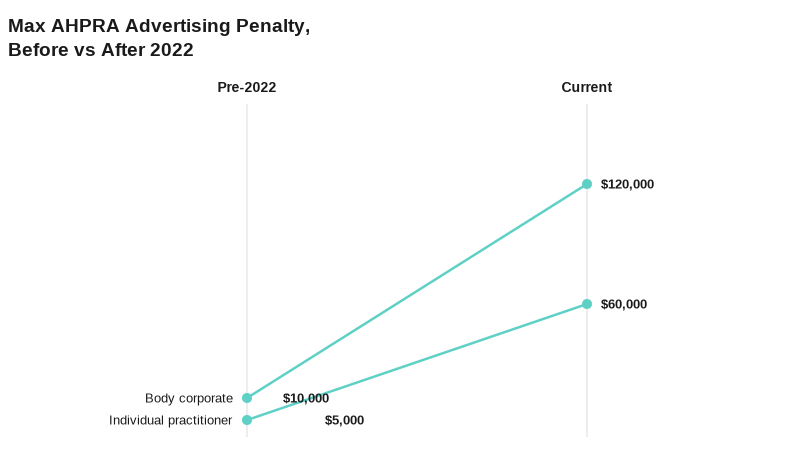
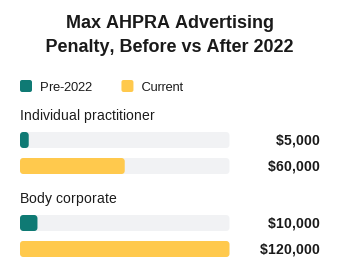
Source: Ahpra, Advertising guidelines, seen 24 November 2026. Figures are the maximum financial penalty per offence, in AUD, before and after the 2022 amendment.
The 13 Headings on Ahpra’s Summary Page
Ahpra’s Summary of the advertising requirements sets out the requirements under headings. We count 13. Ahpra notes the summary does not replace the guidelines, which should be read in full.
| Heading | What Ahpra’s summary says |
|---|---|
| Accurate and clear | Information should not be false, misleading or deceptive |
| Supported by acceptable evidence | Claims need acceptable evidence or may be misleading |
| Claims about treating health conditions | Make clear how the treatment helps each condition listed |
| Risk information | Give accurate information about risks or potential risks |
| Comparisons | Can mislead without clear, accurate, evidenced information |
| Profession, title and qualifications | Titles, registration and qualification claims must be correct |
| Pricing | Clear, accurate, and include the total price |
| Gift, discount or other inducement | State the terms and conditions, and make them easy to find |
| Testimonials | Advertising must not use testimonials or purported testimonials |
| Personal experience anecdotes | May create an unreasonable expectation of beneficial treatment |
| Images or before and after photos | May breach the law if not genuine, or edited or enhanced |
| Regular check-ups | Should not encourage use where there is no clinical need |
| Time limited offers | Urgency wording may be unlawful if linked to unsubstantiated health claims |
Source: Ahpra, Summary of the advertising requirements, page reviewed 2 September 2025, seen 24 November 2026. Right-hand column is our shortened paraphrase of Ahpra’s wording.
Who Is Actually Liable: It Is Not Just the Practitioner
Ahpra’s summary page says the requirements apply to any person or business that advertises a regulated health service. That includes registered health practitioners, individuals who are not registered health practitioners, and businesses, partnerships and corporate entities. It also says advertisers are responsible for their advertising, so they need to check any content produced by others on their behalf and ensure it is compliant.
On testimonials, Ahpra says advertisers are responsible for removing them from advertising they control, including social media platforms such as a clinic Facebook page.
In our view, that makes a website audit against the current guideline worth repeating on a schedule: page copy gets updated and new landing pages get added. An AHPRA compliance review checks a site’s current state against the guideline as it stands today.
Takeaway: Handing a website or ad account to an outside marketer does not hand off the obligation, because Ahpra places responsibility on the advertiser.
What This Means for Your Clinic or Practice Website
In our view, a generic “our services” page that mixes many treatments under one block of copy makes it harder to keep every claim, risk statement and price correct for each one. A dedicated page per treatment is easier to audit, since it carries only the claims for that service.
The testimonial rule changes what counts as proof on a page. Ahpra’s summary says comments about customer service or communication style that do not refer to clinical aspects are not considered testimonials. Statements about symptoms, diagnosis, treatment or outcome are. Content that stays on accurate qualifications, total pricing and plainly stated risk information is the safer ground.
For cosmetic and injectable services, the cosmetic-specific guidelines mentioned above apply on top of section 133.
Takeaway: Build each service page around evidence, total pricing and risk information rather than implied outcomes.
FAQ
Do Ahpra’s advertising rules apply to physiotherapists, chiropractors and other allied health practitioners, not just cosmetic clinics?
Yes. Ahpra says the advertising requirements apply to any person or business that advertises a regulated health service, including registered practitioners, individuals who are not registered practitioners, and businesses, partnerships and corporate entities. The National Scheme regulates 16 health professions through 15 National Boards, including Chiropractic, Occupational Therapy, Optometry, Osteopathy, Physiotherapy, Podiatry and Psychology.
What is the maximum fine for breaching Ahpra’s advertising rules?
Ahpra’s Advertising and the law page gives a maximum of $60,000 per offence for an individual and $120,000 per offence for a body corporate. Unlawful use of a protected title is also an offence, with a maximum for an individual of $60,000 per offence, imprisonment of up to three years per offence, or both. Footnote 3 on Ahpra’s guidelines page lists $30,000 for an individual and $60,000 for a body corporate in Western Australia against that protected-title offence, but the same page says the increased advertising penalties apply in all jurisdictions, including Western Australia, as of July 2024.
When did the increased advertising penalties start applying in Western Australia?
Ahpra says that in 2022 the National Law was amended to increase the maximum penalty for advertising offences, and that as of July 2024 the increased penalties apply in all jurisdictions, including Western Australia. The page does not say when each state’s law changed.
What can a clinic or allied health practice actually say in its advertising under Ahpra’s rules?
Ahpra’s summary says advertising must be accurate and clear, and any claims must be supported by acceptable evidence. Claims about titles, registration and qualifications must be correct, and pricing information should be clear and include the total price. Advertising must not use testimonials, meaning recommendations or positive statements about the clinical aspects of a service. Comments about customer service or communication style that do not refer to clinical aspects are not considered testimonials. Patient stories and before and after images need care: Ahpra says they may create an unreasonable expectation of beneficial treatment, and images may breach the law if they are not genuine or have been edited or enhanced.
Get Your Website Checked Against the Current AHPRA Guideline
ClinicCode fixes clinic and allied health practice websites against the current AHPRA advertising guideline, page by page.
Talk to us about a compliance-first website buildSources and References
- Ahpra - Advertising guidelines: 14 December 2020 effective date, 2022 penalty increase, July 2024 statement, footnote 3
- Ahpra - Advertising and the law: section 133 prohibitions, penalties and the protected title offence
- Ahpra - Summary of the advertising requirements: who the rules apply to and the requirement headings
- Ahpra - What we do: 15 National Boards, 16 health professions
- Ahpra - National Boards: list of the National Boards
- Ahpra - New guidelines for cosmetic procedures: non-surgical cosmetic guidelines apply to all regulated professions
Related reading:
- AHPRA Advertising Fines for Cosmetic Clinics
- AHPRA Testimonial Rules
- AHPRA Website Compliance Checklist
For a build satisfying both the general rule and any cosmetic-specific guideline, see clinic website design or talk to us about your practice’s marketing.
Vikas Thakur
Founder, Perth. 16 years of experience from working at TPG, iiNet and Monadelphous, now helping Australian clinics keep their websites, ads and online presence AHPRA compliant.