Ahpra Website Compliance Checklist for Clinics (2026)
Ahpra’s summary of the advertising requirements has 13 headings, and its rules apply to a clinic website, not only to paid ads. A court can order a body corporate to pay up to $120,000 per offence.
 Vikas Thakur Founder, Perth 11 min read Fact checked
Key takeaways
- Ahpra’s Summary of the advertising requirements has 13 headings (our count), and the page was reviewed on 2 September 2025
- A court can order up to $120,000 per offence for a body corporate and $60,000 per offence for an individual (Ahpra, Advertising and the law). Ahpra’s advertising guidelines page still carries footnote 3, which gives Western Australia maxima of $30,000 for an individual and $60,000 for a body corporate against the unlawful use of a protected title offence, and the page does not reconcile it with its statement that the higher penalties apply in all jurisdictions, including Western Australia, as of July 2024.
- Ahpra’s advertising guidelines say the 2022 National Law amendment raised the caps from $5,000 and $10,000; Ahpra says the higher penalties apply in all jurisdictions, including Western Australia, from July 2024
- The Guidelines for advertising higher risk non-surgical cosmetic procedures were issued 2 September 2025 and list websites among the advertising they cover
- Section 133 of the National Law lists 5 ways advertising of a regulated health service is not allowed (Ahpra)
Ahpra’s Summary of the advertising requirements has 13 headings, from accurate and clear advertising to time limited offers. The page says advertising includes all forms of verbal, printed or electronic public communication that promotes a regulated health service provider, so a clinic website is covered, not just a Google ad or a Meta campaign. A court can order a body corporate to pay up to $120,000 per offence.
This guide walks through all 13 headings in Ahpra’s order. For each one, it sets out what Ahpra’s page says and, where we add a reading of our own, it says so.
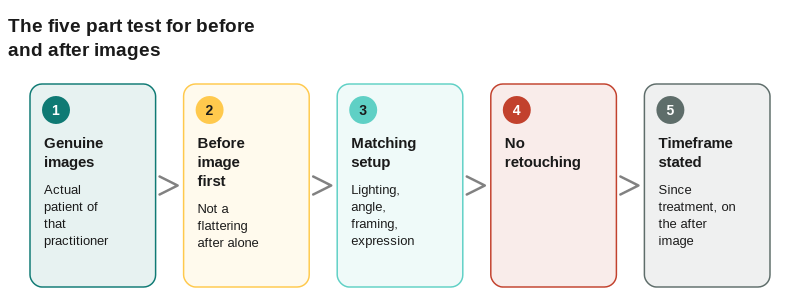
Source: Ahpra, Cosmetic procedure advertising guidelines, requirements for using before and after images, date seen 24 November 2026. The five items are Ahpra’s list for higher risk cosmetic procedures.
The 13 Headings on Ahpra’s Summary Page
Ahpra’s summary page lists the advertising requirements as separate expandable headings. The page does not number them; we counted 13. The page says it does not replace the advertising guidelines, which should be read in full.
| # | Heading on Ahpra’s page | What the page says |
|---|---|---|
| 1 | Advertising is accurate and clear | Information should not be false, misleading or deceptive, and should be clear, honest and include all important details |
| 2 | Advertising is supported by acceptable evidence | Claims need acceptable evidence or may be false, misleading or deceptive |
| 3 | Claims about treating health conditions | If a list of conditions is claimed to be treated or helped, the advertising should make clear how the treatment helps each one, with acceptable evidence |
| 4 | Information about risk or potential risks | Advertising should give accurate information about the risks of a treatment or procedure |
| 5 | Comparisons in advertising | Comparisons of health outcomes, professions, practitioners or prices can mislead unless supported by clear, accurate information and acceptable evidence |
| 6 | Descriptions of profession, title and qualifications | Titles and claims about registration, competence and qualifications must be correct; only a practitioner with specialist registration may use a specialist title |
| 7 | Pricing | Pricing information should be clear, accurate and include the total price, not just initial costs or the price of certain consultations |
| 8 | Gift, discount or other inducement | The advertising must state or refer to the terms and conditions of the offer, and they must be clear and easy to find |
| 9 | Testimonials | Advertising must not use testimonials or purported testimonials, and advertisers must remove them from advertising they control |
| 10 | Claims based on personal experience anecdotes | Patient stories, patient journeys or anecdotes about personal benefit may create an unreasonable expectation of beneficial treatment |
| 11 | Images or before and after photos | Images must not create an unreasonable expectation of benefit, and may breach the Law if not genuine or if edited or enhanced |
| 12 | Recommends regular check-ups for a health condition or prevention of disease | Advertising should not encourage use of a service where there is no clinical or therapeutic need |
| 13 | Time limited offers | Phrases that create urgency may be unlawful where linked to unsubstantiated claims that a person’s health may suffer without the service |
Source: Ahpra, Summary of the advertising requirements, page reviewed 2 September 2025, date seen 24 November 2026. The right-hand column paraphrases Ahpra’s text; the numbering is ours.
Takeaway: In our view, each of the 13 headings can be tested against copy that already sits on your own service pages, home page and blog.
What the Penalty Line Actually Says
Section 133 of the National Law says a person must not advertise a regulated health service, or a business that provides one, in a way that:
- is false, misleading or deceptive, or likely to be
- offers a gift, discount or other inducement unless the terms and conditions are also stated
- uses testimonials or purported testimonials
- creates an unreasonable expectation of beneficial treatment, or
- directly or indirectly encourages the indiscriminate or unnecessary use of regulated health services.
That is five separate tests, and the page lists them as alternatives. Ahpra’s Advertising and the law page says a court may order a penalty for each offence: a maximum of $60,000 for an individual and $120,000 for a body corporate. Ahpra says the 2022 National Law amendment raised the maximum, and that the higher penalties now apply in all jurisdictions, including Western Australia, as of July 2024. Ahpra’s advertising guidelines give the earlier caps as $5,000 for an individual and $10,000 for a body corporate.
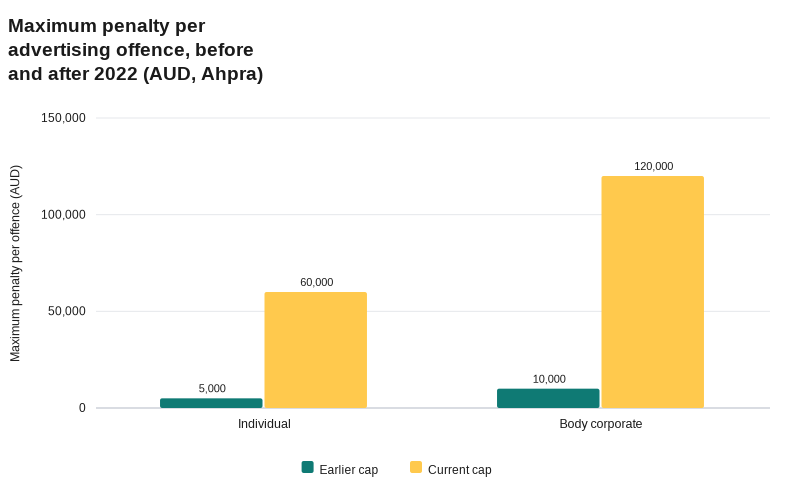
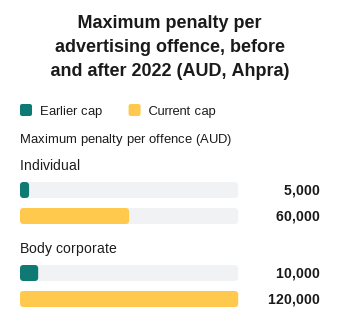
Source: Ahpra, Advertising and the law (current caps) and Ahpra, Advertising guidelines (earlier caps), amounts in Australian dollars per offence, date seen 24 November 2026.
Takeaway: By our arithmetic ($60,000 / $5,000 and $120,000 / $10,000), the cap per offence is 12 times the earlier cap for both an individual and a body corporate. That is a general ceiling a court can apply, not a prediction of what any clinic would be fined.
The Guidelines That Apply If You Advertise Higher Risk Cosmetic Procedures
If your clinic advertises higher risk non-surgical cosmetic procedures, a second, more specific document applies alongside the summary page. The Guidelines for advertising higher risk non-surgical cosmetic procedures were developed by National Boards under section 39 of the National Law and issued on 2 September 2025. Ahpra’s announcement says the new guidelines were in effect from that day.
Ahpra’s examples of higher risk cosmetic procedures include dental veneers, cosmetic injectables such as botulinum toxin and dermal fillers, injection lipolysis, thread lifts, sclerotherapy and microsclerotherapy, procedures using products derived from the patient’s blood, and hair transplants. The list is not exhaustive. The guidelines also point to Therapeutic Goods Administration requirements on testimonials and endorsements for procedures that involve a prescription-only medicine, such as cosmetic injectables.
The guidelines name “internet, including websites and social media” in their list of covered advertising. In our reading, that means a treatment page on your own domain is held to the same standard as any other channel.
Takeaway: If your service pages describe the procedures Ahpra lists, read the cosmetic guidelines as well as the summary page. The guidelines name websites directly.
Testimonials and Before/After Images Hiding on Your Own Pages
The cosmetic guidelines define a testimonial about higher risk procedures as a positive statement about the experience of, reason for or outcome of the procedure, or about the practitioner’s skills or experience, made directly or by comparison. They say a practitioner has used a testimonial if they publish one on a website, link to testimonials on third-party advertising, re-share a patient’s post, or interact with a review, for example by liking it.
For before and after images of higher risk procedures, the guidelines require:
- Both images are genuine, of an actual patient who had the advertised procedure from that practitioner.
- The first or most prominent image seen is the “before” image or a combined image, not the “after” alone.
- The images are as similar as possible in lighting, camera angle, background, framing, exposure, posture, clothing and makeup.
- The images are not edited or enhanced, for example by filters or retouching.
- The “after” image should say how long after the procedure it was taken.
The guidelines also require a prominent warning on outcome images that the result is only relevant to that patient and does not necessarily reflect other patients’ results.
A clinic’s Ahpra compliance review looks for this kind of content: testimonial or before and after material that has stayed live on a service page without anyone treating it as advertising.
Takeaway: These rules name websites, and a results gallery on your own site is advertising under them.
What You’re Still Allowed to Say
The 13 headings describe what to correct or remove, not a ban on marketing. The summary page itself points to what compliant copy includes: accurate information, the risks or potential risks of a treatment, and the total price rather than only an initial cost.
In our view, a dedicated page per treatment makes this easier, because it gives you room for treatment-specific risk and price information instead of a vague disclaimer on a general services page. That is our reading of the requirements, not a statement from Ahpra.
Takeaway: In our view, specific, accurate treatment pages are easier to check against the 13 headings than one generic page.
Turning the Checklist Into an Actual Audit
Reading the 13 headings is not the same as knowing which ones your own site fails. A practical audit, in our view, works through each service page against the table above, checks the home page hero and gallery sections separately, and reviews blog content that names specific outcomes or patient stories.
The cosmetic guidelines say they will be reviewed from time to time as required, generally at least every five years, and Ahpra’s summary page says it does not replace the advertising guidelines. Check the current Ahpra pages when you review, and keep a dated record of what you changed.
Takeaway: The table above is a starting checklist, not a finished audit.
The Source Pages
Screenshots of the pages cited in this post, taken on 24 November 2026 and framed on the passage each one supports.
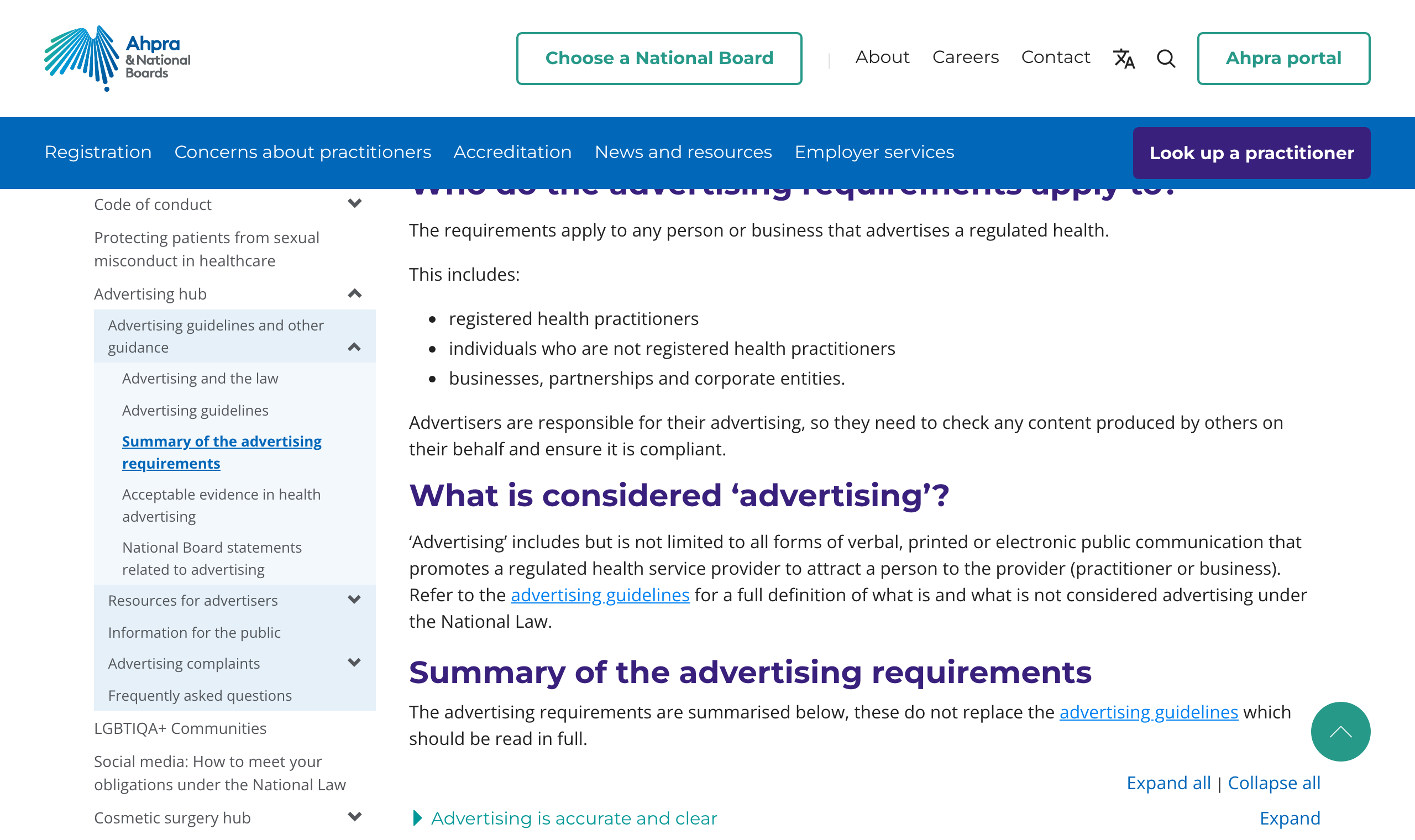
Source: Ahpra, Summary of the advertising requirements, screenshot taken 24 November 2026.
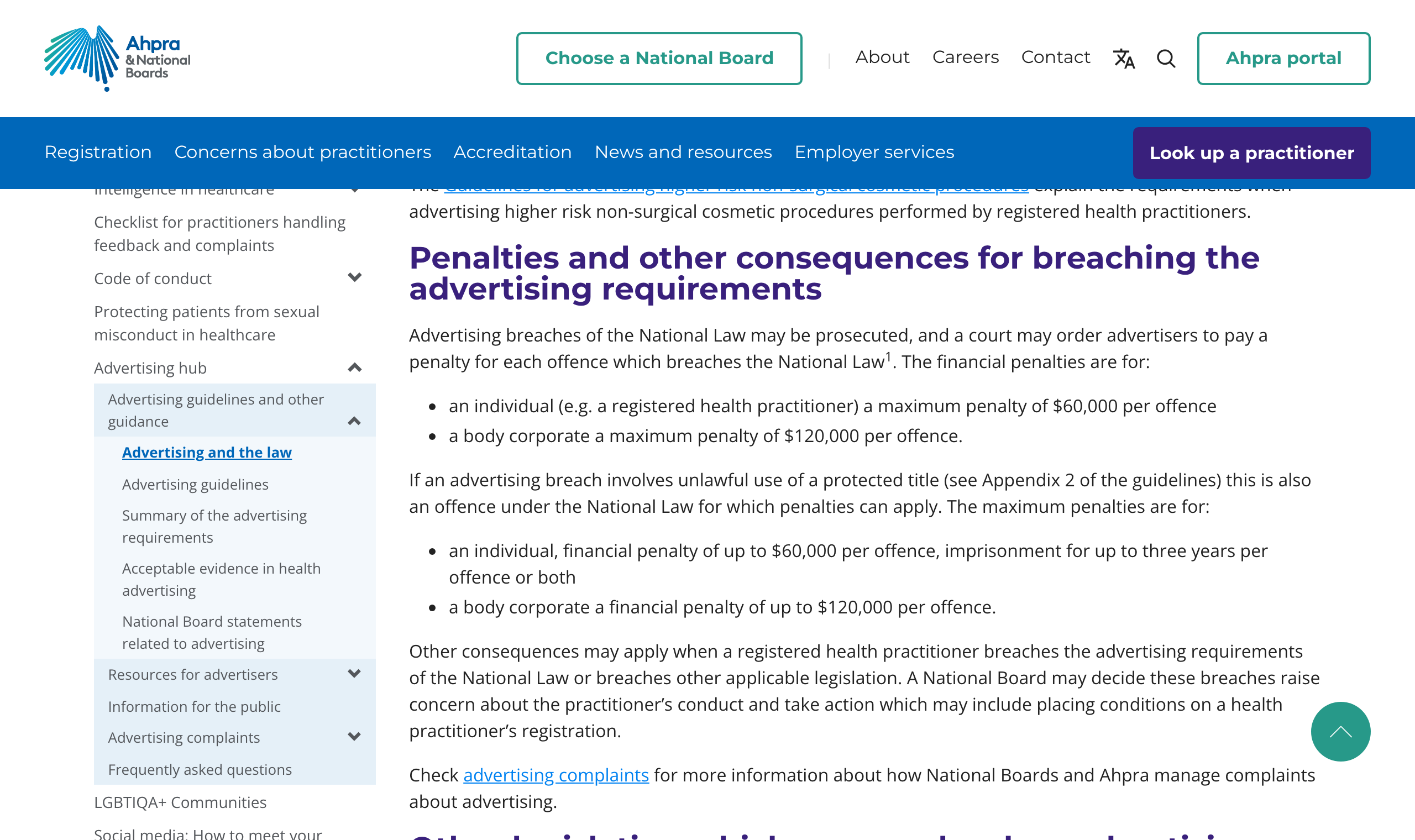
Source: Ahpra, Advertising and the law, screenshot taken 24 November 2026.
FAQ
What are Ahpra’s advertising requirements for a clinic website?
Ahpra’s Summary of the advertising requirements, page reviewed 2 September 2025, covers any person or business that advertises a regulated health service, and counts all forms of verbal, printed or electronic public communication as advertising. It has 13 headings (our count), from accurate and clear advertising through to time limited offers.
What is the maximum fine for a non-compliant clinic website?
Ahpra’s Advertising and the law page gives a maximum penalty of $60,000 per offence for an individual and $120,000 per offence for a body corporate, ordered by a court. Ahpra says these higher penalties apply in all jurisdictions, including Western Australia, from July 2024. Ahpra’s advertising guidelines say the 2022 National Law amendment raised the caps from $5,000 to $60,000 and $10,000 to $120,000.
Do the higher risk cosmetic procedure guidelines apply to my website?
Yes, if you advertise the procedures they cover. The Guidelines for advertising higher risk non-surgical cosmetic procedures, issued 2 September 2025, list “internet, including websites and social media” among the forms of advertising they cover. Ahpra’s examples of higher risk procedures include dental veneers, cosmetic injectables, thread lifts, sclerotherapy and hair transplants.
How do I check if my clinic website is compliant right now?
Get in touch with ClinicCode for an Ahpra compliance review of your website. We review every page against the current requirements and flag each finding against the specific category it falls under.
Get Your Website Checked Against All 13 Headings
ClinicCode fixes cosmetic clinic websites against Ahpra’s advertising framework, from the summary page through to the higher risk guidelines.
Talk to us about your clinic’s website
Sources and References
Ahpra, Summary of the advertising requirements - the 13 headings, page reviewed 2 September 2025
Ahpra, Advertising and the law - section 133 wording, current penalty amounts, July 2024 note
Ahpra, Cosmetic procedure advertising guidelines - scope, testimonial and before/after rules
Ahpra, New guidelines for cosmetic procedures - confirms the guidelines were in effect from 2 September 2025
Ahpra, Cosmetic surgery hub - Cosmetic Surgery Hotline number and hours
Related reading:
- Ahpra Compliance Audit Checklist: a channel by channel self-audit
- Ahpra advertising complaints: the enforcement data behind these rules
- Clinic Website Design: website builds for Ahpra-regulated clinics
For a website built around these headings from the first draft, talk to us about your clinic’s marketing.
Vikas Thakur
Founder, Perth. 16 years of experience from working at TPG, iiNet and Monadelphous, now helping Australian clinics keep their websites, ads and online presence AHPRA compliant.