Up to $120,000: The AHPRA Fine Optometry Ads Can Trigger (2026)
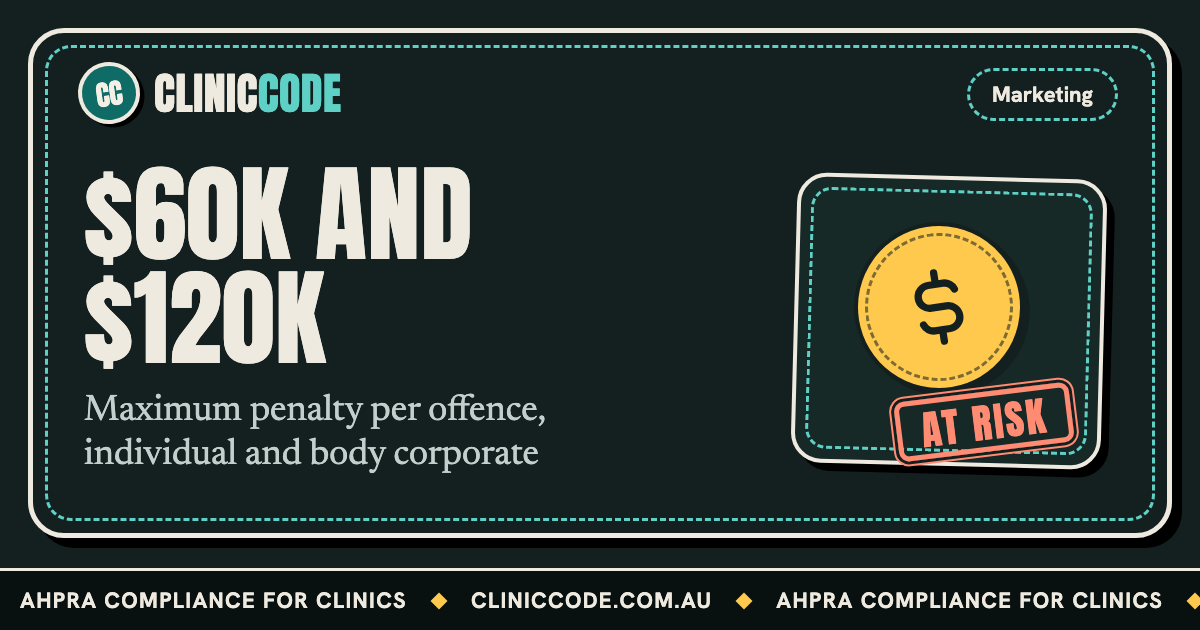
Under Section 133 of the National Law, an optometry practice run as a body corporate faces up to $120,000 per offence for breaking the advertising rules. The Optometry Board says the increased penalty scale applies in all jurisdictions, including WA, as of July 2024.
 Vikas Thakur Founder, Perth 9 min read Fact checked
Key takeaways
- $120,000 is the maximum National Law fine for a body corporate advertising breach, and $60,000 for an individual practitioner, a scale the Optometry Board states applies in all jurisdictions, including WA, as of July 2024. Ahpra’s advertising guidelines page still carries footnote 3, which gives Western Australia maxima of $30,000 for an individual and $60,000 for a body corporate against the unlawful use of a protected title offence, and the page does not reconcile it with its statement that the higher penalties apply in all jurisdictions, including Western Australia, as of July 2024.
- That penalty scale is a 12-fold increase (our arithmetic: $60,000 / $5,000 and $120,000 / $10,000): before a 2022 amendment, the maximums were $5,000 for an individual and $10,000 for a body corporate, per the Optometry Board
- Optometry advertising sits under Section 133 of the National Law, the same rule that binds every AHPRA-registered profession, not a separate optometry-only code
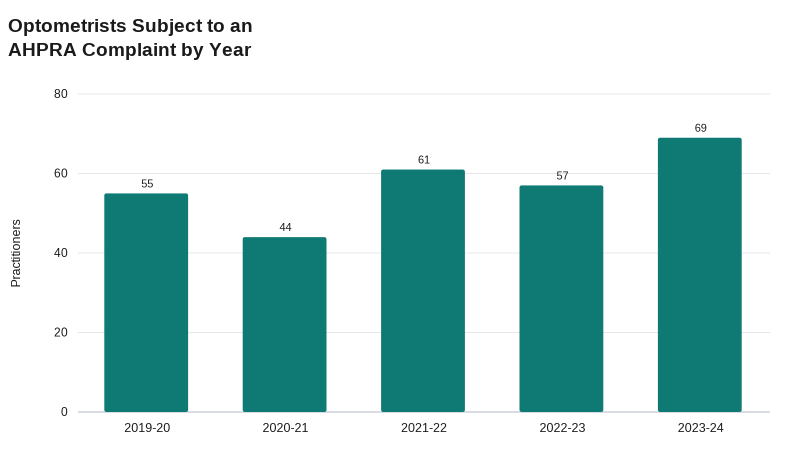
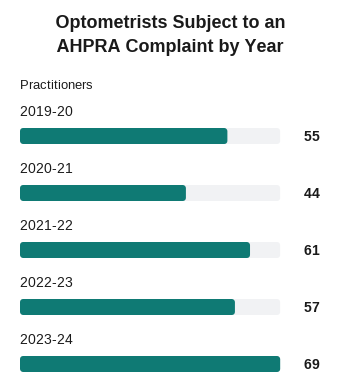
- 69 optometrists were the subject of an AHPRA complaint in 2023/24, the highest figure in five years, up from 44 in 2020/21, per Insight reporting the Board’s annual report
- Registered optometrist numbers reached 7,051 in the Optometry Board’s 2023/24 annual report, a 4.3% year-on-year rise (Insight)
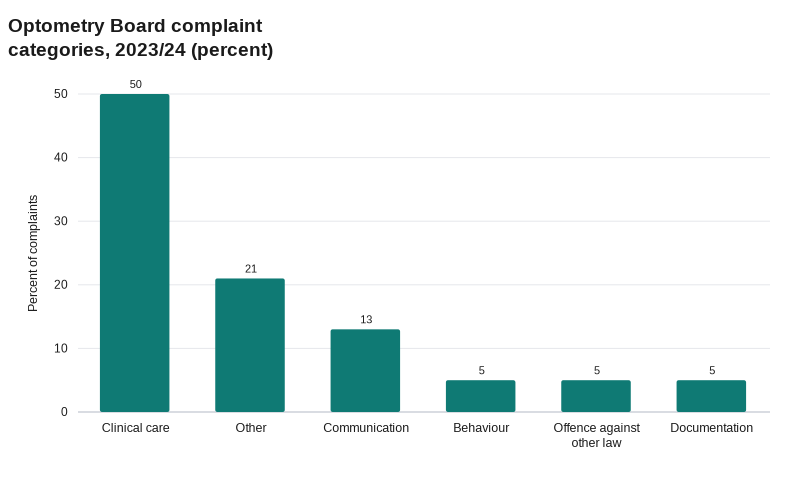
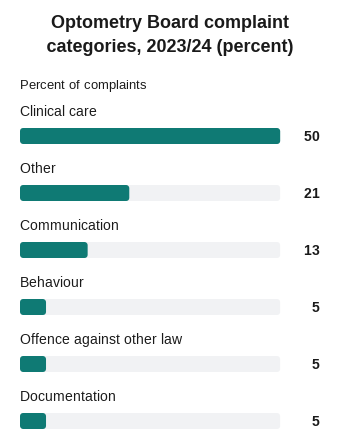
- 50% of 2023/24 optometry complaints related to clinical care (Insight), and we found no published breakdown of optometry-specific advertising complaints
- A “free eye test” or discounted-glasses ad is lawful only if it states the terms and conditions of the offer in the same advertisement
An optometry practice can be fined up to $120,000 for a single advertising breach in Australia. That is the maximum body corporate penalty under Section 133 of the Health Practitioner Regulation National Law, the same rule that binds every AHPRA-registered profession, optometry included. The Optometry Board of Australia states that this scale, individual $60,000 and body corporate $120,000 per offence, has applied in all jurisdictions, including Western Australia, as of July 2024. Optometrists are not exempt from it. The same rule that bans testimonials and undisclosed discounts for a cosmetic clinic bans them for an optical retailer running a “2-for-1 glasses” campaign too. Complaints against optometrists also hit a five-year high in 2023/24, though half concerned clinical care rather than advertising (Insight). This guide sets out what Section 133 bans, what a breach costs, and what it means for a practice’s website and ads.
What Section 133 Actually Bans
The National Law does not give optometry a separate advertising code. Section 133 applies to anyone advertising a regulated health service, or a business that provides one, and it bans five specific things. An advertisement must not be false, misleading or deceptive. It must not offer a gift, discount or other inducement unless the terms and conditions of the offer are stated in the same ad. It must not use testimonials or purported testimonials about the service or business. It must not create an unreasonable expectation of beneficial treatment. And it must not directly or indirectly encourage the indiscriminate or unnecessary use of a regulated health service.
For an optometry practice, these map onto everyday marketing habits. A Google review widget on a service page is a testimonial. A “free eye test with any frame purchase” ad without the conditions spelled out is an undisclosed inducement. “See clearer than ever, guaranteed” is an unreasonable expectation of benefit. A blanket reminder telling every patient they are “overdue” for a check-up regardless of clinical need risks the indiscriminate-use clause. None of these require a cosmetic procedure to trigger the rule. Get in touch with ClinicCode to check a website against this list, testimonials and undisclosed inducements included, against the specific provision each one falls under.
| Prohibited under Section 133 | Common optometry example |
|---|---|
| False, misleading or deceptive claims | Overstating what a lens coating or treatment achieves |
| Undisclosed gift, discount or inducement | “Free eye test” ad with no stated conditions |
| Testimonials or purported testimonials | Embedded Google review widgets, patient quotes |
| Unreasonable expectation of benefit | “Guaranteed clearer vision” style copy |
| Encouraging indiscriminate or unnecessary use | Blanket “you’re overdue” reminders with no clinical basis |
Takeaway: Section 133 applies to optometry the same way it applies to every AHPRA profession.
What a Breach Actually Costs
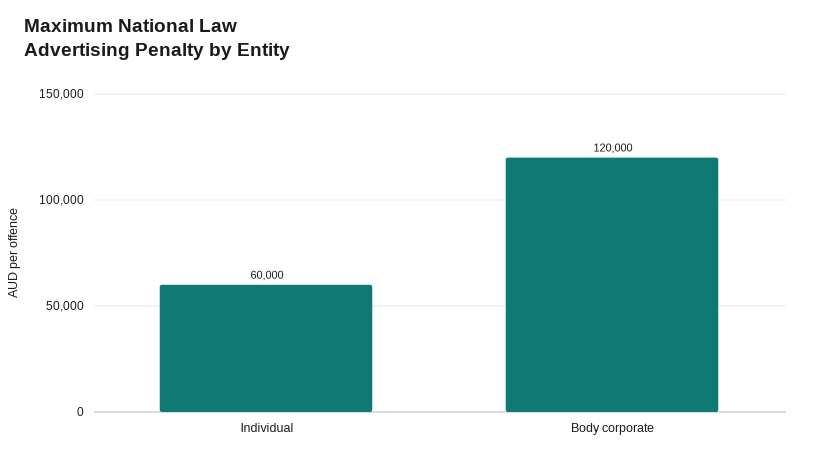
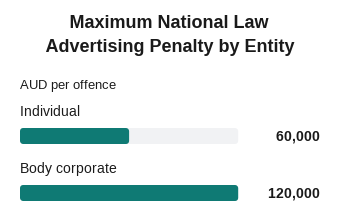
The financial penalties are not new, but they went up in 2022. The Optometry Board of Australia states plainly that a 2022 National Law amendment increased the maximum penalty for an individual from $5,000 to $60,000 per offence, and for a body corporate from $10,000 to $120,000 per offence, a 12-fold jump in both cases (our arithmetic from those two sourced inputs). The board also states that these increased penalties apply in all jurisdictions, including Western Australia, as of July 2024.
Ahpra says unlawful use of a protected title is also an offence under the National Law, and that a National Board may treat an advertising breach as a conduct concern and take action that can include placing conditions on a practitioner’s registration.
Source: Optometry Board of Australia and Ahpra.
Takeaway: The $120,000 figure is not a cosmetic-surgery-only number. It is the standard body corporate advertising penalty for every AHPRA-registered profession, optometry practices included, and the Optometry Board states it applies in all jurisdictions as of July 2024.
Why Enforcement Is No Longer Theoretical
Complaints against optometrists reached a five-year high in the Optometry Board’s 2023/24 annual report, as reported by Insight: 75 notifications about 69 optometrists Australia-wide. The number of optometrists notified in the earlier years was 55 in 2019/20, 44 in 2020/21, 61 in 2021/22 and 57 in 2022/23. That represents 1% of the entire profession. Registered optometrist numbers grew alongside that, reaching 7,051 in the same report, a 4.3% year-on-year rise and 16% growth over five years, up from 6,043 in 2019/20.
Half of those complaints, 50%, related to clinical care, and a further 13% to communication. Behaviour, offence against other law and documentation each accounted for 5%, with the remaining 21% categorised as other. We found no published figure for how many were specifically about advertising. That gap in the public data we could find is not a sign the rule goes unenforced.
Source: Insight, citing the Optometry Board of Australia 2023/24 annual report.
Takeaway: The profession is growing and so is complaint volume in absolute terms, though we found no public figure isolating advertising-specific breaches for optometry.
Source: Insight, citing the Optometry Board of Australia 2023/24 annual report.
What This Means for Your Optometry Website
Section 133 sets the same ceiling for every page on an optometry website, whatever the service. A dedicated landing page for myopia management, dry eye, orthokeratology, low vision or contact lens fittings can describe what the service involves and who it is generally for, in factual, evidence-based language. It cannot lean on a testimonial, promise a guaranteed outcome, or run a “book now, first visit free” offer without stating the conditions in the same ad. Building separate pages per service, rather than one generic “eye care” page, is a marketing decision, not a clinical one: it matches the specific search a parent researching myopia control or an adult researching dry eye is actually running, and in our view a page built around one specific search can match an enquiry better than one page competing for every keyword at once. It is the same compliance discipline we apply whenever we build a website for an AHPRA-regulated practice, regardless of which National Board the practitioner sits under.
The workforce data also shows where digital competition is building: in the Board’s Q4 2023 statistics, as reported by Insight, NSW had the largest optometry workforce, followed by Victoria, Queensland, Western Australia and South Australia.
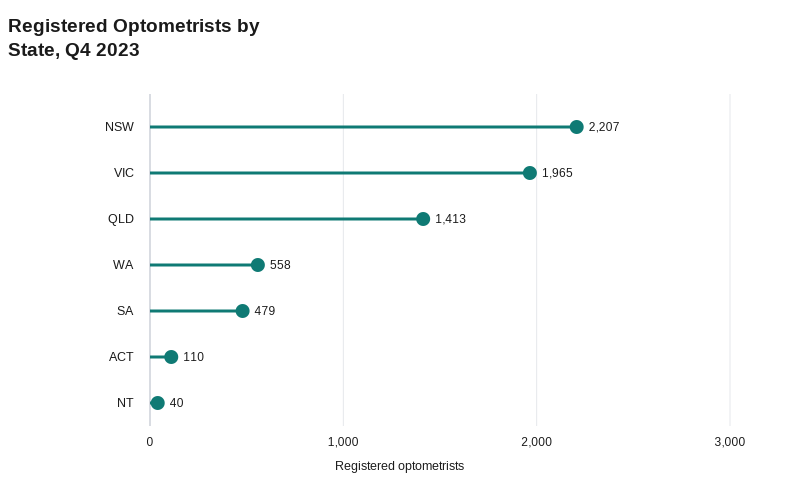
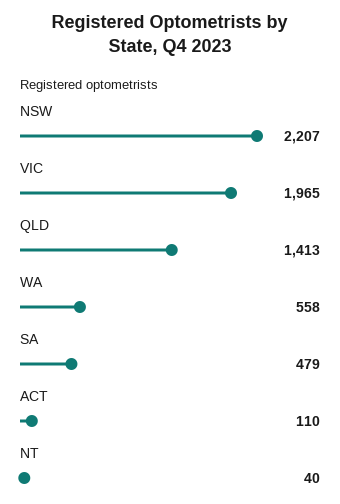
Source: Insight, citing the Optometry Board of Australia Q4 2023 quarterly statistics.
More registrants in a state can mean more practices competing for the same local searches, which is our reading of the data, not a sourced finding.
Takeaway: The digital lever available to an optometry practice is page structure and disclosure, not clinical claims. Section 133 sets the same limits regardless of which service the page is selling.
FAQ
What are the AHPRA advertising rules for optometrists in Australia?
Optometrists are bound by Section 133 of the Health Practitioner Regulation National Law, the same rule that applies to every AHPRA-registered profession. It bans false or misleading claims, undisclosed gifts or discounts, testimonials, claims that create an unreasonable expectation of benefit, and encouraging indiscriminate or unnecessary use of a regulated health service.
What is the maximum fine for breaching optometry advertising rules?
Up to $60,000 per offence for an individual practitioner and up to $120,000 per offence for a body corporate. The Optometry Board states this scale, up from $5,000 and $10,000 before a 2022 National Law amendment, applies in all jurisdictions, including WA, as of July 2024.
Can an optometry practice advertise a free or discounted eye test?
Yes, but only if the advertisement also states the terms and conditions of the offer. Section 133 bans offering a gift, discount or other inducement unless the terms and conditions of the offer are also stated.
Do complaints about optometrists usually relate to advertising?
Not mostly. Per Insight’s report on the Optometry Board’s 2023/24 annual report, half of complaints related to clinical care and 13% to communication. We found no published optometry-specific advertising complaint figure.
Get an Advertising Compliance Check Before AHPRA Does
ClinicCode fixes AHPRA-regulated practice websites and ad accounts against the current National Law requirements, testimonials and undisclosed inducements included.
Talk to us about your practice’s website and advertising
Sources and References
Optometry Board of Australia - Advertising a regulated health service: Section 133 prohibited list, the 2022 penalty increase from $5,000/$10,000 to $60,000/$120,000, and the July 2024 statement that the increased penalties apply in all jurisdictions
Insight - Complaints against Australian optometrists hit a five-year high: the 2019/20-2023/24 complaint trend, 2023/24 complaint categories, and registrant figures, citing the Optometry Board of Australia’s 2023/24 annual report
Insight - Registered optometrists surpass 7,000: state-by-state registrant totals from the Optometry Board of Australia’s Q4 2023 quarterly statistics
Related reading:
- AHPRA Advertising Fines for Cosmetic Clinics: the penalty structure for cosmetic procedure advertisers
- AHPRA Assessed 380 Advertising Complaints in 2022/23: enforcement activity across all AHPRA professions
- Clinic Website Design: compliant website builds for AHPRA-regulated practices
For a website and ad accounts that stay inside Section 133 regardless of which National Board applies, talk to us about your practice’s marketing.
Vikas Thakur
Founder, Perth. 16 years of experience from working at TPG, iiNet and Monadelphous, now helping Australian clinics keep their websites, ads and online presence AHPRA compliant.