Anti-Wrinkle Injection Statistics Australia: What We Could Source
Grand View Research puts Australia’s facial injectable market at US$209.3 million in 2025. ISAPS counted 26,775 botulinum toxin procedures in Australia in 2024. Here is what each figure covers, and what it does not.
 Vikas Thakur Founder, Perth 8 min read Fact checked

Key takeaways
- Grand View Research estimates Australia’s facial injectable market at US$209.3 million in 2025, forecasting US$402.6 million by 2033 (8.6% a year from 2026 to 2033). These are US dollar market estimates, not clinic revenue.
- On the same research house’s pages, botulinum toxin was the largest product segment in Australia in 2025
- ISAPS’s 2024 survey of plastic surgeons counted 26,775 botulinum toxin procedures in Australia, ahead of 25,148 hyaluronic acid procedures
- Worldwide, ISAPS reports 7.8 million botulinum toxin procedures by plastic surgeons in 2024 (the ISAPS press release figure; the report tables list 7,887,955), the most common non-surgical procedure
- 47.0% of botulinum toxin patients in the ISAPS survey were aged 35-50, the largest age group
- We found no current source that ranks Australia per person for anti-wrinkle injectables, so we do not repeat that claim
Grand View Research estimates Australia’s facial injectable market at US$209.3 million in 2025 and forecasts US$402.6 million by 2033. ISAPS, the International Society of Aesthetic Plastic Surgery, counted 26,775 botulinum toxin procedures in Australia in 2024. You may also have seen the claim that Australia is one of the highest per-person users of anti-wrinkle injectables in the world. We went looking for a source for that claim and did not find one. Here is what we could check, with the page behind each figure.
Checking the Per-Capita Claim
Search “Australia botox per capita” and you will find clinic blogs repeating some version of the same line: Australia is one of the highest per-person users of anti-wrinkle injectables. We wanted the primary source. ISAPS runs the main global survey of aesthetic procedures, so we read its 2024 report in full.
The report gives procedure counts by country and worldwide totals by procedure type. In the text we searched, we found no per-person ranking of countries for botulinum toxin. The only mention of population is in the survey method: ISAPS used a regression model on population size and GDP to estimate the number of plastic surgeons in countries where it lacked data. It is not a usage rate.
| What gets claimed | What we found |
|---|---|
| “Australia ranks #X in the world for anti-wrinkle injectables per capita” | We found no source for this in the ISAPS 2024 report |
| Australia’s botulinum toxin volume in 2024 | 26,775 procedures, per ISAPS 2024, page 33 |
| Hyaluronic acid (filler) volume in Australia in 2024 | 25,148 procedures, same page |
Source: ISAPS International Survey on Aesthetic/Cosmetic Procedures performed in 2024, pages 33 and 4. Our companion post on how many cosmetic procedures Australia performs yearly covers the same survey.
These counts come from a survey, not a census. ISAPS says the survey focuses on board-certified (or national equivalent) plastic surgeons, and that worldwide totals are extrapolated from the responses of 2,975 surgeons. So the Australian figures show what surveyed plastic surgeons reported, not every anti-wrinkle treatment given in Australia.
Takeaway: A claim repeated often enough starts to sound like a fact. We could not trace this one to a primary source, so we would rather say so than repeat it.
Australia’s Market Size and Procedure Counts
Grand View Research publishes country pages for the facial injectable market. Its Australia page says the market generated US$209.3 million in 2025 and is expected to reach US$402.6 million by 2033, a compound annual growth rate of 8.6% from 2026 to 2033. It names botulinum toxin as the largest revenue-generating product in 2025. Its UK page gives US$517.4 million in 2025 and US$963.9 million by 2033, a growth rate of 8.1% over the same period, with botulinum toxin again the largest product.
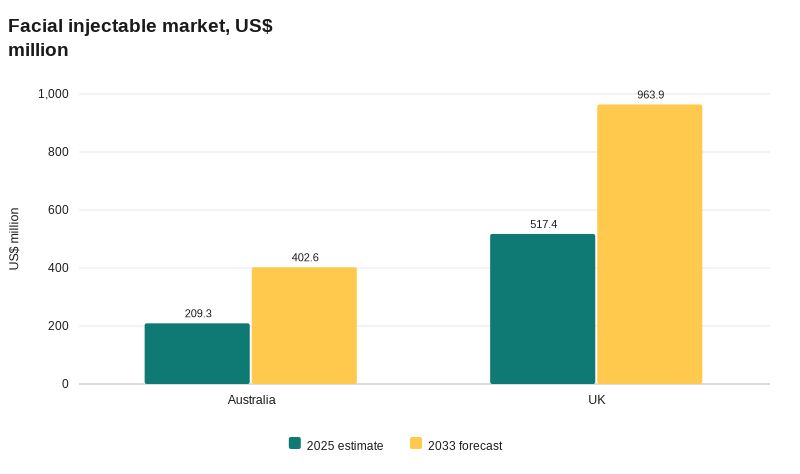
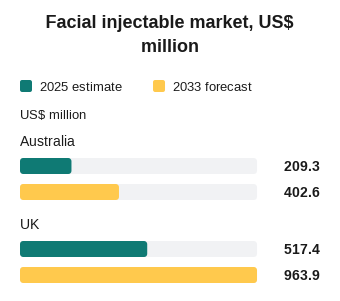
Source: Grand View Research, Australia facial injectable market outlook and UK facial injectable market outlook. Figures are US dollars; 2033 values are forecasts.
These are research-house estimates, and the detailed data sits behind a paywall, so we have only used what the public pages state. We have not turned them into a per-person spend figure. Market estimates and survey procedure counts measure different things and cannot be divided into each other.
The ISAPS report gives a different view for Australia: how many procedures plastic surgeons reported. In its list of the most common non-surgical procedures in Australia in 2024, botulinum toxin came first, with hyaluronic acid second. The chart shows the five largest non-surgical procedures only; ISAPS’s Australian total of 177,502 includes 114,188 surgical procedures.
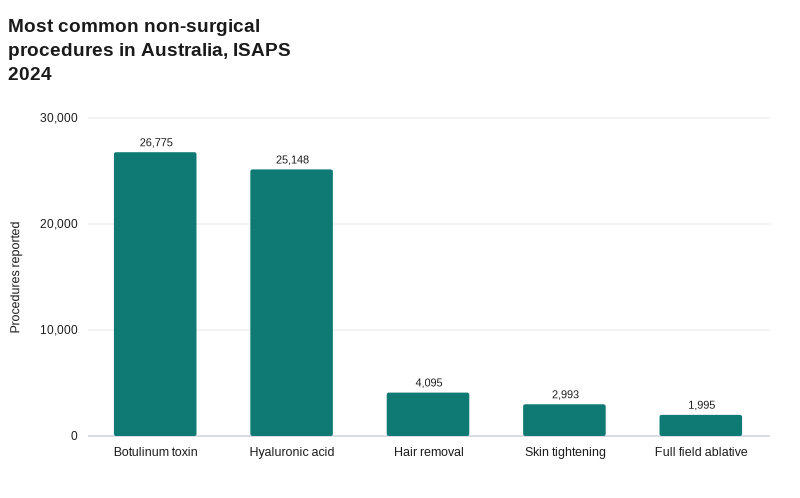
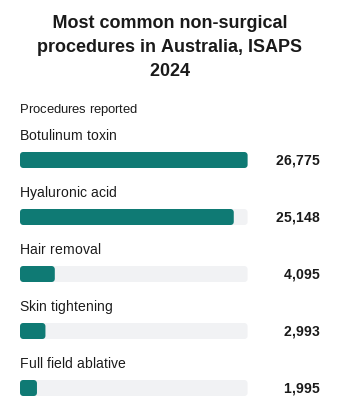
Source: ISAPS 2024 survey, Australia, page 33. The page lists botulinum toxin as 42.3% of 63,315 non-surgical procedures reported for Australia.
Takeaway: The Australian figures that hold up are a market estimate from one research house and a survey count from plastic surgeons. Neither tells you what a typical clinic earns or treats.
Who’s Getting Anti-Wrinkle Injections
ISAPS’s age breakdown is global, not Australian. Of the botulinum toxin procedures in its 2024 report, the 35-50 age group was the largest. The press release gives that group as 47.0% of the total. The report’s own age table (page 77) shows 47.1%, a rounding difference between the two ISAPS documents.
| Age group (global, 2024) | Botulinum toxin procedures | Share in ISAPS table |
|---|---|---|
| 17 years or younger | 39,440 | 0.5% |
| 18-34 years | 1,798,454 | 22.8% |
| 35-50 years | 3,715,227 | 47.1% |
| 51-64 years | 1,861,557 | 23.6% |
| 65 years or older | 473,277 | 6.0% |
Source: ISAPS 2024 survey, page 77 (table) and the ISAPS press release (47.0%).
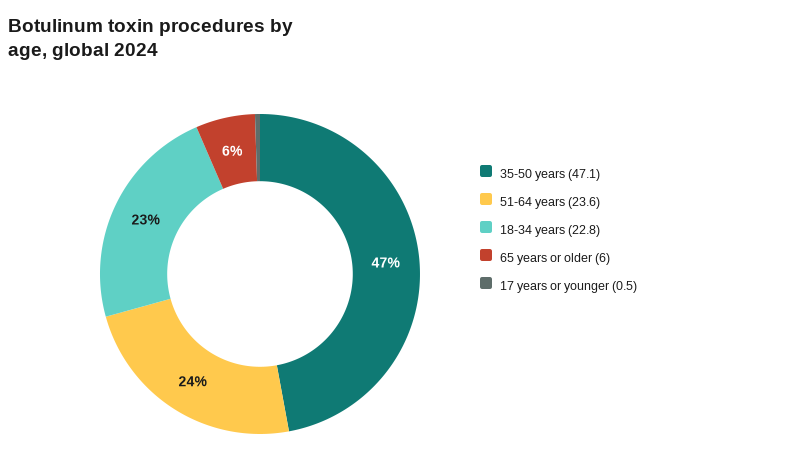
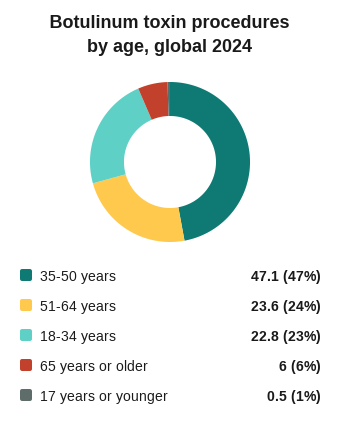
Source: ISAPS 2024 survey, page 77. Shares as printed in the table; they are global, not Australian.
On sex, the ISAPS top-five tables list 6,622,473 botulinum toxin procedures for women and 1,265,482 for men worldwide in 2024 (page 6). We did not find an Australia-only age or sex breakdown for anti-wrinkle injectables from Ahpra, the TGA or an Australian professional body, so we have not labelled any of this as an Australian statistic. For wider demand data, see our cosmetic surgery statistics piece.
Takeaway: In this survey, the 35-50 group is the biggest slice of botulinum toxin patients and most procedures are on women. Treat it as a global picture, not a profile of your clinic’s patients.
Dosing Reference
The only dosing source we opened is the US prescribing information for BOTOX Cosmetic (revised 10/2024). Australian product information can differ, so check the TGA-approved product information for the brand you use. The US label’s total recommended doses are:
| Treatment area | Total recommended dose (US label) | Injection sites on the label |
|---|---|---|
| Glabellar lines (frown lines) | 20 Units | 5 sites, 4 Units each |
| Lateral canthal lines (crow’s feet) | 24 Units | 3 sites per side, 6 in total, 4 Units each |
| Forehead lines with glabellar lines | 40 Units (20 forehead + 20 glabellar) | 5 forehead sites plus 5 glabellar sites, 4 Units each |
| Forehead, glabellar and lateral canthal | 64 Units | Doses above added together |
Source: BOTOX Cosmetic prescribing information (US, revised 10/2024), Table 1 and the forehead lines section.
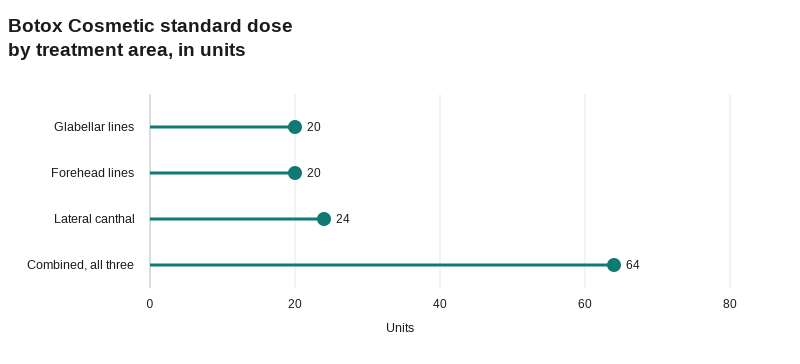
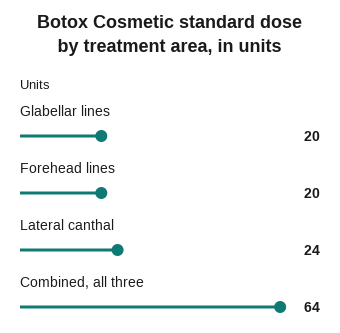
Source: same US prescribing information. Doses are for BOTOX Cosmetic only.
The same label says its potency Units cannot be compared to or converted into Units of any other botulinum toxin product. That matters for clinic websites: a price per unit for one brand is not like for like with another brand.
Takeaway: Dose is set per product, so a price per unit only makes sense next to the brand, and the brand is exactly what a public ad cannot name (see below).
What This Means for Clinics Marketing Anti-Wrinkle Treatments
Two regulators matter here, and they cover different things.
Ahpra’s Guidelines for advertising a regulated health service say advertising of a regulated health service must not use testimonials or purported testimonials about the service or business (National Law section 133). On before and after images, the guidelines say care should be taken because they can be misleading, and list when they are less likely to be, such as images being as similar as possible in content, camera angle, background, framing and exposure.
The TGA covers the medicine itself. Its FAQ on advertising health services and cosmetic injections says most cosmetic injectables contain Schedule 4 substances and, under the Therapeutic Goods Act 1989, cannot be advertised to the public. It also says the TGA no longer expressly permits terms such as “wrinkle reducing injections” where a reasonable consumer would understand the content as promoting a prescription-only medicine, and that this includes acronyms, nicknames, abbreviations and hashtags. Its guidance is that clinics should focus advertising on the types of consultations available.
An unsourced statistic, a brand name in an ad or an old testimonial on a website can become a real compliance problem. If you are not sure where your site stands, get in touch with ClinicCode and we will check it against these two sets of rules and tell you what to fix. We build cosmetic clinic websites with Ahpra and TGA advertising rules in mind from the first wireframe. This post is not legal advice, and neither regulator will tell you whether a specific ad complies.
Takeaway: Clinics that market accurately, with a source for every number, carry less risk than those repeating the biggest-sounding stat they found online.
Data sources: International Society of Aesthetic Plastic Surgery (ISAPS), International Survey on Aesthetic/Cosmetic Procedures performed in 2024 and its June 2025 press release; Grand View Research, Australia and UK facial injectable market outlook pages; BOTOX Cosmetic US prescribing information (revised 10/2024); Ahpra, Guidelines for advertising a regulated health service; TGA, advertising health services and cosmetic injections FAQ.
ClinicCode builds Ahpra-aware websites for Australian cosmetic clinics. Visit cliniccode.com.au to see our work, or get in touch to discuss your clinic’s website and marketing.
Vikas Thakur
Founder, Perth. 16 years of experience from working at TPG, iiNet and Monadelphous, now helping Australian clinics keep their websites, ads and online presence AHPRA compliant.