AI in Dentistry Australia: What It Means for Your Website
BDO Australia reported that about 12% of dental practices use AI tools and about 70% of dentists want AI for patient education. Here is what that means for a dental practice’s website, chatbot and marketing copy under Ahpra’s advertising rules, not the clinical AI getting most of the attention.
 Vikas Thakur Founder, Perth 9 min read Fact checked
Key takeaways
- BDO Australia’s article of 8 September 2025 says “only ~12 per cent of practices currently use AI tools” in Australian dentistry, per BDO
- The same BDO article says about 70% of dentists want to use AI for patient education, and nearly two-thirds want it for data analysis, diagnostics and practice management
- A survey of 155 Australian dentists and dental students found 54.8% were aware of dental AI applications, but 70.3% could not name a specific AI software (Hegde et al., 2025)
- A Dental Reviewed survey of 300 dentists in the UK, US and Canada found 32% use at least one AI tool, as reported by GDPUK on 1 June 2026
- Ahpra’s guidelines for advertising higher risk non-surgical cosmetic procedures (issued 2 September 2025) name dental veneers as an example and say before and after images must be genuine images of actual patients, per Ahpra
BDO Australia says about 12% of dental practices currently use AI tools. In the same article, about 70% of dentists say they want AI for patient education, and nearly two-thirds want it for data analysis, diagnostics and practice management. Those two numbers use different bases (practices in one case, dentists in the other), so we do not subtract one from the other. They do tell you that interest is running ahead of use.
Most coverage of AI in dentistry talks about chairside tools: AI reading X-rays, writing clinical notes, flagging cavities. This post is about something else. A website chatbot or an AI copywriting subscription needs no clinical equipment, so our view is that many practices will meet AI through their website and marketing first. That is where Ahpra’s advertising rules and a practice’s digital presence collide.
How Many Australian Dental Practices Use AI
BDO Australia’s healthcare team published “Navigating the future: Trends, challenges and opportunities for Australian dental practices” on 8 September 2025. On AI it says: “While only ~12 per cent of practices currently use AI tools, interest is high, with about 70 per cent of dentists wanting to deploy AI for patient education and nearly two-thirds keen on AI for data analysis, diagnostics, and practice management.”
The article page gives no survey name, sample size or fieldwork dates for those figures, so treat them as a professional services firm’s industry estimate, not a peer-reviewed study.
| Measure | BDO figure |
|---|---|
| Practices currently using AI tools | about 12% |
| Dentists wanting AI for patient education | about 70% |
| Dentists keen on AI for data analysis, diagnostics and practice management | nearly two-thirds |
Source: BDO Australia, “Navigating the future” (8 September 2025), AI trends section.
Takeaway: Use is low and interest is high, and BDO also lists cost, integration, training and data privacy as barriers to wider implementation.
An Overseas Comparison, With Caveats
Dental Reviewed surveyed 300 licensed dentists in Canada, the US and the UK between February and April 2026. GDPUK reported the results on 1 June 2026: 32% currently use at least one AI-powered tool, 38% are considering it, 12% tried AI and stopped, and 18% have no interest.
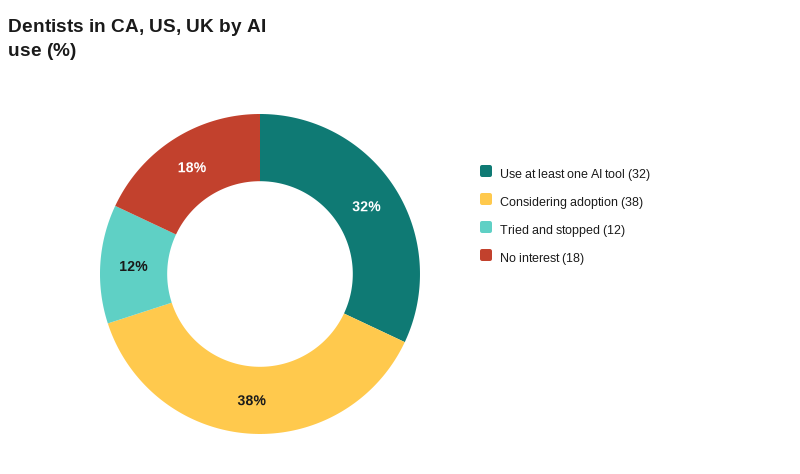
Source: GDPUK, “One in three dentists now using AI tools, survey finds” (1 June 2026), reporting a Dental Reviewed survey of 300 licensed dentists in the UK, US and Canada.
Among dentists already using AI, GDPUK reports 52% described it as a helpful second opinion, and 82% of current users cited radiograph analysis, the most widely adopted application.
We have not set this beside BDO’s 12%. BDO counts practices and the Dental Reviewed survey counts individual dentists in three other countries, so the two are not like for like.
Among dentists who had stopped using AI tools, GDPUK reports cost was the most commonly cited reason (28%), followed by poor integration with existing practice management systems (22%) and concerns about accuracy and reliability (18%).
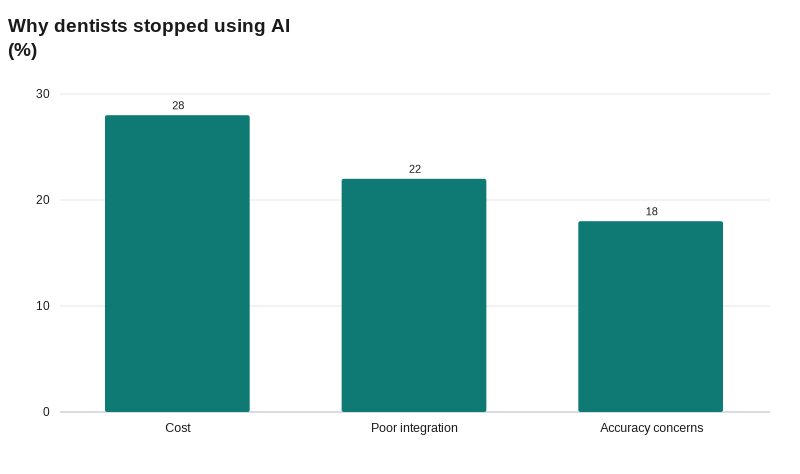
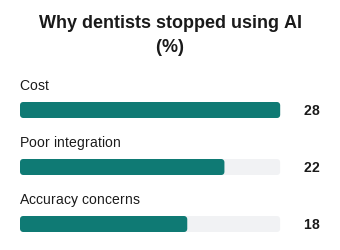
Source: GDPUK, 1 June 2026, reporting Dental Reviewed’s survey of 300 dentists in the UK, US and Canada. Only the three reasons GDPUK lists are shown; the report does not give the remainder.
Takeaway: Price and software fit, not doubt about AI itself, were the top reasons given for dropping a tool in that survey.
What Australian Dentists Say About AI
The clearest Australian data on attitudes is a peer-reviewed survey in the European Journal of Dental Education. Hegde and colleagues invited registered Australian dentists and students in accredited dental or oral health programmes to an online questionnaire. They received 177 responses and used 155 complete ones.
| Finding (per the paper’s abstract) | Figure |
|---|---|
| Aware of dental AI applications | 54.8% |
| Could not name a specific AI software | 70.3% |
| Viewed AI as a supportive tool | 91.6% |
| Believed AI would be beneficial in clinical tasks | 69% |
| Anticipated routine dental AI use in the next 5 to 10 years | 40% |
Source: Hegde S, Nanayakkara S, Jordan A, Jeha O, Patel U, Luu V, Gao J, “Attitudes and Perceptions of Australian Dentists and Dental Students Towards Applications of Artificial Intelligence in Dentistry: A Survey,” European Journal of Dental Education, 2025;29(1):9-18. Abstract read via Europe PMC (PMID 39340812). 155 complete responses analysed. The sample is dentists and students combined and was not drawn to represent all Australian dentists.
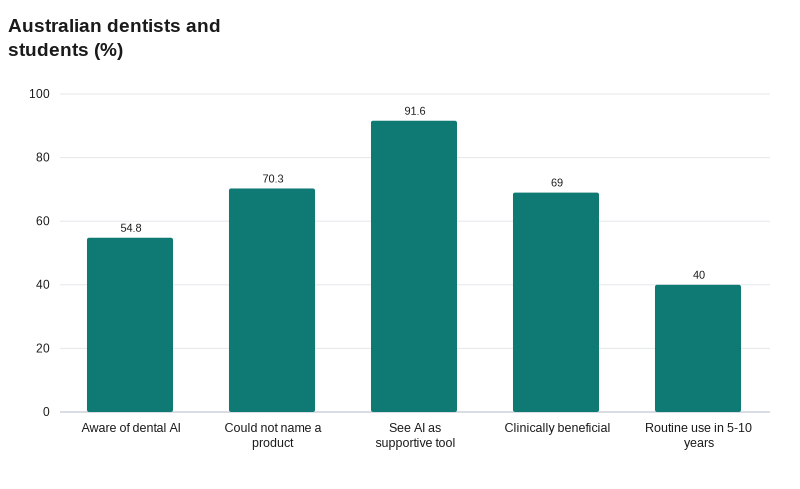
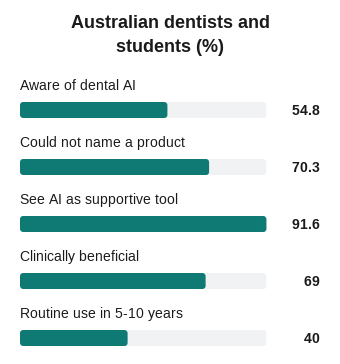
Source: Hegde et al., European Journal of Dental Education, 2025 (abstract, doi 10.1111/eje.13042). Based on 155 complete responses from Australian dentists and dental students.
The abstract also reports concerns about job displacement, inflexibility in patient care and mistrust of AI’s accuracy.
Takeaway: In this sample, most people had heard of dental AI and most saw it as supportive, but most could not name a product.
The AI Risk Ahpra Cares About: Your Website
Ahpra’s Guidelines for advertising higher risk non-surgical cosmetic procedures were issued on 2 September 2025. The page says they were developed by National Boards under section 39 of the National Law. The page lists “dental veneers” among its examples of higher risk cosmetic procedures. Other dental advertising falls under the broader guidelines for advertising a regulated health service, which the page links to.
On images, the guidelines say:
- before and after images must be genuine, meaning “actual patients who have had the procedure being advertised performed by that health practitioner”
- images must not be “edited or enhanced, for example through the use of filters, retouching, grey-scaling and similar techniques”
- images of people under 18 must not be used
- testimonials are banned under the National Law (the page cross-refers to its section on testimonials)
We did not find the words “AI-generated” on that page. Our reading is that an AI-generated “preview” of a veneer result is not an image of an actual patient treated by that practitioner, so it cannot stand in as a before and after image. Confirm your own case with the Dental Board, Ahpra or your adviser. We cover the wider rules in our guide to the Ahpra advertising rules for cosmetic dentistry.
On who is responsible, the same page says the National Law restrictions “apply to each person who is advertising the service”, that any person who authorises advertising is responsible for it, and that this includes the business owner and anyone in control of the advertising. Ahpra’s separate guidance on AI says “the practitioner remains responsible” and “must apply human judgment to any output of AI.”
Sources: Ahpra, Advertising higher risk non-surgical cosmetic procedures (date of issue 2 September 2025, page reviewed 14/10/2025); Ahpra, Meeting your professional obligations when using Artificial Intelligence in healthcare.
Takeaway: The AI risk on a dental website is an unsupervised writing or image tool publishing something the practice is accountable for.
AI Chatbots on Booking Pages
An AI chatbot on a booking page is not automatically a compliance problem. It becomes one when it starts doing a dentist’s job in text: describing what a treatment will look like on a specific patient, or writing anything that reads like a testimonial. Our suggestion is to keep a booking chatbot to logistics.
| A booking chatbot can | A booking chatbot should not |
|---|---|
| Show appointment slots and confirm bookings | Diagnose a condition or recommend a treatment |
| Answer opening hours and location questions | Promise or imply a treatment outcome |
| Collect basic intake details before a visit | Generate a “preview” image of a treatment result |
| Pass urgent queries to a human at the practice | Use testimonial-style or review-style language |
Scope is our suggested approach, not Ahpra wording. The outcome, image and testimonial rows draw on the Ahpra guidelines page cited above; the Ahpra AI page says practitioners must apply human judgment to AI output.
How to Evaluate a Website AI Tool
Before switching one on, check four things.
- Does a human review every output before it publishes? Ahpra’s AI page says practitioners must apply human judgment to any output of AI.
- Does it generate images? If it offers “smile preview” or “before/after simulation” features, do not use them in advertising a result. See the genuine-image requirement above.
- Can it spot testimonial-style claims? A general-purpose writing tool is not built around Ahpra’s rules, so check its drafts against them.
- Who is accountable if it gets something wrong? Per Ahpra’s pages above, the practice and the people who authorise the advertising, not the software vendor.
If that sounds like copy or a chatbot script live on your site now, it is worth checking. A compliance review from ClinicCode covers testimonials, before and after imagery, outcome claims and AI-generated content.
What This Means for Your Practice’s Website
If you are weighing a chatbot, an AI-assisted copy workflow or an AI review-response tool, check what it publishes against Ahpra’s advertising guidelines before it goes live. That is the part most vendor sales pages skip.
Talk to ClinicCode About Your Dental Practice’s Website
ClinicCode builds websites for dental and cosmetic clinics across Australia, including booking flows, chatbot logic and content review steps designed around Ahpra’s advertising rules. If an AI tool already drafts copy or answers patient questions on your site, it is worth confirming what it says.
Get in touch to talk through what an AI-aware website looks like for your practice.
Data sources: BDO Australia, “Navigating the future: Trends, challenges and opportunities for Australian dental practices” (8 September 2025); GDPUK, “One in three dentists now using AI tools, survey finds” (1 June 2026), reporting Dental Reviewed’s survey of 300 licensed dentists in Canada, the US and the UK (February to April 2026); Hegde et al., European Journal of Dental Education, 2025;29(1):9-18; Ahpra, Guidelines for advertising higher risk non-surgical cosmetic procedures (issued 2 September 2025) and Ahpra, guidance on Artificial Intelligence in healthcare.
Vikas Thakur
Founder, Perth. 16 years of experience from working at TPG, iiNet and Monadelphous, now helping Australian clinics keep their websites, ads and online presence AHPRA compliant.