Drip Pricing Rules 2027: What Your Checkout Must Show
From 1 July 2027, a mandatory booking fee must be shown next to the price you display, not appear for the first time at checkout. The law has passed Parliament but had not commenced when we checked on 25 August 2026.
 Vikas Thakur Founder, Perth 13 min read Fact checked
Key takeaways
- The Competition and Consumer Amendment (Unfair Trading Practices) Bill 2026 has passed Parliament and its requirements take effect from 1 July 2027 (Allens)
- From that date, a mandatory booking, transaction, or facility fee must sit next to the price you display, not appear for the first time at the payment screen
- Allens says corporate penalties are the greater of $100 million, three times the benefit gained, or 30% of turnover, per contravention (Allens)
- Dendy Cinema paid a $19,800 infringement notice penalty in June 2025 over an alleged drip pricing pattern under existing law (ACCC)
- Allens says the charge must be disclosed in close proximity to the base price in offers and advertising, so show it with the price on your price listing and ads, and, in our reading, at each booking step where a price appears, not just the final page
- As at 25 August 2026 the law was passed but not commenced. Nothing changes on your site yet, but the build work does not wait for commencement day
As at 25 August 2026, the Competition and Consumer Amendment (Unfair Trading Practices) Bill 2026 has passed Parliament but is not yet in force. From 1 July 2027, a business that displays a price for a consumer service online has to show transaction-based charges, such as a mandatory booking fee, next to that price, not reveal them for the first time at the payment screen. If your booking widget adds a fee partway through checkout, that flow needs rebuilding before commencement, because the ACCC already treats this pattern as a live enforcement target under the law as it stands today.
What the Law Actually Says
The Allens summary (13 July 2026) reports that Federal Parliament has passed new unfair trading practices laws (the Competition and Consumer Amendment (Unfair Trading Practices) Bill 2026, as the Bills Digest names it) and says the new requirements commence on 1 July 2027. The Parliamentary Library Bills Digest also lists commencement as 1 July 2027. Neither page names an Act: Allens says Parliament has passed new laws and the Bills Digest names the Bill, so this post calls it the Bill. We have not checked the Federal Register of Legislation directly, so confirm the current status and the Act’s title there before you rely on a date.
The Act amends the Australian Consumer Law in two ways that matter for a booking checkout.
First, it introduces a new general prohibition on unfair trading practices, which Allens describes as covering conduct likely to manipulate consumers or unreasonably distort consumer decision-making, such as dark patterns.
Second, and more specifically, it adds a transaction-based charge disclosure duty. Where a business displays a base price for goods or services and a transaction-based charge applies, the business must, per Allens, disclose in close proximity to the base price: the amount of the charge, or the method for working it out if a fixed figure is not possible; that the charge applies per transaction; whether the charge will or may apply; and whether the displayed base price already includes it. Allens says the information must be displayed in a legible, prominent and unambiguous way. It describes a transaction-based charge as one that is or may be payable for the supply, is not an amount payable for the goods or services themselves, and is or would be payable at the same time as that amount. It lists optional charges and payment surcharges among the exclusions. The drip pricing rules apply to offers of goods or services ordinarily acquired for personal, domestic or household use, not to offers made to businesses.
The same Act also adds disclosure, notification and cancellation requirements for subscription contracts (Allens). That matters for any clinic running a treatment membership or skin subscription, though the disclosure duty above is the part that hits a one-off booking checkout hardest.
Takeaway: the rule is specific about where a fee must appear, not just whether it can be charged at all.
What This Means for the Build
Reporting the requirement is one thing. Turning it into a checkout is another, and this is where most existing booking widgets fall short.
Rename the price field wherever a mandatory fee applies. A field labelled service_price that only ever shows the treatment cost, with a separate booking_fee line injected by the payment gateway at the last step, fails the “same time, close proximity” test even if both figures are technically visible somewhere. The fix is a single displayed figure, total_price, built from service_price + mandatory_fees, shown at every point the base price currently shows.
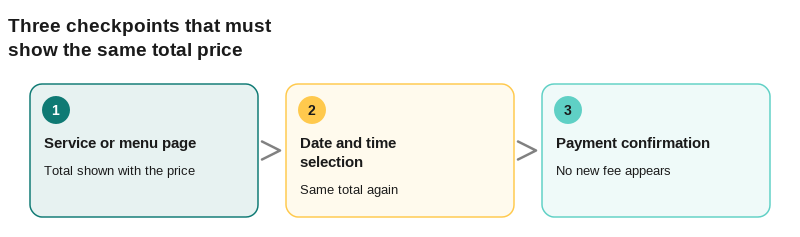
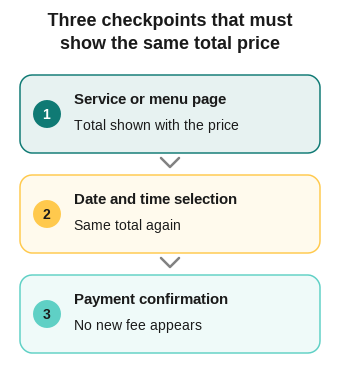
Show the fee at three checkpoints, not one. The service or menu page, the date and time selection step, and the payment confirmation step should all show the same total. If your booking platform’s default behaviour is to add a “platform fee” or “convenience fee” only on the payment screen, that is exactly the pattern the disclosure duty targets, and it is worth checking your platform’s settings for a “show fee upfront” or “include fee in displayed price” toggle before assuming a rebuild is needed.
Separate mandatory from conditional charges in your markup. A charge that applies to every booking, for example a clinic-wide facility fee, is mandatory and needs the full disclosure treatment everywhere the price appears. A charge that only applies in some cases is conditional, and Allens says the disclosure must state whether the charge will or may be payable (its example is a delivery fee that applies for delivery but not for pickup). Word it as conditional rather than presented as included. Allens lists payment surcharges among the exclusions from the drip pricing regime, so check card surcharges with your lawyer, but show them before payment all the same.
Match your structured data to what the customer actually pays. If your service pages carry schema.org/Offer markup with a price property, that figure needs to match the fully loaded total shown at the final step whenever a mandatory fee applies. A lower number in your structured data than in your checkout is the same problem in a different place, since it is often what surfaces first in a search result or an AI answer.
Sequence the reveal correctly for genuinely optional add-ons. Not every extra needs this treatment. An opt-in numbing cream add-on, chosen by the customer rather than imposed by the business, is, per Allens, an optional charge and excluded from the drip pricing regime, so it can be priced and shown wherever it is offered, subject to the ordinary misleading conduct rules that already apply.
Takeaway: the build fix is almost never “add a disclaimer”. It is making one number the source of truth and showing it everywhere the price currently appears.
Decision Matrix: Which Checkout Fees Need Disclosure
| Checkout charge | Mandatory or conditional | Disclosure needed from 1 July 2027 | Where it must appear |
|---|---|---|---|
| Treatment or service price | Base price | Already required under existing law | Wherever the price is shown |
| Booking or platform fee, charged to every booking | Mandatory | Yes, full amount or method | Same screen as the base price |
| Card payment surcharge, avoidable by bank transfer | Conditional | Allens lists payment surcharges as excluded from the drip pricing regime, so check this one against your lawyer’s advice and the ACCC’s surcharge guidance | Show it before payment regardless |
| Clinic-wide facility or compliance fee | Mandatory | Yes, full amount or method | Same screen as the base price |
| Opt-in add-on chosen by the customer | Optional | No, Allens lists optional charges as excluded | Wherever the add-on is offered |
| Cancellation or no-show fee, only triggered later | Conditional on a future event | We found no regulator decision on this | Terms shown before booking is confirmed |
Takeaway: the matrix splits around one question, is this charge payable at the same time as the treatment price, or is it a choice or a later event.
Source: Allens on the definition of a transaction-based charge and its exclusions. The matrix rows are our own reading, not legal advice.
A Worked Example
Cosmetic clinic. A clinic’s service page lists “Anti-wrinkle treatment from $199”. The patient picks a time, enters their details, and reaches the payment page, where a “$47 clinic booking fee” appears for the first time, taking the total to $246. That fee is charged on every booking regardless of treatment or payment method. Under the pre-2027 pattern, the $199 figure is the only number a shopper compares against a competitor’s; the $246 figure is what they actually pay. The fix is a single displayed total, “$246 total, including $47 booking fee”, shown on the service page, the time-selection step, and the payment step alike.
Cosmetic dental practice. A practice advertises “Teeth whitening $349”. At the final payment screen, a “$50 mandatory hygiene compliance fee” appears, applied to every patient regardless of treatment, bringing the total to $399. The same fix applies: the advertised figure becomes the total figure, itemised if useful, but never lower than what the patient is asked to pay at the end.
These figures are invented for illustration, to show the mechanics of the gap. They are not pricing drawn from any specific clinic or practice.
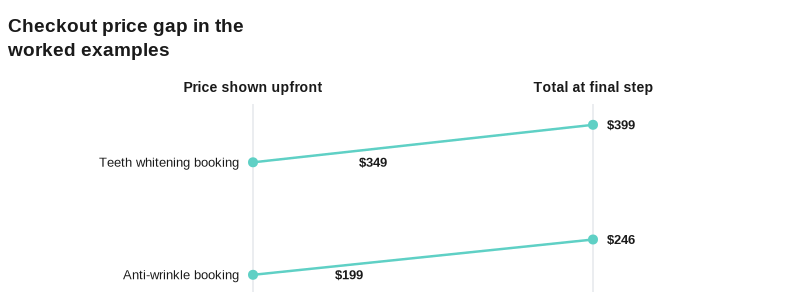
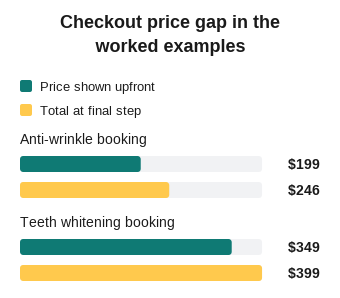
Illustrative worked-example figures only, showing where a checkout price grows between the listing page and the final payment step.
Takeaway: the shopper-facing number and the pay-facing number are meant to be one number, not two.
What to Check on Your Own Site
- Open your booking flow in a private or incognito browser window and complete a test booking without submitting payment. Note whether any figure changes between the first screen and the last.
- Search your CMS and booking platform settings for every charge that is not shown on the initial price display: booking fee, platform fee, card surcharge, facility fee, compliance fee.
- Check whether a fee is added automatically by your payment gateway’s default surcharge setting. A platform can inject this without any content change on your part.
- Check your
schema.org/Offeror product structured data. Confirm thepricevalue matches the fully loaded total shown at the final step, wherever a mandatory fee applies. - If you run a treatment membership or skin subscription, confirm a clear online cancellation path exists if signup happened online, and that it does not require a phone call or an in-person visit, then check the subscription cancellation requirements with your lawyer.
- Check your deposit wording. Does it state clearly when a deposit is required, how much it is, and whether it is refundable.
The Enforcement Anchor
We found no infringement notice or determination under the new Act, which is not in force. That is a fact about timing, not a reason to treat the pattern as low-risk.
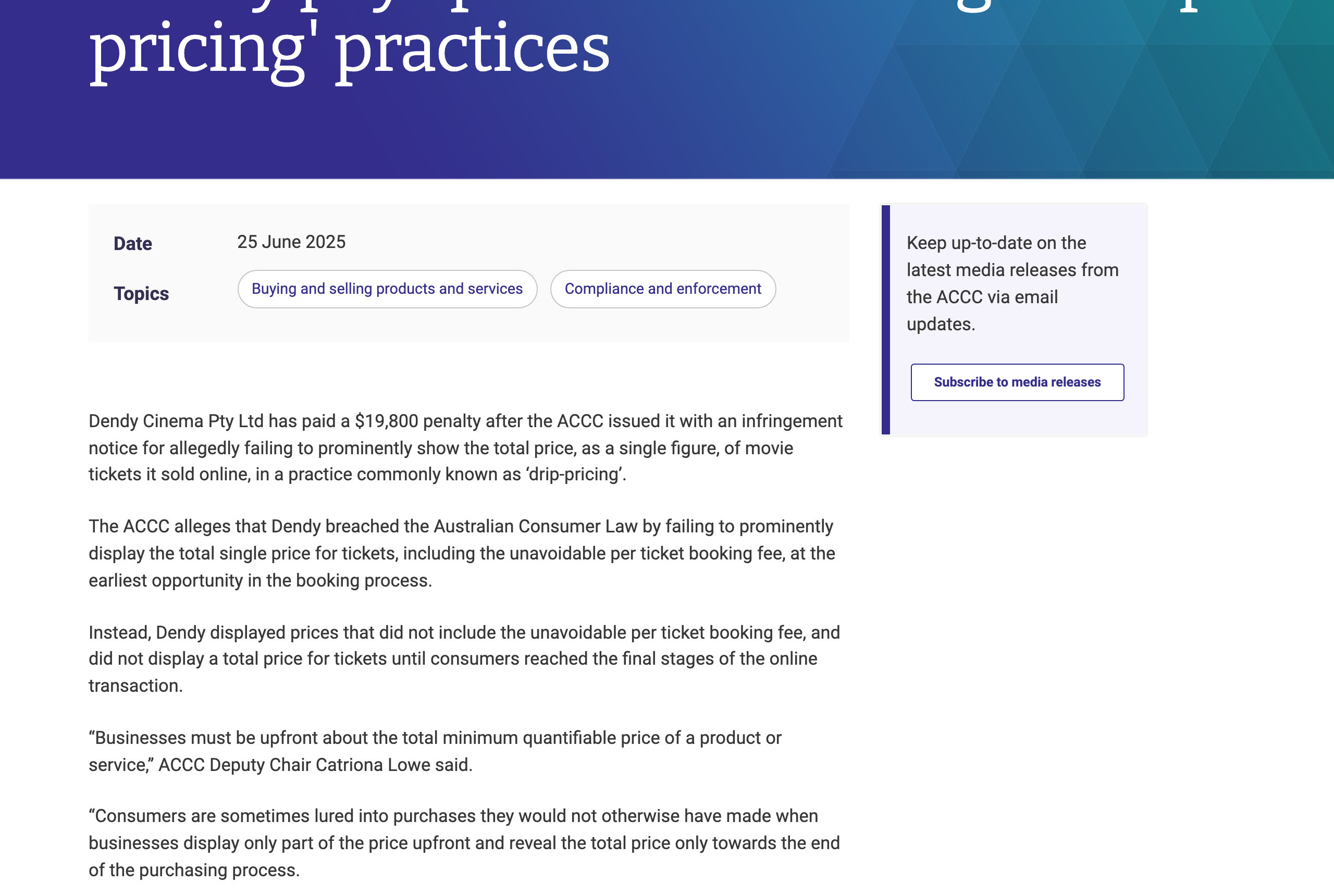
The ACCC has already acted against the same underlying practice under existing law. In June 2025, Dendy Cinema Pty Ltd paid a $19,800 penalty after the ACCC issued an infringement notice alleging Dendy failed to prominently show the total price of movie tickets as a single figure, including an unavoidable per-ticket booking fee, at the earliest opportunity in the booking process. The ACCC says payment of an infringement notice penalty is not an admission of a contravention, but the release shows the ACCC treating a late-revealed mandatory fee as an enforcement target under the existing Australian Consumer Law, before the 2027 disclosure duty gives it a more detailed tool to work with.
Takeaway: the specific new law has no enforcement record yet. The pattern it targets already does.
Where This Gets Hard
We found no published guidance from the ACCC aimed specifically at clinics or dental practices, and the law firm commentary we read covers the general drafting, not a sector-specific application of it.
Allens defines a transaction-based charge by reference to what is payable at the same time as the price of the service itself, and excludes optional charges and payment surcharges. Where a clinic deposit, facility fee or compliance fee sits against that definition is a question for your medical defence organisation or your lawyer.
Status
Passed, not commenced. As at 25 August 2026, Allens reported that Federal Parliament had passed new unfair trading practices laws (the Competition and Consumer Amendment (Unfair Trading Practices) Bill 2026, as the Bills Digest names it). The new requirements, including the transaction-based charge disclosure duty, commence on 1 July 2027 and were not in force at that date. Keep this separate from the ACL’s existing single-price and misleading conduct rules, which already apply and are the basis for the Dendy Cinema enforcement action above.
Frequently Asked Questions
Is drip pricing already illegal in Australia?
In a general sense, the ACCC says so. In a June 2025 media release it alleged that Dendy Cinema failed to prominently display the total single price, including an unavoidable per-ticket booking fee, under the existing Australian Consumer Law. The new Act adds a specific, more detailed disclosure obligation for transaction-based charges on top of that existing rule. It does not create drip pricing liability from nothing.
When does the drip pricing disclosure rule actually start?
Allens reports that Federal Parliament has passed new unfair trading practices laws (the Competition and Consumer Amendment (Unfair Trading Practices) Bill 2026, as the Bills Digest names it), and both Allens and the Parliamentary Library say the new requirements commence on 1 July 2027. As at 25 August 2026, we found nothing in the Act reported as in force yet.
Does this apply to a refundable deposit a clinic takes to hold a booking?
It depends on whether the deposit is a charge payable at the same time as the treatment price, or a genuinely optional amount. Allens says optional charges are excluded from the drip pricing regime. We found no regulator decision on clinic deposits, so treat it as a question for your own legal advice rather than something a general guide can answer for your specific booking terms.
What penalty applies if a booking checkout breaches the new rule?
Allens says the maximum penalty for corporations is the greater of $100 million, three times the benefit obtained, or 30% of turnover, per contravention. The Parliamentary Library Bills Digest says contraventions of the drip pricing reforms fall under the existing ACL civil penalty regime. It gives the $2.5 million maximum for individuals for the general unfair trading prohibition specifically, and we did not find an individual figure for the drip pricing provisions.
Do I need to change my booking widget now?
Not for this specific law, since the requirements commence on 1 July 2027. The ACCC is already acting on the same total-price principle under existing law, so a checkout that reveals fees late is already an enforcement risk today.
Fix Your Checkout Before 1 July 2027
Rebuilding a booking checkout so the total price is the only price a patient ever sees takes more than swapping a label. It usually means tracing how your booking platform, payment gateway, and structured data each independently decide what number to show, then making one of them the source of truth for the rest. If you would rather have that mapped and fixed as a scoped, fixed-price piece of work than guess at it yourself, talk to us about your booking checkout.
Sources
- Allens - Australia’s new unfair trading practices regime: what businesses need to know, 13 July 2026.
- ACCC - Dendy pays penalties for alleged drip pricing practices, 25 June 2025.
- Parliament of Australia - Bills Digest, Competition and Consumer Amendment (Unfair Trading Practices) Bill 2026.
Last reviewed: 25 August 2026.
Vikas Thakur
Founder, Perth. 16 years of experience from working at TPG, iiNet and Monadelphous, now helping Australian clinics keep their websites, ads and online presence AHPRA compliant.