88% of Tracked Health Keywords Show an AI Overview
BrightEdge found an AI Overview on 88% of 2,760 tracked healthcare keywords by December 2025. Here is what that means for clinic treatment and FAQ pages.
 Vikas Thakur Founder, Perth 12 min read Fact checked
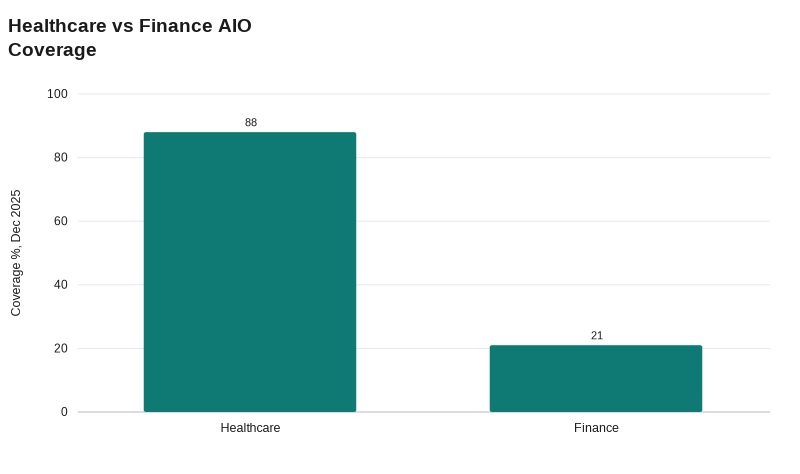
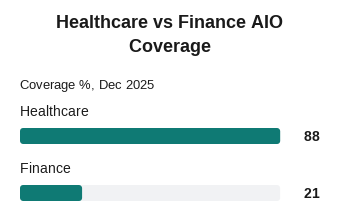
Search “how long does lip filler last” and there is a good chance Google answers the question before you reach a website. That is not just a hunch. BrightEdge’s Generative Parser tracked 2,760 healthcare keywords from May 2024 through December 2025 and found the share showing an AI Overview climbed from 72% to 88%. In the same report, BrightEdge’s finance keywords sat at 21%.
Key takeaways
- 88% of BrightEdge’s 2,760 tracked healthcare keywords showed an AI Overview in December 2025, up from 72% in May 2024
- BrightEdge’s finance keywords were at 21% in the same December 2025 snapshot, so healthcare sits well above that other sensitive-advice category
- Treatment and procedure queries, the kind a cosmetic clinic’s service pages target, showed an AI Overview 100% of the time in December 2025, up from 45% in December 2023
- Specialties differ: genetic and genomic content was at 97%, while mental health and eating disorder content was at 63%
- Local “near me” healthcare queries are the exception. BrightEdge’s two reports give different figures for them (11% and 0% in December 2025), and both are far below the clinical queries
- About 24% of the sources cited in healthcare AI Overviews also rank in the organic top 10, so ranking and being cited are linked but not the same
- BrightEdge says monthly swings in healthcare coverage fell from about 20 percentage points in early 2024 to about 5 percentage points by late 2025
BrightEdge’s own keyword panel is the base for every figure here. These are not Australian search figures, and BrightEdge’s pages do not say how the keywords split by country. Treat the numbers as a direction for an Australian clinic, not a local measurement.
For a cosmetic clinic or cosmetic dental practice, the 88% figure is the search environment your treatment pages, FAQ pages and blog posts now sit inside. This post uses BrightEdge’s published tracking to explain what that means for a clinic’s build, which query types on your own site are most exposed, and what to change so the site still earns a click when the answer box is already full.
What BrightEdge’s Tracking Shows
BrightEdge is a paid enterprise SEO platform. Its 18 Months of AI Overviews report (29 January 2026) uses its Generative Parser tool to check how often a Google AI Overview appears against 2,760 healthcare keywords that were tracked consistently across six measurement points between May 2024 and December 2025. The headline: healthcare coverage moved from 72% to 88%. The report states it plainly: “Healthcare sits at 88% AI Overview coverage. Finance is at 21%.”
A separate BrightEdge report, Healthcare and AI Overviews: How Google Sharpened Its Approach Over Three Years (24 December 2025), compares three December snapshots (22 December 2023, 2024 and 2025). It reports healthcare keyword coverage of 59% in 2023, 84% in 2024 and 89% in 2025. The 89% differs slightly from the 88% above because the two reports are different analyses and the second does not state its keyword count. The direction is the same: a big jump to 2024, then slower growth.
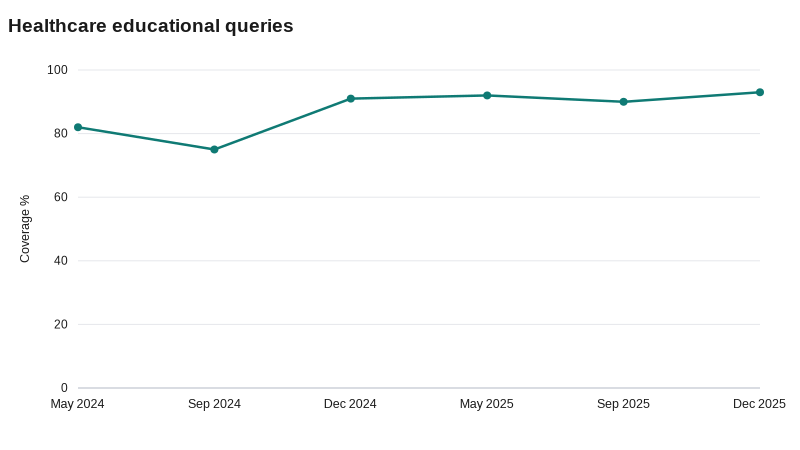
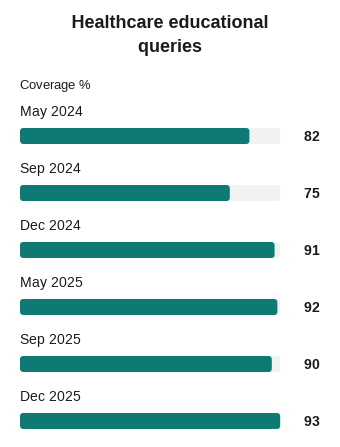
The first report also isolates educational healthcare queries (conditions, symptoms and treatments within specialty care):
| Period | Healthcare educational-query coverage |
|---|---|
| May 2024 | 82% |
| September 2024 | 75% |
| December 2024 | 91% |
| May 2025 | 92% |
| September 2025 | 90% |
| December 2025 | 93% |
Source: BrightEdge, 18 Months of AI Overviews (29 January 2026), “Healthcare Educational (Specialty Care: Conditions, Symptoms, Treatments)” table.
Source: BrightEdge, 18 Months of AI Overviews (29 January 2026).
Notice the dip in September 2024 before the climb resumed. BrightEdge’s three-year report says monthly volatility in healthcare coverage ran at about 20 percentage points in early 2024 and settled to about 5 percentage points by late 2025. Coverage did not rise in a straight line, and one month’s reading is not the whole story.
Takeaway: in BrightEdge’s panel, educational healthcare queries sat at or above 90% for most of the months shown, and the climb was uneven.
What Saturation Means for Your Clinic’s Build
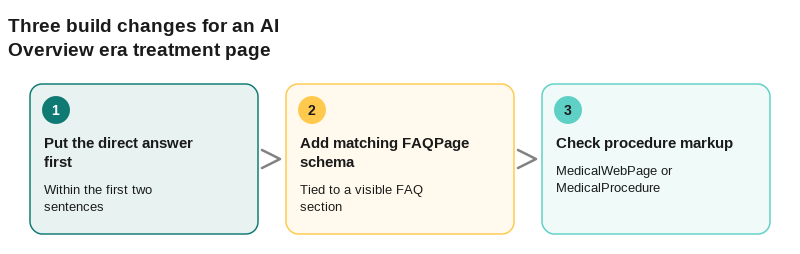
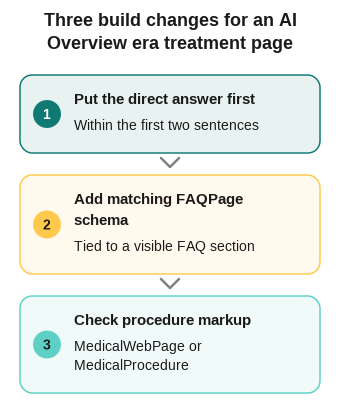
If Google already answers the question inside the search page, a treatment page has to do more than rank. It has to be a source the summary can lift from. That is a build problem more than a copywriting problem, and it comes down to three changes. These are our recommendations, not findings from the BrightEdge data.
First, put the direct answer first. Many clinic treatment pages open with a hero image, a paragraph about the clinic’s history or a general introduction before they answer the question in the page’s target query. If your page targets “how long does lip filler last”, the first two sentences of body copy should state the answer your own practitioners give, and what affects it. Push the clinic backstory and the booking widget further down.
Second, add FAQPage schema that matches a visible FAQ section on the same page, not only on blog posts. Check whether your booking platform or website template adds it to service pages. If it does not, a treatment page with a few genuinely common patient questions, each with a short answer, wrapped in FAQPage structured data, gives search engines a second, cleanly marked-up copy of what the prose already says.
Third, check whether MedicalWebPage or MedicalProcedure schema.org markup is present on procedure pages. Nothing in BrightEdge’s data says it earns a citation. It is a low-cost, unambiguous signal about what kind of page it is.
Source: BrightEdge, 18 Months of AI Overviews (29 January 2026), December 2025 figures for healthcare and finance keyword panels.
Takeaway: the fix is restructuring the content you already have so the answer sits at the top and is marked up, not writing more of it.
Which Query Types on Your Site Are Most Exposed
Not every page on a clinic site carries the same exposure. BrightEdge’s three-year report breaks clinical query types out, and they map closely onto pages a cosmetic clinic or dental practice publishes.
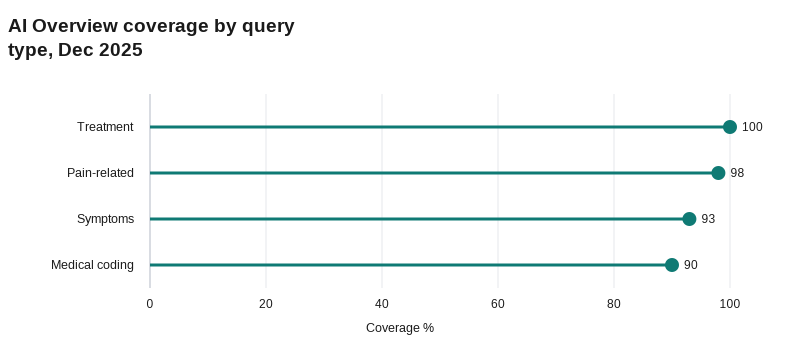
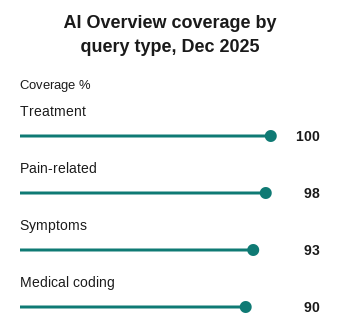
| Query type BrightEdge tracks | AI Overview coverage, Dec 2025 | Coverage, Dec 2023 | Where to start (our view) |
|---|---|---|---|
| Treatment and procedure queries | 100% | 45% | Answer-first opening and FAQPage schema |
| Pain-related queries | 98% | 58% | State discomfort and recovery expectations near the top |
| Symptoms and conditions queries | 93% | 57% | Lead with the plain-language definition |
| Medical coding queries (ICD-10, CPT) | 90% | 67% | Mostly relevant to billing and insurance-facing pages |
Source: BrightEdge, Healthcare and AI Overviews: How Google Sharpened Its Approach Over Three Years (24 December 2025), “Query Type Breakdown (December 2025)”. The last column is our view, not BrightEdge’s.
Source: BrightEdge, Healthcare and AI Overviews (24 December 2025).
A cosmetic clinic’s treatment-explainer pages, the ones answering “how does the procedure work” or “what does recovery look like”, fit the treatment and procedure category. BrightEdge puts it at 100% in December 2025, up from 45% in December 2023, a 55 percentage point rise and the largest of the four query types above.
Local searches behave differently. BrightEdge’s two reports disagree on the figure. The 18-month report says healthcare “near me” keywords went from 0% in May 2024 to 11% in December 2025. The three-year report says local and provider-intent queries went from 100% in December 2023 to 14% in December 2024 and 0% in December 2025. They use different keyword sets, so we show neither in the chart. What both agree on is that local queries are far below clinical ones, and the three-year report says local provider searches remain “traditional SEO territory”, so Google Business Profile completeness still matters most there.
BrightEdge’s specialty breakdown comes from a general healthcare taxonomy, not a cosmetic-specific one:
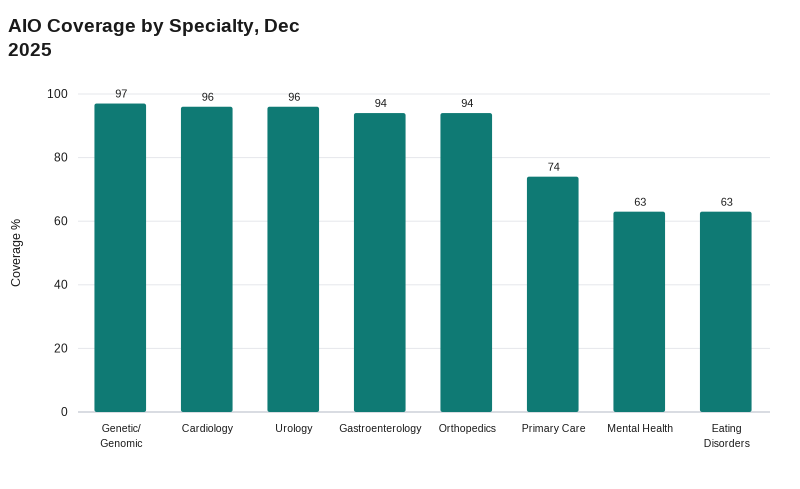
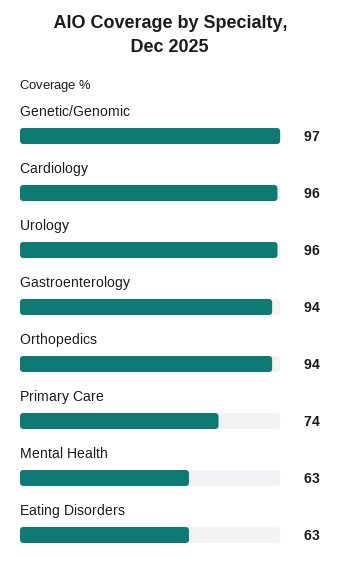
Source: BrightEdge, Healthcare and AI Overviews (24 December 2025), “The Specialty Breakdown”.
BrightEdge’s reading is that specialties with clear diagnostic and treatment pathways saw the most expansion, while sensitive or local-intent topics saw more conservative treatment. We found no BrightEdge figure for cosmetic procedures specifically.
Takeaway: of the query types BrightEdge lists, treatment and pain pages face the most AI Overviews, and local-intent pages the fewest.
A Worked Example: Two Clinic Pages
These two examples are illustrations, not case studies of real clinics.
A cosmetic injectables clinic
Picture a Perth cosmetic clinic’s page targeting “how long does lip filler last”. It opens with a paragraph about the clinic’s philosophy, a photo carousel and a booking button, with the duration answer three paragraphs down and no structured data. BrightEdge’s panel puts treatment and procedure queries at 100% in December 2025, so an AI Overview is very likely for that query. Whether the clinic is cited depends partly on whether the page gives a short, specific answer to lift. The build fix is to move a two-sentence answer, written by the clinic’s own practitioners with the duration range they quote to patients, to the top of the page, and add FAQPage schema for the questions patients ask at consultation, each with a matching visible answer.
A cosmetic dental practice
A practice’s page for “do veneers hurt” faces the same problem. BrightEdge puts pain-related queries at 98% in December 2025, up from 58% in December 2023. If the page spends its opening paragraphs on the dentist’s qualifications before it addresses the pain question, there is little to extract. The fix mirrors the clinic example: a direct opening statement about what patients typically feel, then the credentials and booking content further down.
Takeaway: the treatment does not change, only the order and markup of the same information.
What to Check on Your Own Site
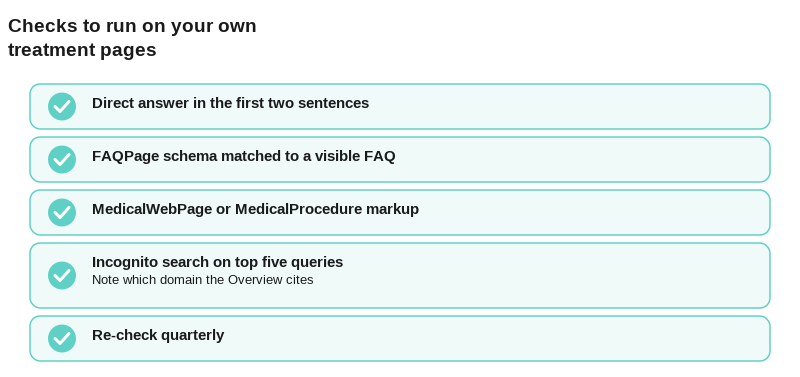
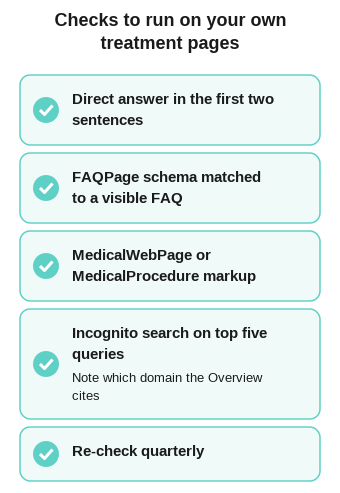
- For every treatment or procedure page, confirm a direct, specific answer sits within the first two sentences of body copy, not below a hero image, video or clinic history
- Add FAQPage schema, matched to a visible FAQ section, on treatment pages that carry common patient questions
- Check whether MedicalWebPage or MedicalProcedure structured data is present on procedure pages
- Search your five highest-traffic informational queries in a private window and note whether an AI Overview appears and which domain it cites, not just where your page ranks
- For any “near me” or locality-qualified page, check Google Business Profile completeness first
- Re-check quarterly rather than once, since BrightEdge reports coverage swings of about 20 percentage points a month in early 2024
Is There Anything Forcing This Change?
No. This is not a compliance rule, and we found no regulator requirement that a page earn an AI Overview citation. Advertising rules for regulated health services still apply to every word on these pages, but they are a separate matter.
What does matter commercially is the gap between ranking and citation. BrightEdge’s February 2026 report measured the share of AI Overview citations that also rank in the organic top 10. For healthcare it was 24.0%, against 23.9% a year earlier, and for finance 11.3%, against 7.6%. Healthcare had the highest figure of the nine verticals in that table. Put the other way, and by our arithmetic (100% minus 24%), roughly three in four healthcare citations came from sources outside the organic top 10. The same report found 22.5% of healthcare citations came from sources not ranking anywhere in the top 100.
BrightEdge’s own advice is that ranking number one does not automatically get you cited, and not ranking on page one does not exclude you. That gap is the ground a clinic’s build sits on.
Where This Gets Hard
Three limits apply to everything above.
BrightEdge is a commercial SEO vendor selling a platform built on this tracking, and its Generative Parser methodology is proprietary. We found no independent dataset that confirms these exact percentages. They are BrightEdge’s reported figures from a fixed panel of 2,760 healthcare keywords, not every clinic-relevant search.
The pages we read do not split healthcare coverage by country, and the three-year report says all its figures are expressed as percentages “to protect proprietary dataset composition”. An Australian clinic’s real exposure could be higher or lower than 88%.
We found no published recipe that guarantees a citation. The build changes in this post are our recommendations, not a documented cause-and-effect rule. A page can do everything on the checklist and still not be cited.
Status
This is a documented search-behaviour trend, not a law or regulation, so there is no in-force or proposed status to report. As of 23 November 2026, the pages we read show BrightEdge’s healthcare coverage figures running through December 2025 and its citation-overlap figures through February 2026. We found no statement from BrightEdge about whether it will keep updating this series.
Frequently Asked Questions
What percentage of healthcare searches trigger a Google AI Overview?
In BrightEdge’s tracking of 2,760 healthcare keywords, 88% showed an AI Overview in December 2025, up from 72% in May 2024. It is a fixed keyword panel, not every healthcare search, and BrightEdge’s pages do not break it out by country.
Does a high AI Overview rate mean a clinic will lose website traffic?
Not automatically. BrightEdge’s February 2026 report found that about 24% of the sources cited in healthcare AI Overviews also rank in the organic top 10. Ranking on page one and being cited are linked but not the same thing, so a clinic needs to watch both.
How does a clinic get its treatment pages cited inside a healthcare AI Overview?
Put a direct, specific answer in the first two sentences of the page, back it with FAQPage schema that matches a visible FAQ, and check in a private window which sites the AI Overview cites for that query. No source we found guarantees a citation.
Get Your Treatment Pages Checked Against This Data
Get in touch with ClinicCode and we will review your highest-traffic treatment and FAQ pages against the patterns in this post, check whether an AI Overview currently appears for your target queries and which domain it cites, and return a written list of the pages worth restructuring first. If you would rather see the platform first, create a ClinicCode account.
Sources
- BrightEdge - 18 Months of AI Overviews: What Healthcare Tells Us About Where Finance Is Headed, 29 January 2026. Checked 23 November 2026.
- BrightEdge - Healthcare and AI Overviews: How Google Sharpened Its Approach Over Three Years, 24 December 2025. Checked 23 November 2026.
- BrightEdge - AI Overviews at the One-Year Mark: Presence, Size, and What They’re Citing, 12 February 2026. Checked 23 November 2026.
Last reviewed: 23 November 2026.
Vikas Thakur
Founder, Perth. 16 years of experience from working at TPG, iiNet and Monadelphous, now helping Australian clinics keep their websites, ads and online presence AHPRA compliant.