TGA Names Cosmetic Procedure Goods a Priority to 2027
The TGA lists therapeutic goods used in cosmetic procedures as a priority focus area from 1 January 2026 to 31 December 2027. Two TGA releases, on 17 June and 6 July 2026, announced eight infringement notices over alleged imports of unapproved cosmetic injectables, worth $31,680 combined, and tied both to this priority.
 Vikas Thakur Founder, Perth 12 min read Fact checked
Key takeaways
- The TGA’s Compliance Principles 2026 and 2027 page covers 1 January 2026 to 31 December 2027, and its list of priority focus areas includes “Therapeutic goods used in cosmetic procedures”
- On 17 June 2026 and 6 July 2026 the TGA announced eight infringement notices over alleged imports of unapproved cosmetic injectables, worth $31,680 combined (our arithmetic: $19,800 plus $11,880)
- Both releases say the TGA is “targeting unapproved therapeutic goods used in cosmetic procedures as part of its Compliance Principles 2026 and 2027”
- Each release’s total divides evenly to $3,960 per notice (our arithmetic: $19,800 divided by 5, $7,920 divided by 2, $11,880 divided by 3)
- Separate from imports, TGA guidance says a cosmetic service advertisement should not refer to prescription medicines, even indirectly, and gives brand names, abbreviations, nicknames and hashtags as examples
- The priority list is an operational statement. It does not change the Therapeutic Goods Act 1989
The TGA has published where it plans to direct compliance effort until the end of 2027, and cosmetic procedures are on the list. It has also published enforcement announcements that point back to that list.
This post covers what the priority page says, what the two announcements say, and what TGA advertising guidance means for a clinic website.
What the Policy Actually Says
The TGA’s Compliance Principles 2026 and 2027 page says the principles and priority focus areas apply to “the import, export, supply, manufacture and advertising requirements of the Therapeutic Goods Act 1989 for the period 1 January 2026 to 31 December 2027”. It says the focus areas “will be reviewed every quarter and updated as required”.
The linked infographic lists thirteen priority focus areas. One is “Therapeutic goods used in cosmetic procedures”. Others include peptides, weight loss medications and vaping goods. The TGA adds that it may “take compliance action on any non-compliance detected whether the matter falls within a compliance priority or not”.
The infographic does not name dermal fillers or anti-wrinkle injectables. The TGA’s own releases do link unapproved cosmetic injectables to the priority, which the next section covers.
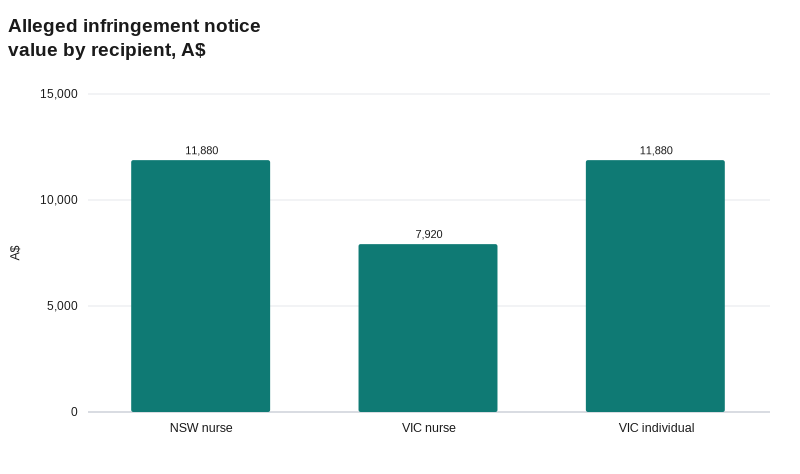
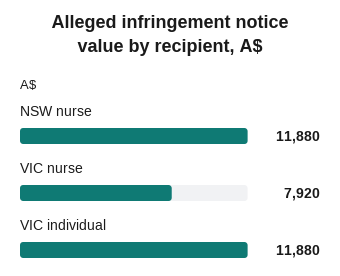
Source: TGA media releases, 17 June 2026 and 6 July 2026, seen 25 November 2026. The TGA calls the imports alleged.
The Enforcement Announcements
The TGA’s 17 June 2026 release says it “has issued 5 infringement notices totalling $19,800 to a health practitioner and an individual for the alleged unlawful importation of unapproved cosmetic injectables”. A Victorian nurse registered with Ahpra and a Victorian-based individual allegedly imported unapproved pre-filled syringes containing hyaluronic acid, poly-L-lactic acid and lidocaine. The individual also allegedly imported unapproved prescription-only tranexamic acid without an exemption. The nurse received 2 notices totalling $7,920 and the individual received 3 notices totalling $11,880. The release says the notices “were paid in May 2026”.
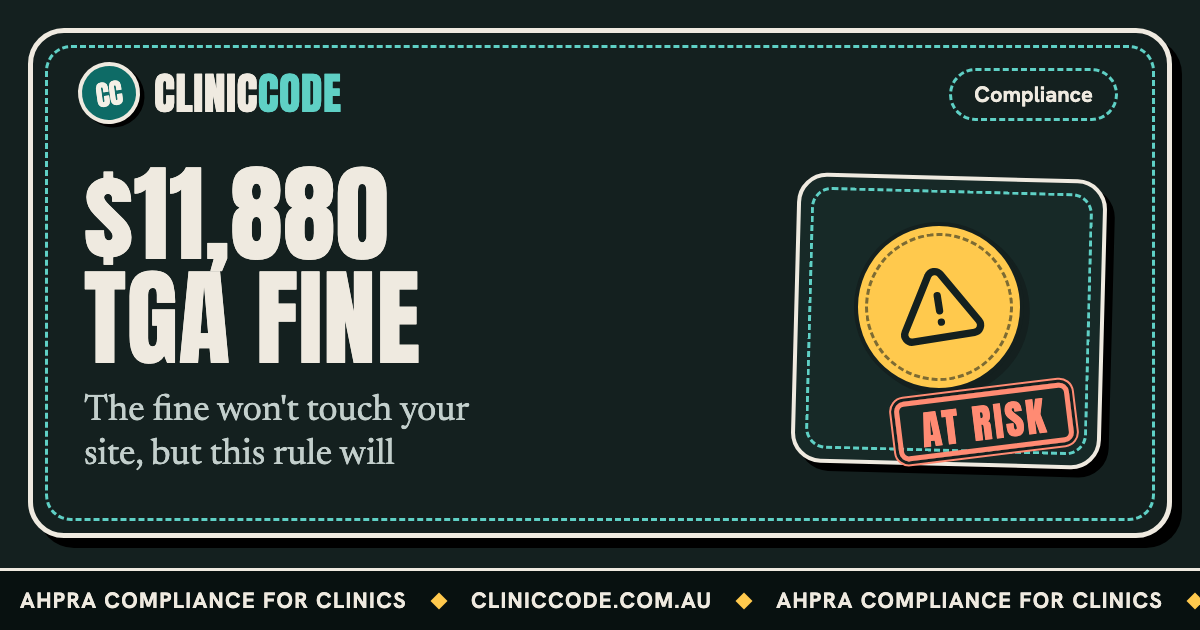
The TGA’s 6 July 2026 release says it issued 3 notices totalling $11,880 to a New South Wales nurse registered with Ahpra, who allegedly imported unapproved vials of botulinum toxin and pre-filled syringes containing lidocaine. It says the notices “were issued to the nurse in May 2026”. Our breakdown of that case is in the July 2026 nurse infringement notice post.
Both releases carry the same sentence: “In recognition of their potential harm and increased use, the TGA is targeting unapproved therapeutic goods used in cosmetic procedures as part of its Compliance Principles 2026 and 2027.”
The TGA’s 17 June release says its notices “were paid in May 2026”, and its 6 July release says its notices “were issued to the nurse in May 2026”. Both were announced in June and July. The TGA’s infringement notices register lists further cosmetic injectable entries, so these two are not a full count.
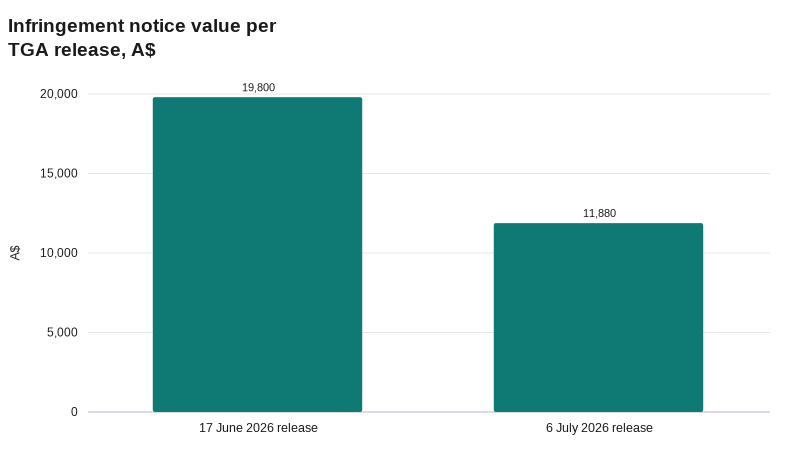
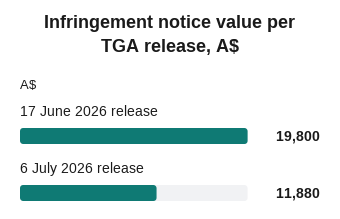
Source: TGA media releases, 17 June 2026 and 6 July 2026, seen 25 November 2026. The two releases total $31,680 (our arithmetic: $19,800 plus $11,880).
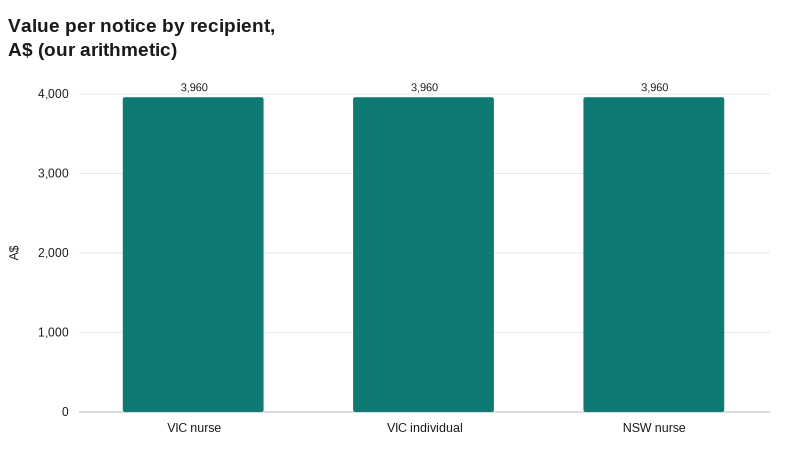
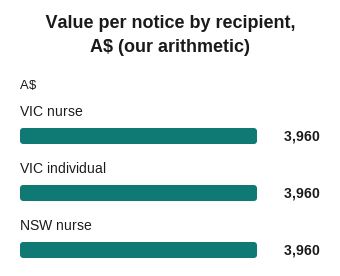
Source: TGA media releases, 17 June 2026 and 6 July 2026, seen 25 November 2026. Our arithmetic: $7,920 divided by 2 notices, $11,880 divided by 3 notices, and $11,880 divided by 3 notices.
How the Notice Amount Is Set
The TGA’s information about infringement notices page says the TGA “must calculate the amount payable for an infringement notice using the formula in the Act” and does “not have discretion to set the value”. It says the formula relies on the value of a penalty unit, and that the amount for corporations is larger than for individuals.
The page says the TGA issues notices “as an alternative to pursuing court action”. It says payment “discharges the recipient’s liability” and “is not an admission of liability”. If a notice is not paid, the TGA “will usually take the recipient of the infringement notice to court”.
What That Means for the Build
A priority list changes nothing in your code. The rule that matters for a clinic website is the TGA’s advertising rule for prescription medicines.
The TGA guidance, Advertising health services that involve therapeutic goods (last updated 18 June 2026), says: “When advertising a health service, you must not directly or indirectly refer to prescription medicines.” For cosmetic injection services it says most cosmetic injectables contain prescription-only substances. It also says: “When advertising a cosmetic service, do not refer to prescription medicines or substances” and adds “even indirectly”. It lists brand names, acronyms or abbreviations, colloquial names or nicknames, and hashtags that may be taken as a reference to a specific prescription-only medicine or substance.
The TGA says this restriction “does not apply to advertisements for cosmetic injectables that do not contain prescription-only substances”.
The TGA’s 7 March 2024 media release explains the change. The TGA had allowed generic terms such as “wrinkle reducing injections” in the context of promoting a service. It now says it “no longer permits references to terms such as ‘wrinkle reducing injections’ where those terms would result in a reasonable consumer understanding the intention of the content is to promote the use or supply of a prescription medicine”. The TGA’s advertising health services guidance gives an example of a non-compliant advertisement from a cosmetic clinic: “Achieve a youthful look with our dermal filler treatments!”
In our view, the practical consequence is that swapping the brand for a generic term is not a safe fix in our reading of the TGA pages. The TGA’s test is what a reasonable consumer would understand, not whether a brand appears.
The TGA says it cannot provide “a list of ‘acceptable’ or ‘substitute’ terms”. It says clinics “should focus their advertising on the types of consultations available”. Its example of wording that does not refer to therapeutic goods is “Call our clinic for a consultation to discuss treatment options for migraine”.
Where the Rule Reaches on a Website
The TGA’s cosmetic injections FAQ (last updated 21 July 2026) and the 2024 release name several website elements.
| Website element | What the TGA says | Where |
|---|---|---|
| Brand name in a heading or title | Express references to products or ingredients, such as ‘Botox’ or ‘botulinum toxin’, were not permitted | Media release, 7 March 2024 |
| Terms such as “wrinkle reducing injections” or “dermal fillers” | No longer expressly permitted where a reasonable consumer would take them to promote a prescription-only medicine | Cosmetic injections FAQ |
| Hashtags, nicknames, abbreviations | Included if they may be taken as a reference to a specific prescription-only medicine or substance | Advertising health services guidance |
| Public booking system | A form where the consumer self-selects from a list of treatments involving prescription-only medicines or substances is an example of likely unlawful advertising | Cosmetic injections FAQ |
| Price information | Providing price information for a prescription-only medicine or substance is an example of likely unlawful advertising | Cosmetic injections FAQ |
| Before and after photos, testimonials, price lists | Advertising prescription medicines “includes through use of testimonials, claims about the goods, before and after photos, or price lists” | Media release, 7 March 2024 |
| Consultation-focused wording | Promoting the types of consultations offered is “unlikely” to make the material an advertisement for therapeutic goods, in context | Cosmetic injections FAQ |
Source: TGA cosmetic injections FAQ, advertising health services guidance and 7 March 2024 media release, seen 25 November 2026.
The TGA FAQ also says a business name needs care. It says whether a business name breaches the Act “must be considered in context on a case-by-case basis”. It says business owners are responsible for the content of “websites, social media channels, blog posts, hashtags, or discussion forums” that they create or manage.
The TGA pages do not discuss structured data, image alt text or URL slugs. In our view, those fields are published content like any other, and a reference to a prescription medicine there deserves the same check as the visible page.
What to Check on Your Own Site
- Search your own site for brand names, abbreviations and nicknames of prescription injectables, using your site search or a
site:search. - Read your treatment pages as a reasonable consumer would, and ask whether the page promotes a prescription-only medicine, not only whether a brand appears.
- In our view, check structured data output, image alt text and URL slugs for the same references, because the TGA pages do not address them.
- Check any downloadable price list or treatment menu for prescription medicine references and prices.
- Check your booking system’s service list as the public sees it before a consultation step.
- Check hashtags and social media pages you manage, because the TGA says you are responsible for them.
Where This Gets Hard
The hard part is the line between describing a service and advertising the goods used to deliver it. The TGA says the question depends on what a reasonable consumer would understand the content to promote, and that it must be considered “in context on a case-by-case basis”. It does not publish approved wording.
The TGA says clinics may obtain advice from an industry representative or regulatory affairs consultant, and its guidance says to “seek independent legal advice”. Whether a particular page crosses the line is a question for your lawyer or your medical defence organisation.
Status
The priority window runs from 1 January 2026 to 31 December 2027, according to the TGA page last updated 10 June 2026. The TGA says the focus areas are reviewed every quarter, so check the page again before relying on this list. This post describes the pages as we saw them on 25 November 2026.
Get a Direct Answer on Your Copy
If you are not sure whether your treatment pages, structured data or booking system refer to prescription injectables, talk to us about your clinic’s website. For the case behind this post, see the July 2026 nurse infringement breakdown.
Frequently Asked Questions
What is the TGA Compliance Principles 2026 and 2027 document?
It is the TGA’s statement of five compliance principles and priority focus areas for compliance activities on the import, export, supply, manufacture and advertising of therapeutic goods from 1 January 2026 to 31 December 2027. The list of priority focus areas includes “Therapeutic goods used in cosmetic procedures”. The TGA says it reviews the focus areas every quarter.
Does a stated priority mean every clinic gets audited?
No source we opened says so. The TGA says it may take compliance action on any non-compliance it detects, whether or not the matter falls within a compliance priority. In our view, a priority tells you where the regulator says it is directing effort. It does not tell you that your clinic is under review.
Can I put a brand name like Botox or a filler brand on my clinic website?
No. The TGA’s guidance says that when advertising a cosmetic service you should not refer to prescription medicines or substances, even indirectly, including brand names, acronyms or abbreviations, colloquial names or nicknames, and hashtags. The TGA also says it no longer expressly permits terms such as ‘wrinkle reducing injections’ or ‘dermal fillers’ where a reasonable consumer would understand the content to promote a prescription-only medicine. It does not publish a list of acceptable substitute terms, so take independent legal advice on your own wording.
Is a TGA infringement notice the same as being found guilty in court?
No. The TGA describes an infringement notice as an alternative to formal court action. It says paying the notice in full by the due date discharges the recipient’s liability and prevents court action on that breach, and that payment is not an admission of liability. If a notice is not paid, the TGA says it will usually take the recipient to court.
How is this different from Ahpra’s advertising rules?
They are separate regulators. The TGA says it regulates the advertising of therapeutic goods and does not regulate the promotion of health services as such. Ahpra regulates the conduct of registered health practitioners, including the advertising of their services. The TGA also lists the ACCC and state and territory consumer laws as possible regulators of the same advertisement.
Need a hand with your website?
If you want a second pair of eyes on how this applies to your own site, request a callback and we will talk it through.
Sources and References
- TGA - Compliance Principles 2026 and 2027, page last updated 10 June 2026. Seen 25 November 2026.
- TGA - Compliance Principles 2026 and 2027 infographic (PDF), listing the priority focus areas. Seen 25 November 2026.
- TGA - TGA issues infringement notices to a health professional and an individual for alleged unlawful importation of cosmetic injectables, published 17 June 2026. Seen 25 November 2026.
- TGA - TGA issues infringement notices to nurse for alleged unlawful importation of cosmetic injectables, published 6 July 2026. Seen 25 November 2026.
- TGA - Infringement notices register, last updated 17 November 2026. Seen 25 November 2026.
- TGA - Information about infringement notices, last updated 3 July 2026. Seen 25 November 2026.
- TGA - Referring to cosmetic injectables in advertising, published 7 March 2024. Seen 25 November 2026.
- TGA - Advertising health services that involve therapeutic goods, last updated 18 June 2026. Seen 25 November 2026.
- TGA - Advertising health services and cosmetic injections: frequently asked questions and answers, last updated 21 July 2026. Seen 25 November 2026.
- ClinicCode - the July 2026 nurse infringement notice, covering the NSW case.
Last reviewed: 25 November 2026.
Vikas Thakur
Founder, Perth. 16 years of experience from working at TPG, iiNet and Monadelphous, now helping Australian clinics keep their websites, ads and online presence AHPRA compliant.