4x Private, 5.5x to 6.5x Corporate: Dental Practice Sales 2026
BDO’s September 2025 review puts private practice sales at about 4x EBITDA and corporate acquisitions at 5.5x to 6.5x for the practices corporates target. It also says 90% of Australian dental clinics are still owner-operated.
 Vikas Thakur Founder, Perth 9 min read Fact checked
Key takeaways
- Corporate buyers pay 5.5x to 6.5x EBITDA for eligible Australian dental practices, against roughly 4x EBITDA in a typical private sale, per BDO’s September 2025 dental sector review
- 90% of Australian dental clinics are still owner-operated, per BDO, leaving most of the market open to further consolidation
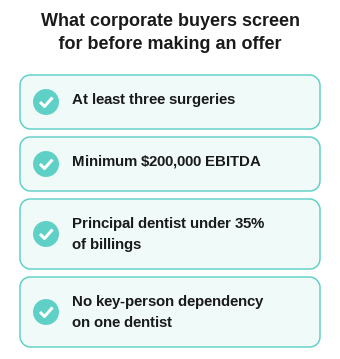
- Corporates typically require a minimum $200,000 EBITDA and at least three surgeries before a practice enters their pipeline, and the principal dentist must contribute under 35% of total billings
- A typical corporate deal pays 75-80% upfront, with the balance spread across a 3-4 year earn-out, per BDO
- Abano Healthcare acquired 1300SMILES for A$165 million in 2022, and Crescent Capital proposed a A$303 million takeover of Pacific Smiles Group in 2024, per BDO
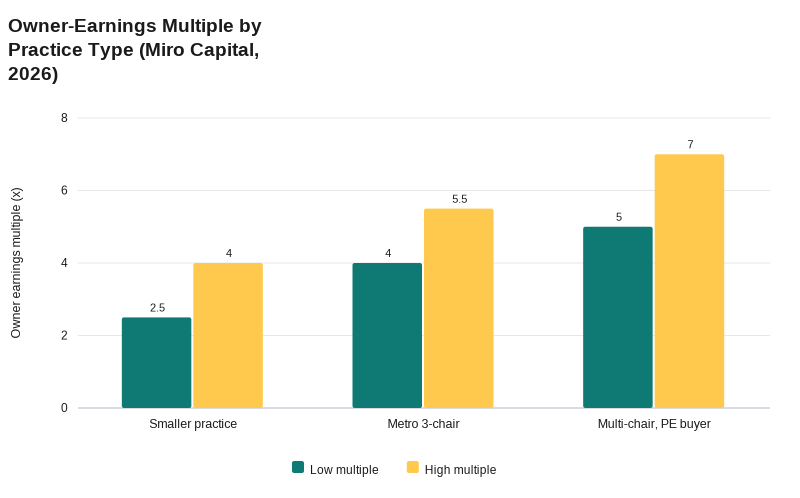
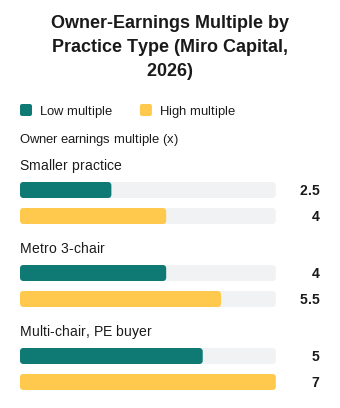
- Smaller independent practices sell for 2.5x to 4x owner earnings; multi-chair practices with a private equity buyer can reach 5x to 7x, per Miro Capital’s April 2026 valuation guide
- Gross-fee valuations, a quicker but less rigorous method, run 60% to 90% of average annual billings, per Miro Capital
- Rising practice start-up costs of $600,000 to $650,000 are pushing more buyers toward acquiring an existing practice instead of building one, per BDO
Australian dental practices sell for about 4x EBITDA in a private sale and 5.5x to 6.5x EBITDA when a corporate buyer is involved, per BDO’s September 2025 dental sector review. BDO also reports that 90% of Australian dental clinics are still owner-operated.
BDO gives two market-wide figures, not one practice priced two ways: private practice sales at around 4x EBITDA, and corporate acquisitions at 5.5x to 6.5x (both per BDO). BDO says corporates are generally targeting clinics with at least three surgeries, where the principal dentist contributes less than 35 per cent of total billings and there is no key person dependency for clinical delivery, with a minimum EBITDA of $200,000 typically required. Buyers test those traits in due diligence, which is where a practice’s records, website and booking data come in (our reading, not a BDO statement). This post breaks down what buyers actually pay, what corporates screen for before making an offer, and where a practice’s website, reviews and booking data quietly move the number.
This post covers sale price and valuation multiples specifically. For the separate question of what a dental practice earns while it is still trading, not what it sells for, see our companion piece on dental practice profit margins in Australia.
What Corporate Buyers Actually Pay
BDO’s September 2025 review of the Australian dental sector puts private practice sales at around 4x EBITDA, a level the firm describes as relatively stable. Corporate acquisition multiples sit higher, in a 5.5x to 6.5x range, for the kind of practice corporates target (three or more surgeries, a principal under 35 per cent of billings, EBITDA of at least $200,000, per BDO).
The structure of a corporate deal matters as much as the headline multiple. BDO says most corporate transactions pay 75-80% upfront, followed by a 3-4 year earn-out period (the remainder, by our arithmetic, is 20-25%). A seller quoting only the multiple, without the earn-out terms attached to it, is quoting half a number.
| Buyer type | Typical EBITDA multiple | Deal structure |
|---|---|---|
| Private practice sale | ~4x (BDO) | Not stated in BDO’s review |
| Corporate acquirer | 5.5x to 6.5x (BDO) | 75-80% upfront, then a 3-4 year earn-out |
Source: BDO Australia, September 2025.
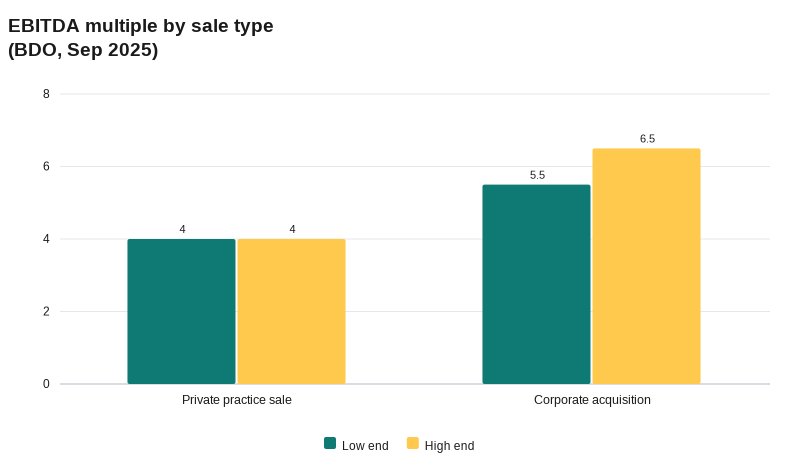
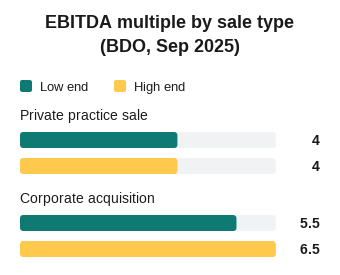
Source: BDO Australia, September 2025. BDO gives private sales as “around” 4x, so both values are 4.
Takeaway: The corporate premium exists, but it is paid in instalments tied to future performance, not handed over on settlement day.
The Corporatisation Trend Behind Corporate Multiples
Ninety per cent of Australian dental clinics are still owner-operated, according to BDO’s September 2025 review. That leaves a large pool of practices still available for a corporate group to buy, and the recent deal history shows the appetite is real. BDO cites New Zealand’s Abano Healthcare acquiring Australia’s 1300SMILES chain for A$165 million in 2022, and Crescent Capital proposing a A$303 million takeover of Pacific Smiles Group in 2024.
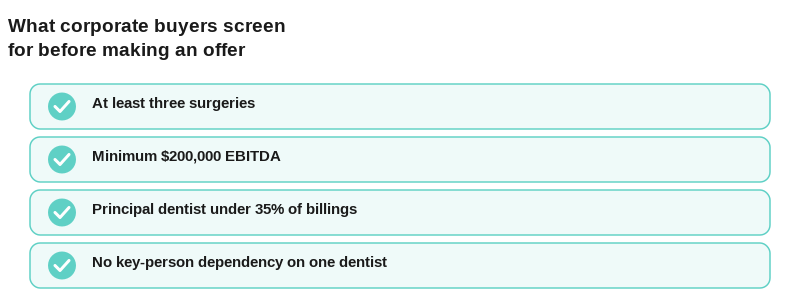
Corporates are not buying every practice on the market. BDO reports they are generally targeting clinics with at least three surgeries, where the principal dentist contributes less than 35% of total billings and clinical delivery has no key-person dependency on one dentist. A minimum EBITDA of $200,000 is typically required before a practice attracts serious corporate interest at all.
A buyer’s due diligence team is likely to look at advertising compliance history too, since a testimonial breach or an unresolved AHPRA complaint sitting against the practice could become the buyer’s problem after settlement. This is our reading, not a finding from BDO or Miro Capital. See ClinicCode’s guide to AHPRA advertising rules for cosmetic dentistry for the current testimonial and before-and-after rules a due diligence review will check against.
Takeaway: BDO reports that 90% of Australian dental clinics are still owner-operated, and the deal criteria filter hard for scale, low key-person risk and a clean compliance record.
Two Ways Brokers Value a Practice
There is no single formula for dental practice valuation in Australia. Miro Capital says most buyers use one of two approaches, sometimes both as a cross-check.
The gross fee percentage method is the simpler one: take average annual gross billings over three years and apply a percentage, typically 60% to 90%, per Miro Capital’s April 2026 valuation guide. It is quick, but it ignores profitability entirely, so two practices billing the same revenue can be worth very different amounts once overheads are accounted for.
The capitalised future maintainable earnings method is the more rigorous one. It starts from a sustainable owner benefit, adjusts for one-off items, then applies a multiple. Per Miro Capital, smaller practices typically attract 2.5x to 4x owner earnings. A well-run three-chair metro practice with a solid patient base, two associates and a clean lease is looking at 4x to 5.5x maintainable owner earnings. Multi-chair practices with strong associate structures and a private equity buyer in the room can reach 5x to 7x.
| Valuation method | Range | Best fit |
|---|---|---|
| Gross fee percentage | 60% to 90% of gross billings | Quick estimate, ignores overheads |
| FME, smaller practice | 2.5x to 4x owner earnings (Miro Capital) | Smaller practices |
| FME, metro three-chair | 4x to 5.5x owner earnings (Miro Capital) | Well-run three-chair metro practice, two associates, clean lease |
| FME, multi-chair with PE buyer | 5x to 7x owner earnings (Miro Capital) | Multi-chair practice, strong associate structure, PE buyer |
Source: Miro Capital, 23 April 2026.
Miro Capital also describes an informal 50-40-30 rule for what gross fees split into: overheads eat roughly 50%, the principal draws around 40%, and approximately 30% remains as discretionary cash flow a buyer can use to service acquisition debt. Miro says a practice with much heavier overheads leaves a buyer little to work with and will attract a lower multiple, or not sell at all.
Takeaway: The multiple a practice attracts depends less on revenue and more on how much of that revenue survives as earnings a buyer can actually rely on.
Where Your Website Sits in Due Diligence
None of the multiples above are handed out on trust. A buyer, private or corporate, builds a picture of how a practice actually acquires patients, and a website that cannot be verified as belonging to the seller is a due diligence flag before a single financial figure is discussed.
Our companion post on who owns your clinic website covers the mechanics in full, but the short version matters directly here: a clinic website is five separate assets, the domain licence, hosting, codebase, content and data, and any of them can sit with an agency rather than the practice. In a sale, a website the seller cannot show they own may be left out of the asset schedule, which would leave the buyer with nothing to pay for on that front.
A Google Business Profile with unverifiable review history, a booking platform whose data the seller cannot export, or a domain registered to an agency rather than the practice entity all raise the same question in a buyer’s mind: what else in this practice isn’t actually owned the way it appears to be. Before a practice goes to market, ClinicCode checks the site and ad accounts against current advertising rules, so a compliance problem doesn’t surface for the first time in someone else’s due diligence process.
Takeaway: A website a seller cannot prove they own is hard to include in a sale, no matter how much traffic or how many bookings it has generated.
Building a Practice Corporates Actually Want
BDO’s roughly 4x private sale figure and its 5.5x to 6.5x corporate acquisition range describe different kinds of practice. The corporates it describes want a practice that does not depend on the founding dentist, so building one that runs, and markets itself, without them is the part a practice controls. Website and booking infrastructure that a practice owns outright, with clean domain records, an assignable codebase and exportable patient enquiry data, is a small part of that picture that is entirely within a practice’s control years before a sale is on the table.
ClinicCode builds cosmetic clinic websites for dental and cosmetic clinics around exactly that brief: compliant with current AHPRA and dental board advertising rules, structured to convert bookings on their own, and built with the practice, not an agency, holding every asset the site is made of.
Takeaway: The fastest way to protect a practice’s future sale price is making sure everything a buyer will ask to see is already something the practice actually owns.
Get Your Practice’s Numbers and Assets Reviewed
BDO’s multiples describe different kinds of practice, and in our reading a practice’s digital assets can matter in either kind of sale. ClinicCode fixes dental and cosmetic clinic websites against current advertising rules and ownership best practice, ahead of a sale or otherwise.
Talk to ClinicCode about your practice’s website and digital assets
Sources and References
- BDO Australia - Navigating the future: Trends, challenges and opportunities for Australian dental practices. Published 8 September 2025. EBITDA multiples, corporate acquisition criteria, deal structure, start-up costs, 1300SMILES and Pacific Smiles Group transaction values, owner-operated share.
- Miro Capital - How Much Is My Dental Practice Worth in Australia? Published 23 April 2026. Gross fee percentage method, capitalised future maintainable earnings multiples, 50-40-30 overhead rule.
- Dental Practice Profit Margin Australia: ClinicCode’s related research on dental practice operating margins, sourced to the ATO’s small business benchmarks.
- Who Owns Your Clinic Website: ClinicCode’s guide to the five ownership layers of a clinic website, including why an unassigned website can be a problem in a sale.
Related reading:
- AHPRA Advertising Rules for Cosmetic Dentistry: current dental board advertising rules covering testimonials and before-and-after imagery.
- Clinic Website Design: AHPRA-compliant website builds for dental and cosmetic clinics, built to convert bookings.
Data current as of BDO’s dental sector review published 8 September 2025 and Miro Capital’s valuation guide published 23 April 2026, the most recently published sets at time of writing.
Vikas Thakur
Founder, Perth. 16 years of experience from working at TPG, iiNet and Monadelphous, now helping Australian clinics keep their websites, ads and online presence AHPRA compliant.