Electronic Signatures On Consent Forms: What Holds Up
Under the Electronic Transactions Act 1999, a typed name or a signature pad entry can meet a legal signature requirement, but only if the build actually proves who signed and what they agreed to. Here is the four-part test a clinic or dental consent form needs to pass.
 Vikas Thakur Founder, Perth 14 min read Fact checked

Key takeaways
- The Electronic Transactions Act 1999 (Cth), current compilation dated 5 December 2025, sets a four-part functional test for when an electronic signature meets a legal signature requirement
- The test does not name any software product. It asks whether the method used identifies the signer, shows their intent, is as reliable as the purpose calls for, and was consented to by the person receiving it
- Every state and territory runs its own near-identical Electronic Transactions Act, which is the version that actually governs most clinic paperwork, since consent forms are rarely a Commonwealth law matter
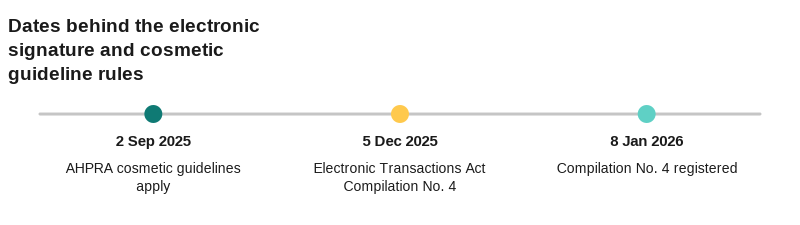
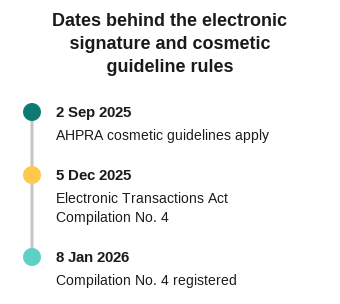
- AHPRA’s Guidelines for registered health practitioners who perform non-surgical cosmetic procedures, in effect since 2 September 2025, apply to every registered health practitioner except medical practitioners, who stay under the Medical Board’s 2023 cosmetic guidelines
- Between September 2022 and March 2025, AHPRA investigated about 360 notifications concerning non-surgical cosmetic procedures, closed about 300, and logged over 1,500 calls to its cosmetic surgery hotline
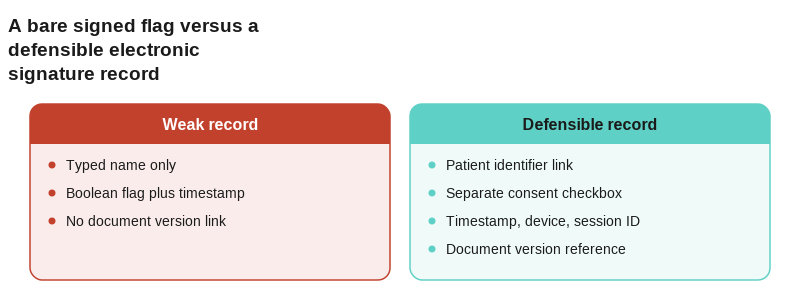
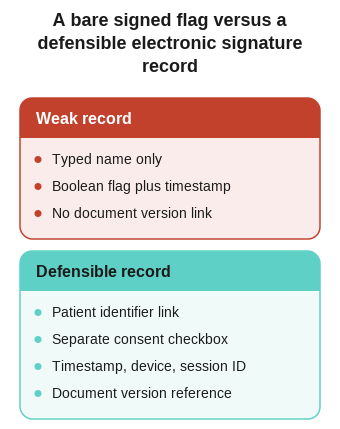
- A typed name on its own is the weakest evidence a build can produce. A timestamp, a device or IP record, and a link to the exact document version signed are what turn a signature into something defensible
- No published AHPRA or court decision was found that turns specifically on whether an electronic signature met the Electronic Transactions Act 1999 test on a cosmetic clinic or dental consent form. That gap is stated here, not filled in
In Australia, an electronic signature meets a legal signature requirement if it identifies the signer, shows their intent, and is reliably fit for the purpose, under the Electronic Transactions Act 1999 (Cth).
A patient taps “I agree” on a tablet before an anti-wrinkle injection. A dental patient types their name into a booking widget before a veneer consult. Neither event looks like a signature in the pen-on-paper sense, and both practice managers asking whether it counts get the same vague answer from most vendors: “yes, it is legally binding.” That answer is usually true, but it is also incomplete. The Act does not certify any particular tool. It sets a test, and whether a specific clinic’s build passes that test depends on what gets captured at the moment someone taps the button, not on which software vendor’s logo sits in the corner of the screen.
What The Act Actually Says
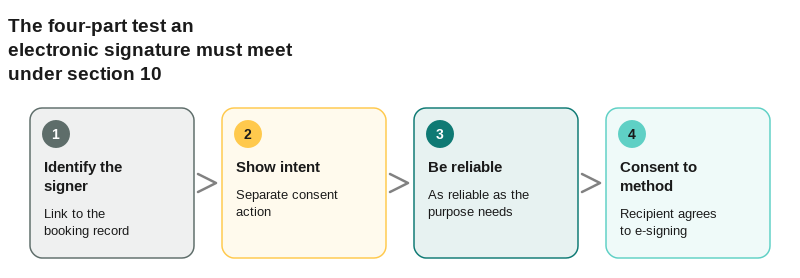
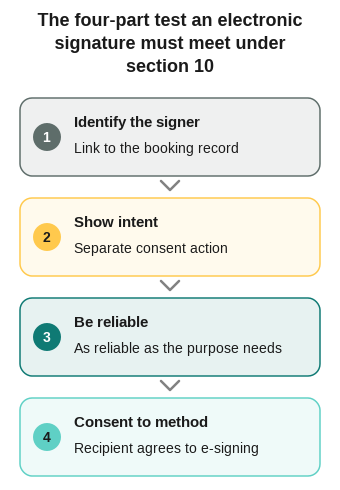
Section 10 of the Electronic Transactions Act 1999 deals with signatures. Where a Commonwealth law requires a person’s signature, that requirement is met by an electronic communication if, in every case, a method is used to identify the person and to indicate their intention in respect of the information communicated, and that method is either as reliable as was appropriate for the purpose the communication was generated or communicated for (given the circumstances and any relevant agreement), or proven in fact to have done the job. If the signature is required to be given to someone other than a Commonwealth entity, that person also has to consent to the requirement being met by the method used. The current compilation, No. 4, is dated 5 December 2025 and was registered on 8 January 2026.
That is a functional test, not a product list. It does not say “use DocuSign” or “install a signature pad plugin.” It asks four questions about the method actually used: does it identify the signer, does it capture their intent, is it reliable enough for what is at stake, and did the recipient of the signature agree to that method. Section 8 of the same Act adds the general rule that a transaction is not invalid under Commonwealth law purely because it happened by electronic communication.
One qualification matters more than the Act’s own wording. The Electronic Transactions Act 1999 governs requirements arising under Commonwealth law. A private clinic’s consent form requirement usually comes from state health records law, contract principles, or a professional body’s guidelines adopted through state legislation, not from a Commonwealth statute directly. Every state and territory has run its own near-identical Electronic Transactions Act since the early 2000s, built from the same national model. The Commonwealth Act is the reference version and the one most publicly documented, and its four-part test is the one that turns up in the state equivalents too, but the state Act operating in a clinic’s own jurisdiction is the one that actually applies to its paperwork.
Takeaway: The legal test for an electronic signature is functional, not brand-specific, and it usually runs through a state Electronic Transactions Act, not the Commonwealth one, even though the wording is close to identical.
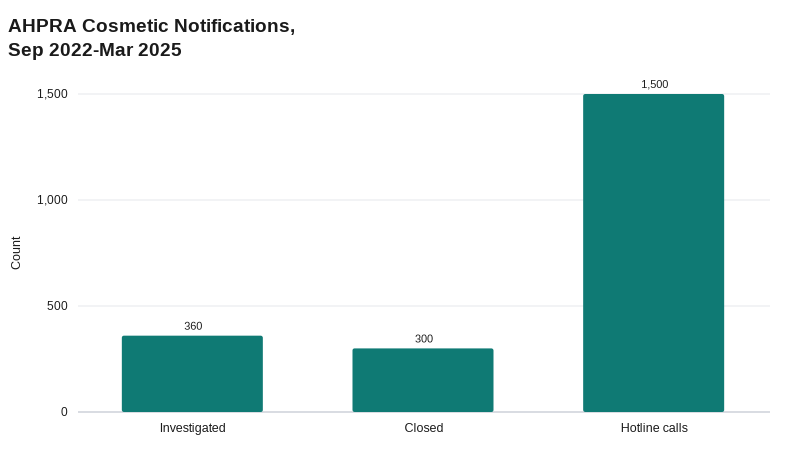
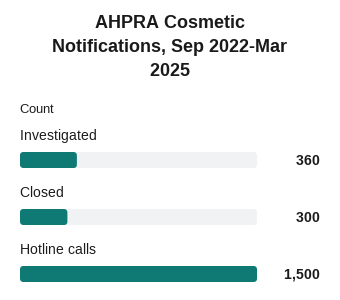
That volume of notification activity, reported in AHPRA’s own announcement of the new cosmetic guidelines, is the backdrop against which a weak consent record becomes a real problem. Any one of those notifications could turn on what a patient was actually told and what they actually agreed to. A signature that cannot prove identity, intent or reliability is a weak witness in that kind of dispute.
What That Means For The Build
Meeting section 10’s test is a data capture problem, not a signature widget problem. Four things need to exist in the record for every signed form, matched to the four parts of the test.
Identification. Pre-fill the signer’s name, date of birth and contact detail from the booking record rather than asking for free text, and store which patient record the signature is linked to. A free-text name field with no link to an authenticated booking session is the weakest version of this element.
Intent. Use an explicit, separate action for consent, not a bundled “next” or “continue” button. A checkbox reading “I have read and understood this information and consent to the procedure,” followed by a distinct signature action (typed name confirmation or a drawn signature pad entry), is stronger evidence of intent than scrolling to the bottom of a page and clicking through.
Reliability. Store a timestamp, the device or browser user agent, and, where the build supports it, an IP address or session identifier, against the signature event. For higher-risk procedures under AHPRA’s non-surgical cosmetic guidelines, where a documented risk discussion and cooling-off step already apply, pair the signature with a record of which risk disclosure content the patient saw. Our earlier guide on consent form version control covers the field structure for linking a signature to the exact document version shown.
Consent to the method. Say, in the form itself, that an electronic signature is being used to meet the signature requirement, and capture agreement to that as its own step rather than assuming it because the patient used the online form at all.
The one field most builds are missing is the version link: a signature record that stores a boolean “signed: true” with a timestamp, but no reference to which exact wording, pricing, and risk disclosure the patient was shown, cannot answer the question a dispute will actually ask.
| Field | Purpose | Typical gap in existing builds |
|---|---|---|
| Patient identifier link | Identification (s10(1)(a)) | Free-text name with no link to an authenticated booking record |
| Explicit consent checkbox, separate from navigation | Intent (s10(1)(a)) | Consent inferred from clicking “next” rather than a distinct action |
| Timestamp, device or IP, session ID | Reliability (s10(1)(b)) | No metadata captured beyond a single signed date field |
| Document version reference | Reliability, and evidence of what was actually agreed to | No link between a signature and the specific content version shown |
| Method disclosure and agreement | Consent to the method (s10(1)(d)) | No statement that an electronic signature is being used to meet a signature requirement |
Takeaway: A valid electronic signature is not one tool bought once. It is five fields captured consistently, every time, for every form.
A Worked Example
Cosmetic clinic. An injectable clinic’s booking widget asks a new patient to tick “I consent to this procedure” and type their name before checkout. The system stores a single consent_signed boolean and a signed_at timestamp. Nothing links that signature to which version of the risk disclosure the patient actually read, and no device or session metadata is stored. If a patient later says she was never shown the bruising and asymmetry risks listed in AHPRA’s cosmetic procedure guidance, the clinic has a timestamp and a name, and nothing that proves what content was in front of her when she typed it. The fix: add a document_version_id field to the consent record, capture the user agent and an IP or session token at the moment of signing, and separate the consent checkbox from the “confirm booking” button so the two actions are logged individually.
Cosmetic dentistry. A dental practice offering veneers uses a signature pad built into its practice management software at the front desk. The pad captures a drawn signature image and a date, which is stronger identification evidence than a typed name, but the software stores it against the current version of the practice’s consent template, with no historical snapshot. Six months later, the practice cannot show what the template said on the date a specific patient signed, only what it says today. The fix is not a new pad. It is asking the vendor whether a snapshot of the document is stored per signature, and if not, exporting a dated copy of the live template every time it changes, so the practice can reconstruct what a given signature actually attached to.
The scores below are ClinicCode’s own illustrative comparison of common signature methods against the section 10 test, not a formal legal rating or a measured industry benchmark.
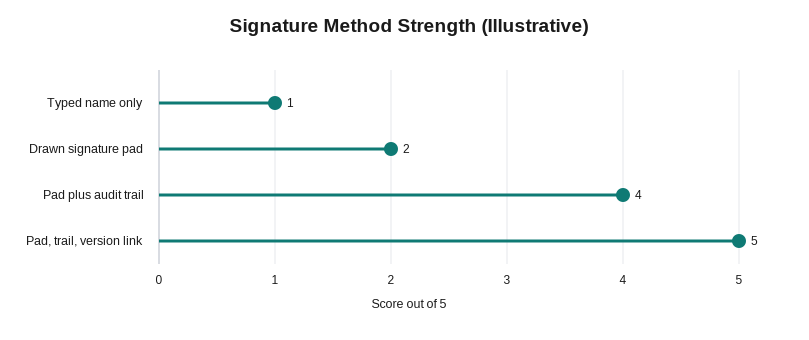
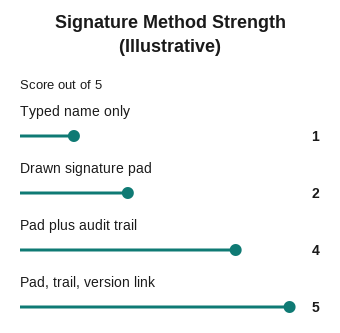
Takeaway: The strongest signature method is not the fanciest one. It is the one with the most metadata attached to the moment of signing.
What To Check On Your Own Site
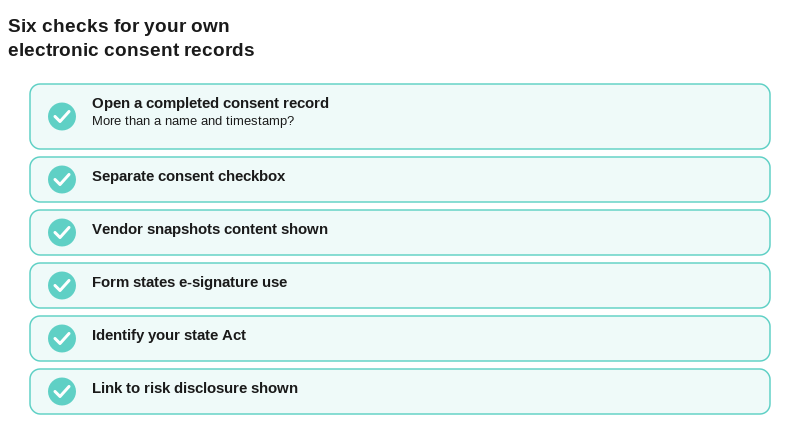
- Open a completed consent form record and check whether it stores anything beyond a name and a timestamp: device, IP or session data, and a link to the document version shown.
- Confirm your consent checkbox is a separate, explicit action from any “next” or “confirm booking” button, so intent is not inferred from unrelated navigation.
- Check whether your booking or practice management vendor snapshots the exact content shown at each signature, or only serves the current live version.
- Confirm the form states, somewhere a patient can see it, that an electronic signature is being used to meet a signature requirement, and that using the form is agreement to that method.
- Identify which jurisdiction’s Electronic Transactions Act actually applies to your practice, and confirm your build’s evidence capture matches that Act’s test, not just a vendor’s marketing claim of being “legally binding.”
- For higher-risk cosmetic procedures, check that the signature record links to the specific risk disclosure content the patient was shown, not just a generic “informed consent given” flag.
The Enforcement Anchor
No published AHPRA determination, tribunal decision or court judgment was found that turns specifically on whether an electronic signature on a cosmetic clinic or cosmetic dentistry consent form met the Electronic Transactions Act 1999 test. That is a genuine gap in the public record, not a claim this guide is prepared to invent evidence for.
What does exist is the volume of activity around cosmetic procedure consent generally, shown in the notification figures above, and AHPRA’s own written expectation, in its September 2025 guidelines, that informed consent be backed by a clear, documented process. A weak signature record does not need a named case to matter. It needs to survive one notification, one complaint, or one patient dispute, and the absence of a public test case is not proof that risk is low, only that it has not yet been litigated in public.
Where This Gets Hard
A valid electronic signature under section 10 proves that a person agreed to something. It does not, by itself, prove that the something they agreed to was adequate informed consent. AHPRA’s cosmetic procedure guidelines set a content standard, plain language, accurate risk disclosure, no minimising of complexity, that a signature satisfies only if it is linked to content that actually met that standard. A perfectly captured, fully auditable signature attached to an inadequate risk disclosure is still an inadequate consent process. The signature test and the consent-content test are two different obligations that happen to meet at the same button click.
There is also a jurisdiction problem this guide cannot resolve in the abstract. The Commonwealth Act’s wording is the clearest public reference point, but the state or territory Electronic Transactions Act operating where a specific clinic is located is usually the one a court or tribunal would actually apply to a private consent form dispute. The regulator says an electronic signature has to identify the signer, show their intent, and be reliable for the purpose; the build consequence is a record that captures all three plus a document version link; whether a specific practice’s existing signature process discharges that obligation in its own circumstances, and under its own state’s Act, is a question for its medical defence organisation or its lawyer.
Status
In force. The Electronic Transactions Act 1999 (Cth) is current law, Compilation No. 4, dated 5 December 2025 and registered 8 January 2026. State and territory equivalents are separately in force in their own jurisdictions. AHPRA’s Guidelines for registered health practitioners who perform non-surgical cosmetic procedures have applied since 2 September 2025, with medical practitioners carved out to the Medical Board’s 2023 guidelines. None of this is a proposal or pending commencement; it is the operating rule today.
Frequently Asked Questions
Is a typed name on a consent form a legally valid signature in Australia?
It can be, under the Electronic Transactions Act 1999 test, but a typed name alone is the weakest form of evidence. It has to be paired with a method that identifies the signer, shows their intent, and is as reliable as the situation calls for, which usually means a timestamp, an audit trail and a link back to a specific document version.
Does a clinic need software like DocuSign to meet the legal test?
No named vendor or product is required by the Electronic Transactions Act 1999. The Act sets a functional test (identification, intent, reliability, consent to the method), not a product mandate. A simple in-house signature pad and audit log can meet that test if it is built to capture the right fields; a paid e-signature platform mainly buys convenience and a stronger off-the-shelf audit trail, not legal validity that a well-built in-house system could not also achieve.
What happens if a patient later disputes signing a consent form electronically?
The burden falls on the practice to show its method identified the signer, recorded their intent and was reliable for the purpose, at the time the form was signed. Without stored evidence, such as a timestamp, an IP or device record, and a link to the exact document version shown, a bare “signed” flag in a database is difficult to defend against a dispute.
Get Your Consent Forms Checked
Sign up or get in touch and ClinicCode will check whether your booking and intake system captures enough evidence, identification, intent, reliability and a document version link, to defend an electronic signature if a patient ever disputes what they agreed to.
Sources
- Federal Register of Legislation - Electronic Transactions Act 1999 (Cth), sections 8, 9 and 10, Compilation No. 4, compilation date 5 December 2025. Checked 15 August 2026.
- AHPRA - Putting patients first: New guidelines for cosmetic procedures, 2 September 2025. Checked 15 August 2026.
- AHPRA - Booming billion-dollar cosmetic industry on notice with new cosmetic procedures guidelines, 3 June 2025. Checked 15 August 2026.
- Medical Board of Australia - Guidelines for registered medical practitioners who perform cosmetic surgery and procedures, in effect 1 July 2023. Checked 15 August 2026.
Last reviewed: 15 August 2026.
Vikas Thakur
Founder, Perth. 16 years of experience from working at TPG, iiNet and Monadelphous, now helping Australian clinics keep their websites, ads and online presence AHPRA compliant.