Cosmetic Injectables Australia: Market Size and Ad Rules
Grand View Research put Australia’s facial injectable market at US$2.7 billion in 2023 and forecast US$9.08 billion by 2030. Here is what those figures do and do not tell a clinic, and what Ahpra and the TGA say about advertising.
 Vikas Thakur Founder, Perth 7 min read Fact checked

Key takeaways
- Grand View Research estimated Australia’s facial injectable market at US$2.7 billion in 2023 and forecast US$9.08 billion by 2030, a 19.3% CAGR from 2024 (US dollars, not Australian dollars)
- Botulinum toxin type A made up 36.36% of total sales in 2023 in that same report
- The publisher’s newer databook page gives a much lower Australian figure (US$209.3 million for 2025), so market-size numbers depend heavily on how each report defines the market
- The CPCA estimated that Australians’ annual spend on minimally or non-invasive cosmetic procedures topped $1 billion for the year ending 31 December 2015
- Ahpra says the maximum penalty for an advertising offence is $60,000 for an individual and $120,000 for a body corporate per offence
- The TGA says most cosmetic injectables are Schedule 4 substances that cannot be advertised to the public
Grand View Research’s 2024-2030 report estimates Australia’s facial injectable market at US$2.7 billion in 2023, with a forecast of US$9.08 billion by 2030. That forecast is a 19.3% compound annual growth rate (CAGR) from 2024.
Those are forecast figures from one research publisher, and other reports on the same market disagree. We cover the numbers, the caveats, and the advertising rules a clinic has to work within.
How big is the Australian injectables market
Grand View Research’s report page states the Australian facial injectable market “was estimated at USD 2.7 billion in 2023” and is “projected to grow at a compound annual growth rate (CAGR) of 19.3% from 2024 to 2030”. The report’s scope table lists a 2024 market size of USD 3.1 billion and a 2030 forecast of USD 9.08 billion, with 2023 as the base year. All figures are in US dollars.
| Year | Market size (US$) | Status on the report page |
|---|---|---|
| 2023 | $2.7 billion | Estimate (base year) |
| 2024 | $3.1 billion | Listed as 2024 market size |
| 2030 | $9.08 billion | Forecast |
CAGR 2024-2030: 19.3%.
Source: Grand View Research, Australia Facial Injectable Market Size and Share Report (report updated January 2024) and its press release (US$9.08 billion by 2030, 19.3% CAGR from 2024 to 2030). We have not converted to Australian dollars, because the page does not.
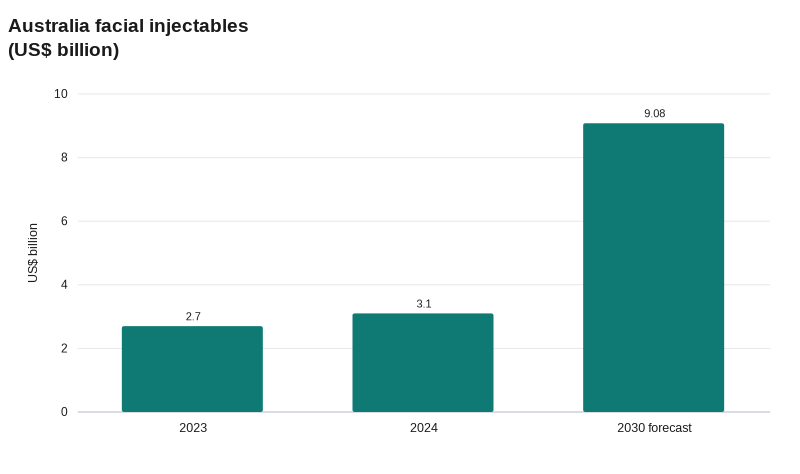
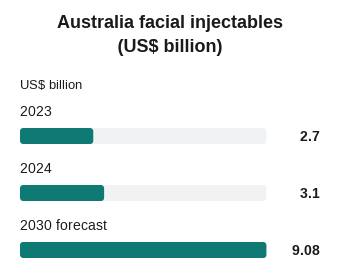
Source: Grand View Research, Australia Facial Injectable Market Size and Share Report. US dollars; 2030 is a forecast.
By our arithmetic, US$2.7 billion to US$3.1 billion is about a 15% rise, and US$9.08 billion is about 2.9 times the 2024 figure. Both are forecasts and estimates, not audited sales.
Treat any single market figure with care
Market reports do not agree. Grand View Research’s newer Horizon databook page for Australia (published 6 May 2026) says the Australian facial injectable market generated USD 209.3 million in 2025 and is expected to reach USD 402.6 million by 2033, at an 8.6% CAGR from 2026 to 2033. That is a far smaller figure than the report above. The two pages do not explain the gap, so we cannot say which definition is closer to what clinics actually earn. The ABC reported the same publisher’s valuation as “$4.1 billion in 2023”, which differs again from the US$2.7 billion on the report page.
If you quote a market size to a client, journalist or investor, say which report, which year and which currency.
Takeaway: Every source agrees the category is growing, but the size depends on the report. Use the figure as context, not as a number to plan a budget around.
Botox still leads the sales mix
Grand View Research’s report page says that in 2023 the botulinum toxin type A segment “dominated the market and accounted for 36.36% of total sales”. The remainder (63.64% by our arithmetic) covers the report’s other product types.
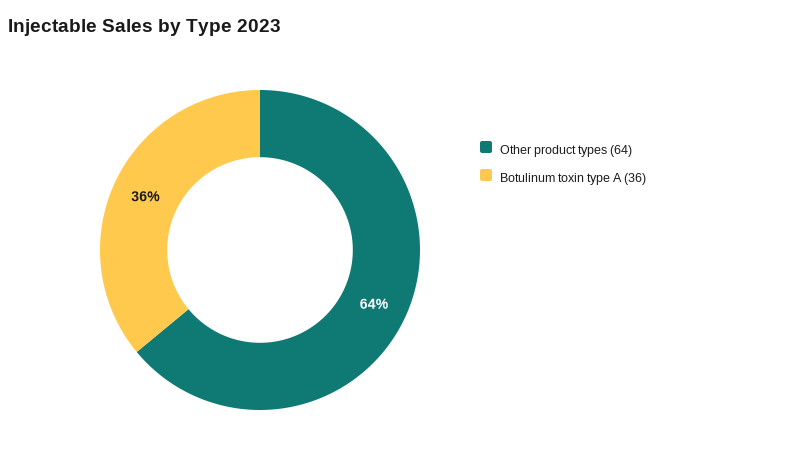
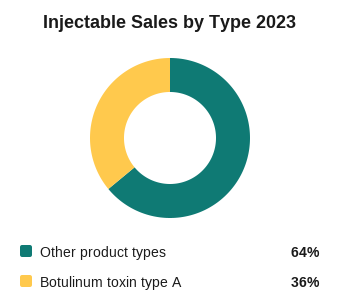
Source: Grand View Research, Australia Facial Injectable Market Size and Share Report, 2023 share of total sales (36.36% botulinum toxin type A; remainder is our arithmetic).
An older data point on growth comes from the Cosmetic Physicians College of Australasia (CPCA). Its estimates, for the year ending 31 December 2015, were that dermal filler spending grew “at least 25 percent” and anti-wrinkle injection spending “at least 14 per cent” on the previous year. The same release said annual spend on minimally or non-invasive cosmetic procedures topped $1 billion for the first time. This is a decade-old estimate and not a current growth rate.
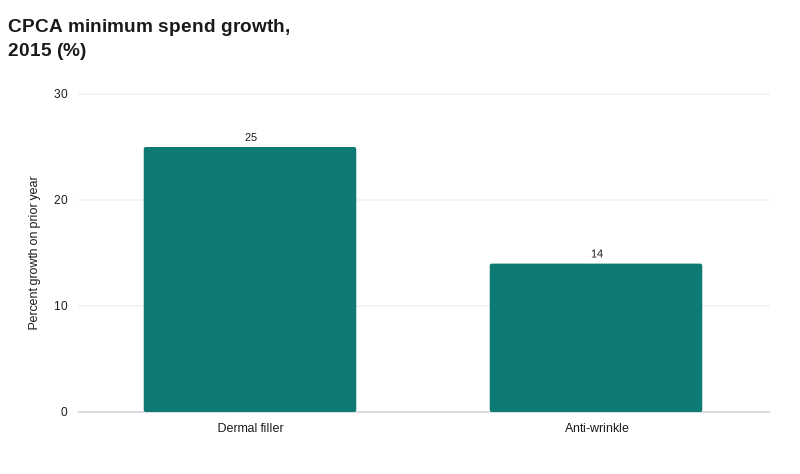
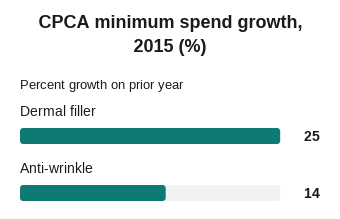
Source: CPCA estimates as reported by SPA+CLINIC, year ending 31 December 2015. Both figures are “at least” estimates.
Takeaway: Botulinum toxin is the largest single product in the Grand View data, and the CPCA’s 2015 figures are minimums (“at least” 25 percent for fillers and 14 per cent for anti-wrinkle), so they do not rank the two. Neither tells you what your own clinic’s mix should be.
What the advertising rules mean for clinics
A big market does not loosen the advertising rules. Three sources matter most.
Testimonials. Ahpra’s advertising guidelines page lists that advertising of a regulated health service must not “use testimonials or purported testimonials about the service or business”. Ahpra’s page on higher risk non-surgical cosmetic procedures says the same for those procedures.
Before and after images. That cosmetic page does not ban them. It says images “must be used responsibly”, both images must be genuine, and ads showing outcomes must carry a prominent warning that the result applies only to that patient. Read the full requirements before using any.
Prescription-only products. The TGA’s FAQ on advertising health services and cosmetic injections says most cosmetic injectables contain Schedule 4 substances that “cannot be advertised to the public”. It says advertisers cannot refer, directly or indirectly, to prescription-only substances or their trade names, including through acronyms, nicknames, abbreviations and hashtags, and that it no longer expressly permits terms such as “wrinkle reducing injections” or “dermal fillers” where they would be read as promoting a prescription-only medicine.
Penalties. Ahpra says the maximum financial penalty per advertising offence is $60,000 for an individual and $120,000 for a body corporate. Its advertising guidelines page says “as of July 2024 these increased penalties now apply in all jurisdictions, including Western Australia”. Footnote 3 on the same advertising guidelines page says “In Western Australia different penalties apply”, with maximums of $30,000 for an individual and $60,000 for a body corporate, but it is attached to the penalties for unlawful use of a protected title, and the page does not reconcile it with the July 2024 statement. These are maximums, not set fines.
The new Ahpra guidelines for advertising higher risk non-surgical cosmetic procedures are “in effect from 2 September 2025”, according to Ahpra’s resources page for those guidelines.
If you are not sure where your site sits against these rules, talk to ClinicCode about a review. Ahpra and the TGA are the authority, and we are a web developer, not a legal adviser.
Takeaway: The market data says demand exists. The rules say how you may talk about it, and the penalties are per offence.
Building a website around the rules
A site that carries paid traffic, organic search and referrals needs each page checked against the Ahpra and TGA material above, not only the homepage. ClinicCode builds cosmetic clinic websites with those rules in mind from the first wireframe, so clinics are not retrofitting after the fact.
Data sources: Grand View Research, Australia Facial Injectable Market Size and Share Report (updated January 2024) and Horizon databook page (published May 2026); Cosmetic Physicians College of Australasia (CPCA) estimates via SPA+CLINIC; Ahpra, advertising guidelines and cosmetic procedure advertising pages; TGA, advertising health services and cosmetic injections FAQ; ABC News, 3 December 2024.
ClinicCode builds websites for Australian cosmetic clinics. Contact us to discuss a rebuild.
Vikas Thakur
Founder, Perth. 16 years of experience from working at TPG, iiNet and Monadelphous, now helping Australian clinics keep their websites, ads and online presence AHPRA compliant.