Dental Website Conversion Rate: 4.3% Median Benchmark
Unbounce puts the median dental landing page conversion rate at 4.3%. We found no Australian dataset for clinics, so here is what it says and what it does not.
 Vikas Thakur Founder, Perth 8 min read Fact checked
Key takeaways
- Unbounce’s healthcare benchmark page puts the median conversion rate for dental landing pages at 4.3%, and says dental is the only healthcare subcategory below the industry median
- Half of the dental pages measured convert between 2% and 8.3%
- The healthcare industry median on that page is 5.1%, with medical treatment at 5.3% and wellness at 8.2%
- Median conversion rates by channel on the same page: Instagram 7.7%, Google Ads 4.7%, Yahoo 4.1%, Bing 2.8%, TikTok 2.8%
- Unbounce’s page says mobile drives about 7x more traffic than desktop, while desktop converts 22% better
- Pages written at a 5th to 7th grade reading level have a 10.8% median conversion rate on that page
- We found no Australian dataset that breaks out dental or clinic website conversion rates. These figures cover Unbounce landing pages, and the page does not say which countries they come from
Dental landing pages have a median conversion rate of 4.3% on Unbounce’s healthcare benchmark page. It is the only healthcare subcategory the page lists below the industry median. We found no Australian source that publishes an equivalent figure for dental or cosmetic clinic websites, so this is the closest benchmark we opened.
Half of the dental pages on that page convert somewhere between 2% and 8.3%. That spread is wide enough to make a single “good” number close to meaningless. What matters more is where your own visitors drop off, and what the page says about channels, devices and copy.
This post sets out the figures Unbounce publishes, what they can and cannot tell a practice, and how Ahpra’s advertising rules sit alongside them.
Why we have no Australian benchmark
We searched for an Australian conversion rate benchmark for dental or cosmetic clinic websites and did not find one. That is a statement about what we found, not proof that none exists.
The Unbounce figures are the best named, public numbers we opened. Three limits matter. They measure landing pages built on Unbounce, not whole clinic websites. The page does not say which countries the pages come from. And “conversion” means whatever goal each page owner set, such as a form submission or an email sign-up. The page itself notes that conversion rates vary a lot by funnel stage.
Takeaway: Treat the figures below as a rough outside reference for a dental or cosmetic clinic website, not as an Australian number.
Dental sits below the healthcare median
Unbounce breaks its healthcare and wellness category into subcategories.
| Subcategory | Median conversion rate | Range for about half of pages |
|---|---|---|
| Wellness | 8.2% | 4.5% to 14.5% |
| Medical treatment | 5.3% | Not stated |
| Dental | 4.3% | 2% to 8.3% |
| Healthcare industry median | 5.1% | Not stated |
Source: Unbounce, Healthcare, Wellness and Medical Services conversion rate benchmarks. All four rows come from that page.
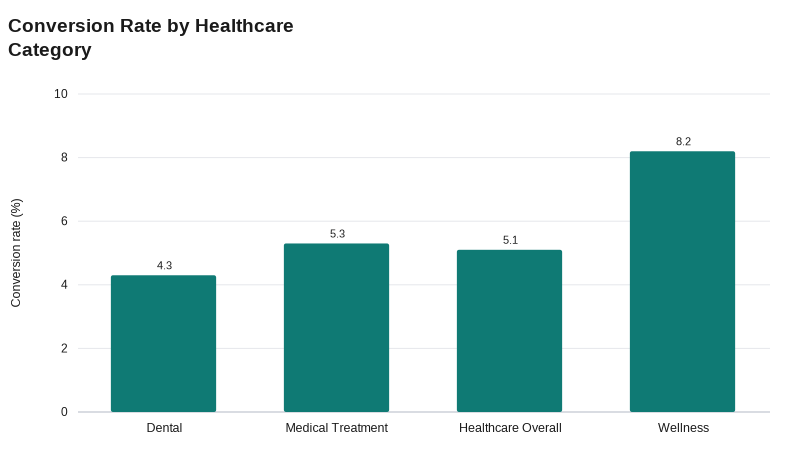
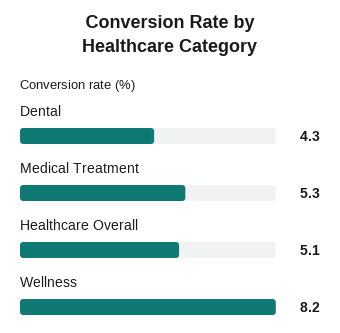
Source: Unbounce healthcare benchmark page.
The page does not explain why dental is lower. One possible reason is that cosmetic dental work costs more and takes more research than a single consultation, so a first-time visitor is less likely to book straight away. That is our guess, not a finding in the source.
Takeaway: If a dental page converts anywhere between 2% and 8.3%, it sits inside the range Unbounce reports for half of dental pages. That range is a reference point, not a pass mark.
Which channel converts
The channel that brought a visitor in changes what a typical rate looks like. These are the paid channel medians the healthcare page states.
| Channel | Median conversion rate | Notes |
|---|---|---|
| Instagram (paid social) | 7.7% | Top pages reach up to 39.7% |
| Google Ads (paid search) | 4.7% | Not stated |
| Yahoo (paid search) | 4.1% | Not stated |
| Bing (paid search) | 2.8% | Not stated |
| TikTok (paid social) | 2.8% | Top pages reach up to 12.6% |
Source: Unbounce healthcare benchmark page. Every row is from that page.
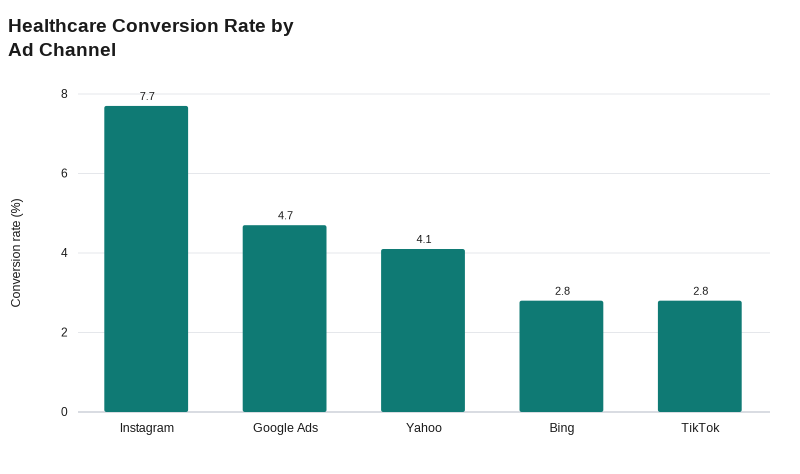
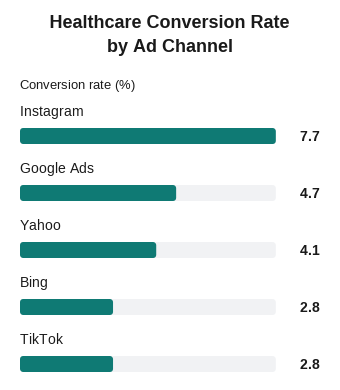
Source: Unbounce healthcare benchmark page.
The page also says email campaign traffic to health and wellness pages converts at nearly double the rate of both paid search and paid social. It gives no exact email figure in its text. If your practice has a recall or referral email list, that traffic is worth protecting.
Takeaway: The page’s median for Google Ads healthcare traffic is 4.7%. A campaign well below that is worth a closer look, but one page’s median is not a guarantee of what your campaign should achieve.
Mobile, desktop and reading level
Two more findings from the same page bear on how a clinic site is built.
Unbounce’s page says mobile drives 7x more traffic than desktop, while desktop converts 22% better. A gap like that can point to a mobile booking flow that is awkward or slow, though the page does not say that is the cause.
On copy, the page says pages written at a 5th to 7th grade reading level are the most effective, with a 10.8% median conversion rate. It says content at the 8th and 9th grade level drops the median conversion rate by 48%, and the 10th to 12th grade level reduces it by 55.6%. For word count, it suggests 355 to 1,020 words to increase your chances of hitting or exceeding the 5.1% healthcare median. By our arithmetic, 10.8% is a little over double 5.1%.
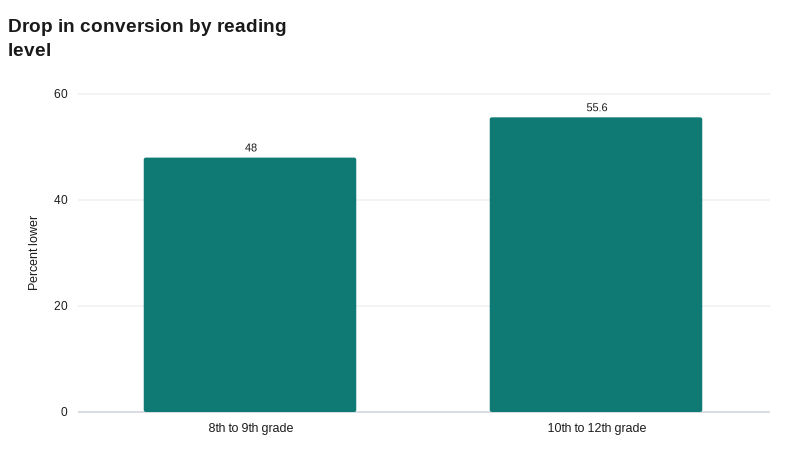
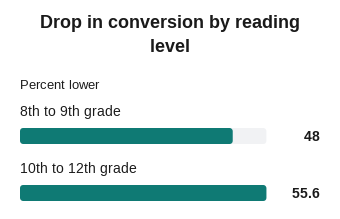
Source: Unbounce healthcare benchmark page, reading level section, as stated by Unbounce.
Takeaway: The page ties plainer copy to higher conversion. It does not prove that rewriting your copy will lift your own rate.
What this means for a cosmetic dentistry website
None of these figures tell a practice what it may publish. That is governed by advertising rules. Ahpra’s Guidelines for advertising a regulated health service say they apply to “anyone (registered health practitioners, individuals who are not registered as health practitioners and body corporates)” who advertises a regulated health service (Ahpra advertising guidelines). Check what you can say before rewriting a page to chase a better score. Our breakdown of the Ahpra advertising rules for cosmetic dentistry covers that, and ClinicCode can flag specific pages against the current rules before you invest in a rebuild.
Inside those rules, three changes are worth testing. These are our suggestions, not findings from the Unbounce page:
- Shorten the path to a booking form. Fewer fields between “I’m interested” and “I’ve requested a consultation” means fewer places to drop off.
- Write simply. The Unbounce page favours a 5th to 7th grade reading level. Explaining a procedure plainly is not the same as making an outcome claim.
- Consider showing a price range. A visitor who knows roughly what to expect may be less likely to abandon an enquiry form. This is our view, and the page does not test it.
Takeaway: The conversion levers and the advertising rules are two separate systems. Check the rules first, then test the levers.
FAQ
What is a good conversion rate for a dental or cosmetic clinic website?
We found no published Australian benchmark for dental or cosmetic clinic websites. The closest figure we opened is Unbounce’s healthcare benchmark page, which gives a median of 4.3% for dental landing pages, with half of dental pages converting between 2% and 8.3%. It measures Unbounce landing pages, not whole clinic websites, and the page does not say which countries are included. Use it as a rough reference, not a target.
Why do dental websites convert lower than other healthcare categories?
Unbounce’s page does not give a reason. It reports dental at 4.3%, below wellness (8.2%) and medical treatment (5.3%), with a healthcare industry median of 5.1%. Any explanation, such as higher cost or more research before booking, is our guess, not something the page states.
Does Ahpra restrict what a cosmetic dentistry website can publish?
Ahpra’s Guidelines for advertising a regulated health service apply to anyone who advertises a regulated health service, which the guidelines define as one provided, or usually provided, by a registered health practitioner. That is an advertising question, not a conversion question, so read the guidelines and our dental advertising rules post rather than treating this post as legal advice.
Should a dental practice website show exact prices or price ranges?
That is a content decision for the practice, and this post cannot tell you what is required. Unbounce’s page does not test price display. Our view is that a visitor who knows roughly what to expect is less likely to stall at an enquiry form, but that is opinion, not benchmark data.
Get your practice’s website reviewed
ClinicCode builds Ahpra-aware cosmetic dentistry and clinic websites. If you want help finding where your booking flow loses visitors before you spend on a rebuild, talk to us.
Talk to us about your practice’s website
Sources and references
- Unbounce - Healthcare, Wellness and Medical Services conversion rate benchmarks: dental, medical treatment and wellness medians, channel medians, mobile and desktop, reading level and word count
- Ahpra - Guidelines for advertising a regulated health service
Related reading:
- Cosmetic Clinic Website Booking Conversion Australia: a closer look at booking-flow friction for Ahpra-regulated clinics
- ADA social media and cosmetic dentistry: where cosmetic dentistry demand forms before it reaches your website
- Ahpra Advertising Rules for Cosmetic Dentistry: the rules governing what a dental practice can publish
Vikas Thakur
Founder, Perth. 16 years of experience from working at TPG, iiNet and Monadelphous, now helping Australian clinics keep their websites, ads and online presence AHPRA compliant.