Clinic Website Costs in Australia: What You Should Pay
There is no independently published market rate for a cosmetic clinic website in Australia. Here is what sets the price of a compliant build, what every quote should include, and how to compare quotes on scope.
 Vikas Thakur Founder, Perth 9 min read Fact checked
Key takeaways
- There is no published market rate for a cosmetic clinic website in Australia, so the price you are quoted is set by scope: what is removed, gated, stored and reviewed, not by a going rate
- ClinicCode promises no fixed delivery time for a build or a remediation: We work to your schedule and your needs.
- With ClinicCode you get a fixed-price quote after the 10 to 20 minute call, itemised against the same four build items listed below
- No independent, publicly verified survey of cosmetic clinic website costs across the Australian market exists as of August 2026. Every pricing page we could locate in this niche, including ours, is fixed-quote-after-scoping, not a published rate card
- Since 2 September 2025, AHPRA’s consolidated guidelines apply to every registered health practitioner except medical practitioners, who instead sit under the Medical Board’s guidelines in force since 1 July 2023, and both add build requirements a pre-2025 site is unlikely to have
- The compliance features driving cost are specific and checkable: a disabled testimonial field, a gated before/after component, a stored date of birth against the patient record, and a cooling-off interstitial, not vague “compliance” line items
There is no published number that answers “what does a cosmetic clinic website cost in Australia” the way a real estate listing answers “what does a house cost”. As at August 2026, the pricing pages we could find in this niche (ours included) are scoped-quote pages, not rate cards. So instead of inventing a market average, this post breaks the price into its actual components: what a compliant build has to include, what that takes in time, and the questions that let you compare quotes on scope.
If you are a practice manager staring at three agency quotes that differ by several multiples with no explanation of the gap, this is the framework for closing that gap yourself.
What Sets the Price
A cosmetic clinic website costs more than a generic small business site because of one thing: since 2 September 2025, AHPRA’s consolidated guidelines for registered health practitioners who perform non-surgical cosmetic procedures apply to every registered health practitioner except medical practitioners. Medical practitioners instead sit under the Medical Board of Australia’s guidelines for registered medical practitioners who perform cosmetic surgery and procedures, in force since 1 July 2023. Both sets of guidelines ban testimonials for the procedures they cover, restrict before/after imagery, and require specific consumer-protection language.
That is the rule as the regulators state it. What it means for a quote is that a compliant build is not a generic WordPress theme with your logo dropped in. It is a site with specific fields removed from the CMS, specific components added, and a review pass against the current guideline before launch. A quote that does not mention any of that is quoting a different, cheaper product.
Takeaway: the price gap between agency quotes is usually a scope gap, not a margin gap. Find out what is included before comparing the number.
What That Means for the Build
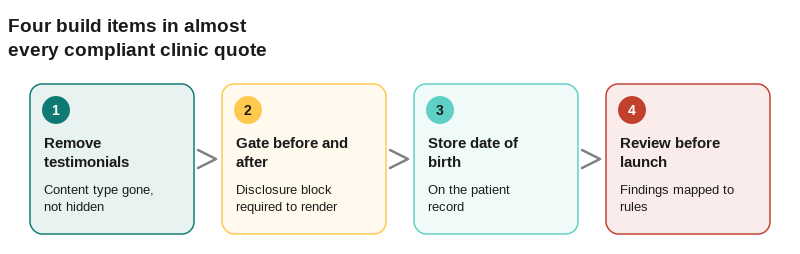
Four build items show up in almost every compliant quote, and each one is a line item you can ask a vendor about directly.
Testimonial field removed, not just hidden. A testimonial carousel commented out in the template still exists in the CMS and gets switched back on by whoever edits the site next. The compliant version removes the content type entirely.
Before/after component gated behind a disclosure block. Under both guidelines, before/after imagery for the procedures they cover needs specific disclosures and cannot imply typical results. The build fix is a component that will not render an image pair without the accompanying text block populated, not a photo gallery with a disclaimer somewhere else on the page.
Date of birth stored against the patient record, not just emailed. Where a cooling-off period applies, the logic that enforces it needs to query a stored value at booking time, which means a database field, not a form submission that only reaches an inbox.
A structured content review against the current guideline before launch. Not a general proofread. A page-by-page check against the specific bans (testimonials, time-limited offers, language that trivialises risk, unregistered Schedule 4 product naming) with each finding mapped to the rule it breaches.
Skip any of these and the “finished” site is not compliant. It is a site that will need the same work done later, on top of whatever the launch already cost.
Cost by Build Type
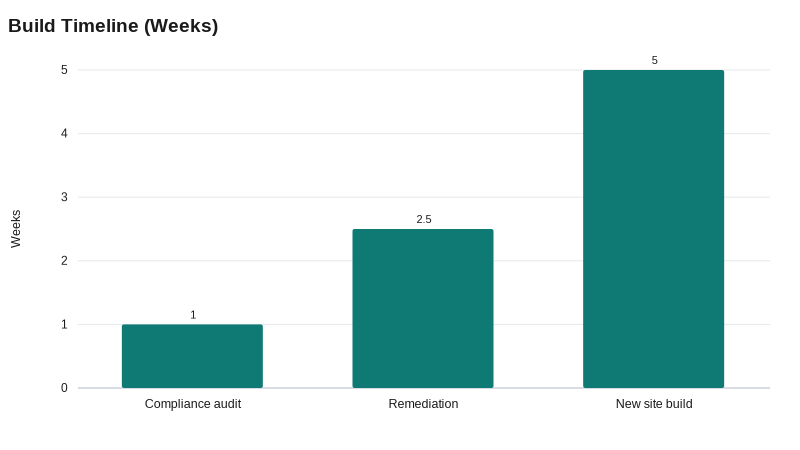
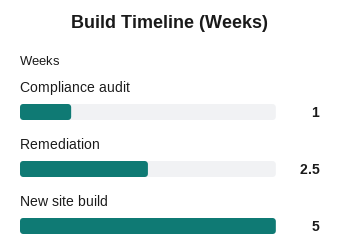
The table below sets out the scope and typical timeframe for each build type. It states no price, because there is no verified market rate to quote. Use it as a decision matrix: match your situation to a row, then ask any vendor you are comparing whether their quote covers the same scope.
| Build type | What it covers | Timing | Cost model |
|---|---|---|---|
| Remediation of an existing site | Remove non-compliant content, add required disclosures, restructure affected pages | To your schedule | Fixed-price scoped quote |
| New compliant build | Full site built from a clean structure: compliant copy, gated imagery, correct practitioner registration details, cooling-off logic | To your schedule | Fixed-price scoped quote |
| Ongoing compliance monitoring | A recurring check of the live site against rule changes, with fixes scoped as they arise | Continuous, monthly cycles | Fixed-price quote after the 10 to 20 minute call |
A Worked Example
Cosmetic clinic, existing site built in 2023. The site predated the September 2025 guideline change entirely: a testimonial carousel on the homepage, unlabelled before/after photo pairs on three treatment pages, and no age or cooling-off logic anywhere in the booking form. A quote for a full rebuild came back higher than the clinic expected, until the issues were mapped line by line against what each fix required: removing the testimonial content type, rebuilding the before/after component with a mandatory disclosure block, and adding a date of birth field wired to the booking logic rather than a plain text input.
None of that is decorative work. It is the difference between a site that displays content and a site that enforces the rules the content is subject to. Once the clinic could see the scope broken out this way, the number stopped looking arbitrary. It matched the remediation row in the table above: fixed-price, because the structure and copy voice already existed and did not need to be rebuilt from scratch.
If your current site only needs its wording fixed, that is a smaller, faster piece of work than a full rebuild quote.
What to Check on Your Own Quote
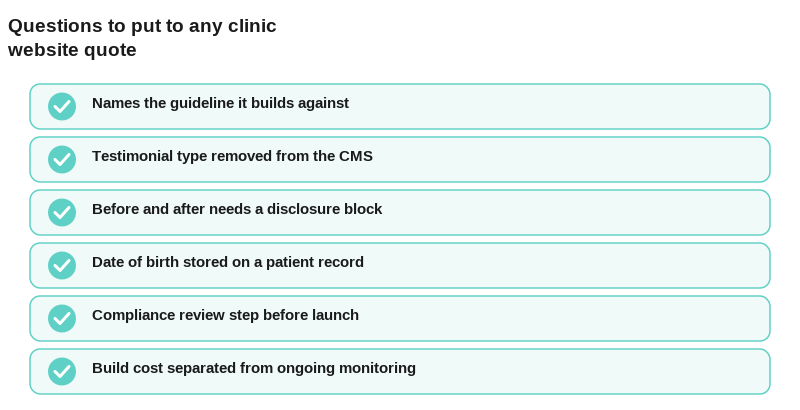
- Does the quote name the specific guideline it is being built against, and does it distinguish medical practitioners (Medical Board, 2023 guidelines) from other registered health practitioners (AHPRA, September 2025 guidelines)?
- Is the testimonial content type removed from the CMS, or just hidden from the template?
- Does the before/after component require a disclosure block to render, or is disclosure left to a separate page?
- Is date of birth stored against a queryable patient record, or only captured in a form submission?
- Is there a stated compliance review step before launch, with findings mapped to specific rules?
- Does the quote separate one-off build cost from any ongoing monitoring cost, so you know what happens when the guideline next changes?
- If the quote includes ongoing work, does it state what is covered each month and what is charged separately when the scope grows?
The Enforcement Anchor
AHPRA’s September 2025 announcement carried a direct warning from the regulator that practitioners had been given time to prepare and that AHPRA would act where practitioners were found to be prioritising commercial interests over patient protection. That is the regulator’s stated posture, on the record, in the same announcement that introduced the guidelines this post is built around.
We could not locate a published infringement notice, determination, or complaint outcome tied specifically to a clinic’s choice of a cheap, non-compliant website build. The general enforcement posture toward non-compliant advertising is documented; a case tied directly to a build-cost decision is not, and we are not going to imply otherwise.
Where This Gets Hard
Two honest limits here. First, there is no independent market survey to check any vendor’s quote against, ours included. A quote that looks high or low has to be judged on scope, not against a published figure that does not exist. Second, “compliant” is not a fixed target. The guidelines were consolidated in September 2025 and the TGA’s advertising code consultation, open until 3 September 2026, could change the rules again before this post is a year old. A build that is compliant today needs a maintenance plan, not just a launch date.
The regulator says testimonials, before/after imagery and cooling-off periods are governed by specific, named rules; the build consequence is a defined set of removed fields, gated components and stored data your developer can quote against directly; whether your particular site’s current state discharges those obligations is a question for your medical defence organisation or your lawyer, not a website audit.
Status
In force. AHPRA’s consolidated guidelines have applied since 2 September 2025 and the Medical Board’s guidelines for medical practitioners since 1 July 2023.
Frequently Asked Questions
How much does a compliant clinic website cost?
There is no independently published market rate, so any single number would be a guess. The price is set by scope, because a remediation of an existing site and a new compliant build are two different pieces of work. With ClinicCode, you get a fixed-price quote after the 10 to 20 minute call.
Is a cheap, non-compliant clinic website cheaper in the end?
The upfront number might be lower, but a site missing the mandatory features (cooling-off logic, testimonial removal, compliant before/after handling) is not a finished compliant product. It is a site that still needs the remediation work done, which means paying for the same build twice.
How long does a new compliant clinic website take to build?
ClinicCode does not promise a fixed delivery time for a new AHPRA-compliant clinic website or for remediating an existing one. We work to your schedule and your needs.
Get a Scoped Quote, Not a Guess
Call me back with your current site’s URL and ClinicCode will map what a compliant build or remediation needs, item by item, before you sign anything. You get a fixed-price quote after the 10 to 20 minute call. For the build detail, see clinic website design.
Sources
- AHPRA - Putting patients first: New guidelines for cosmetic procedures, 2 September 2025. Checked 15 August 2026.
- Medical Board of Australia - Guidelines for registered medical practitioners who perform cosmetic surgery and procedures, in force 1 July 2023. Checked 15 August 2026.
- ClinicCode - Clinic Website Design, service list. Checked 15 August 2026.
Last reviewed: 15 August 2026.
Vikas Thakur
Founder, Perth. 16 years of experience from working at TPG, iiNet and Monadelphous, now helping Australian clinics keep their websites, ads and online presence AHPRA compliant.