$319,260 in TGA Fines Over Weight-Loss Medicine Ads
The TGA’s July 2024 release reports 21 infringement notices, totalling $319,260, to 4 businesses and 3 individuals for alleged unlawful medicine advertising. The medicines were prescription-only, mainly for weight loss, including Ozempic and Saxenda. A clinic offering GLP-1 scripts should check its treatment pages against the same conduct.
 Vikas Thakur Founder, Perth 8 min read Fact checked
Key takeaways
- The TGA issued 21 infringement notices totalling $319,260 to 4 businesses and 3 individuals over the alleged unlawful advertising of prescription-only medicines, primarily for weight loss (TGA media release, published 12 July 2024).
- Advert Digital Pty Ltd received the largest total penalty on the list: 5 notices totalling $93,900 (TGA).
- Eveadam Health Pty Ltd and Chronic Therapy Pty Ltd each received 4 notices totalling $75,120 apiece.
- Reda Compounding Chemist Pty Ltd, together with a NSW-based individual, received 4 notices totalling $60,096.
- Two Victorian-based sole traders each received 2 notices totalling $7,512.
- The alleged conduct included promoting prescription-only medicines such as Ozempic, Saxenda and Viagra, and stating that certain prescription-only medicines were TGA approved.
- Acting Deputy Secretary Nick Henderson said advertising prescription-only medicines directly to consumers “could create an inappropriate demand for these medicines and lead to unnecessary or harmful prescribing.”
- The TGA says it has issued several warnings since 2022 that advertising Ozempic is prohibited, and that Ozempic is approved only for lowering blood sugar in adults with type 2 diabetes.
The TGA issued 4 businesses and 3 individuals a combined $319,260 across 21 infringement notices for the alleged unlawful advertising of prescription-only medicines, primarily for weight loss. The case covers Ozempic, Saxenda and Viagra, and the notices were issued over content on the recipients’ websites (TGA, 12 July 2024).
Twenty-one infringement notices. Seven recipients. $319,260 total, issued for alleged unlawful advertising of prescription-only medicines on the recipients’ websites. The TGA’s release says the notices went to businesses including online telehealth clinics and medical practices offering telehealth services, and it names Ozempic, Saxenda and Viagra. The alleged conduct includes promoting prescription-only medicines and stating that certain medicines were TGA approved. A cosmetic clinic that offers GLP-1 scripts alongside injectables publishes the same kind of web page, so the question is whether its copy matches the rules.
What the TGA actually fined
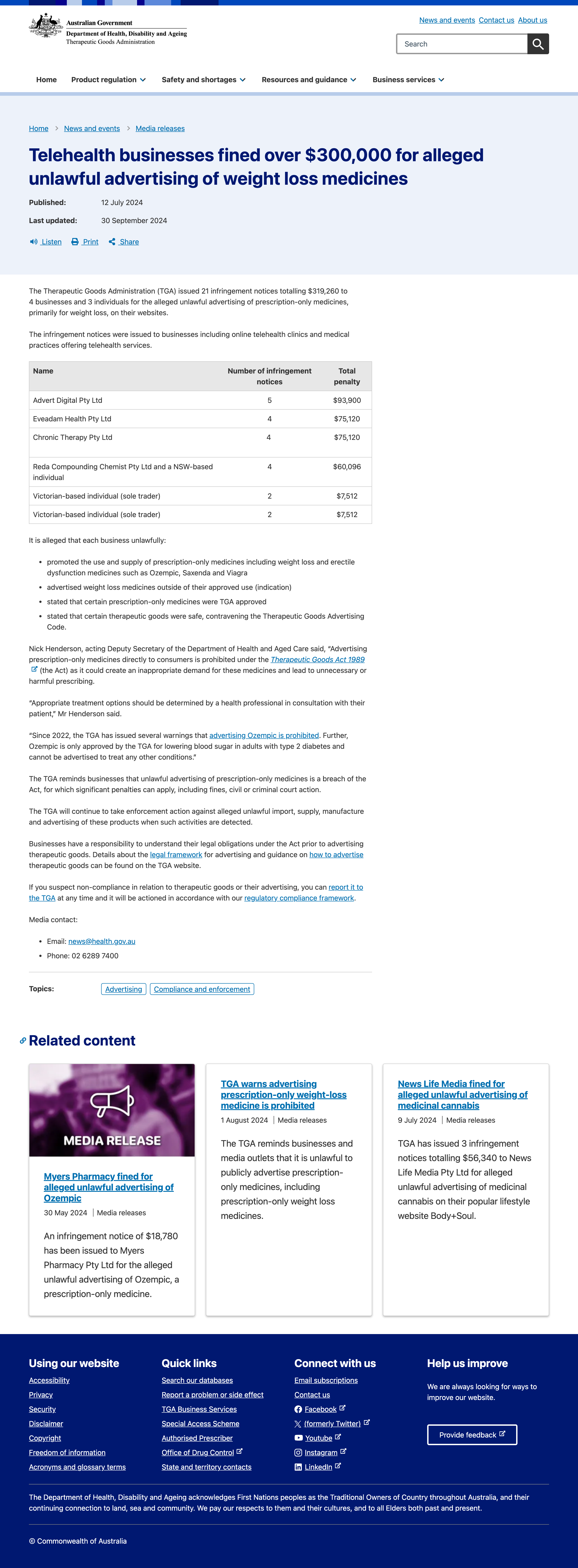
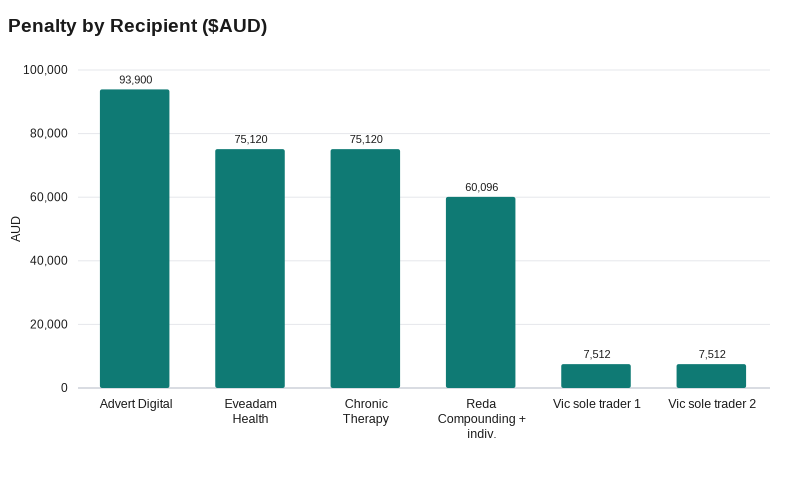
The TGA’s release breaks the $319,260 down by recipient. The largest total, $93,900, went to Advert Digital Pty Ltd.
| Recipient | Infringement notices | Total penalty |
|---|---|---|
| Advert Digital Pty Ltd | 5 | $93,900 |
| Eveadam Health Pty Ltd | 4 | $75,120 |
| Chronic Therapy Pty Ltd | 4 | $75,120 |
| Reda Compounding Chemist Pty Ltd and a NSW-based individual | 4 | $60,096 |
| Victorian-based individual (sole trader) | 2 | $7,512 |
| Victorian-based individual (sole trader) | 2 | $7,512 |
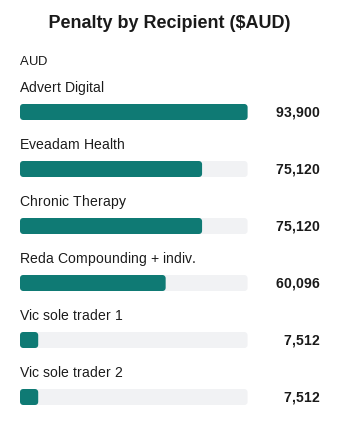
Source: TGA media release, 12 July 2024.
Notice counts range from 2 to 5 per recipient, and the dollar totals do not scale evenly with them: 4 notices came to $75,120 for two recipients but $60,096 for the Reda Compounding Chemist row, so the release does not show one flat amount per notice. The TGA’s release does not describe what Advert Digital Pty Ltd does, so the table alone does not tell us which role in a campaign drew the largest total.
Takeaway: The penalties were spread across 7 recipients, and the largest total was $93,900.
The alleged conduct, in plain terms
Strip out the legal phrasing and the TGA alleges that each business unlawfully did four things:
- Promoting the use and supply of prescription-only medicines, including weight-loss and erectile dysfunction medicines such as Ozempic, Saxenda and Viagra, directly to consumers.
- Advertising weight-loss medicines outside of their approved use (indication).
- Stating that certain prescription-only medicines were TGA approved.
- Stating that certain therapeutic goods were safe, which the TGA says contravenes the Therapeutic Goods Advertising Code.
Source: TGA media release, 12 July 2024.
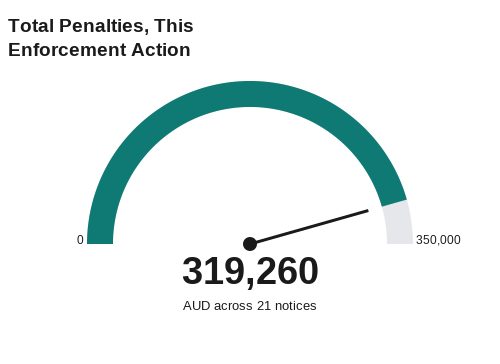
Source: TGA media release, 12 July 2024.
Nick Henderson, acting Deputy Secretary of the Department of Health and Aged Care, put the reasoning behind the ban in plain terms: “Advertising prescription-only medicines directly to consumers is prohibited under the Therapeutic Goods Act 1989 (the Act) as it could create an inappropriate demand for these medicines and lead to unnecessary or harmful prescribing.” He added that “appropriate treatment options should be determined by a health professional in consultation with their patient.” On Ozempic specifically, Henderson said: “Since 2022, the TGA has issued several warnings that advertising Ozempic is prohibited. Further, Ozempic is only approved by the TGA for lowering blood sugar in adults with type 2 diabetes and cannot be advertised to treat any other conditions.” (TGA)
Takeaway: The alleged conduct is specific: promoting a prescription-only medicine, advertising it outside its approved use, claiming TGA approval, or claiming it is safe.
Why this is a website problem, not just an ad-spend problem
The TGA’s release describes notices for how the recipients advertised prescription-only medicines, primarily for weight loss. It does not mention Botox or filler ads. That matters for cosmetic clinics that list injectables on the treatment menu and also offer a GLP-1 weight-loss script through a partnered prescriber or an in-house telehealth arm.
If a clinic’s website names Ozempic, Saxenda, Mounjaro or any other prescription-only weight-loss medicine by brand, states or implies TGA approval for weight loss specifically, or describes the medicine as safe, that page resembles the conduct alleged in this case. A call with ClinicCode fixes treatment pages, booking widget copy and landing pages against this pattern.
Takeaway: The allegations are about what the page says about the medicine.
What to check before your GLP-1 page goes near a regulator
This is a website content check, not clinical or legal advice about which medicines to offer or how to prescribe them. Whether specific copy on your site crosses the line is a question for your medical defence organisation or your lawyer.
| Page element | What to look for | Why it matters here |
|---|---|---|
| Medicine names | Ozempic, Saxenda, Mounjaro or similar named directly on a public page | Promoting prescription-only medicines such as Ozempic, Saxenda and Viagra is the first allegation in this case |
| Approval language | “TGA approved,” “approved for weight loss” or similar claims | Stating that certain prescription-only medicines were TGA approved is one of the TGA’s allegations |
| Safety claims | “Safe,” “well-tolerated,” or similar unqualified reassurance copy | Stating that certain therapeutic goods were safe is one of the TGA’s allegations, which it says contravenes the Advertising Code |
| Booking and intake flows | Package names or drop-down menus referencing a specific weight-loss drug | Package names and menus are public page content, so they are worth checking with the rest |
Start with medicine names, since the TGA’s release names Ozempic, Saxenda and Viagra. ClinicCode builds and fixes cosmetic clinic websites, and treats treatment and booking pages as regulated advertising rather than generic marketing copy.
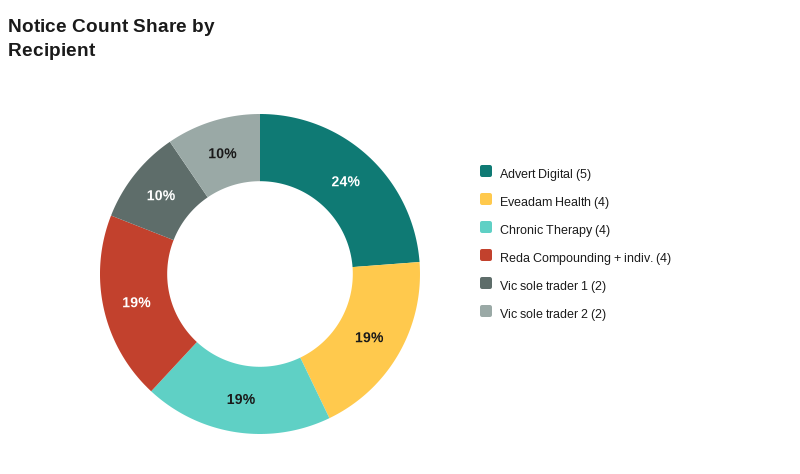
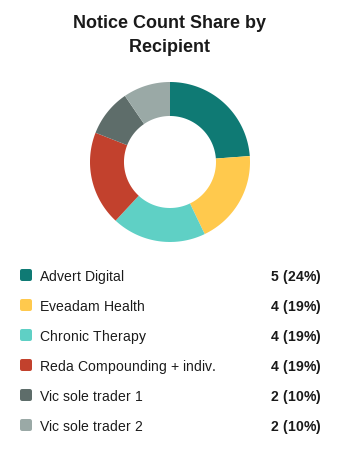
Source: notice counts from the TGA media release, 12 July 2024; shares are our arithmetic on those counts (out of 21).
Takeaway: Run the four-item table before a GLP-1 page goes live.
The pattern behind this case
This was not the TGA’s only action on the topic. The related-content links on the same release point to three other TGA media releases. On 30 May 2024, the TGA issued one infringement notice of $18,780 to Myers Pharmacy Pty Ltd for the alleged unlawful advertising of Ozempic through in-store signs at a pharmacy in New South Wales (TGA). On 1 August 2024, the TGA reminded businesses and media outlets that it is unlawful to publicly advertise prescription-only medicines, including prescription-only weight loss medicines (TGA). On 9 July 2024, it issued 3 infringement notices totalling $56,340 to News Life Media Pty Ltd for alleged unlawful advertising of medicinal cannabis on its Body+Soul website, where the TGA says the references were restricted or prohibited representations (TGA). The medicines differ, and the TGA’s stated position is the same: advertising prescription-only medicines directly to consumers is prohibited.
Takeaway: The TGA says it will continue to take enforcement action on unlawful advertising of these products when it detects them.
Frequently Asked Questions
How much did the TGA fine the telehealth businesses and individuals?
The TGA issued 21 infringement notices totalling $319,260 to 4 businesses and 3 individuals for the alleged unlawful advertising of prescription-only medicines, primarily for weight loss, on their websites (TGA).
Which medicines were named in the case?
The TGA’s release names Ozempic, Saxenda and Viagra as examples of the prescription-only medicines allegedly promoted, and also alleges that weight loss medicines were advertised outside of their approved use (TGA).
Does offering GLP-1 prescriptions alongside injectables automatically breach these rules?
Not automatically. The case is about specific alleged advertising conduct: promoting prescription-only medicines, advertising outside the approved use, stating TGA approval, or stating that goods are safe. Whether specific wording on your site matches that pattern is a question for your medical defence organisation or your lawyer.
Get Your GLP-1 Pages Checked
Ready to see what a regulator would find on your own GLP-1 or injectables page? Book a compliance-focused website review before a treatment page nobody has checked in months becomes the next case on this list.
Sources and References
- Therapeutic Goods Administration, “Telehealth businesses fined over $300,000 for alleged unlawful advertising of weight loss medicines,” media release, published 12 July 2024, last updated 30 September 2024. tga.gov.au. Date checked: 24 November 2026. Source for the $319,260 total, the 21-notice count, the per-recipient breakdown table, the medicines named, the alleged conduct, and the direct quotes from Nick Henderson.
- Therapeutic Goods Administration, “Myers Pharmacy fined for alleged unlawful advertising of Ozempic,” media release. tga.gov.au. Date checked: 24 November 2026. Source for the related $18,780 Myers Pharmacy infringement notice referenced in the pattern section.
- Therapeutic Goods Administration, “TGA warns advertising prescription-only weight-loss medicine is prohibited,” media release. tga.gov.au. Date checked: 24 November 2026. Source for the standalone TGA warning referenced in the pattern section.
- Therapeutic Goods Administration, “News Life Media fined for alleged unlawful advertising of medicinal cannabis,” media release. tga.gov.au. Date checked: 24 November 2026. Source for the $56,340 News Life Media case referenced in the pattern section.
Vikas Thakur
Founder, Perth. 16 years of experience from working at TPG, iiNet and Monadelphous, now helping Australian clinics keep their websites, ads and online presence AHPRA compliant.