Google Reviews and Ahpra: When a Reply Counts as a Testimonial
A five-star Google review is not an Ahpra problem on its own, but liking, sharing or replying to one with outcome language can be. Here is the test Ahpra publishes.
 Vikas Thakur Founder, Perth 10 min read Fact checked
Key takeaways
- Ahpra’s testimonial ban only catches a review if it refers to a clinical aspect: a symptom, a diagnosis or treatment, or an outcome, stated directly or by comparison (Ahpra)
- A court may order a maximum penalty of $60,000 per offence for an individual and $120,000 per offence for a body corporate (Ahpra). Ahpra’s advertising guidelines page still carries footnote 3, which gives Western Australia maxima of $30,000 for an individual and $60,000 for a body corporate against the unlawful use of a protected title offence, and the page does not reconcile it with its statement that the higher penalties apply in all jurisdictions, including Western Australia, as of July 2024.
- Comments about customer service or communication style that do not refer to a clinical aspect are not testimonials and may be used in advertising (Ahpra)
- The 2022 amendment to the National Law raised the maximum per offence from $5,000 to $60,000 for an individual and from $10,000 to $120,000 for a body corporate (Ahpra)
- Advertisers do not have to remove, or try to remove, a review on a website or social media they do not control (Ahpra)
- Ahpra says engaging with reviews on third-party websites may be considered using a testimonial to advertise
- Ahpra’s cosmetic procedure guidelines came into effect on 2 September 2025 and strengthen the ban on testimonials from social media influencers (Ahpra)
- Ahpra says most advertising cases start with a letter requiring the advertiser to correct the advertising within 30 days (Ahpra)
A five-star Google review sitting on your clinic’s listing is not, by itself, an Ahpra problem. What can turn it into one is liking it, sharing it to Instagram, or replying “so glad you loved your results”. A court may order a maximum penalty of $120,000 per offence for a body corporate and $60,000 per offence for an individual (Ahpra). Ahpra’s advertising guidelines page still carries footnote 3, which gives Western Australia maxima of $30,000 for an individual and $60,000 for a body corporate against the unlawful use of a protected title offence, and the page does not reconcile it with its statement that the higher penalties apply in all jurisdictions, including Western Australia, as of July 2024.
Ahpra draws a specific line. A comment is a testimonial if it is a recommendation or positive statement about the clinical aspects of a regulated health service (Ahpra). Ahpra says comments about customer service or communication style that do not refer to clinical aspects are not testimonials. The risk sits in what a clinic does with the reviews that do cross the line. This guide sets out the test from Ahpra’s own published guidance and what it means for the review widgets and reply templates on your clinic’s website.
What Counts as a Testimonial Under Ahpra’s Rules
Ahpra’s advertising guidelines define a testimonial as recommendations or positive statements about the clinical aspects of a regulated health service used in advertising. Ahpra says a clinical aspect exists if one of these is expressed:
- Symptom: the specific symptom or the reason for seeking treatment.
- Diagnosis or treatment: the specific diagnosis or treatment provided by the practitioner.
- Outcome: the specific outcome, or the skills or experience of the practitioner, either directly or via comparison.
Ahpra also says: “Not all reviews or positive comments made about a regulated health service are considered testimonials.” Comments about clinical aspects are testimonials and cannot be used in advertising. Comments that are not about clinical aspects, such as customer service or communication style, may be used in advertising.
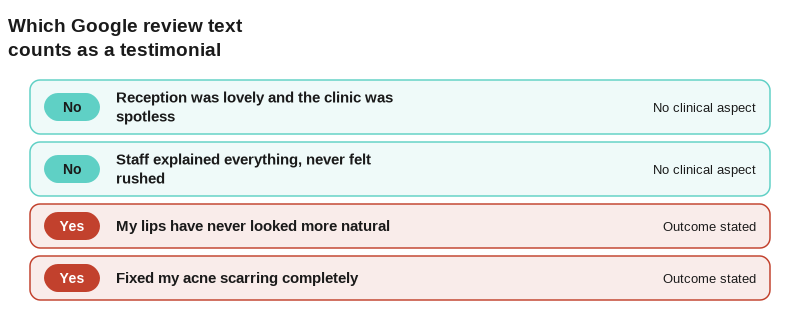
The examples below are our own illustrations, sorted against that test.
| Example review text (our illustration) | Clinical aspect present? | Testimonial? |
|---|---|---|
| “Reception was lovely and the clinic was spotless.” | No | No |
| “Staff explained everything and I never felt rushed.” | No | No |
| “My lips have never looked more natural, best filler in Perth.” | Yes, outcome | Yes |
| “Fixed my acne scarring completely, so happy with the result.” | Yes, outcome | Yes |
Source: classification applied from the clinical aspect test on Ahpra’s testimonials page, seen 25 November 2026. The review texts are invented examples, not real reviews.
Takeaway: The test is not whether a review is positive. It is whether the review refers to a symptom, a treatment, or an outcome.
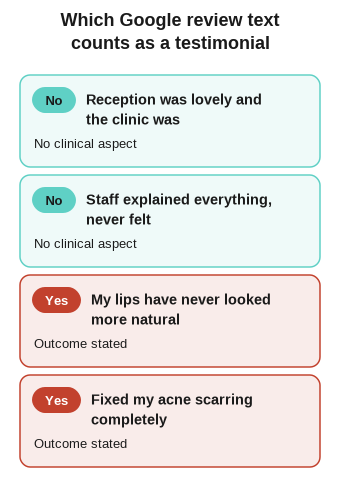
Source: Ahpra testimonials page, seen 25 November 2026. The review texts in the figure are our illustrations.
Reviews That Do Not Refer to a Clinical Aspect
Under Ahpra’s guidance, comments about customer service or communication style that do not refer to clinical aspects may be used in advertising. In our view, that covers comments about reception, wait times or how a consultation felt.
Ahpra also lists selective publishing and editing as a risk. Its testimonials page says the risk of harm is greatest where a testimonial is false, misleading or deceptive, “including testimonials that are: selectively published or edited, or fake”.
Takeaway: A review that stays on service and communication is not a testimonial under Ahpra’s test. Curating or editing reviews carries its own risk.
Where Clinics Can Get This Wrong: Replying and Sharing
Ahpra says the advertiser, meaning whoever has control over the advertising, is responsible for compliance with the testimonial prohibition. An advertiser has control if they publish or authorise content, or if there is a mechanism for the advertiser to modify or remove content published by an unrelated publisher.
For a review on a site the clinic does not control, Ahpra says advertisers “do not have to remove or try to remove a review on a website or in social media over which they do not have control”. It then adds: “Advertisers should take care if they choose to engage with reviews on third-party websites as this may be considered using a testimonial to advertise a regulated health service.”
Ahpra does not list liking, sharing or replying as separate acts in that passage. In our view, a clinic that likes a review describing an outcome, shares it to Instagram Stories, or replies with outcome language such as “so glad you loved your filler results” is using that content in its own marketing, where the clinical aspect test applies.
Source: Ahpra testimonials page, seen 25 November 2026.
Takeaway: A review on a platform you do not control is not yours to remove. Engaging with its clinical content is where Ahpra says care is needed.
The Penalty Ahpra Publishes
Ahpra says advertising breaches of the National Law may be prosecuted, and a court may order advertisers to pay a penalty for each offence (Ahpra). The maximums are $60,000 per offence for an individual, such as a registered health practitioner, and $120,000 per offence for a body corporate. Ahpra’s advertising guidelines page still carries footnote 3, which gives Western Australia maxima of $30,000 for an individual and $60,000 for a body corporate against the unlawful use of a protected title offence, and the page does not reconcile it with its statement that the higher penalties apply in all jurisdictions, including Western Australia, as of July 2024.
Ahpra says the 2022 amendment to the National Law increased the maximum financial penalty per offence from $5,000 to $60,000 for an individual and from $10,000 to $120,000 for a body corporate (Ahpra). That is twelve times in both cases (our arithmetic: $60,000 divided by $5,000, and $120,000 divided by $10,000, both equal 12).
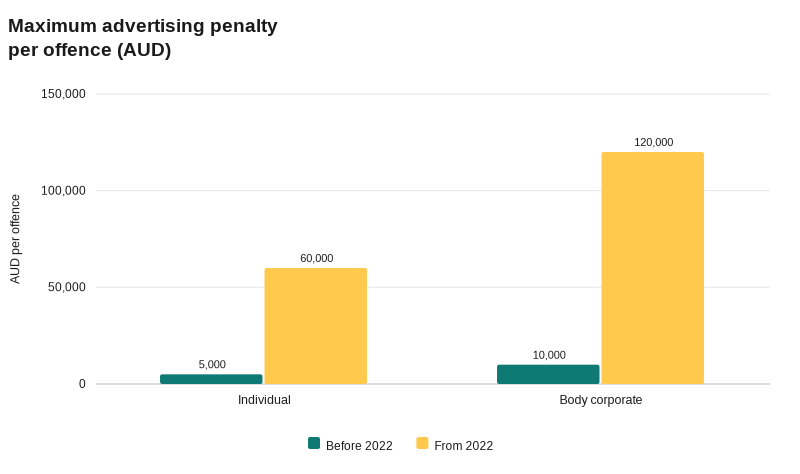
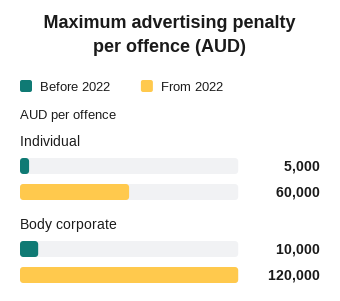
Source: Ahpra advertising guidelines and Ahpra advertising and the law, seen 25 November 2026.
On process, Ahpra says all advertising breaches are managed case by case, and most cases start with a letter to the advertiser saying their advertising breaches the National Law and requiring them to correct it within 30 days (Ahpra). If the advertiser corrects it, Ahpra says it will in most cases close the matter. Where the advertiser is a registered practitioner and does not correct, Ahpra says it may propose to impose conditions on their registration which prohibit advertising.
Takeaway: The figures are maximums a court may order per offence. Ahpra’s own description of most cases is a letter and a 30-day correction window.
What This Means for Your Clinic’s Website
The clinical aspect test applies to your own pages as well. Ahpra says a social media page used to promote a regulated health service, such as a clinic’s Facebook page, is advertising and must not include testimonials. In our view, a treatment page that quotes outcome-based reviews faces the same test as a reply that repeats those outcomes.
Ahpra’s cosmetic procedure advertising guidelines came into effect on 2 September 2025. Among other changes, they strengthen the ban on the use of testimonials from social media influencers (Ahpra).
Takeaway: In our view, the safest use of Google reviews on a clinic website is to leave them as written and keep clinic replies focused on service, not results.
FAQ
Does Ahpra ban all Google reviews for cosmetic clinics?
No. Ahpra says not all reviews or positive comments about a regulated health service are testimonials. A comment about customer service or communication style that does not refer to a clinical aspect is not a testimonial for the purposes of the National Law and may be used in advertising. A comment about a symptom, a diagnosis or treatment, or an outcome is a testimonial and cannot be used in advertising (Ahpra testimonials page).
Can I reply to a Google review on my clinic’s page?
Ahpra says advertisers should take care if they choose to engage with reviews on third-party websites, as this may be considered using a testimonial to advertise a regulated health service (Ahpra testimonials page). In our view, a short thank-you that does not mention any treatment or result is the safer reply.
Am I responsible for removing reviews I did not ask for and cannot control?
Ahpra says advertisers do not have to remove, or try to remove, a review on a website or in social media over which they do not have control (Ahpra testimonials page).
What is the maximum penalty if a review reply breaches Ahpra’s rules?
Ahpra says a court may order a maximum penalty of $60,000 per offence for an individual and $120,000 per offence for a body corporate (Ahpra advertising and the law). Ahpra’s advertising guidelines page still carries footnote 3, which gives Western Australia maxima of $30,000 for an individual and $60,000 for a body corporate against the unlawful use of a protected title offence, and the page does not reconcile it with its statement that the higher penalties apply in all jurisdictions, including Western Australia, as of July 2024.
Get Your Google Reviews and Website Checked
If you want a second pair of eyes on the reviews, widgets and reply templates on your clinic’s website, ask for a call back and we will compare them against the clinical aspect test above.
The Source Pages
Screenshots of the pages cited in this post, taken on 25 November 2026 and framed on the passage each one supports.
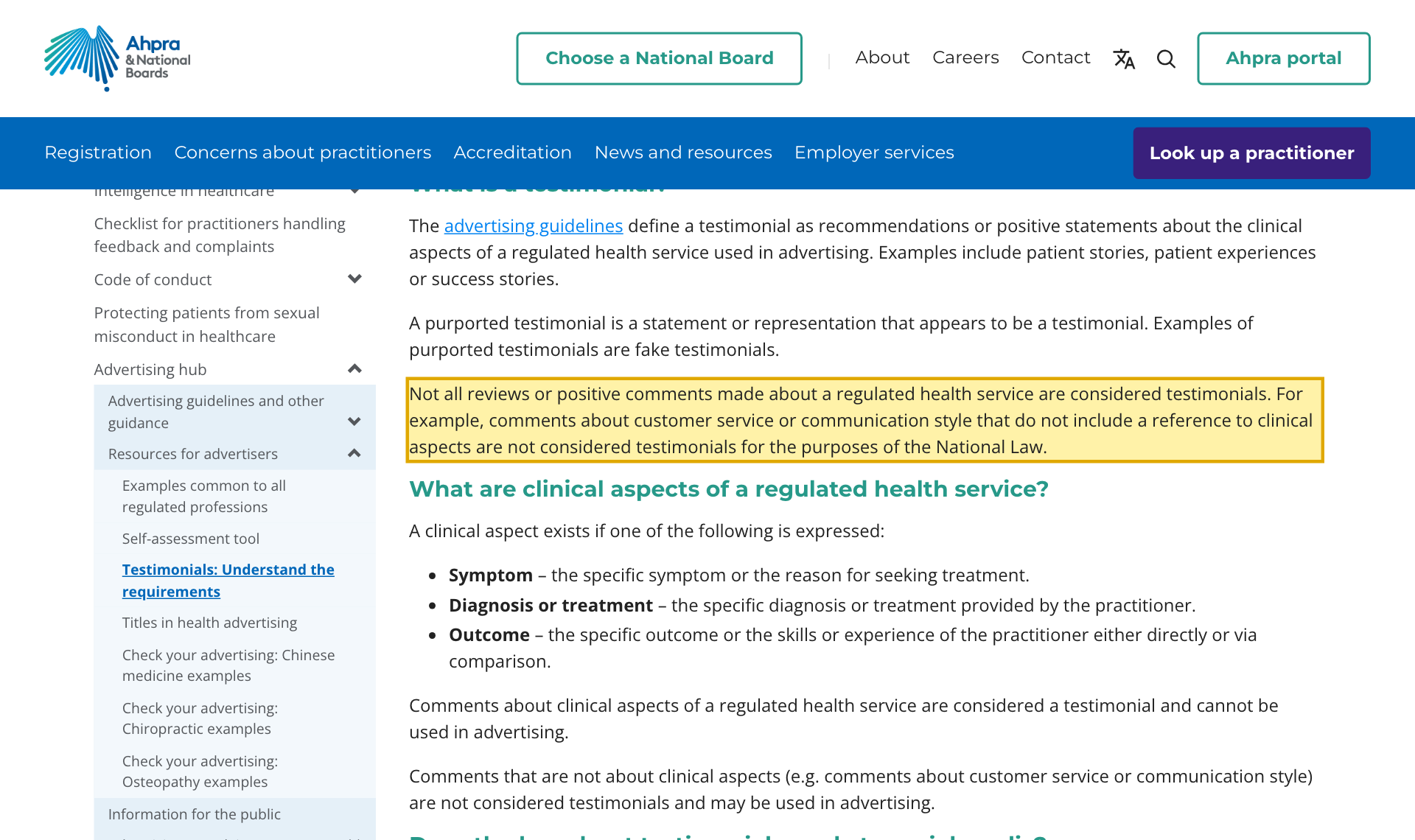
Source: Ahpra, Testimonials: Understand the requirements, screenshot taken 25 November 2026.
Sources and References
Ahpra - Testimonials: the definition of a testimonial, the clinical aspect test, who is responsible, and the guidance on engaging with reviews on third-party websites (seen 25 November 2026)
Ahpra - Advertising and the law: the maximum penalties of $60,000 and $120,000 per offence (seen 25 November 2026)
Ahpra - Advertising guidelines: the 2022 penalty increase, the July 2024 statement on all jurisdictions, and footnote 3 on Western Australia (seen 25 November 2026)
Ahpra - How we manage advertising complaints: the letter and 30-day correction process (seen 25 November 2026)
Ahpra - New guidelines for cosmetic procedures, 2 September 2025: the influencer testimonial ban (seen 25 November 2026)
Related reading:
- AHPRA Testimonial Ban: Fines Jumped 12x to $120K in 2022: the full testimonial rule and penalty history
- AHPRA Social Media Rules for Cosmetic Clinics: platform-by-platform compliance guidance
- AHPRA Advertising Fines for Cosmetic Clinics: the full penalty structure
- Clinic Website Design: compliant website builds for AHPRA-regulated clinics
Vikas Thakur
Founder, Perth. 16 years of experience from working at TPG, iiNet and Monadelphous, now helping Australian clinics keep their websites, ads and online presence AHPRA compliant.