Card Surcharges Ended 1 October 2026: Fix Your Clinic Checkout
From 1 October 2026, the ACCC says businesses can no longer add a surcharge to Visa, Mastercard, American Express or eftpos card payments. This post covers what that means for a clinic or dental practice booking page, what to remove from your gateway and terminal, and how to show one clear price.
 Vikas Thakur Founder, Perth 10 min read Fact checked
Key takeaways
- The ACCC says that from 1 October 2026 businesses can no longer charge a surcharge for payments made with Visa, Mastercard, American Express or eftpos credit, debit or prepaid cards
- The rule covers card payment surcharges only. Businesses can still recover card costs by building them into their overall prices
- A business must not mislead customers about prices, including the reasons for a price increase
- Calling a card surcharge a “service fee” does not change what it is. The ACCC says the fee may still be a card payment surcharge
- The no-surcharge rules sit in card network scheme rules and merchant contracts. The card networks or payment service providers enforce them, not the ACCC
- Displayed prices must still show the minimum total cost as a single figure, and any partial price must not be more prominent than the total
As at 25 November 2026, a clinic or dental practice booking page that still adds a card fee at the payment step has two problems. The fee is a card payment surcharge that the ACCC says businesses can no longer charge on Visa, Mastercard, American Express or eftpos cards. If the page also hides the fee until the customer enters card details, it can fall foul of the price display rules too.
This post was first written before the change took effect, when the main question was how prominently to show a surcharge-inclusive total. The question now is simpler. The surcharge line comes out, and the price the patient sees at the start is the price they pay. Here is what the ACCC says and what to change on a booking or checkout page.
What the ACCC Says About Card Surcharges
The ACCC’s card surcharges page states: “From 1 October 2026, businesses can no longer add a surcharge for payments made using Visa, Mastercard, American Express and eftpos cards.” It adds that the rules “only apply to card payment surcharges” and “do not apply to other fees or surcharges, such as weekend and public holiday surcharges.”
The ACCC explains the background. On 31 March 2026, the Reserve Bank of Australia announced changes that allowed the Visa, Mastercard and eftpos networks to introduce “no surcharge” rules from 1 October 2026. The ACCC also says American Express, which is not regulated by the Reserve Bank in the same way, “also decided to remove surcharging from 1 October 2026.” The industry site cardsurcharge.com.au, run by an initiative of eftpos, Mastercard and Visa and coordinated by Australian Payments Network, carries general information about the rules.
Card acceptance still costs a business money. The ACCC says those costs “should be reflected in a business’s overall pricing for the products or services it sells, rather than charged as a separate surcharge.” Businesses can raise prices to do this, per the ACCC’s card surcharges page, but must not mislead consumers about prices or the reasons for a price increase, per the ACCC’s setting prices page.
The ACCC gives a salon example. A salon charges $60 for a haircut and applies a 1.0% credit card surcharge. From 1 October 2026 it can no longer do so, and building its card costs into the price would make the haircut $60.60. The salon also reviews other costs and lifts the price to $65. The ACCC says the salon must not tell customers the rise is due to the changes to card payment surcharging, because it also reflects other costs.
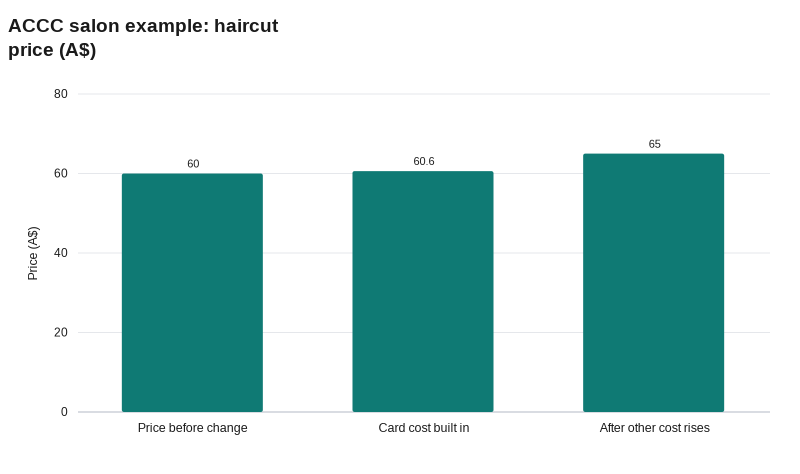
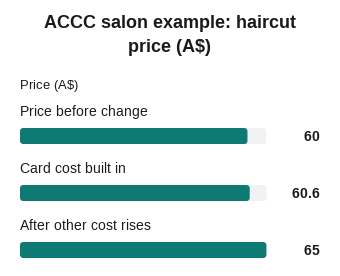
Source: ACCC, Card surcharges, worked example “A hair salon charges $60 for a haircut”, seen 25 November 2026. The first bar is the $60 haircut price before the change, the second is the ACCC’s $60.60 figure, the third is the ACCC’s $65 figure. This is the ACCC’s example for a salon, not a clinic price.
Takeaway: A clinic can recover card costs through its prices, but the reason it gives for any price change has to be true.
What That Means for the Build
In our view, four places in a booking journey need checking.
The price shown before payment. The ACCC’s price displays page says businesses must display the total price as a single figure, being “the minimum total cost,” and that “all unavoidable or pre-selected extra fees” belong in it. A card fee added after the customer enters card details is no longer permitted for these card types, and a fee revealed late is the kind of drip pricing the ACCC warns about.
The payment gateway configuration. Check every surcharge or “card fee” setting in your gateway or booking platform for Visa, Mastercard, American Express and eftpos. The ACCC says businesses should check the card network rules or contact their payment service provider about the rules. A setting left in place from before 1 October 2026 is a question to put to your provider.
The EFTPOS terminal in reception. In our view, terminal settings are easy to forget when auditing a website. Confirm the terminal does not add a surcharge for these card types.
Fee labels. The ACCC says businesses “shouldn’t try to avoid” the card network rules “by describing a card payment surcharge as another type of fee or charge,” and that doing so “may be engaging in misleading conduct.” In its example, a takeaway shop displays a meal at $20, charges $20.24 by card and calls the extra 24 cents a “service fee.” The ACCC says that fee may still be a card payment surcharge.
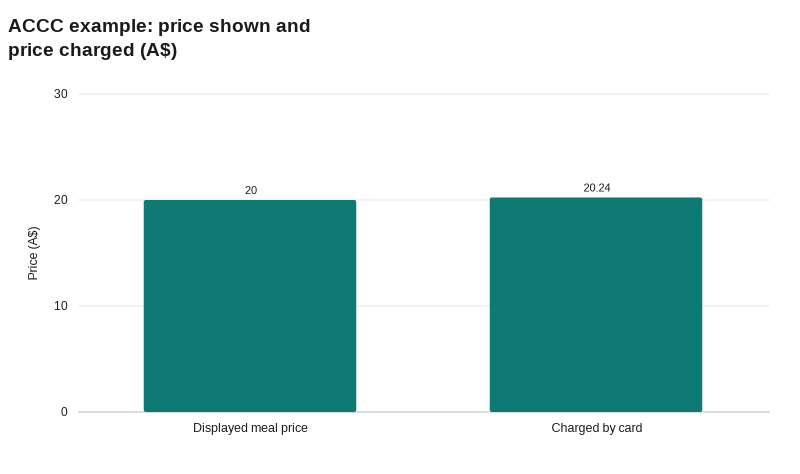
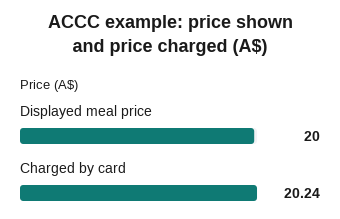
Source: ACCC, Card surcharges, example “A consumer is still charged a card payment surcharge”, seen 25 November 2026. This is the ACCC’s example for a takeaway shop, not a clinic price.
Decision Table: What You Can and Cannot Show
| Scenario | Allowed from 1 October 2026? | What the checkout shows |
|---|---|---|
| Surcharge on a Visa, Mastercard, American Express or eftpos credit, debit or prepaid card | No | One price, with card costs built into it |
| A “service fee” that covers the cost of accepting cards | The ACCC says it may still be a card payment surcharge | Remove it, or treat it as a surcharge risk |
| Discount for paying by cash or PayID | Yes | Full price displayed, discount clearly disclosed, discounted price not more prominent |
| A mandatory booking fee that is not based on how the customer pays | The ACCC says other fees can still be charged | The price including the booking fee, at least as prominent as any price without it |
Source: ACCC, Card surcharges and Price displays, seen 25 November 2026.
On payment method discounts, the ACCC says the displayed price “must be the full price the consumer will pay if they do not receive the payment method discount,” and businesses should not display only the discounted price or make the discounted price more prominent than the full price. On booking fees, the ACCC says a business can show a price without a mandatory booking fee only if it also shows the price including the fee “just as prominently.”
Takeaway: For card payments the checkout has no surcharge line. For other fees, one total price has to be at least as prominent as any partial price.
What to Check on Your Own Site
- Find every page where a customer can pay by card: online deposits, treatment plan payments, gift voucher purchases and the in-clinic terminal.
- In your payment gateway and booking platform, look for any card fee, surcharge or “processing fee” setting and ask your payment provider whether it is still active for Visa, Mastercard, American Express and eftpos.
- Check the terminal in reception for a surcharge setting.
- Search your site, emails, forms and terms for wording that describes a card cost as a “service fee”, “processing fee” or similar.
- If you raised prices to cover card costs, check what your price notices say about the reason. The ACCC says the stated reason must not mislead.
- If you offer a discount for cash or PayID, check the full price is displayed and the discounted price is not more prominent.
- Where you show a price without a mandatory fee, check the price including that fee is shown just as prominently.
The Enforcement Position
The ACCC says it does not enforce the “no surcharge” rules for card networks. Per the ACCC, “the card networks or payment service providers are responsible for enforcing these rules.” The ACCC and state and territory consumer protection agencies enforce the Australian Consumer Law, “including requirements that businesses do not make misleading claims about prices or the reasons for price changes.”
The ACCC page also says consumers who see a surcharge can ask the business for a refund, then raise it with the card network on their card or receipt, their bank, or the business’s payment service provider. They can also report concerns about how a fee was described to the ACCC or their state or territory consumer protection agency. We did not search for named enforcement cases for this update, so this post names none.
Where This Gets Hard
The ACCC says it cannot provide legal advice about card network rules or business agreements with payment service providers. Whether your gateway contract, terminal and card mix comply is a question for your payment provider’s terms and, where the amounts are material, your accountant or lawyer. The ACCC also says businesses should check the relevant card network rules or contact their payment service provider.
The build consequence, in our view, is a checkout that shows one total price and no card fee line for these card types. Any other fee should be disclosed at the start of the booking, not added at the payment step.
Status
In effect since 1 October 2026. Per the ACCC, the no-surcharge rules apply to Visa, Mastercard, American Express and eftpos credit, debit and prepaid cards. The earlier ACCC rules on excessive card surcharging, which capped a surcharge at the cost of accepting the card, “ended on 1 October 2026.”
Frequently Asked Questions
Can I still charge a card surcharge on my booking or checkout page?
No, not for Visa, Mastercard, American Express or eftpos credit, debit or prepaid cards. The ACCC says businesses can no longer charge a surcharge on those payments from 1 October 2026. A business can build card costs into its prices, but it must not mislead patients about prices or about the reasons for a price change.
Who enforces the no-surcharge rules?
The card networks or payment service providers enforce them, not the ACCC. The ACCC and state and territory consumer protection agencies enforce the Australian Consumer Law, including the rules against misleading claims about prices or the reasons for price changes.
Can I offer a discount for paying by cash or PayID?
Yes. The ACCC says businesses can offer discounts for a particular payment method. The displayed price must be the full price a customer pays without the discount, and the discounted price must not be shown alone or more prominently than the full price.
Get Your Checkout Reviewed
Get in touch and ClinicCode will walk your booking and payment pages the way a patient would, checking where the price is shown and whether any card fee or surcharge wording is still in place.
The Source Pages
Screenshots of the pages cited in this post, taken on 25 November 2026 and framed on the passage each one supports.
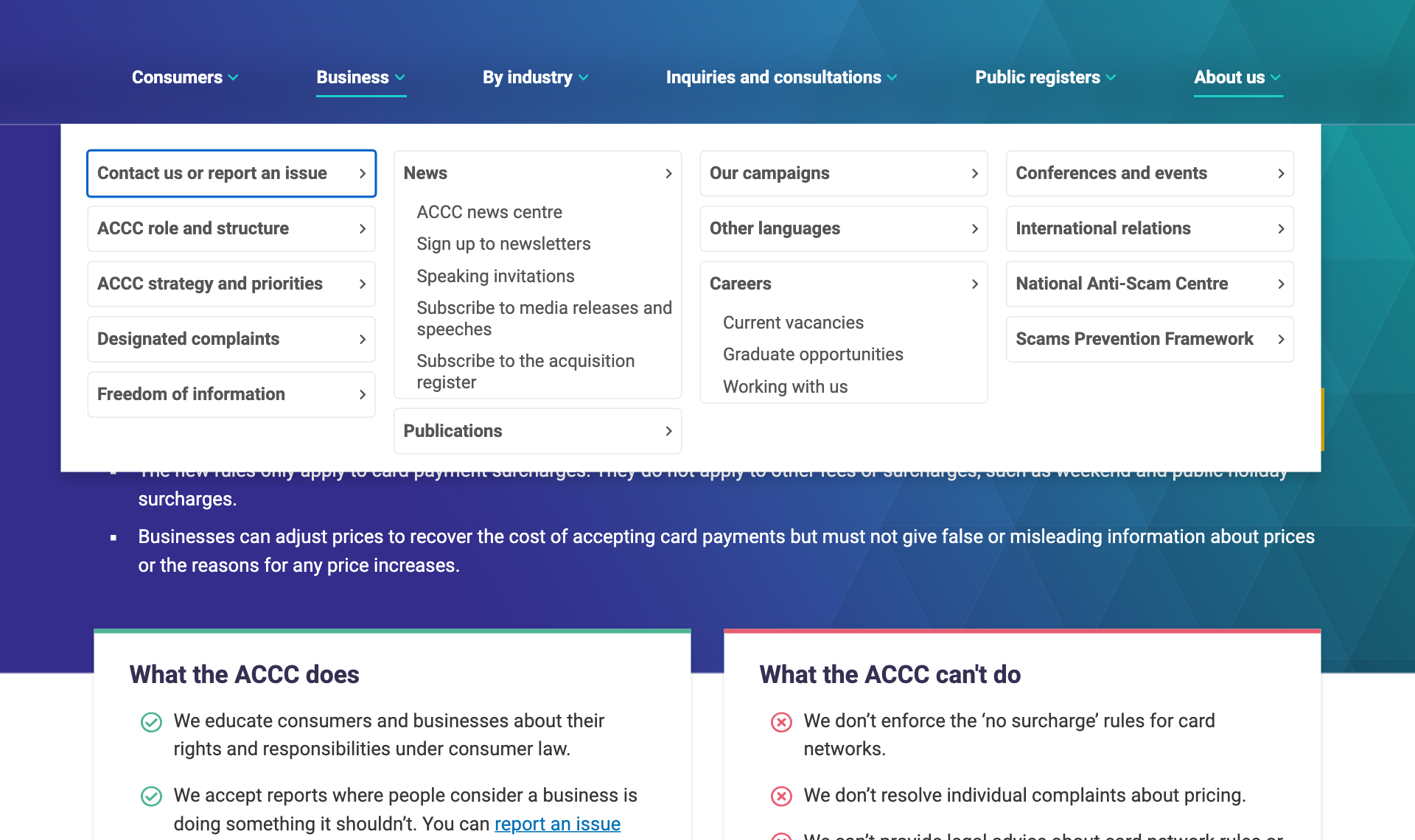
Source: ACCC, Card surcharges, screenshot taken 25 November 2026.
Sources
- ACCC, Card surcharges. Seen 25 November 2026.
- ACCC, Price displays. Seen 25 November 2026.
- ACCC, Setting prices. Seen 25 November 2026.
- Australian Payments Network, Card payment surcharging in Australia (cardsurcharge.com.au). Seen 25 November 2026.
Last reviewed: 25 November 2026.
Vikas Thakur
Founder, Perth. 16 years of experience from working at TPG, iiNet and Monadelphous, now helping Australian clinics keep their websites, ads and online presence AHPRA compliant.