Google Ads Suspended? A Clinic Triage Checklist
Google can suspend a clinic’s Ads account without warning under its Healthcare and medicines policy. Here is the exact order to check the notice, close the certification gap, and file one appeal that actually works.
 Vikas Thakur Founder, Perth 11 min read Fact checked
Key takeaways
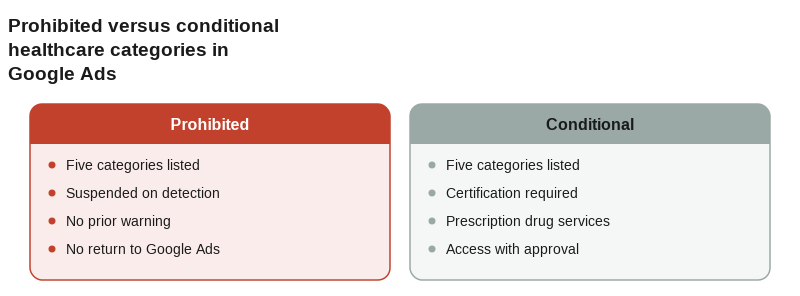
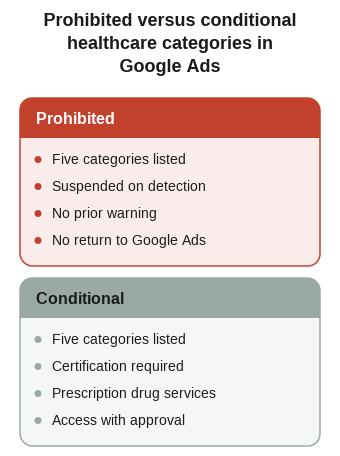
- Google’s Healthcare and medicines policy lists five categories as fully prohibited (including unauthorised pharmacies and prescription opioid ads) and five more as conditional, requiring certification, according to Google Ads Help (support.google.com/adspolicy/answer/176031, checked 15 August 2026)
- For categories Google treats as egregious, accounts are “suspended upon detection and without prior warning, and you will not be allowed to advertise with Google Ads again”
- An appeal is granted only “in compelling circumstances, and when there is good reason,” so a generic appeal that restates intent rather than fixing the underlying gap gets rejected
- Prescription drug service ads from Australian advertisers need LegitScript certification or state-level pharmacy registration on file before the appeal is filed, not after
- Google’s healthcare and medicines policy page does not name cosmetic procedures specifically, so a clinic guessing whether a lip filler or teeth whitening ad counts as a prescription drug service is guessing without a direct answer from Google
- This is Google’s own advertising policy, not an Australian government regulation. It sits outside AHPRA, the TGA and the Privacy Act entirely, so a clean site under those rules will not protect a Google Ads account on its own
It is Monday morning, campaigns should be spending, and the dashboard reads zero. You log into Google Ads and there it is: Suspended. No urgent email, no phone call, just a red banner and a link to a policy page you have never opened before.
Your clinic’s Google Ads account can go from active to suspended overnight, with no warning, if Google’s Healthcare and medicines policy treats the flagged content as an egregious violation. As at 15 August 2026, the fix is not to panic-appeal within the hour. Read the exact policy Google names in Policy Manager, close the certification or content gap that policy points to, then file one appeal that speaks to that gap directly. Skip straight to a generic appeal and, by Google’s own guidance, you get rejected: accounts are reinstated only “in compelling circumstances, and when there is good reason.”
Here is that triage order, worked through step by step, with the exact wording Google uses and where a cosmetic clinic or a dental practice most often gets caught out.
What Google’s Policy Actually Says
Google’s healthcare and medicines policy sits inside Google Ads’ wider set of restricted content rules, and it splits into two tiers. Google Ads Help lists five categories as fully prohibited and five more as conditional, meaning the ad can run, but only once certification is on file.
| Category | Status | Examples Google names | What clears it |
|---|---|---|---|
| Prescription opioid painkillers | Prohibited, narrow exceptions | Painkiller ads outside approved public health or MAT campaigns | Certified addiction treatment or public health campaign status |
| Unauthorised pharmacies | Prohibited | Prescription sales without proper licensing | Not clearable, the category is closed |
| Speculative or experimental treatments | Prohibited | Unproven medical procedures | Not clearable |
| Prescription drug services | Conditional | Ads naming or promoting prescription medicines | LegitScript or NABP accreditation |
| Online pharmacies | Conditional, varies by location | Ads for pharmacy services | LegitScript or local regulatory verification |
| Health insurance (US-specific) | Conditional | Insurance product ads | G2RS or government certification |
For an Australian clinic, the row that matters most is prescription drug services. If your ad or landing page names or promotes a prescription-only medicine, or a treatment that depends on one, this is the category most likely cited in a suspension notice.
For the categories Google treats as most serious, the consequence is immediate and stated plainly on the policy page: “If violations of this policy are found, your Google Ads accounts will be suspended upon detection and without prior warning, and you will not be allowed to advertise with Google Ads again.”
That sentence does two jobs. It tells you there was no warning email you missed, and it tells you the stakes: a second strike inside an egregious category is not a slap on the wrist, it is a permanent bar from the platform.
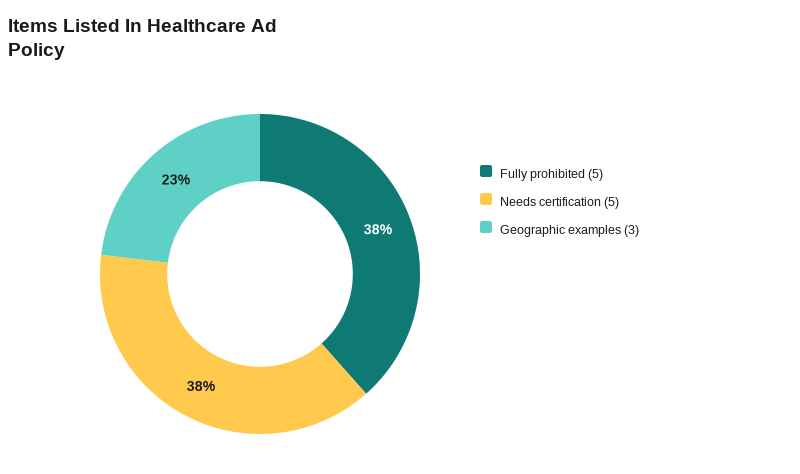
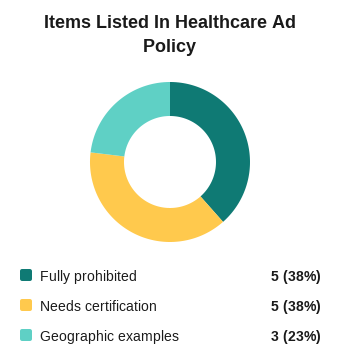
The split above is not a probability of what gets flagged. It is simply a count of the items Google’s own policy page lists in each tier, plus the geographic-specific examples it names (Poland’s blanket ban on online pharmacy ads, Australia’s certification-or-registration requirement, and the stricter US pathway). It shows the policy is not a single blanket rule; it is several rules stacked, and the notice you received names exactly one of them.
What That Means for the Build
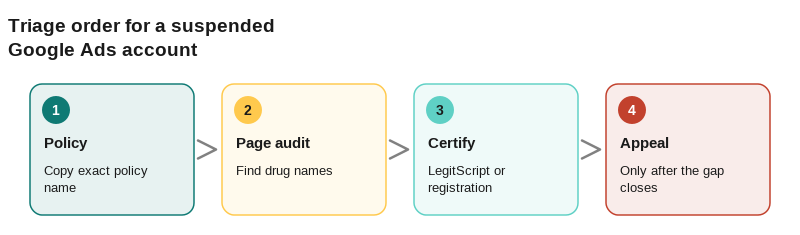
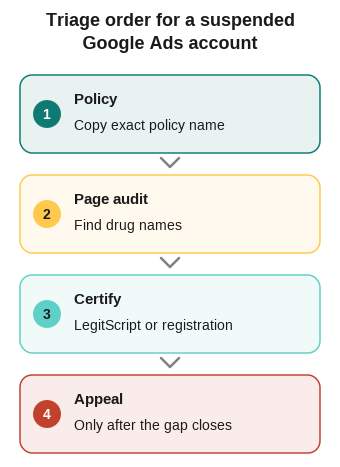
Policy Manager, not the general Support inbox, is where the exact rule lives. The suspension email links to it, and inside the account it usually still opens read-only for a limited window even when the account itself is locked. Screenshot every rejected ad and the specific policy name attached to it before touching anything else. Once you edit a live ad or landing page under a suspended account, you lose the “before” state an appeal reviewer would otherwise compare against.
From there, work down two build paths in order, not in parallel.
1. Landing page audit. Search the URL Google flagged for a prescription-only medicine name sitting in the body copy, the page title, the meta description, or structured data. Cosmetic clinics most often trip this on the active ingredient name inside an injectable treatment page; dental practices trip it on a named sedative on a sedation or sleep dentistry page. If the name is there, this is very likely the prescription drug services trigger.
2. Certification check. If the flagged content is a prescription drug service, Australian advertisers need LegitScript certification or state-level pharmacy registration on file before an appeal has any real chance, per Google’s own page. Confirm which pathway applies to your business type and start that process first. Filing an appeal while certification is still pending restates the same gap to the same reviewer.
Only once the underlying page or certification gap is closed does the appeal form get touched.
| Suspension symptom | Likely policy | Fix before appealing | Certification needed |
|---|---|---|---|
| Landing page names a prescription-only treatment | Prescription drug services | Remove or generalise the drug name on the flagged URL | LegitScript or state pharmacy registration |
| Ad links to a booking page for injectables or fillers | Prescription drug services, cosmetic wording unconfirmed | Generalise copy; confirm applicability with Google’s policy team directly | Same pathway, unconfirmed for cosmetic-only use |
| Account was previously suspended for the same policy | Treated as an egregious repeat violation | No appeal path Google guarantees | Not applicable, the category is closed |
| Ad promotes a payment-plan or insurance-style product | Health insurance policy, US-specific per this source | Confirm applicability outside the US directly with Google | G2RS or government certification (US) |
| Notice cites a different named policy entirely | Outside healthcare and medicines | Read the specific notice; this guide covers healthcare and medicines only | Not applicable |
Takeaway: match the exact policy name in your notice to a row before you do anything else. Guessing wastes the one clean appeal you get.
A Worked Example, Two Practices
A cosmetic clinic’s Ads account was suspended after Google’s review flagged the landing page for its anti-wrinkle injection service. The page named the prescription-only active ingredient in the H1 and the meta description. The practice manager’s first appeal argued that the clinic was AHPRA-registered, and it was rejected, because AHPRA registration is not what Google’s healthcare and medicines policy asks for. It asks for certification specific to Google Ads: LegitScript or a state-level pharmacy registration. Once the clinic obtained that certification and rewrote the page to describe the treatment category rather than the specific prescription ingredient, a second appeal referencing both changes was approved.
A cosmetic dentistry practice ran ads for a sedation dentistry package, and the landing page mentioned the specific prescription sedative used during the procedure, the same kind of drug-name mention that lands in the prescription drug services category. The fix mirrored the clinic’s: pull the specific drug name from the page, describe the option generically as sleep dentistry, and check whether the practice’s compounding pharmacy partner already held LegitScript certification for its own ordering platform. It did. Referencing that existing certification in the appeal, rather than re-explaining the practice’s dental board registration, is what got the account back.
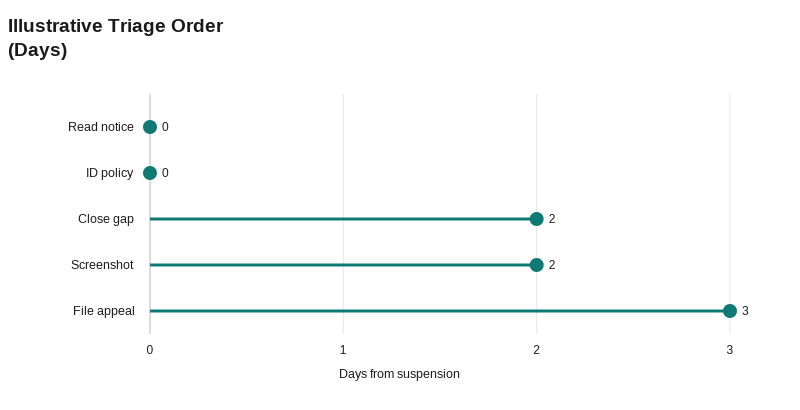
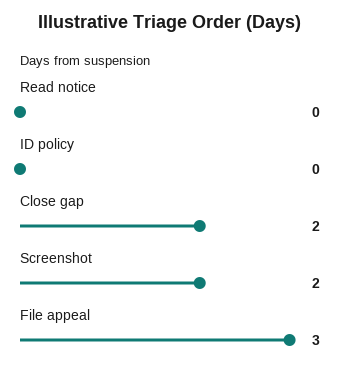
The timeline above is an illustrative example built from the two practices’ triage order, not a published Google figure. The two days spent on “Close gap” is the certification wait, and it is usually the longest single step.
What to Check on Your Own Site
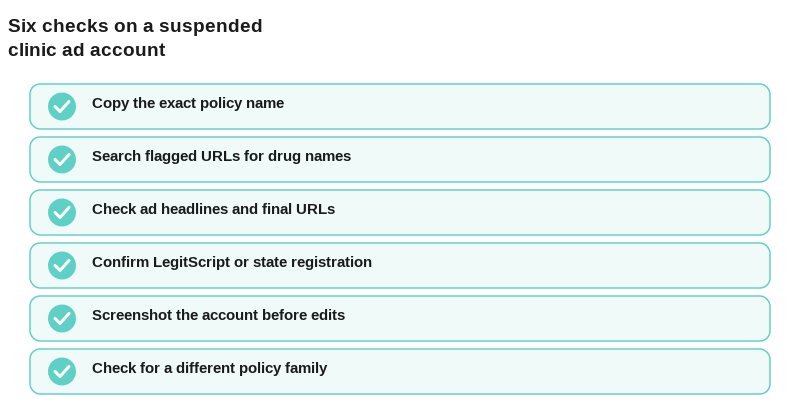
- Open Policy Manager, or the link in the suspension email, and copy the exact policy name Google cites, word for word.
- Search every URL Google flagged for a named prescription medicine, in visible copy, the page title, the meta description, and schema markup.
- Check every live ad’s headline and final URL for the same drug names, not just the landing page.
- Confirm whether the business already holds LegitScript certification or the equivalent state-level pharmacy registration, and if not, start that application before appealing.
- Screenshot the suspended account state, including every policy notice and flagged landing page, before making a single edit.
- Check whether the notice actually cites a different policy family, such as Misrepresentation or Circumventing systems. Not every clinic suspension is a healthcare and medicines call, and each policy has its own fix.
The Enforcement Anchor
Unlike AHPRA and the TGA, Google does not publish a public register of individual advertiser suspensions, so there is no named clinic case study to point to here the way there is for a TGA infringement notice. The closest thing to an enforcement anchor is the policy’s own wording: Google states plainly that an egregious violation gets an account suspended without warning and permanently barred from advertising again, a harder first-offence consequence than most Australian regulatory penalties carry. Treat that wording as the evidence the rule has teeth, because a public case log to check it against does not exist.
Where This Gets Hard
Google’s healthcare and medicines policy, as published, does not name cosmetic procedures specifically. It names prescription drug services, unauthorised pharmacies and a handful of other categories, and it is left to the advertiser, and to Google’s automated review, to decide whether a lip filler ad or a prescription-strength teeth whitening ad falls inside one of those categories. That gap is exactly where clinics get caught: the safest technical fix, removing prescription-specific drug names from ad-facing pages, is also the change that can cost long-tail search rankings for a term patients actually search. The regulator here is Google, not a government body, and Google’s own guidance is the only authority that can confirm whether a specific ad falls under this policy. Where the same page also raises an AHPRA or TGA advertising question, that separate question is one for your medical defence organisation or your lawyer.
Status
In force, as a currently published, privately set Google Ads policy, not an Australian government regulation. It sits alongside, not inside, AHPRA’s advertising guidelines and the TGA’s advertising code, and satisfying one does not satisfy the other. Google can revise this policy at any time, without the fixed commencement date a piece of legislation would carry.
Frequently Asked Questions
Why did Google suspend my clinic’s Ads account without warning?
Google’s Healthcare and medicines policy treats certain violations, including unauthorised pharmacy and uncertified prescription drug service ads, as egregious. Google’s own guidance states accounts in this category are “suspended upon detection and without prior warning, and you will not be allowed to advertise with Google Ads again.”
Can I get a suspended Google Ads clinic account reinstated?
You can submit an appeal, but Google’s guidance warns that accounts “are only reinstated in compelling circumstances, and when there is good reason.” A generic appeal that does not close the underlying certification or content gap named in the notice is unlikely to succeed.
Does advertising cosmetic injectables need special Google Ads certification in Australia?
If the ad promotes a prescription drug service, Google’s healthcare and medicines policy requires certification, and for Australian advertisers that means LegitScript certification or state-level pharmacy registration. Google’s policy page does not specifically address cosmetic procedure advertising, so confirm directly with Google’s policy team if you are unsure whether your ad falls under this category.
Get the Triage Done Today
ClinicCode can fix a suspended clinic account: book a call and we match the notice to the exact policy and rebuild the flagged page before a second appeal goes in.
Sources and References
- Google Ads Help - Healthcare and medicines policy. Checked 15 August 2026.
- Google Ads Help - Prescription drug services policy (named as a related policy page; not independently reviewed). Checked 15 August 2026.
- Google Ads Help - Restricted drug terms policy (named as a related policy page; not independently reviewed). Checked 15 August 2026.
Last reviewed: 15 August 2026.
Vikas Thakur
Founder, Perth. 16 years of experience from working at TPG, iiNet and Monadelphous, now helping Australian clinics keep their websites, ads and online presence AHPRA compliant.