Dental Implant Success Rate in Australia: One Hospital Study
A 2018 Australian Dental Journal study of 527 implants at Adelaide Dental Hospital reported an overall known survival rate of 87.67%. We set it beside one clinic’s advertised 95-98% and a 2024 international meta-analysis, and explain what a dental practice should do with a success-rate claim online.
 Vikas Thakur Founder, Perth 10 min read Fact checked
Key takeaways
- An Australian retrospective cohort study reported an overall known implant survival rate of 87.67%, from 527 implants placed in 320 patients at Adelaide Dental Hospital between 1996 and 2015 [1]
- That study, by Duong and Dudley, was published in the Australian Dental Journal in 2018 (volume 63, issue 2, pages 177-186) [1]
- In the same cohort, mandibular implant overdentures carried a risk of implant failure four times that of single implant-retained crowns (P = 0.0100) [1]
- One Australian clinic page states a 95-98% success rate, “shown by studies in Australia,” and names no study [4]
- A 2024 international meta-analysis reported 20-year survival of 88% across five retrospective studies covering 1,440 implants [2]
- The same meta-analysis reported prospective-study survival of 92% before and 78% after imputation for implants lost to follow-up [2]
- Ahpra says consumers should have information that is accurate, not misleading, and supported by acceptable evidence [3]
An Australian study of implant treatment at Adelaide Dental Hospital reported an overall known implant survival rate of 87.67% [1]. One clinic’s website says dental implants have a success rate of 95-98%, shown by studies in Australia, and names no study [4]. The clinic page does not say what its figure measures, so this post does not treat either number as a correction of the other. It shows where each figure comes from and what a dental practice should do before it publishes a success rate. If your practice quotes one anywhere on its website, in ad copy or in a booking-flow FAQ, the source behind it is the part a reader and a regulator can check.
An Australian Implant Survival Study
Duong and Dudley’s 2018 retrospective cohort study in the Australian Dental Journal reviewed implant treatment completed at Adelaide Dental Hospital between 1996 and 2015 [1]. The authors describe it as a public sector clinic with finite resources and a defined system of patient and restorative selection criteria [1]. In their words, 320 patients (mean age 51.50 years) were treated with 527 implants. One hundred and eighty-four female patients received 296 implants and 136 males received 231 implants [1].
The headline finding: “The overall known implant survival rate was 87.67%” [1]. This is survival over the 1996 to 2015 review period for implants with a known status. It is not a measured survival rate at exactly 20 years. The study also found that mandibular implant overdentures had a risk of implant failure four times that of single implant-retained crowns, and the authors report that result as statistically significant (P = 0.0100) [1]. They describe the survival rate as high and say further investigation of parameters that could improve treatment delivery and longevity would be ideal [1].
We did not find a national Australian implant-outcomes dataset in the sources we checked. We cannot say this is the only Australian study.
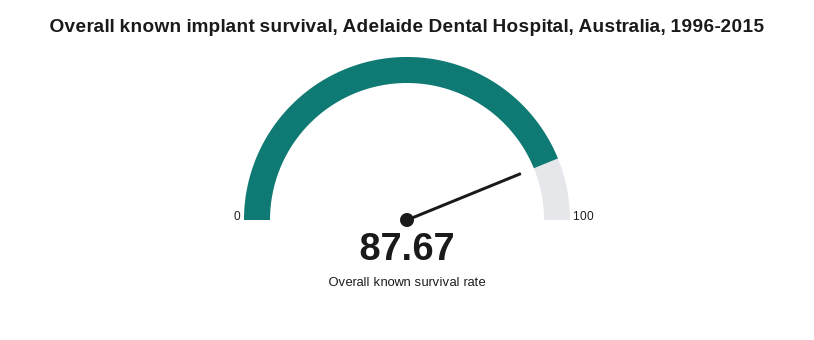
Source: Duong A, Dudley J, Australian Dental Journal, 2018, PubMed abstract, seen 25 November 2026.
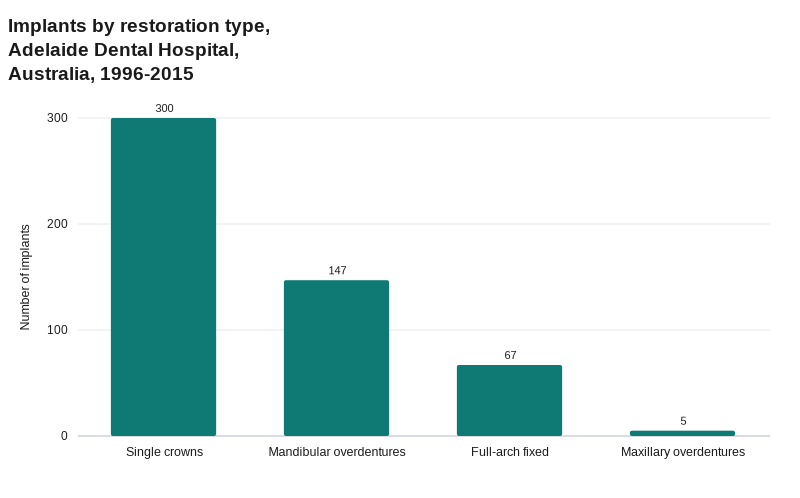
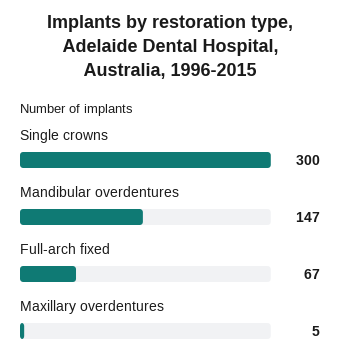
Source: Duong A, Dudley J, Australian Dental Journal, 2018, PubMed abstract, seen 25 November 2026. The abstract lists these four groups, which add to 519 of the 527 implants. It does not say how the other 8 were restored.
Takeaway: 87.67% is a peer-reviewed result for implants with a known status at one Australian public hospital over 1996 to 2015. It is one clinic’s records, not a national rate.
How the Australian Figure Compares Internationally
A 2024 meta-analysis in Clinical Oral Investigations, “How far can we go? A 20-year meta-analysis of dental implant survival rates,” came from researchers at the University Medical Center Mainz in Germany [2]. It included only screw-shaped titanium implants with a rough surface [2]. It found no Australian study among its sources that we could identify, so it is an international comparison, not an Australian one.
Across five retrospective studies (1,440 implants), 20-year survival was 88% (95% CI: 78%-94%) [2]. Three prospective studies (237 implants) showed 92% (95% CI: 82% to 97%), decreasing to 78% (95% CI: 74%-82%) after imputation (422 implants) [2].
The imputation matters. The authors note that long-term studies have a high rate of patients or implants lost to follow-up [2]. They assumed failures were five times more common among those lost to follow-up than among those tracked, and describe that as a conservative estimate that likely underestimates the actual survival rate [2]. They also say the approach is supported by limited evidence [2].
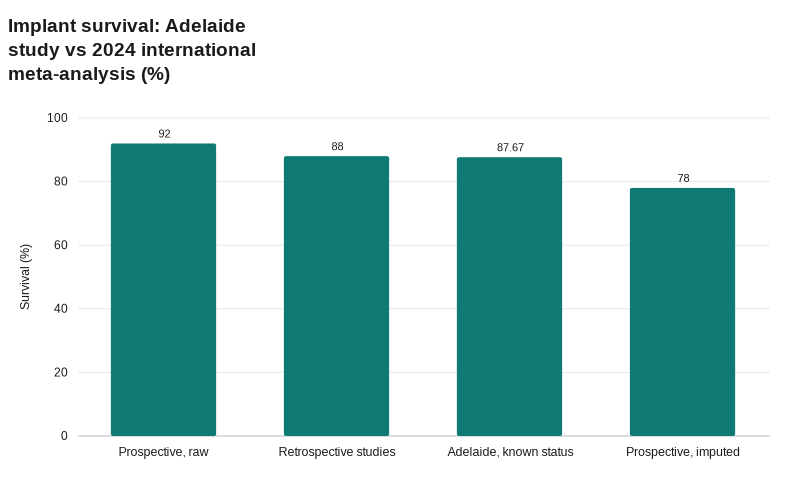
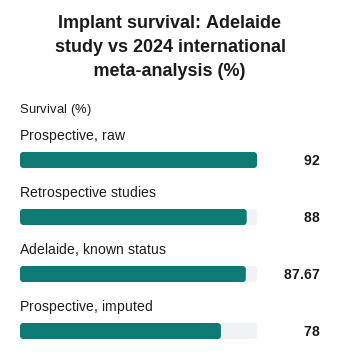
Source: Duong A, Dudley J, Australian Dental Journal, 2018, and Kupka JR et al., Clinical Oral Investigations, 2024, both seen 25 November 2026. The Adelaide figure is overall known survival over 1996 to 2015 in Australia. The other three are 20-year survival from the international meta-analysis. The measures are not identical.
Takeaway: The Adelaide figure of 87.67% is close to the meta-analysis figure of 88% for retrospective studies [1][2]. The measures differ, so treat the match as a rough comparison.
The Gap Between Published Data and Website Claims
One clinic page we read, from Bayside Family Dental and dated 9 July 2024, states: “Dental implants have a success rate of 95-98%, shown by studies in Australia” [4]. The page names no study in the text we read. We cannot tell from the page which study or definition of success the figure rests on.
The Adelaide study reports “implant survival”, and the clinic page says “success rate”. The clinic page does not say which definition it uses, so we do not claim its number is wrong. We only note that a reader cannot check it.
Takeaway: In our view, a website that states a success rate without naming the study behind it asks a visitor to trust a number nobody can check.
What This Means for Your Dental Practice Website
Ahpra’s advertising hub says: “It is important that consumers have access to information that is accurate, not misleading, and is supported by acceptable evidence” [3]. Its advertising guidelines say they set out obligations that apply to any person or business advertising a regulated health service, and that advertising must not be false, misleading or deceptive or likely to be [5]. A success-rate percentage with no named source sits close to that principle. Whether any specific page crosses the line is a compliance question for that page, not something a general article can rule on. Ahpra suggests advertisers seek their own independent advice, such as from a legal adviser or indemnity insurer [5]. Our full breakdown of AHPRA advertising rules for cosmetic dentistry covers the testimonial ban and outcome-claim restrictions that apply alongside this.
In our view, a page that states “87.67% overall known survival, Adelaide Dental Hospital study, 2018” gives a visitor something to check, and “95-98% success rate” with no citation does not. If your site carries an uncited success-rate claim anywhere, from a treatment page to a Google Business Profile post, it is worth a proper look. ClinicCode can review a claim like this against the current rules.
Takeaway: A success-rate figure with a named, dated, checkable source is easier to defend than a round number attributed to unnamed “studies.”
Building a Dental Website Around Real Data
Clinics that want to compete on transparency need a site built to carry that content without breaking a compliance rule elsewhere on the page. In our view, that means treatment pages that cite real sources, booking flows that do not rely on testimonials to build trust, and content that survives an audit rather than needing one. Our cosmetic clinic website builds are designed around that constraint.
Takeaway: Build the page with the rules in mind from the first draft, not after a complaint.
FAQ
What is the real dental implant success rate in Australia?
One Australian study reported an overall known implant survival rate of 87.67%. It reviewed 527 implants placed in 320 patients at Adelaide Dental Hospital, a public clinic, between 1996 and 2015, and was published in the Australian Dental Journal in 2018. It is one hospital’s records, not a national figure, and we did not find a national dataset.
Is the commonly advertised 95-98% dental implant success rate accurate for Australia?
We cannot say. One clinic page we read states that dental implants have a success rate of 95-98%, shown by studies in Australia, and does not name a study. The Adelaide figure measures overall known implant survival at one public hospital, and the clinic page does not say what its figure measures, so we cannot compare the two.
How does the Australian implant survival rate compare internationally?
A 2024 meta-analysis in Clinical Oral Investigations, by researchers at the University Medical Center Mainz in Germany, reported 20-year survival of 88% across five retrospective studies (1,440 implants). For three prospective studies it reported 92% (237 implants), falling to 78% after the authors imputed outcomes for implants lost to follow-up (422 implants). That review did not cite an Australian study, and its figures cover screw-shaped titanium implants with a rough surface only.
Can a dental clinic advertise a specific implant success rate on its website?
Ahpra says it is important that consumers have information that is accurate, not misleading, and supported by acceptable evidence. Its advertising guidelines say advertising a regulated health service must not be false, misleading or deceptive. Whether a specific figure on a specific website meets that bar is a compliance question, not something a general article can answer. In our view, a clinic that publishes any success-rate figure should name the study behind it.
Get Your Dental Practice Website Checked
ClinicCode fixes cosmetic dental practice websites and marketing content against current Ahpra advertising rules.
Talk to us about your dental practice websiteSources and References
Duong A, Dudley J, Australian Dental Journal, PubMed (PMID 29396995) - “Twenty-year analysis of implant treatment in an Australian public dental clinic,” 63(2):177-186, 2018: the 87.67% overall known implant survival rate, 527 implants in 320 patients, and the mandibular overdenture finding. Seen 25 November 2026.
Kupka JR, König J, Clinical Oral Investigations, 2024 (PMC) - “How far can we go? A 20-year meta-analysis of dental implant survival rates”: the 88% retrospective, 92% prospective and 78% imputed figures, and the imputation method. Seen 25 November 2026.
Ahpra, Advertising hub - the statement that consumers should have information that is accurate, not misleading, and supported by acceptable evidence. Seen 25 November 2026.
Bayside Family Dental, Success Rates and Factors Affecting Dental Implants - one clinic page, cited only as an example of a success-rate claim that names no study, not as a data source. Seen 25 November 2026.
Ahpra, Advertising guidelines - obligations that apply to any person or business advertising a regulated health service, and the list of what advertising must not do. Seen 25 November 2026.
Related reading:
- Dental Implant Cost Australia: full price breakdown by treatment stage
- AHPRA Advertising Rules for Cosmetic Dentistry: the testimonial and outcome-claim rules that apply alongside success-rate claims
- Clinic Website Design: compliant website builds for AHPRA-regulated practices
Vikas Thakur
Founder, Perth. 16 years of experience from working at TPG, iiNet and Monadelphous, now helping Australian clinics keep their websites, ads and online presence AHPRA compliant.