Cosmetic Nurse Injectors in Australia: No Register Exists
No official source counts how many cosmetic nurse injectors work in Australia, and Ahpra’s nurse registrant data has no cosmetic field. This guide covers what the register does and does not record, and how to word a headcount claim on your clinic’s site.
 Vikas Thakur Founder, Perth 13 min read Fact checked
Key takeaways
- We could not find an official count of how many cosmetic nurse injectors work in Australia. In 2022 the ABC reported that cosmetic nurses were not yet counted in official workforce data
- The Nursing and Midwifery Board’s registrant data for 1 April to 30 June 2026 counted 517,546 registrants in the nurse profession, plus 25,191 with nurse and midwife registration
- That report splits registrants by state, registration type, age group and gender, and lists endorsements and notations. None marks cosmetic practice
- Ahpra’s 3 June 2025 news release said it investigated about 360 non-surgical cosmetic procedure notifications between September 2022 and March 2025. That measures regulator workload, not practitioner headcount
- Ahpra’s cosmetic procedure guidelines apply to every registered health practitioner who performs non-surgical cosmetic procedures except medical practitioners
- In our view, a clinic page should name the practitioner’s own registration and training, and leave out any national headcount it cannot source
No official source we could find counts how many cosmetic nurse injectors work in Australia, as at 25 November 2026. The ABC reported in 2022 that cosmetic nurses were not yet counted in Australia’s official workforce data. The nurse register we read for this guide, the Nursing and Midwifery Board’s registrant data to 30 June 2026, still has no field for cosmetic practice. This guide walks through what that register does and does not record, and what that means for any clinic tempted to put a practitioner-population claim on its own website.
What Ahpra’s Register Actually Says
Ahpra runs the national registration scheme, and the Nursing and Midwifery Board of Australia (NMBA) publishes registrant data every quarter. The newest edition we found covers 1 April 2026 to 30 June 2026. It counted 517,546 registrants in the nurse profession: 502,215 on general registration, 14,986 non-practising and 345 provisional. A further 25,191 registrants hold both nurse and midwife registration.
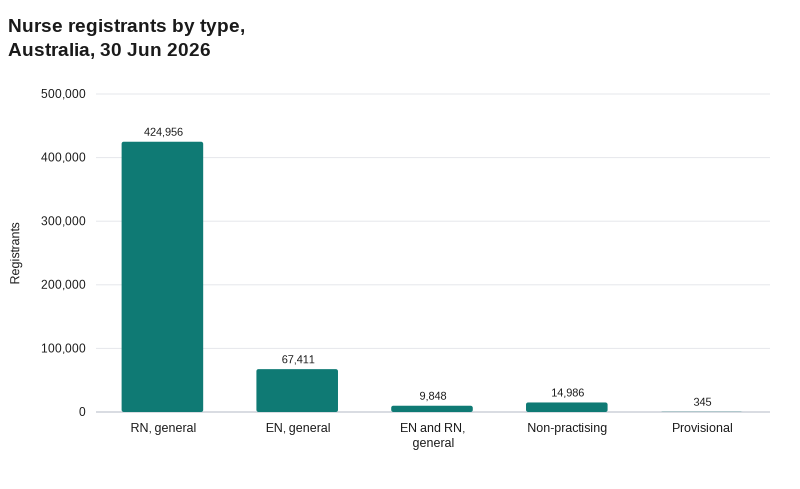
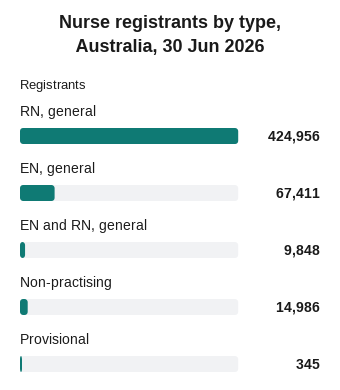
Source: Nursing and Midwifery Board of Australia registrant data, reporting period 1 April 2026 to 30 June 2026, Table 1.1. Seen 25 November 2026. Nurse profession only. Nurse and midwife registrants (25,191) are counted separately in the same table. RN is registered nurse and EN is enrolled nurse.
The report breaks the nurse profession down by principal place of practice, registration type, age group and gender.
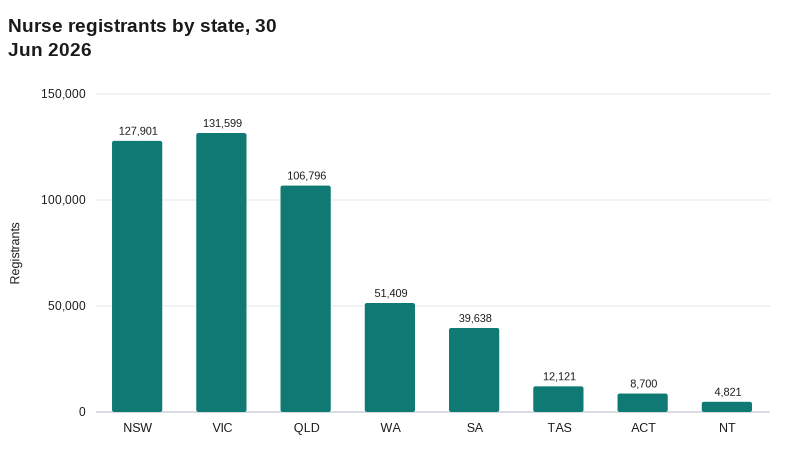
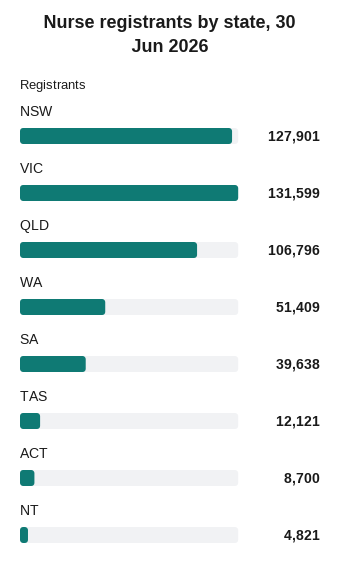
Source: NMBA registrant data, 1 April 2026 to 30 June 2026, Table 1.1, nurse profession by principal place of practice. Seen 25 November 2026. The 517,546 total also includes 34,561 registrants with no principal place of practice recorded.
It also lists endorsements and notations. The NMBA endorsements for registered nurses are Nurse Practitioner and Registered Nurse - scheduled medicines (rural and isolated practice). The notations mark registered nurses whose sole qualification is in disability, mental health or paediatric nursing. None of those is a cosmetic marker.
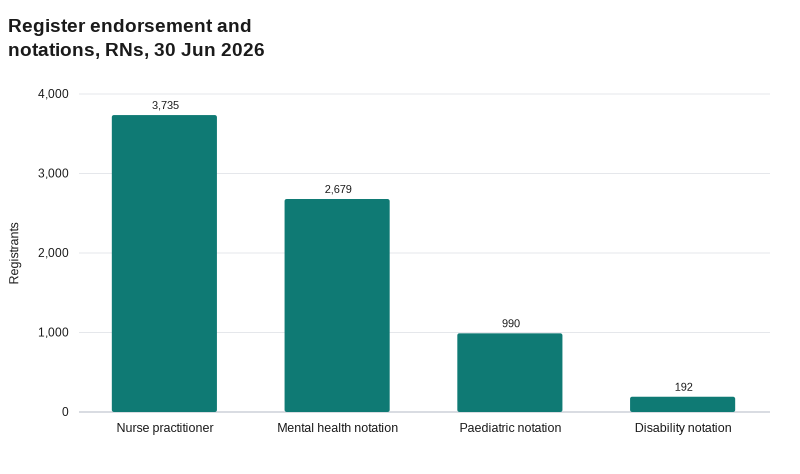
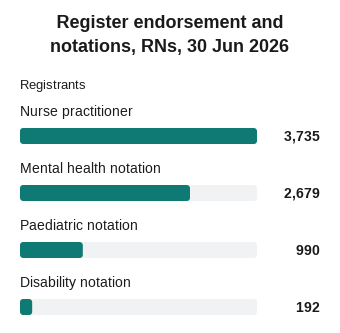
Source: NMBA registrant data, 1 April 2026 to 30 June 2026, Tables 5.1 and 6.1. Seen 25 November 2026. The register records these items. It has no cosmetic equivalent.
In our reading, a nurse can hold general registration and inject dermal filler five days a week, or never touch a needle outside a hospital ward, and these tables would record them the same way. We found nothing in the report that separates the two.
The rule this workforce works under is a separate matter. Ahpra’s cosmetic procedure guidelines page says the Guidelines for registered health practitioners who perform non-surgical cosmetic procedures apply to “any health practitioners registered under the National Law who perform non-surgical cosmetic procedures, except medical practitioners”. The page gives 2 September 2025 as the date of issue. Ahpra’s 3 June 2025 news release said the guidelines would come into effect on that date. Medical practitioners are pointed to the Medical Board’s separate guidelines for registered medical practitioners who perform cosmetic surgery and procedures (July 2023). A guideline sets a standard for how the work is done. It does not create a list of who does it.
Takeaway: The data you would need for an official injector count, a field marking which nurses do cosmetic work, is not in the register tables we read.
What Other Numbers Measure
Two other numbers circulate, and neither is a headcount.
The first is the ABC’s 2022 report. It said Australia’s injectables industry was worth more than $2.6 billion and employed an estimated 4,000 people. The $2.6 billion comes from a Grandview Research market report that the article cites, which put Australia’s facial injectable market at $2.6 billion in 2020. It also said cosmetic nurses were not yet counted in the official workforce data, and quoted a Cosmetic Nurses Association board member on the make-up of that workforce. The 4,000 is an industry estimate from July 2022 for the whole industry. The article does not present it as a count of nurse injectors, and we do not use it as one.
The second is Ahpra’s regulatory activity. The 3 June 2025 release said that between September 2022 and March 2025 Ahpra investigated about 360 notifications related to non-surgical cosmetic procedures, with about 300 of them closed. It also said over 1500 calls had been made to the cosmetic surgery hotline. Those are complaint and enquiry volumes.
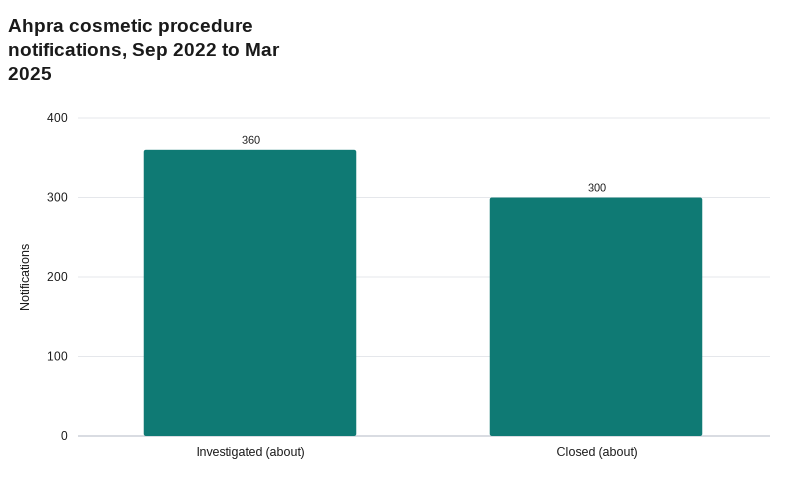
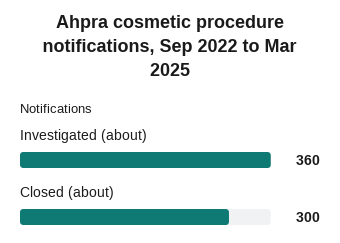
Source: Ahpra news release, 3 June 2025. Seen 25 November 2026. The release gives both figures as approximate.
| Source | What it measures | Figure | Period | Use it as an injector headcount? |
|---|---|---|---|---|
| NMBA registrant data | Registrants in the nurse profession | 517,546 | 1 April to 30 June 2026 | No, no cosmetic field |
| Ahpra news release | Cosmetic procedure notifications investigated | About 360 | September 2022 to March 2025 | No, measures complaints |
| Ahpra news release | Calls to the cosmetic surgery hotline | Over 1500 | As at 3 June 2025 | No, measures enquiries |
| ABC, 15 July 2022 | Industry estimate of people employed in injectables | More than 4,000 | July 2022 | No, whole industry, an estimate |
Source: the four pages linked in the table, seen 25 November 2026.
Each row measures something real. In our view none of them answers the question “how many cosmetic nurse injectors work in Australia”.
What That Means for the Build
If your clinic’s website, media kit or investor materials cite a number for how many cosmetic nurses exist nationally, the fix is to find out where the number came from. In our view, a population-wide figure has no place on a page about your own practitioners.
Do not hardcode an unsourced practitioner-population figure in a bio page, About page or Person/MedicalOrganization schema block. A line like “one of just 2,400 qualified cosmetic injectors nationally” states a precision that no source we found supports. A search engine or AI answer engine reads a figure in structured data as fact, with no human reader to spot the missing citation.
If you cite any estimate, name its source and date in the visible copy. “The ABC reported in July 2022 that the injectables industry employed an estimated 4,000 people” is a checkable sentence. “Australia has around 3,000 qualified injectors” is not, because it has no source.
Keep credibility claims specific to the individual. A bio page can state a named nurse’s registration number, years of cosmetic-specific experience and the training they hold. Ahpra’s register of practitioners is where a patient looks up a practitioner’s registration.
Date-stamp any workforce figure you do cite. The NMBA publishes its registrant data every quarter, so a national nurse total copied from an old report will be out of date.
A Worked Example
This is a hypothetical, not a real clinic. A Perth cosmetic clinic drafts an About page and writes: “Our nurse injector is one of a growing network of cosmetic injectors across Australia, trusted by thousands of patients.” Neither the network nor the “thousands” has a source.
A defensible rewrite moves the claim onto something checkable: “Our nurse injector holds current Ahpra registration as a registered nurse and has completed [named training body]’s cosmetic injectables program.” The registration can be checked on Ahpra’s public register. The training can be confirmed with the named provider.
Takeaway: A practitioner-population estimate does little on a bio page. What a patient or a regulator can check in minutes is the individual practitioner’s own registration and training.
What to Check on Your Own Site
- Search your site, media kit and any partner directory listing for phrases like “one of”, “among”, “network of” or “join thousands” attached to a practitioner-population number, and find where that number came from.
- Check practitioner bio pages and any
PersonorMedicalOrganizationschema block for a hardcoded national injector count with no citation. - If you cite an estimate, confirm the copy names the publisher, gives its date and says it is an estimate, not a register figure.
- Confirm any Ahpra registration total you cite carries its reporting period.
- Move any credibility claim resting on a national population figure onto the named practitioner’s own registration number, training provider and years of cosmetic-specific experience.
- Check whether a “verified network” or partner badge on your site implies a specific practitioner count. If the badge issuer cannot show the register behind the number, treat the claim like an unsourced one on your own page.
The Enforcement Anchor
The closest case we cite sits in a related sector and concerns insurance cover, not a workforce number. The ACCC announced on 11 November 2022 that the Federal Court had ordered SmileDirectClub Aus Pty Ltd and its US parent company to pay penalties totalling $3.5 million, after SmileDirectClub admitted that between May 2019 and October 2020 it made false or misleading statements about private health fund reimbursement for its aligner treatment. The ACCC said 98.5 per cent of the market of Australian private health insurance companies did not cover that treatment, and that at least 26,300 consumers signed up in the period.
Section 133 of the National Law is the advertising rule for regulated health services. Ahpra’s advertising page says a person must not advertise a regulated health service, or a business that provides one, in a way that is false, misleading or deceptive or is likely to be misleading or deceptive. The build consequence is that any practitioner-population claim on your site needs a named, dated source. Whether a specific claim crosses the line is a question for your medical defence organisation or your lawyer.
Where This Gets Hard
In our view the gap will not close on its own. A register field for cosmetic practice would need a decision by the NMBA, and we found no public sign of one. We cannot see which nurses inject from the registrant data, and the Cosmetic Nurses Association’s own membership total, which we could not find published, would not cover nurses who are not members.
That leaves anyone asking “how many cosmetic nurse injectors work in Australia” with one honest answer. We could not find an official number, and we did not find a source for any other number that states its scope and date as a headcount.
Status
As at 25 November 2026, we found no official cosmetic nurse injector count. The registrant total cited here is current as at 30 June 2026 and will move at the NMBA’s next quarterly update. Ahpra’s cosmetic procedure guidelines page gives 2 September 2025 as the date of issue.
Frequently Asked Questions
How many cosmetic nurse injectors are there in Australia?
We could not find an official figure. Ahpra’s nurse registrant data for 30 June 2026 splits registrants by state, registration type, age group and gender, and lists only a few endorsements and notations. None of them marks cosmetic work. In 2022 the ABC reported that cosmetic nurses were not yet counted in official workforce data, and we found nothing since that fills the gap.
Does Ahpra count how many nurses perform cosmetic procedures?
Not in the tables we read. The Nursing and Midwifery Board’s registrant data for the period 1 April 2026 to 30 June 2026 counted 517,546 registrants in the nurse profession and a further 25,191 who hold nurse and midwife registration. The report has no field for cosmetic practice, so that total cannot be filtered down to nurses who inject.
Can I cite an injector headcount on my clinic’s website?
Only with a named, dated source that states the figure, and we could not find one for an Australian cosmetic nurse injector headcount. Section 133 of the National Law says a person must not advertise a regulated health service, or a business that provides one, in a way that is false, misleading or deceptive or is likely to be. Whether a particular claim crosses that line is a question for your medical defence organisation or your lawyer. In our view the safer page leaves the national headcount out and states the named practitioner’s own registration and training instead.
Who do Ahpra’s cosmetic procedure guidelines cover?
Ahpra says the Guidelines for registered health practitioners who perform non-surgical cosmetic procedures apply to any health practitioners registered under the National Law who perform non-surgical cosmetic procedures, except medical practitioners. Medical practitioners should refer to the Medical Board’s separate guidelines for registered medical practitioners who perform cosmetic surgery and procedures (July 2023). Ahpra gives 2 September 2025 as the date of issue for the guidelines.
Does a nurse’s registration show cosmetic training?
Not as a notation or endorsement in the Nursing and Midwifery Board’s June 2026 registrant data. That report lists two endorsements for registered nurses, Nurse Practitioner and Registered Nurse - scheduled medicines (rural and isolated practice), and notations for sole qualifications in disability, mental health or paediatric nursing. Cosmetic training is not among them.
Get Your Practitioner Credibility Claims Checked
ClinicCode builds cosmetic clinic websites where every credibility claim on a practitioner page, in the visible copy and in the schema markup, traces to something a patient or a regulator can verify. If your site leans on an unsourced injector-count or “verified network” claim, talk to us about your clinic’s practitioner pages and we will tell you what needs a source and what needs to come down.
Sources
- Ahpra, Guidelines for registered health practitioners who perform non-surgical cosmetic procedures, page showing “Date of issue: 2 September 2025” and the scope “except medical practitioners”. Seen 25 November 2026.
- Nursing and Midwifery Board of Australia, Registrant data, reporting period 1 April 2026 to 30 June 2026, Tables 1.1, 5.1 and 6.1, listed on the NMBA statistics page. Seen 25 November 2026.
- Ahpra, news release, 3 June 2025 (about 360 notifications investigated and about 300 closed between September 2022 and March 2025, over 1500 hotline calls, guidelines due to come into effect on 2 September 2025). Seen 25 November 2026.
- ABC News, Registered nurses leaving hospitals to work in rapidly growing cosmetic injectables industry, 15 July 2022. Seen 25 November 2026.
- ACCC, SmileDirectClub to pay $3.5m for misleading claims, 11 November 2022. Seen 25 November 2026.
- Ahpra, Advertising and the law, section 133 of the National Law. Seen 25 November 2026.
- ClinicCode, how many cosmetic clinics are in Australia, a related data-gap post covering business-count sources for the sector.
Last reviewed: 25 November 2026.
Vikas Thakur
Founder, Perth. 16 years of experience from working at TPG, iiNet and Monadelphous, now helping Australian clinics keep their websites, ads and online presence AHPRA compliant.