BNPL Is Now Regulated Credit: Fix Your Payment Plan Page
Buy now pay later became regulated credit on 10 June 2025, so a clinic’s payment plan page needs a second look. Here is what ASIC says about who needs the credit licence, and what to check on the page.
 Vikas Thakur Founder, Perth 12 min read Fact checked
Key takeaways
- ASIC says the credit licence requirement for anyone engaging in credit activities involving buy now pay later contracts applies from 10 June 2025.
- The Treasury Laws Amendment (Responsible Buy Now Pay Later and Other Measures) Act 2024 extended the National Credit Code to buy now pay later contracts.
- ASIC issued Regulatory Guide 281 (Low cost credit contracts) on 8 May 2025.
- A “low cost credit contract” (LCCC) is a defined category under section 13E of the National Credit Code. ASIC says LCCC providers can elect to comply with modified responsible lending obligations.
- ASIC defines a buy now pay later arrangement as one where a third-party provider pays the merchant and holds a credit contract with the consumer. In our reading, that provider, not the merchant, is the credit provider.
- In our view, embedding a provider’s widget does not make the clinic the credit provider. A clinic’s own instalment plan has no third-party provider, so it needs separate legal advice.
- In a 2024 media release, ASIC described a court enforceable undertaking from the buy now pay later provider Elepay over missing Target Market Determinations. That was a different set of rules from the 2025 licensing change.
- The build consequence, in our view, is attribution: the page should make clear who the actual credit provider is, and that is not always the clinic’s own brand.
Buy now pay later became regulated credit on 10 June 2025, under the National Credit Code. If your clinic’s price page still reads “flexible payment plans, get started today” with a BNPL badge bolted on, it is worth a second look.
What changed, and where the answer sits
The rule change did not touch the widget. It changed the rules for the party that provides the credit behind it.
ASIC’s 2024 release on Elepay noted that “buy now, pay later products are not considered credit products” under the regime then in place. The Treasury Laws Amendment (Responsible Buy Now Pay Later and Other Measures) Act 2024 (No. 138, 2024, Federal Register of Legislation) changed that. ASIC’s information sheet INFO 285 says the Government “has amended the National Consumer Credit Protection Act 2009 … to extend the application of the National Credit Code … to ‘buy now pay later’ contracts.”
On the licence itself, the same page says that from 10 June 2025 anyone engaging in credit activities involving these contracts must hold an Australian credit licence with all appropriate authorisations. A provider without a licence needed, by that date, to have a licence application accepted for lodgement by ASIC and to be a member of the Australian Financial Complaints Authority (AFCA).
ASIC issued Regulatory Guide 281 on 8 May 2025. The guide covers low cost credit contracts and “the modified responsible lending obligations in Ch 3 of the National Consumer Credit Protection Act 2009”. ASIC’s media release 25-069MR said the new laws were “coming into effect on 10 June 2025”.
An LCCC is a narrower category. Per INFO 285, a contract is a low cost credit contract if it is a buy now pay later contract and also meets any requirements set by the regulations on fees or charges, and the credit period is no longer than any period the regulations prescribe (section 13E of the National Credit Code). ASIC says providers of LCCCs “will be able to elect to comply with modified responsible lending obligations.”
Takeaway: the licence requirement sits with whoever is providing the credit, and that is the first question a payment plan page has to answer clearly.
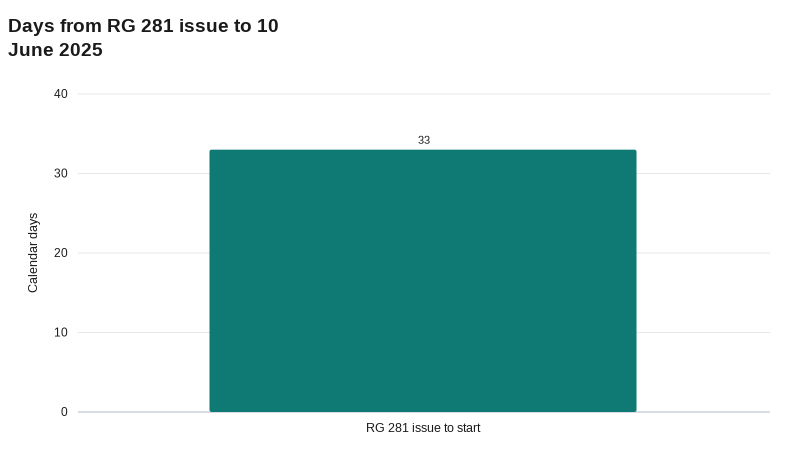
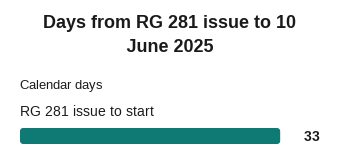
Source: ASIC, RG 281 (issued 8 May 2025) and ASIC media release 25-069MR (10 June 2025 start), seen 25 November 2026. The 33 days is our arithmetic: 8 May 2025 to 10 June 2025.
What that means for the build
A payment plan section on a clinic website is usually one of three things. In our view, each carries a different build obligation.
Scenario 1: an embedded third-party BNPL widget. ASIC describes a buy now pay later arrangement as one where a merchant supplies goods or services, a third-party provider pays the merchant, and “there is a contract between the buy now pay later provider and the consumer” under which the provider provides credit. In our reading of that description, the provider is the credit provider and the clinic is the merchant. The build task is attribution. Use the provider’s official badge markup and copy as supplied in their merchant integration documents, link the badge to their current terms page, and do not rewrite their disclosure copy in your own words. A content editor who can free-type payment wording next to a hand-made logo is a maintenance risk.
Scenario 2: an in-house instalment plan. Some clinics run their own “deposit, then payments direct to us” plan with no BNPL provider involved. ASIC’s BNPL definition above needs a third-party provider, so a clinic’s own plan does not fit it. Whether the plan is regulated credit under the National Credit Code’s other provisions is a legal question we have not sourced here. In our view, the page copy should not imply the plan is a BNPL product, the checkout should capture informed consent to the actual payment terms (more than a checkbox next to “I agree to T&Cs”), and the terms should set out every date, amount and fee and be stored against the patient record.
Scenario 3: pay in full, or a deposit only. No credit is being extended by a third party. ASIC’s BNPL guidance does not address deposit and refund terms, so treat those as a separate compliance question.
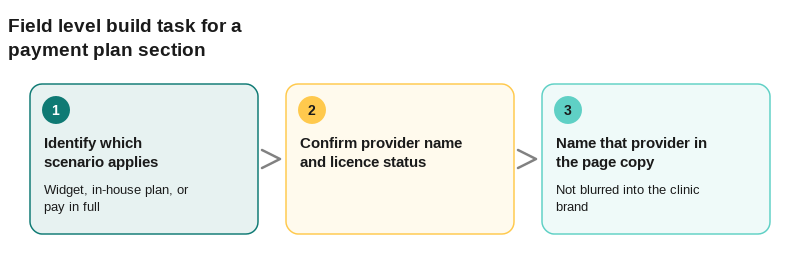
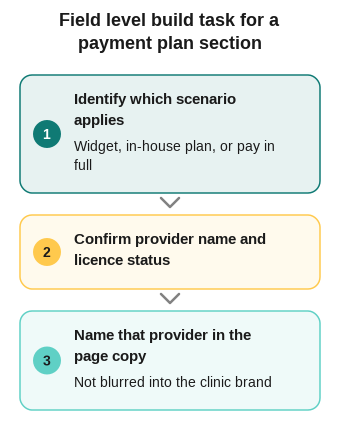
The field-level build task, in order: identify which of the three scenarios your payment section actually is, confirm the credit provider’s name if scenario 1 applies, and make sure the on-page copy names that provider rather than blurring it into the clinic’s own brand voice.
Decision matrix: who holds the obligation
| Payment mechanism | Who the licence question points to | What the page should show (our view) | Build risk if skipped |
|---|---|---|---|
| Third-party BNPL widget | The BNPL provider, as the party providing the credit (INFO 285) | Provider’s official badge and copy, linked to their current terms | Stale or hand-edited disclosure copy left behind after a provider updates its terms |
| In-house instalment plan with a fee | Not answered by ASIC’s BNPL guidance, needs legal advice | The clinic named as the party offering the plan, full fee and date schedule, informed consent capture | Describing the plan as a BNPL product when no BNPL provider is involved |
| In-house instalment plan, no fee, short term | Not answered by ASIC’s BNPL guidance, needs legal advice | Clear statement of any fee or interest and the exact schedule | Assuming “interest-free” alone settles the legal position |
| Full payment or deposit only | No third-party credit provider is involved | Clear refund and deposit terms | Vague deposit terms |
Source: ASIC, INFO 285, seen 25 November 2026. The other columns are our view.
Worked example: a hypothetical $2,400 treatment package
Picture a clinic selling a lip filler and skin course bundle for $2,400. The figures here are hypothetical, chosen for illustration. They are not a market price or any clinic’s real price. The price page offers three ways to pay.
Pay in full. No third-party credit is involved. Standard deposit and refund copy applies.
Pay with a BNPL provider at checkout. The build task is confirming the integration still pulls the provider’s current disclosure text at render time, rather than a cached screenshot or an old static copy block, since the provider is the party that manages that wording.
A 6-week in-house plan with a flat $50 admin fee. The patient pays $2,450 in total (our arithmetic: $2,400 plus $50, both hypothetical). A fee on a clinic’s own plan is the detail that makes it worth asking a lawyer whether the arrangement is regulated credit. We have not sourced the answer, and it is not a template answer.
Takeaway: when an in-house plan adds a fee on top of the treatment price, get legal advice before the page goes live.
What to check on your own site
- Open every procedure or price page that mentions a payment plan and note which of the three scenarios above it is.
- If a BNPL provider’s badge or widget is present, confirm the integration is live and pulling current terms, not a static image or copied text block.
- Confirm the credit provider named on the page matches the entity actually extending the credit.
- If your clinic runs its own instalment plan, check whether any fee, deposit forfeiture clause or interest charge is attached, and ask a lawyer how it is classified.
- Check that instalment plan terms (dates, amounts, fees) are captured in writing at checkout and stored against the patient record, not shown once and discarded.
- Check your booking or practice management platform’s current documentation for a payment plan disclosure field.
- If the plan is in-house and charges any fee, flag it for review by your medical defence organisation or a credit law specialist before the next site update ships.
Enforcement anchor: the Elepay case
ASIC’s 2024 media release shows how the regulator treated a buy now pay later provider before the 2025 licensing change. In media release 24-012MR, ASIC said it accepted a court enforceable undertaking from Elevare Pay Easy Pty Ltd, trading as Elepay, which offers funding to property owners for expenses such as renovation and marketing before a sale.
ASIC said Elepay “admits that from 5 October 2021 to 15 March 2023 it did not have TMDs for seven credit products it distributed to consumers.” Target Market Determinations (TMDs) are required under the Design and Distribution Obligations in the Corporations Act. In that period, ASIC said, Elepay lent $13.748 million to 1,658 retail clients. ASIC said Elepay also did not hold an Australian credit licence in that period and was granted one on 23 January 2024.
The undertaking required an independent expert to report on whether clients fell within the target market. ASIC’s editor’s note says the expert’s final report, provided on 9 September 2024, concluded that none of Elepay’s clients fell outside the target market in its TMDs. ASIC was satisfied Elepay had complied with the undertaking.
This case was about the Design and Distribution Obligations in the Corporations Act, not the credit licensing change that started in June 2025. It is not a direct precedent for the new rules, and it involved property-sale funding, not clinic payment plans. We include it only because it is ASIC’s own account of how it handled a BNPL provider’s compliance gap.
Where this gets hard
The limit of this rule sits at scenario 2 in the decision matrix: the in-house instalment plan. ASIC’s guidance explains who needs a licence once a contract is a buy now pay later contract. Whether a specific fee structure, deposit clause or short-term instalment arrangement is regulated credit is a legal judgment call, not a build decision. ClinicCode can build the disclosure fields, the consent capture and the attribution copy. Whether your in-house plan needs its own assessment is a different question.
The build consequence is that your payment plan page should name the actual credit provider and capture proper consent to the terms. Whether your clinic’s in-house plan falls inside the credit definition is a question for your medical defence organisation or your lawyer.
Status line
According to ASIC, the licence requirement for buy now pay later credit activities applies from 10 June 2025, under the National Credit Code as extended by the Treasury Laws Amendment (Responsible Buy Now Pay Later and Other Measures) Act 2024. ASIC issued Regulatory Guide 281 on 8 May 2025.
Frequently Asked Questions
Does adding an Afterpay or Zip widget to my clinic’s website need my own credit licence?
ASIC’s information sheet says the credit licence requirement applies to anyone engaging in credit activities involving buy now pay later contracts, and it describes the buy now pay later provider as the party providing the credit. In our view, a clinic that only displays a provider’s badge is not the credit provider. We did not find ASIC wording that addresses merchants directly, so confirm it with the provider and a lawyer. A clinic’s own instalment plan is a separate question that needs its own legal advice.
When did buy now pay later become regulated credit in Australia?
From 10 June 2025, according to ASIC. The Treasury Laws Amendment (Responsible Buy Now Pay Later and Other Measures) Act 2024 extended the National Credit Code to buy now pay later contracts, and ASIC issued Regulatory Guide 281 on 8 May 2025.
What is a low cost credit contract and why does it matter for a payment plan page?
A low cost credit contract, or LCCC, is a buy now pay later contract that also meets requirements set by the regulations on fees or charges and on the length of the credit period (section 13E of the National Credit Code). ASIC says providers of low cost credit contracts can elect to comply with modified responsible lending obligations.
If your payment plan page has not had a fresh set of eyes since before 10 June 2025, it is worth a proper audit rather than a guess. Sign up with ClinicCode and we will check the build against what the current rules actually require.
Need a hand with your website?
If you want a second pair of eyes on how this applies to your own site, request a callback and we will talk it through.
The Source Pages
Screenshots of the pages cited in this post, taken on 25 November 2026 and framed on the passage each one supports.
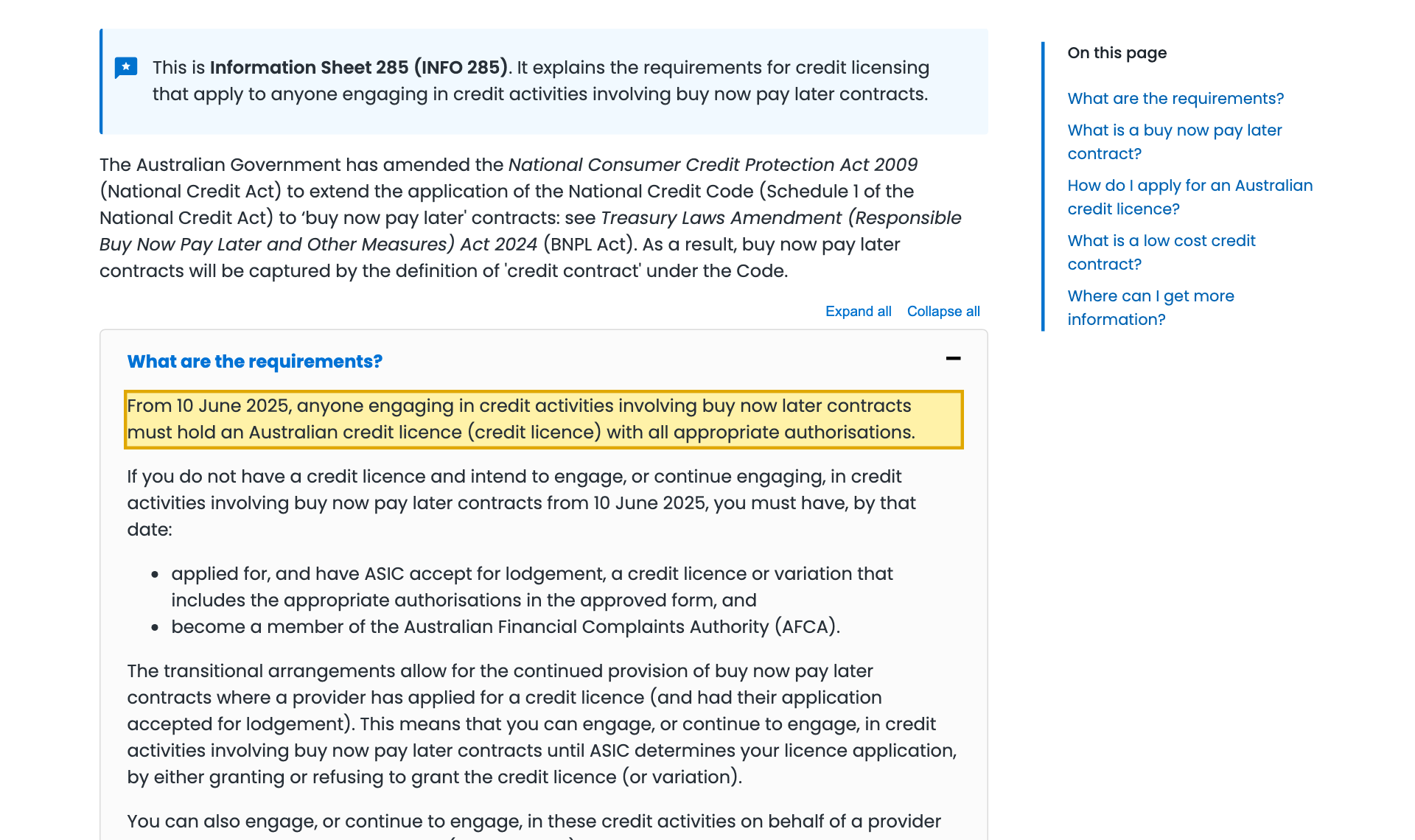
Source: ASIC, Buy now pay later credit contracts and licensing, screenshot taken 25 November 2026.
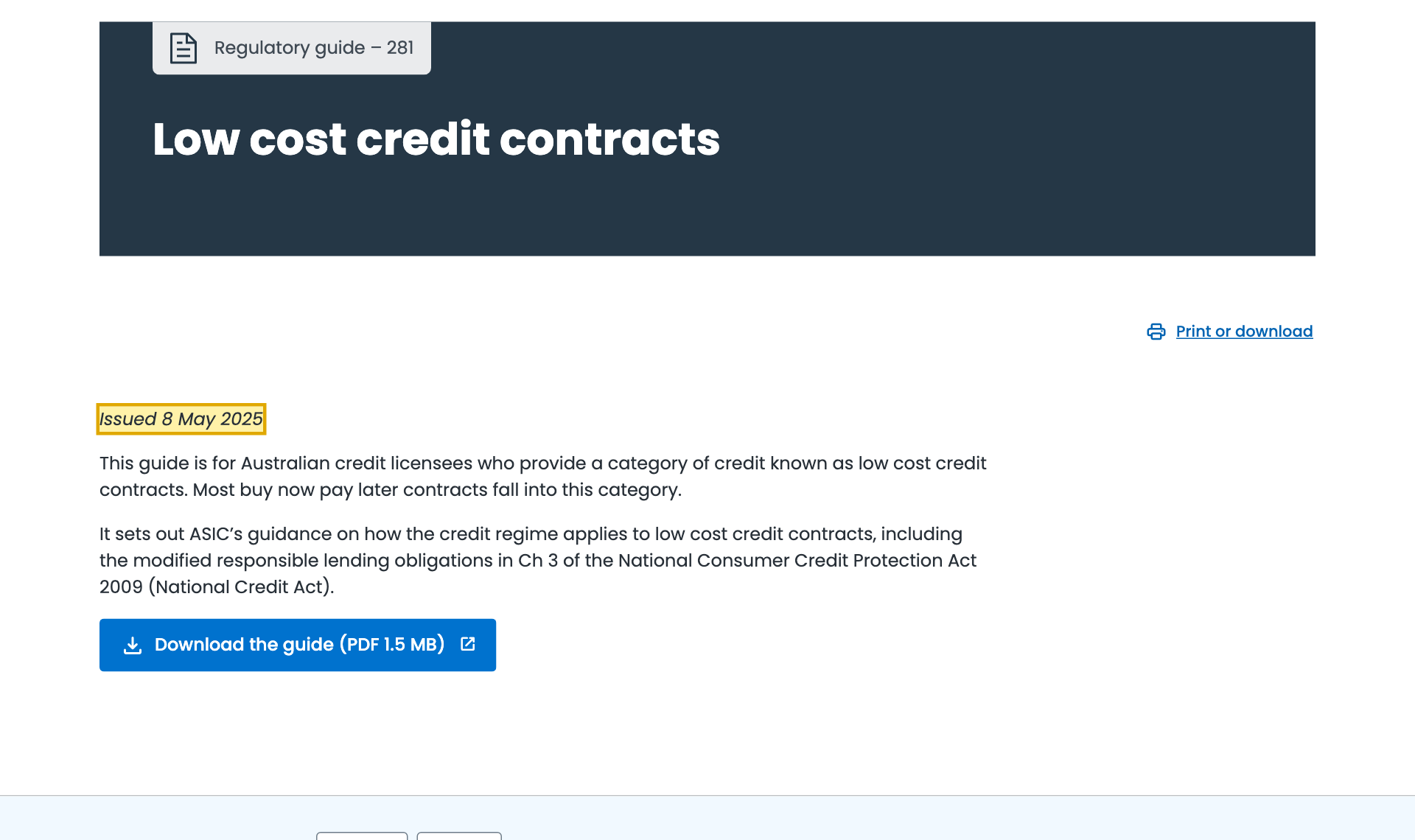
Source: ASIC, RG 281 Low cost credit contracts, screenshot taken 25 November 2026.
Sources and References
- ASIC, “Buy now pay later credit contracts: Credit licensing” (INFO 285). asic.gov.au. Date checked: 25 November 2026.
- ASIC, Regulatory Guide 281, Low cost credit contracts, issued 8 May 2025. asic.gov.au. Date checked: 25 November 2026.
- ASIC media release 25-069MR, “ASIC releases new regulatory guidance to support buy now pay later industry reforms.” asic.gov.au. Date checked: 25 November 2026.
- ASIC media release 24-012MR, “ASIC accepts court enforceable undertaking from buy now, pay later provider Elepay.” asic.gov.au. Date checked: 25 November 2026.
- Federal Register of Legislation, Treasury Laws Amendment (Responsible Buy Now Pay Later and Other Measures) Act 2024 (No. 138, 2024, C2024A00138). legislation.gov.au. Date checked: 25 November 2026.
Last reviewed: 25 November 2026.
Vikas Thakur
Founder, Perth. 16 years of experience from working at TPG, iiNet and Monadelphous, now helping Australian clinics keep their websites, ads and online presence AHPRA compliant.