Non-Refundable Deposits: What The ACL Actually Allows
The ACCC says a “no refunds” policy cannot take away a customer’s consumer guarantee refund rights for a faulty service. Penalties for unfair contract terms in standard form contracts apply from 9 November 2023.
 Vikas Thakur Founder, Perth 13 min read Fact checked
Picture a patient who has paid a deposit to lock in a Tuesday morning anti-wrinkle appointment. On Monday night, the clinic texts to say the injector is sick and the next opening is three weeks away. The patient asks for the deposit back. The booking page’s fine print says “deposits are non-refundable,” with no mention of what happens when the clinic is the one who cancels. This is an illustration, not a real clinic.
In our view, that fine print is a problem, and not just an ethics one.
Key takeaways
- The ACCC says businesses cannot rely on store policies or terms and conditions, such as “no refunds”, to deny a consumer’s right to a refund for faulty products or services.
- The ACCC says the unfair contract terms changes apply to standard form contracts made or renewed on or after 9 November 2023, and to terms varied or added on or after that date. Penalties apply.
- The ACCC lists terms that allow one party (but not the other) to end the contract, or that penalise one party (but not the other) for breaching or ending it, as examples of terms that may be unfair.
- Where a service has a major problem, the customer can cancel the contract and get a refund. It may not be a full refund, because the customer pays a reasonable amount for work done so far.
- Consumers have an automatic right to a cooling-off period when they buy goods or services through telemarketing or door-to-door sales.
- As at 25 November 2026, we found no ACCC enforcement action or court decision about a clinic or dental practice’s deposit forfeiture clause.
As at 25 November 2026, a booking deposit can be labelled “non-refundable” on a clinic’s website, but the words alone do not settle the question. The ACCC’s guidance on repair, replace, refund and cancel says a business cannot rely on policies or terms and conditions that deny a consumer’s right to a refund for faulty services. The ACCC’s contracts guidance for businesses says that from 9 November 2023, proposing, using or relying on unfair contract terms in standard form contracts is banned and penalties apply.
Source: ACCC, repair, replace, refund and cancel and Contracts, seen 25 November 2026.
What the ACCC’s guidance actually says
Two separate rules sit behind the words “non-refundable deposit,” and a clinic’s booking page needs to satisfy both.
The first is the consumer guarantee position. The ACCC’s page on repair, replace, refund and cancel says: “Businesses can’t take away a consumer’s right to a refund or replacement for faulty products or services. It’s illegal for businesses to rely on store policies or terms and conditions which deny these rights.” It gives “policies which say ‘no refunds’” as an example. The same page says that when a service has a major problem, a consumer can “cancel the contract and get a refund. This may not be a full refund, as the consumer needs to pay a reasonable amount for any work done so far and as expected.” It adds that if the consumer has already paid upfront, they have the right to get some money back.
The page also says consumers are not entitled to a refund under the consumer guarantees if they got what they asked for but simply changed their mind. It adds that if a business has a “change of mind” policy, it must follow it. That is why a cancellation window matters.
The second rule is newer. The ACCC’s contracts guidance for businesses says the unfair contract terms changes came into effect on 9 November 2023 and apply to standard form contracts made or renewed on or after that date, and to a term varied or added on or after that date. It says a term is unfair if it:
- causes a significant imbalance in the rights and obligations of the parties under the contract
- is not reasonably necessary to protect the legitimate interests of the party who gets an advantage from the term
- would cause financial or other harm to the other party if enforced
The ACCC says a court must consider the contract as a whole and whether the term is transparent. Its examples of terms that may be unfair include terms that allow one party (but not the other) to avoid or limit their responsibilities, to end the contract, or to change the terms, and terms that penalise one party (but not the other) for breaching or ending the contract. In our view, a clause that lets the clinic keep the deposit if the patient cancels, with nothing in the policy if the clinic cancels or reschedules, is the kind of one-sided term those examples describe. Only a court can decide whether a specific clause is unfair.
The ACCC’s contracts page for consumers also says consumers have an automatic right to a cooling-off period when they buy goods or services through telemarketing or door-to-door sales. In our view that is a narrower fact pattern for clinics, but it matters for any practice that books consultations by outbound phone calls or sign-ups at events.
Source: ACCC, repair, replace, refund and cancel, Contracts (business) and Contracts (consumers), seen 25 November 2026.
Takeaway: The word “non-refundable” on its own does not settle anything. In our view, the deposit clause has to survive both the consumer guarantee rules and the unfair contract terms test.
What that means for the booking page and the build
None of this is abstract for the person writing the booking form. These are our recommendations, not legal requirements stated by the ACCC.
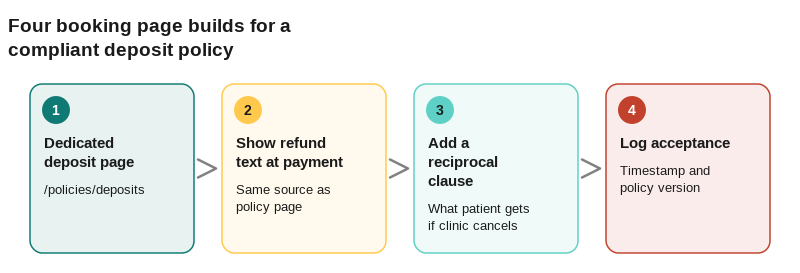
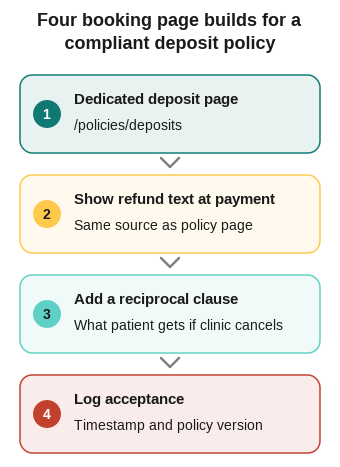
The deposit policy needs its own page, not just fine print. In our view, build a dedicated /policies/deposits page with the full policy: the deposit amount, when it is charged, what counts as a late cancellation, and what happens if the clinic cancels or reschedules. The ACCC says a court must consider the contract as a whole and whether a term is transparent, so one sentence in a footer link is a weak position.
The booking form needs a refund_policy_text field the patient sees before paying, not a checkbox next to a wall of text. Render the specific cancellation window on the payment step, pulled from the same source as the policy page so the two never drift out of sync.
Add a reciprocal clause next to the forfeiture clause. If the policy says the patient forfeits the deposit for a late cancellation, add a matching line saying what the patient gets if the clinic cancels or reschedules, such as a refund, a priority rebooking slot, or both. In our view, this directly answers the “one party (but not the other)” examples above.
Log the acceptance, not just the click. Store a timestamp and the exact policy version against the booking record, the same way you would store a consent form version. If a dispute happens later, you can show which words the patient agreed to.
Deposit forfeiture decision matrix
This matrix is our view of where the risk sits, not a ruling by the ACCC or a court.
| Scenario | Consumer guarantee position (ACCC) | Our view of the unfair contract terms risk | What the build needs |
|---|---|---|---|
| Patient cancels with notice | A change of mind is not a consumer guarantee issue, and a business with a “change of mind” policy must follow it | Lower, if the notice period is clearly stated | Clear cancellation window shown before payment |
| Patient cancels with little or no notice | Same as above | Depends on whether the window is fair to the patient | Late-cancellation threshold defined in hours, not vague wording |
| Clinic cancels or reschedules | Not addressed directly by the ACCC pages we read | Higher if the policy is silent on this case | Reciprocal clause: refund or rebooking priority stated explicitly |
| Major service failure | Customer can cancel and get a refund, which may be less than full because of a reasonable amount for work done | Higher if the deposit is withheld anyway | Refund workflow when a major problem is raised |
| Contract made via telemarketing or door-to-door sale | Automatic cooling-off period | Cooling-off terms need to be disclosed | Separate disclosure step for phone or in-person bookings |
Source: ACCC, repair, replace, refund and cancel and Contracts (consumers), seen 25 November 2026. The third and fourth columns are our assessment.
A worked scenario
The following is a hypothetical illustration, not a real clinic or a real result.
Cosmetic clinic, anti-wrinkle appointment. Imagine an injectables clinic whose policy says the deposit is non-refundable if the patient cancels inside 24 hours. The confirmation email states this window clearly. The gap is that the policy says nothing about what happens if the injector calls in sick and the clinic reschedules. In our view, the fix is one paragraph on the same policy page: “If we need to reschedule your appointment, your deposit is refunded on request or applied to your new booking, whichever you prefer.” That turns a one-sided clause into a balanced one.
Cosmetic dental practice, consultation. Imagine a practice that takes a payment described on one page as a “consultation fee, non-refundable” and on another page as a “deposit”. A patient cannot tell whether it pays for a service already delivered or holds a place for a future one. In our view, the fix is to separate the two: a clearly labelled consultation fee charged for the consult itself, and a separate treatment deposit with its own stated cancellation and clinic-cancellation terms.
Takeaway: In our view, in both scenarios the fix is a missing reciprocal clause or a clear label, not a lower deposit.
What to check on your own site
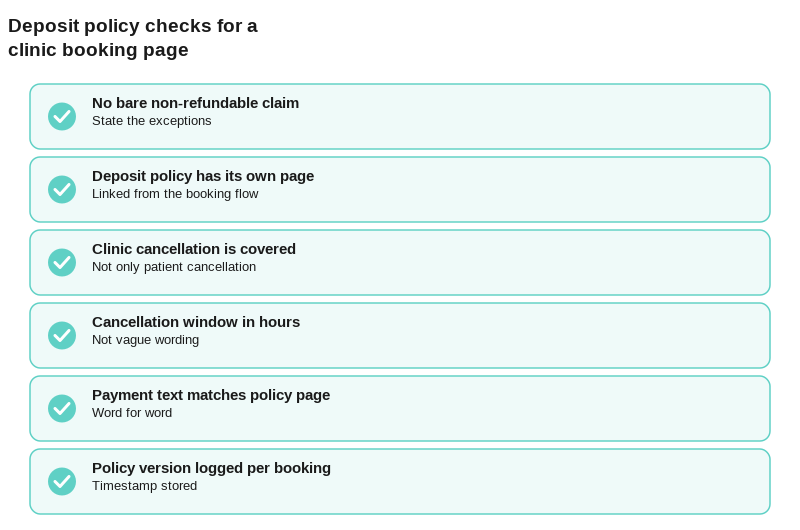
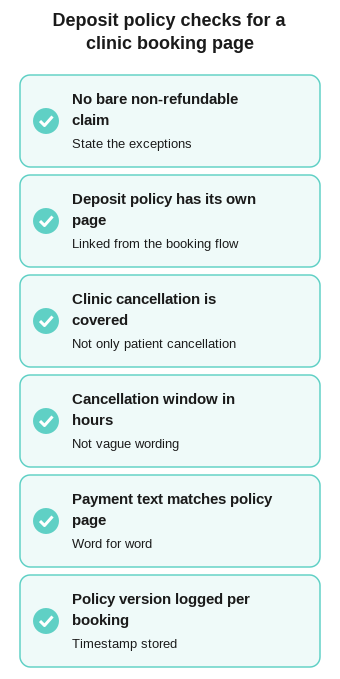
- Search your site for the phrase “non-refundable” and confirm it never appears as a standalone claim with no stated exceptions.
- Confirm the deposit policy has its own page, linked from the booking flow, not just a sentence in the footer or a T&Cs PDF nobody opens.
- Check that the policy states what happens if the clinic, not the patient, cancels or reschedules.
- Confirm the cancellation window is a specific number of hours, not a vague phrase like “sufficient notice.”
- If any bookings originate from a telemarketing call or a door-to-door or in-person event sign-up, confirm the cooling-off right is disclosed separately for that channel.
- Check that the deposit amount and refund policy text shown on the payment step match the policy page word for word.
- Confirm the system logs the policy version and timestamp against each booking record.
- If the site distinguishes a “consultation fee” from a “deposit,” confirm the two terms are not used interchangeably anywhere.
Has anyone actually been penalised for this?
We looked for an ACCC enforcement action, court judgment or determination naming a cosmetic clinic or dental practice’s deposit forfeiture clause. We did not find one, and that does not prove none exists. The ACCC’s guidance says penalties for breaches of the unfair contract terms law apply from 9 November 2023. The risk here is regulatory exposure, not a track record of clinics already penalised for this specific clause.
Where this gets hard
The ACCC’s guidance describes the shape of a problem term. It does not hand a business a pass or fail checklist for a specific deposit clause. The ACCC says a court must consider the contract as a whole, so whether a given cancellation window is reasonable, or a specific forfeiture clause creates a significant imbalance, depends on the whole contract. In our view, the build consequence is that the deposit policy page needs a stated reciprocal clause and a specific cancellation window. Whether a particular version of your policy crosses the line is a question for your medical defence organisation or your lawyer.
Status line
As at 25 November 2026, the ACCC’s contracts page says the unfair contract terms changes came into effect on 9 November 2023 and apply to standard form contracts made or renewed on or after that date, and to terms varied or added on or after it. We did not check for pending changes.
Frequently Asked Questions
Can a clinic legally keep a client’s deposit if the client cancels their own appointment?
It depends on the contract. The ACCC says consumers are not entitled to a repair, replacement or refund under the consumer guarantees if they got what they asked for but simply changed their mind, and that a business with a “change of mind” policy must follow it. The ACCC also lists terms that penalise one party (but not the other) for breaching or ending a contract as examples of terms that may be unfair, so a deposit clause that bites only the customer can be challenged as an unfair contract term. Whether a particular deposit clause is fair depends on the whole contract, so check it with your lawyer.
Does labelling a deposit “non-refundable” on the booking page override the customer’s refund rights?
Not on its own. The ACCC’s guidance on repair, replace, refund and cancel says it is illegal for businesses to rely on store policies or terms and conditions that deny a consumer’s right to a refund for faulty products or services, and gives “no refunds” policies as an example. That right covers faulty products and services. A change of mind is treated separately, as the answer above explains.
What happens to the deposit if the clinic cancels or reschedules the appointment?
The ACCC pages we read do not address a clinic cancelling or rescheduling an appointment directly. Where a service has a major problem, the ACCC says the consumer can cancel the contract and get a refund, which may not be a full refund because the consumer pays a reasonable amount for work done so far. In our view, a deposit clause that lets the clinic keep the money but gives the patient no equivalent protection matches the one-sided examples the ACCC lists as possibly unfair, so the policy should say what happens when the clinic cancels.
Get Your Deposit Policy Page Built Right
A deposit policy only protects your clinic if the page, the checkout wording, and the booking confirmation all say the same thing. If you would rather have those checked together than guess, talk to us about a compliance-ready build.
The Source Pages
Screenshots of the pages cited in this post, taken on 25 November 2026 and framed on the passage each one supports.
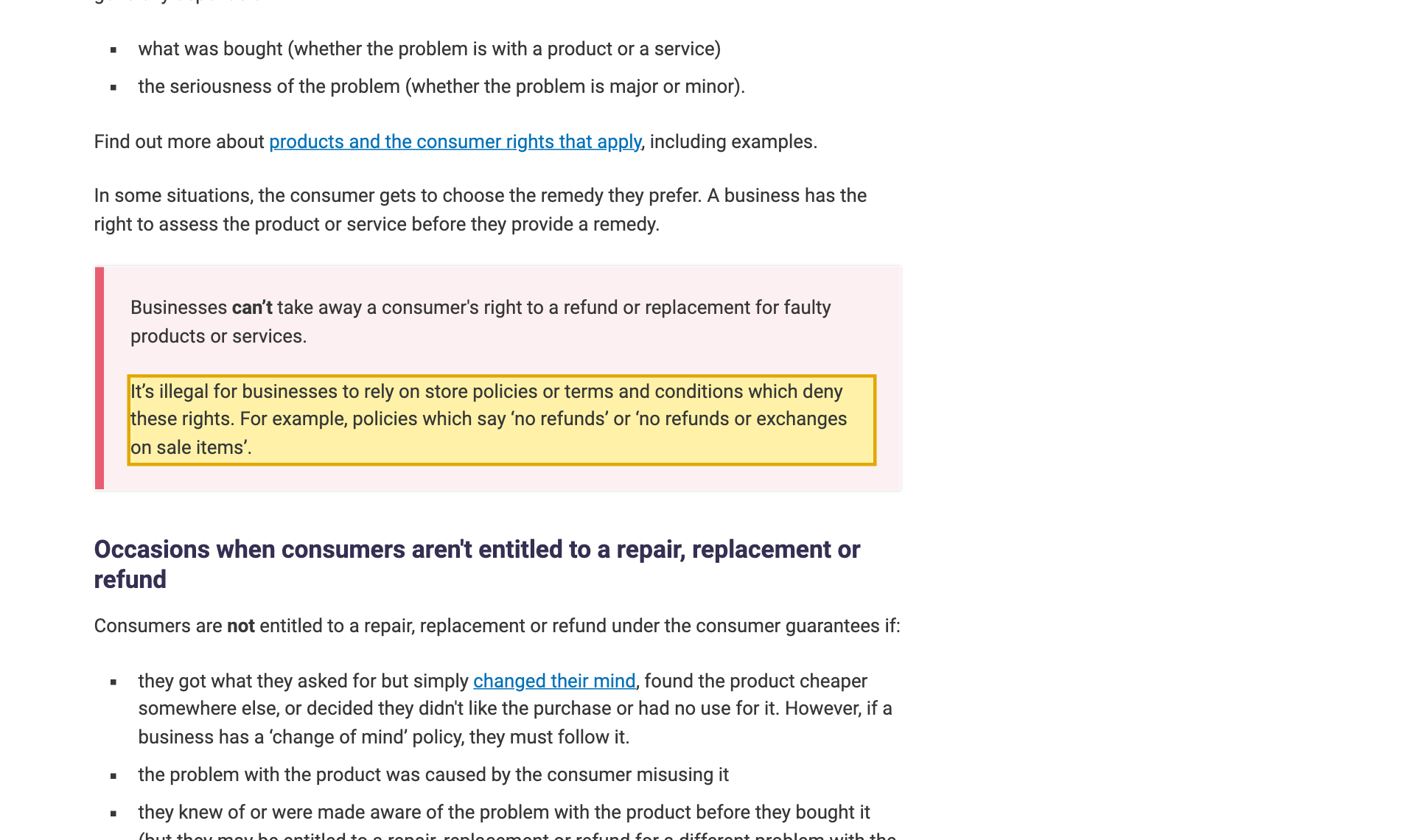
Source: ACCC, Repair, replace, refund and cancel, screenshot taken 25 November 2026.
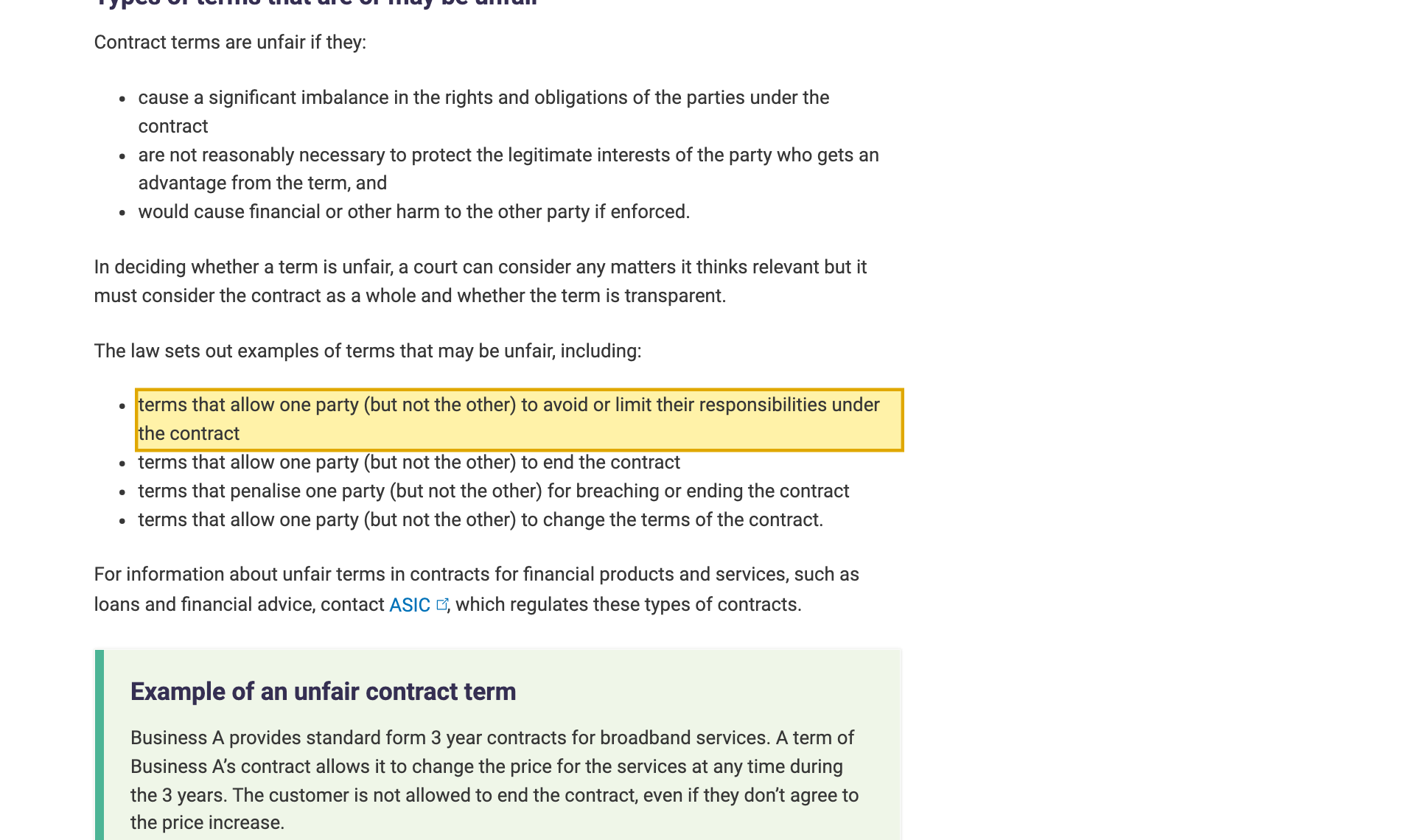
Source: ACCC, Contracts, screenshot taken 25 November 2026.
Sources and references
- ACCC, Repair, replace, refund, cancel: accc.gov.au (seen 25 November 2026)
- ACCC, Contracts (guidance for businesses, including unfair contract terms): accc.gov.au (seen 25 November 2026; the older unfair-contract-terms URL redirects here)
- ACCC, Contracts (consumers, including cooling-off periods): accc.gov.au (seen 25 November 2026)
Last reviewed: 25 November 2026.
If your booking page’s deposit policy is one sentence of fine print with no reciprocal clause, that is a quick fix. Sign up with ClinicCode and we will review your policy page and booking form together.
Vikas Thakur
Founder, Perth. 16 years of experience from working at TPG, iiNet and Monadelphous, now helping Australian clinics keep their websites, ads and online presence AHPRA compliant.