Medispa Market Australia: 13.02% Clinic Growth [2026]
Mordor Intelligence forecasts Australian aesthetic clinics will grow at a 13.02% CAGR to 2031 within its Australia Aesthetic Devices Market report. What the published figures say, and what they mean for clinic marketing.
 Vikas Thakur Founder, Perth 6 min read Fact checked
Key takeaways
- Mordor Intelligence forecasts that aesthetic clinics in Australia will grow at a 13.02% CAGR to 2031 (end-user segment of its Australia Aesthetic Devices Market report)
- The same report puts the whole Australian aesthetic devices market at USD 238.77 million in 2025, USD 262.24 million in 2026 and USD 419.18 million by 2031, a 9.83% CAGR over 2026-2031
- Hospitals held 41.55% of that devices market in 2025, per the same report
- IMARC Group values Australia’s medical aesthetics market at USD 396.4 million in 2025, forecast to reach USD 784.8 million by 2034 (7.89% CAGR, 2026-2034)
- These are paid-research forecasts, not counts of clinics or patients, and the two reports measure different things
- Ahpra’s published maximum penalty for an advertising offence is $60,000 (individual) or $120,000 (body corporate) per offence
Mordor Intelligence forecasts that dedicated aesthetic clinics in Australia will grow at a 13.02% compound annual growth rate to 2031. That is the report’s forecast for the clinic end-user segment of the aesthetic devices market, and it is faster than the report’s 9.83% forecast for the whole devices market. The report says clinics are “moving the revenue center of gravity away from hospitals.”
A clinic growing into that demand is also advertising under Ahpra’s rules for higher-risk non-surgical cosmetic procedures. The market forecast and the compliance risk sit in the same channels.
Below is what the public pages of these reports say, and what a clinic should get right before spending on growth. Both sources are forecasts from research publishers. Neither is a government count.
How Big Is Australia’s Medispa Market
“Medispa market” gets used loosely, so it helps to separate the two figures reported for Australia.
The narrower one is the aesthetic devices market: lasers, body-contouring devices and energy-based skin treatment platforms. Mordor Intelligence’s report puts it at USD 238.77 million in 2025, USD 262.24 million in 2026 and USD 419.18 million in 2031, a 9.83% CAGR over 2026-2031.
| Year | Australia Aesthetic Devices Market (USD) |
|---|---|
| 2025 | $238.77 million |
| 2026 | $262.24 million |
| 2031 (forecast) | $419.18 million |
Overall CAGR 2026-2031: 9.83%. Source: Mordor Intelligence, Australia Aesthetic Devices Market (market size and growth rate figures on the report’s overview page).
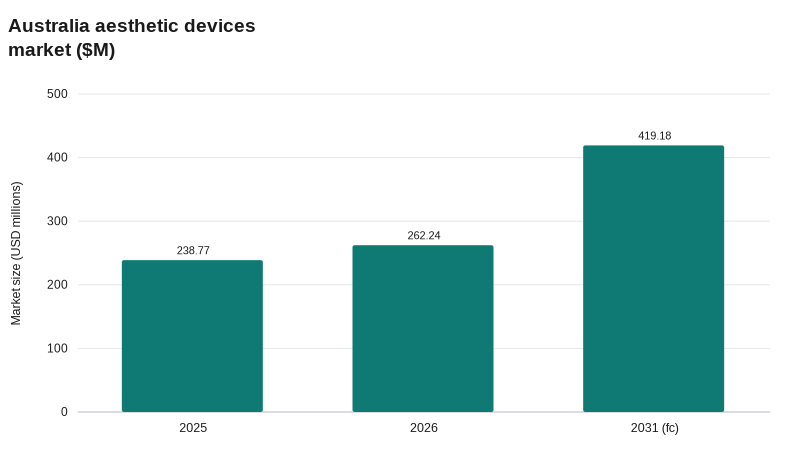
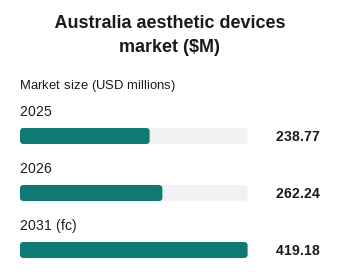
Source: Mordor Intelligence, Australia Aesthetic Devices Market.
The broader figure is Australia’s medical aesthetics market, which IMARC Group says grew from USD 396.4 million in 2025 to USD 427.6 million in 2026, and is expected to reach USD 784.8 million by 2034, a 7.89% CAGR during 2026-2034 (IMARC Group, Australia Medical Aesthetics Market). The two reports use different definitions and forecast windows, so their figures should not be added together or compared line by line.
Takeaway: Both publishers forecast growth, and neither figure is a count of Australian clinics or treatments.
Clinics Are Forecast to Outgrow the Market
Mordor Intelligence’s end-user breakdown is the more useful number for a clinic owner. The report says hospitals held 41.55% of the Australian aesthetic devices market in 2025, whereas aesthetic clinics are projected to grow at a 13.02% CAGR to 2031. The end users it lists are hospitals, aesthetic clinics and home care settings.
The chart below sets the clinic forecast beside two other growth rates from the same report. The report states the whole-market rate for 2026-2031 and the other two “to” or “through” 2031.
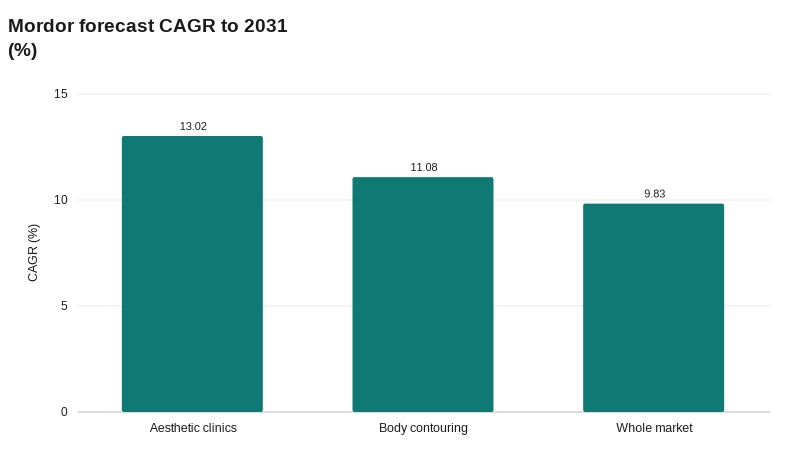
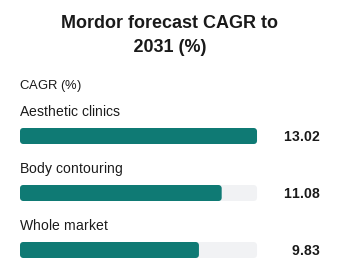
Source: Mordor Intelligence, Australia Aesthetic Devices Market. “Body contouring” is the report’s body contouring and cellulite reduction application segment; “Whole market” is the total Australian aesthetic devices market.
For a global comparison, Mordor Intelligence’s medical spa report currently forecasts the global market at USD 26.20 billion in 2026 and USD 53.06 billion by 2032, a 12.48% CAGR between 2027 and 2032, with Asia-Pacific forecast at a 14.52% CAGR through 2032 (Mordor Intelligence, Medical Spa Market). That is a different market, a different base year and a different window to the Australian figures, so we do not rank the Australian clinic forecast against it.
Takeaway: In this one report, clinics are the segment forecast to grow fastest, and hospitals are still the largest end user for 2025.
What the Reports Say Is Driving Demand
Mordor Intelligence’s Australia report says demand is accelerating as affluent millennials normalise cosmetic enhancements. IMARC Group’s report lists rising demand for non-invasive cosmetic procedures, growing awareness of aesthetic treatments and rising disposable income, and notes strong demand for non-surgical treatments such as botulinum toxin and dermal fillers (IMARC Group, Australia Medical Aesthetics Market). Those are the publishers’ own statements, not measured clinic data.
Clinics scaling into that demand advertise under Ahpra’s rules. Ahpra’s guidelines for advertising higher risk non-surgical cosmetic procedures are “in effect from 2 September 2025” (Ahpra, resources for advertising higher risk non-surgical cosmetic procedures). For advertising offences under the National Law, Ahpra’s “Advertising and the law” page lists a maximum penalty of $60,000 per offence for an individual and $120,000 per offence for a body corporate. Ahpra says the 2022 National Law amendments raised these from $5,000 and $10,000 (Ahpra, Guidelines for advertising a regulated health service).
Ahpra’s pages say that as of July 2024 the increased penalties apply in all jurisdictions, including Western Australia. Footnote 3 on the advertising guidelines page says that in Western Australia different penalties apply, with a maximum of $30,000 for an individual and $60,000 for a body corporate, but it is attached to the penalties for unlawful use of a protected title. Check the current position with Ahpra if you advertise from WA.
If you have not checked your site and ad copy against the current guidelines, ClinicCode can review it line by line and flag what needs to change before the next campaign goes live.
Takeaway: A growing market does not change what you can say in your ads, and the penalty is per offence.
Building a Website and Marketing System for This Growth
A clinic that plans to grow needs a website and booking system that can take on more enquiries without the compliance side falling behind. A template site built before the 2025 guidelines may need a fresh check.
ClinicCode designs and rebuilds AHPRA and TGA-compliant cosmetic clinic websites, so a clinic is not retrofitting compliance after a complaint lands. For clinics that want the website, the compliant ad copy and the ongoing monitoring handled as one system, ClinicCode’s compliance fixes and compliant rebuild is built for that brief.
Data sources: Mordor Intelligence, Australia Aesthetic Devices Market; IMARC Group, Australia Medical Aesthetics Market; Mordor Intelligence, Medical Spa Market; Ahpra, Advertising and the law; Ahpra, Guidelines for advertising a regulated health service.
ClinicCode builds AHPRA-compliant websites and marketing systems for Australian cosmetic clinics. Talk to us about your clinic’s marketing.
Vikas Thakur
Founder, Perth. 16 years of experience from working at TPG, iiNet and Monadelphous, now helping Australian clinics keep their websites, ads and online presence AHPRA compliant.