How Many Dentists Are in Australia? Workforce Data
The AIHW reports around 21,000 registered dentists in 2024, though its own chart caption gives 20,141. Here is what the AIHW and Dental Board counts say.
 Vikas Thakur Founder, Perth 7 min read Fact checked
Key takeaways
- The AIHW reports the number of registered dentists in Australia rose from around 15,800 in 2014 to around 21,000 in 2024, though the page’s own chart caption gives 20,141 for 2024 (AIHW)
- The Dental Board of Australia counted 21,308 people in the Dentist-only registration division in its December 2024 data, and 28,677 dental practitioners across all registration types (Dental Board registrant data, December 2024)
- NSW had the most registered dentists (6,324), then Victoria (5,219) and Queensland (4,479)
- The AIHW’s full-time-equivalent (FTE) rate ranged from 35.4 dentists per 100,000 people in the Northern Territory to 66.9 in the ACT in 2024
- Major cities had 68.9 FTE dentists per 100,000 people against 21.0 in remote and very remote areas
- Most dentists worked in group private practice (around 10,400) rather than solo private practice (around 5,000)
What this data is, and what it is not
No single official number answers “how many dentists are there”. Two public sources give two different counts, and each measures something different.
- The Dental Board of Australia publishes quarterly registrant tables through Ahpra. They count every person holding a registration, including non-practising registrants and people with no principal place of practice recorded.
- The Australian Institute of Health and Welfare (AIHW) uses the National Health Workforce Dataset to report registered dentists, how many are employed in their field, and a rate of FTE dentists per 100,000 people.
Neither source tells you how many dentists are in a given suburb, how many do cosmetic work, or how many accept new patients. No official Australian figure exists for those. Treat any post that claims one with caution.
How Many Dentists Does Australia Have?
| Measure | Figure | Period | Source |
|---|---|---|---|
| Registered dentists (AIHW) | around 21,000 | 2024 | AIHW dental workforce |
| Registered dentists, earlier | around 15,800 | 2014 | AIHW dental workforce |
| Dentist-only registration division | 21,308 | Oct to Dec 2024 | Dental Board registrant data |
| All dental practitioners, every registration type | 28,677 | Oct to Dec 2024 | Dental Board registrant data |
| Dentist-only registration division | 21,804 | Oct to Dec 2025 | Dental Board registrant data |
| All dental practitioners, every registration type | 29,362 | Oct to Dec 2025 | Dental Board registrant data |
The AIHW says dentist numbers grew from around 15,800 in 2014 to around 21,000 in 2024. Note that the AIHW page’s own chart caption gives 20,141 registered dentists for 2024, while its text says around 21,000, so treat the figure as approximate. The Board’s 21,308 counts only the Dentist-only division; people also registered in another division are counted in separate rows, so it is not a total headcount of every dentist. The AIHW also reports that the proportion of dentists employed in their field was 91% in both 2014 and 2024.
The AIHW FTE rate ranged from 56.5 dentists per 100,000 people in 2014 to 62.1 in 2024. In plain terms, headcount grew about a third over the decade, while the FTE rate rose by roughly a tenth, so supply has grown somewhat faster than the population on that measure.
Takeaway: The workforce is growing, but the per-capita FTE rate has risen by about 5.6 points in a decade.
Where Australia’s Dentists Are Registered
The Dental Board’s December 2024 table breaks the “Dentist” division down by principal place of practice. NSW had the largest headcount.
| State or territory | Registered dentists (Dec 2024) |
|---|---|
| New South Wales | 6,324 |
| Victoria | 5,219 |
| Queensland | 4,479 |
| Western Australia | 2,309 |
| South Australia | 1,414 |
| ACT | 385 |
| Tasmania | 329 |
| Northern Territory | 122 |
Source: Dental Board of Australia, Registrant data, 1 October to 31 December 2024. A further 727 people holding a Dentist registration had no principal place of practice recorded.
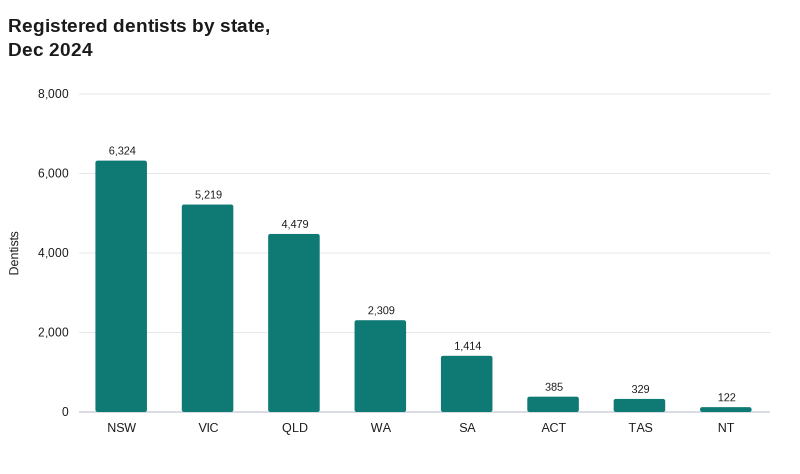
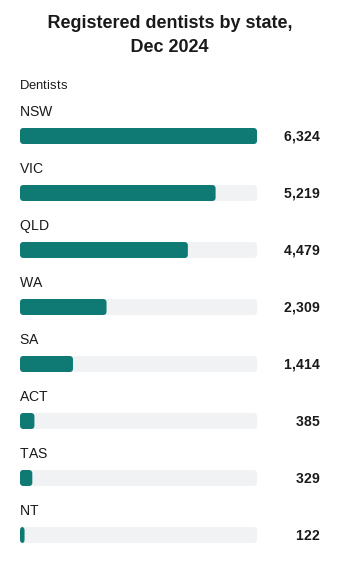
Source: Dental Board of Australia, Registrant data, December 2024
The chart shows headcount, which follows population. NSW and Victoria together hold more than half of the 21,308 total, by our arithmetic from the table above.
Headcount is not density. The AIHW’s 2024 FTE rates ranged from 35.4 in the Northern Territory to 66.9 in the ACT. Across remoteness areas, the rate ranged from 21.0 in remote and very remote areas to 68.9 in major cities.
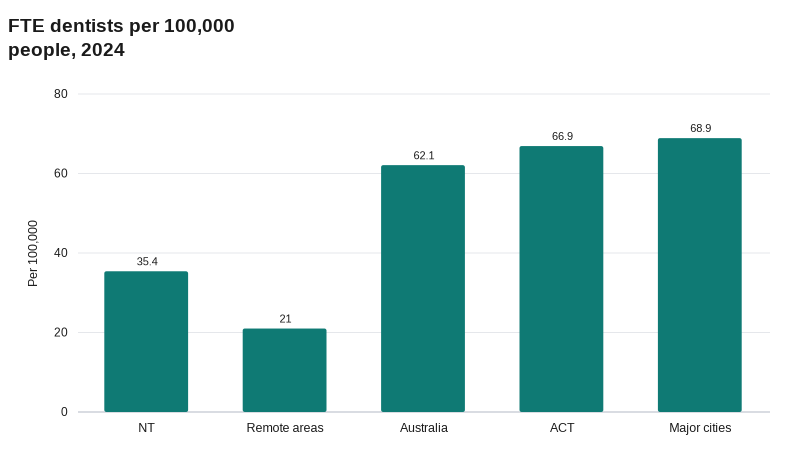
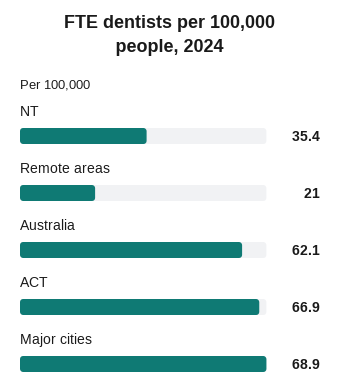
Source: AIHW, Oral health and dental care in Australia, dental workforce
The chart shows a patient in a remote area has access to roughly a third as many dentists per head as one in a major city (21.0 against 68.9). “Remote areas” here means the AIHW’s remote and very remote category.
Takeaway: A practice’s competition looks very different in a capital city postcode than in a regional one, and state averages hide that gap.
What Type of Dental Practitioner Is Registered
“Dentist” is one of several registration types the Dental Board oversees. Oral health therapists, hygienists, prosthetists and therapists are registered separately, and some people hold more than one.
| Registration division (Dec 2024) | Count |
|---|---|
| Dentist-only division | 21,308 |
| Oral health therapist | 3,325 |
| Dental hygienist | 1,513 |
| Dental prosthetist | 1,325 |
| Dental therapist | 640 |
| Combined divisions (people with more than one) | 566 |
| All dental practitioners | 28,677 |
Source: Dental Board of Australia, Registrant data, 1 October to 31 December 2024. The combined-divisions row is our arithmetic: 28,677 minus the five single-division rows above it.
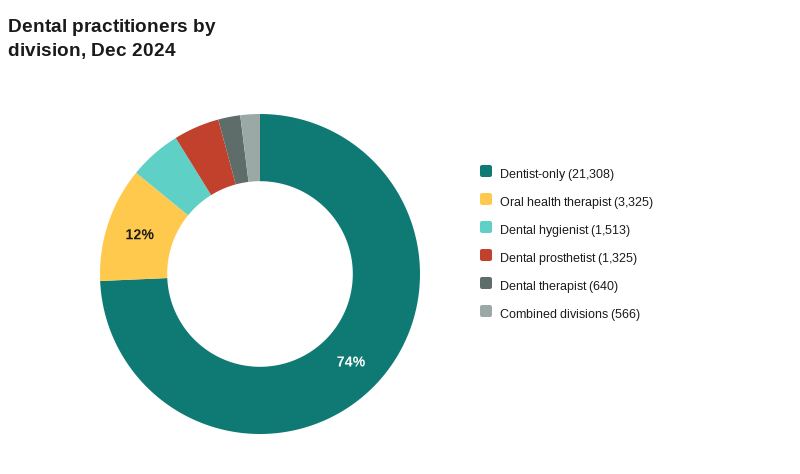
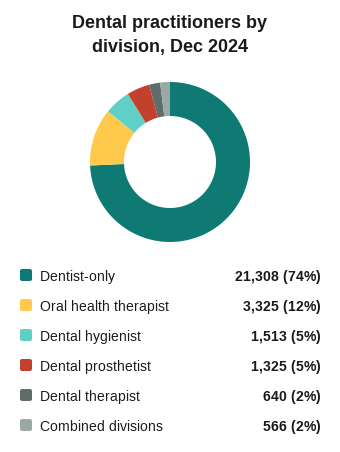
Source: Dental Board of Australia, Registrant data, December 2024
The chart shows dentists are the large majority of the register, and that non-dentist registrants are a meaningful minority. Our arithmetic from the table puts the Dentist-only division at about 74% of all 28,677 dental practitioners.
The same Board table shows 56.6% of all registered dental practitioners were female and 43.4% male. The AIHW reports a different measure: nearly half (48%) of dentists were female in 2024. The two figures cover different groups, so do not compare them directly. The Board’s largest age bracket was 30 to 34, with 4,533 practitioners, followed by 35 to 39 with 4,500.
Takeaway: A “how many dentists” figure that ignores other registration types undercounts the dental workforce, so check which group a number covers.
Where Dentists Work
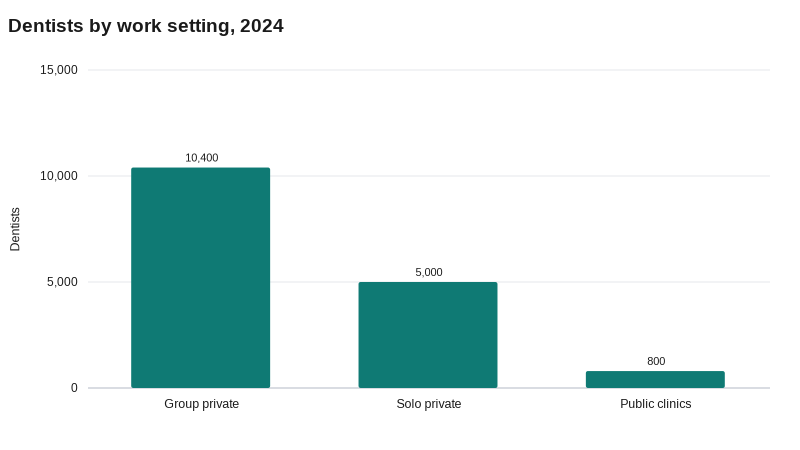
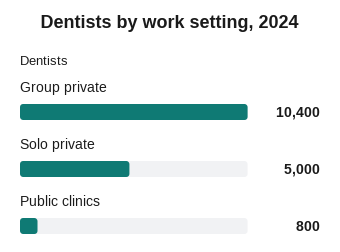
The AIHW reports that in 2024 most dentists worked in group private practices (around 10,400) or solo private practices (around 5,000), and around 800 (4.5%) worked in public clinics. It also reports group private practice rose from 9,512 in 2021 to 10,426 in 2024.
| Employment setting (2024) | Dentists |
|---|---|
| Group private practice | around 10,400 |
| Solo private practice | around 5,000 |
| Public clinics | around 800 |
Source: AIHW, Oral health and dental care in Australia, dental workforce
Source: AIHW, Oral health and dental care in Australia, dental workforce
The chart shows group practice is the most common setting. If you market to dental practices, the buyer is increasingly a group with several decision-makers and a shared brand, not one principal.
Takeaway: When a practice belongs to a group, a compliance problem on one website can affect every location sharing that brand.
What This Means for Practice Compliance
Ahpra says section 133 of the National Law applies to anyone who advertises a regulated health service (Ahpra, Advertising and the law), whatever the state or the local density. Our guide to AHPRA’s advertising rules for cosmetic dentistry covers what applies to a dental practice website. A smaller market does not loosen the rules, and a crowded one does not change what you can say about yourself.
Takeaway: Workforce density changes how much competition a practice faces. It does not change what a practice may say about itself online.
Check Your Website Before You Compete on This Data
Many practices do not know which parts of their website could fail an advertising review until someone reads it line by line. If your site has not been checked recently, ClinicCode can review it and flag what needs to change.
ClinicCode builds websites for Australian cosmetic clinics and dental practices, starting from the current advertising guidelines. For practices that want an audit and a compliant rebuild, book a call.
Sources and References
- AIHW, Oral health and dental care in Australia: dental workforce: registered dentists in 2014 and 2024, FTE rates, state and remoteness ranges, employment settings, share employed in field, female share of dentists.
- Dental Board of Australia, Registrant data, 1 October to 31 December 2024: dentists by state, registration divisions, practitioner totals, gender and age.
- Dental Board of Australia, Registrant data, 1 October to 31 December 2025: December 2025 dentist and practitioner totals.
- Dental Board of Australia, statistics page: index of the quarterly registrant tables.
ClinicCode builds AHPRA-compliant websites for Australian cosmetic clinics and dental practices. Call me back to discuss a compliant rebuild.
Vikas Thakur
Founder, Perth. 16 years of experience from working at TPG, iiNet and Monadelphous, now helping Australian clinics keep their websites, ads and online presence AHPRA compliant.