Healthengine Says It Handles 1 Million Bookings a Month
Healthengine says it handles around one million healthcare bookings a month, while ABS data shows telehealth use fell to 22.5% in 2024-25. Here is what that means for a clinic website.
 Vikas Thakur Founder, Perth 9 min read Fact checked
Key takeaways
- Healthengine says it facilitates around one million healthcare bookings a month, after passing 100 million total bookings on 18 November 2025. That is one platform’s own figure, covering GP, dental, allied health, specialist and pharmacy services
- Healthengine says overall usage grew more than 30% in the past year and that more than half of its bookings are made through its app
- 22.5% of people aged 15 and over had a telehealth consultation in 2024-25, down from a peak of 30.8% in 2021-22, per the Australian Bureau of Statistics
- Of the people who had a telehealth consultation, 90.3% said they would use it again if it was offered, the same ABS survey found
- 76% of Australians said they were changing healthcare decisions due to financial pressures, per the seventh Australian Healthcare Index, released by Healthengine in September 2025
Healthengine, which describes itself as Australia’s leading digital healthcare marketplace, says it now facilitates around one million healthcare bookings every month and passed 100 million total bookings on 18 November 2025. It also says more than half of those bookings are made through its app. Telehealth tells a different story: usage has dropped from a peak of 30.8% of people in 2021-22 to 22.5% in 2024-25, per the Australian Bureau of Statistics, though 90.3% of those who had a telehealth consultation would use it again. This piece walks through what the data says, where it stops, and what it means in our view for how a medical or cosmetic clinic builds its website and booking flow.
How Australians Are Booking Healthcare Online
No source we found publishes a national count of online medical bookings, so the closest available figure comes from a single booking platform. In its 18 November 2025 announcement, Healthengine said it had passed 100 million appointments booked, that it connects patients with “over 10,000 practices and nearly 30,000 practitioners”, and that it “now facilitates around one million healthcare bookings every month, with overall usage growing more than 30% in the past year alone”.
Healthengine also said “more than half of these bookings are made via the Healthengine app”. That is a statement about one company’s app, not about all online booking or all mobile use. All of these are company-reported figures from a private business, not audited government data, and the bookings span GP, dental, allied health, specialist and pharmacy services, not only medical appointments.
Takeaway: The best available signal says a large share of one major platform’s bookings already happen in an app, so a clinic’s booking flow should be tested on a phone. That is our reading, not a figure the source states about clinic websites.
Telehealth Usage Is Down From Its Pandemic Peak
The Australian Bureau of Statistics publishes telehealth use in its Patient Experiences 2024-25 release (released 18 November 2025). The survey covers people aged 15 and over. It found 22.5% of people had at least one telehealth consultation for their own health in the last 12 months, down from 23.6% in 2023-24 and a peak of 30.8% in 2021-22. In the last 12 months, 18.5% of people had a telehealth consultation with a GP and 4.0% had one with a medical specialist.
The drop is not a rejection of the format. Of those who had a telehealth consultation, 90.3% said they would use it again if it was offered. Use differs between groups: 31.2% of people with a long-term health condition had a telehealth consultation compared with 13.3% of people without one, and 27.0% of females compared with 17.8% of males.
Takeaway: Telehealth is below its pandemic peak, but more than one in five people still had a consultation in 2024-25, and nine in ten of those would use it again.
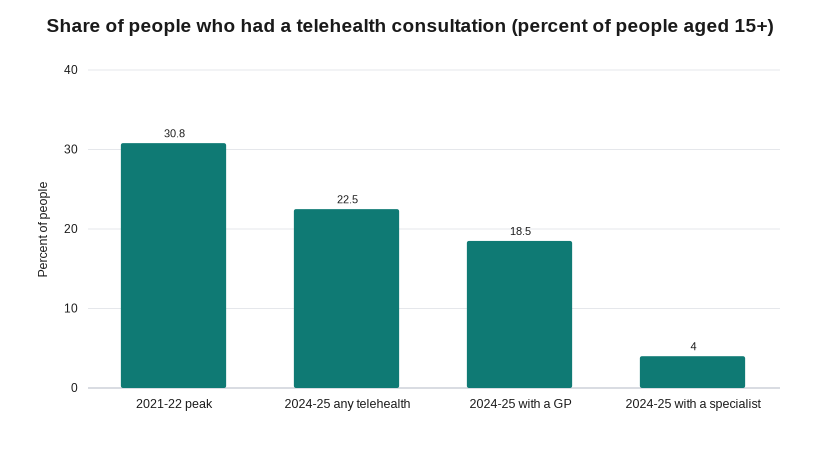
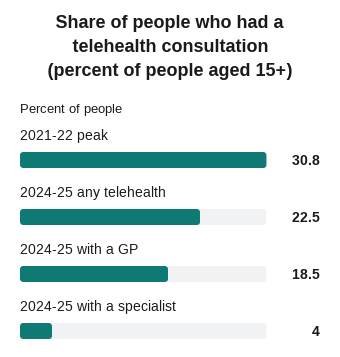
Source: ABS, Patient Experiences 2024-25, seen 24 November 2026. Figures are percent of people aged 15 and over who had at least one telehealth consultation for their own health in the last 12 months.
The Data at a Glance
| Metric | Figure | Source and period |
|---|---|---|
| Healthcare bookings facilitated per month | Around 1 million | Healthengine, 18 Nov 2025 |
| Total bookings since 2006 | More than 100 million | Healthengine, 18 Nov 2025 |
| Share of bookings made via the Healthengine app | More than half | Healthengine, 18 Nov 2025 |
| Practices and practitioners on the platform | Over 10,000 and nearly 30,000 | Healthengine, 18 Nov 2025 |
| Telehealth use, 2024-25 | 22.5% of people | ABS, released 18 Nov 2025 |
| Telehealth use, 2021-22 peak | 30.8% of people | ABS, released 18 Nov 2025 |
Source: Healthengine, 18 November 2025 and ABS, Patient Experiences 2024-25, seen 24 November 2026. Telehealth figures are percent of people aged 15 and over; the Healthengine figures are company-reported counts.
The General Practice Landscape Behind These Numbers
The RACGP’s Health of the Nation 2025 executive summary says: “Last year GPs provided 172 million health services to 22.6 million patients across Australia.” The page does not name the year it refers to, so treat it as the report’s own scale figure for Australian general practice.
Separately, Healthengine’s September 2025 media release on the Australian Healthcare Index reported that three in four Australians (76%) are changing their healthcare decisions due to financial pressures. The index is a national survey of 8,286 Australians. In our view, that makes clear pricing information and a working booking flow worth checking on a clinic site, though neither source tests that directly.
Takeaway: Patient volumes in general practice are large, and a survey of more than 8,000 Australians says cost is changing patient decisions. Both are reasons to review how clearly a clinic site presents fees and booking.
What the Booking Data Means for Your Clinic Website
Three things follow, in our view, from the numbers above.
First, test the booking flow on a phone. Healthengine says more than half of its bookings are made through its app. That does not prove that most bookings to a given clinic come from phones, so check your own analytics before deciding how much weight to give mobile.
Second, telehealth use differs between groups. The ABS figures by health status and by sex are a reasonable basis for deciding which service pages offer a telehealth booking option, rather than adding it everywhere or nowhere.
Third, build a dedicated landing page where the clinic can show real demand for a treatment, not for every procedure it offers. For a cosmetic clinic, what those pages can say is constrained by Ahpra’s advertising guidelines, separately from anything to do with booking technology. A page can have a flawless booking widget and still breach the rules on testimonials, before and after imagery, or outcome claims, so content and booking flow need checking separately. ClinicCode builds cosmetic clinic websites around this split. Get in touch to have your site reviewed.
Takeaway: Build and test for phones, be selective about which pages carry a telehealth option, and keep compliance checks separate from booking-flow decisions.
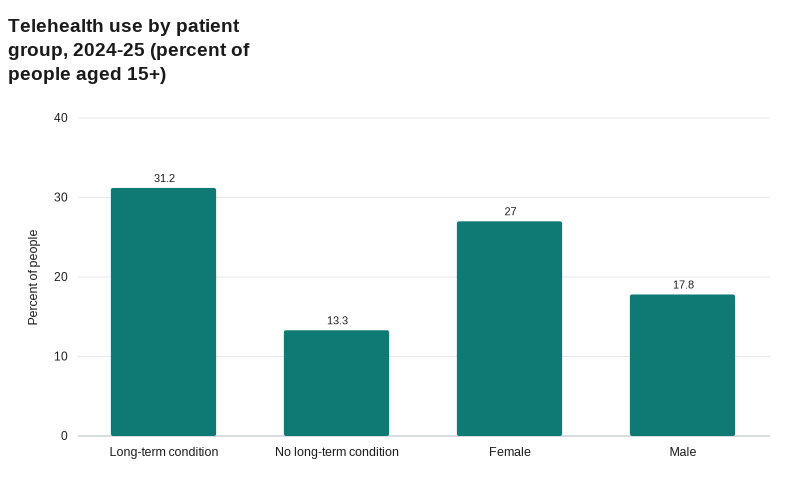
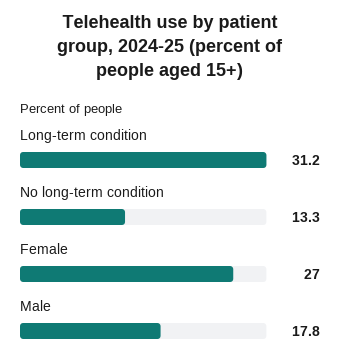
Source: ABS, Patient Experiences 2024-25, seen 24 November 2026. Figures are percent of people in each group aged 15 and over who had at least one telehealth consultation for their own health in the last 12 months.
The Source Pages
Screenshots of the pages cited in this post, taken on 24 November 2026 and framed on the passage each one supports.
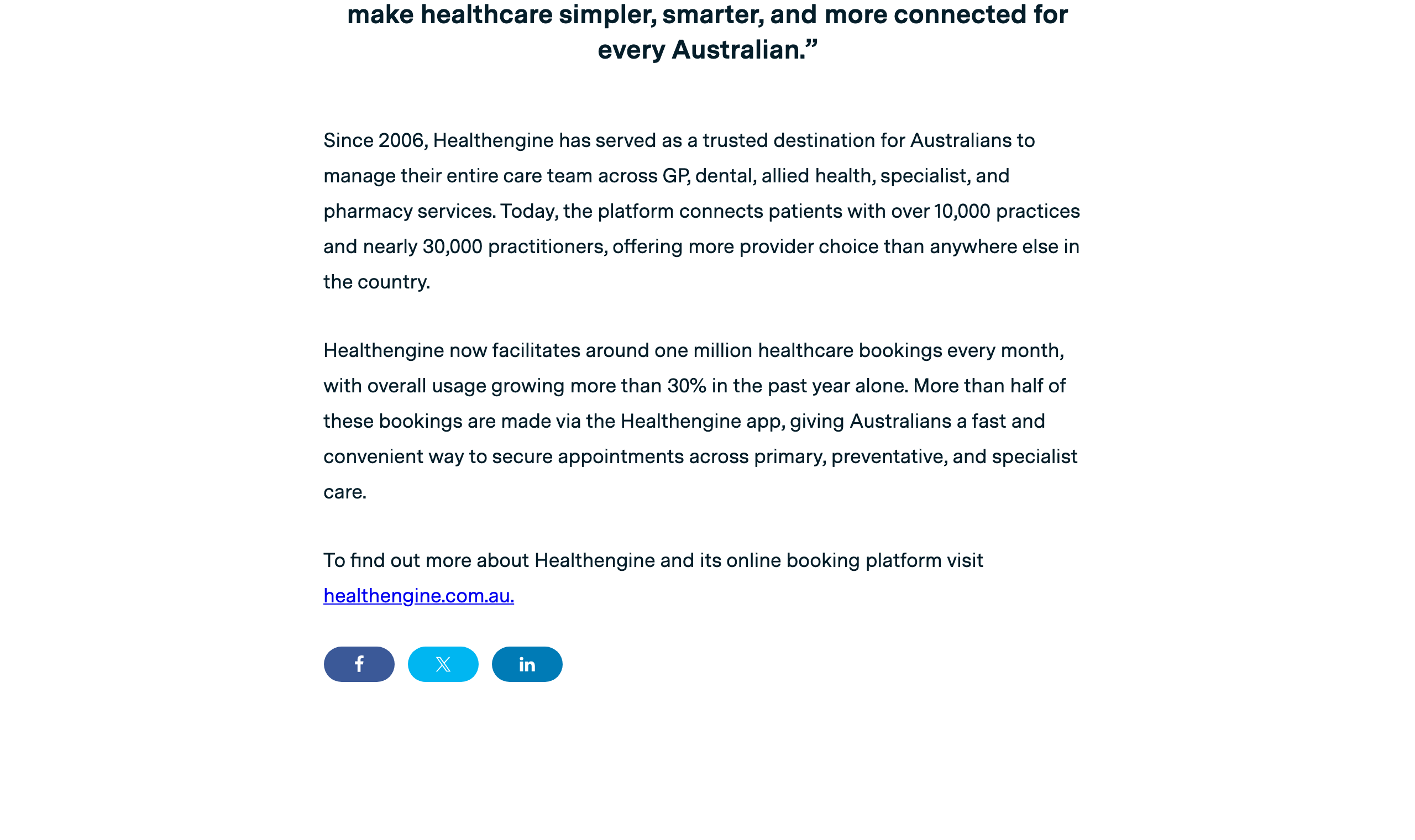
Source: Healthengine, 18 November 2025, screenshot taken 24 November 2026.
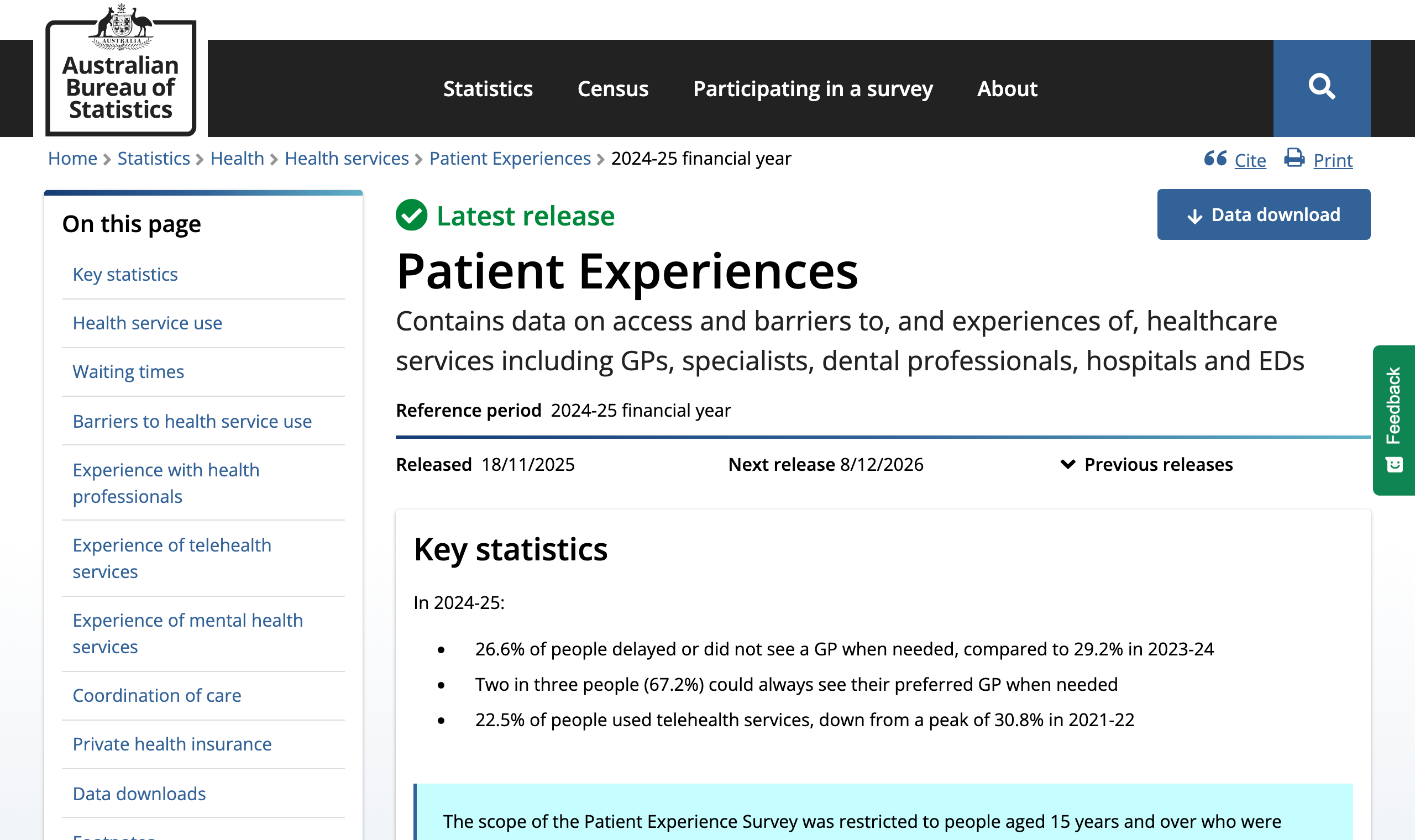
Source: ABS, Patient Experiences 2024-25, screenshot taken 24 November 2026.
FAQ
How many healthcare bookings does Healthengine handle each month?
Around one million, according to Healthengine’s 18 November 2025 announcement that it had passed 100 million bookings. It says more than half of these bookings are made through its app. This is one company’s own figure, not a national count of online bookings.
Has telehealth use in Australia gone up or down since the pandemic?
Down. The Australian Bureau of Statistics recorded a peak of 30.8% of people using telehealth in 2021-22, falling to 22.5% in 2024-25. Of the people who had a telehealth consultation, 90.3% said they would use telehealth again if it was offered.
Does an online booking widget make a clinic website AHPRA compliant?
No. Online booking and AHPRA compliance are separate things. Ahpra’s advertising guidelines are about what advertising of a regulated health service says, and they define advertising as “all forms of verbal, printed and electronic communication” that promotes a regulated health service. In our view that makes a booking form a separate question from the content around it, and a booking form placed next to non-compliant content does not fix the breach.
Which treatments are worth a dedicated landing page on a clinic website?
In our view, the ones where the clinic can show real demand, such as enquiries or search interest, rather than the ones that are easiest to write about. Any page still needs to stay inside AHPRA’s advertising rules for the content it carries.
Get Your Clinic Website Ready for the Booking Shift
ClinicCode builds and fixes websites for cosmetic clinics and medical practices. We can check your site’s content and booking flow separately, so you know which one needs the work.
Sources and References
Healthengine, 18 November 2025 - company source: 100 million total bookings, around one million bookings a month, over 10,000 practices, nearly 30,000 practitioners, more than half of bookings via the app, usage growth of more than 30% in the past year.
Healthengine, 23 September 2025 - company source: 76% changing healthcare decisions due to financial pressures, seventh Australian Healthcare Index, survey of 8,286 Australians.
Australian Bureau of Statistics, Patient Experiences 2024-25 - telehealth use rates, GP and specialist split, group differences, and would-use-again rate, released 18 November 2025.
RACGP, Health of the Nation 2025 executive summary - 172 million health services to 22.6 million patients (“last year”, year not named).
Related reading:
- AHPRA Advertising Guidelines for Cosmetic Clinics: the current rules on testimonials, before and after imagery, and outcome claims
- Cosmetic Clinic Website Design in Australia: what a compliant, mobile-first clinic website looks like
- Clinic Conversion Rate Benchmark: how booking and enquiry conversion is measured for cosmetic clinics
For a website built around how patients actually book, talk to us about your clinic’s website.
Vikas Thakur
Founder, Perth. 16 years of experience from working at TPG, iiNet and Monadelphous, now helping Australian clinics keep their websites, ads and online presence AHPRA compliant.