225 Health Breach Notifications in 2025: Where Websites Fit
Health service providers made 225 of the 1,205 data breach notifications the OAIC received in 2025, more than any other sector. Here is where, in our view, a clinic or dental practice website can create that kind of exposure and what to fix in the build.
 Vikas Thakur Founder, Perth 9 min read Fact checked
Health service providers made 225 of the 1,205 data breach notifications the OAIC received in 2025, more than any other sector. The OAIC says that is the highest number reported in a year since the mandatory scheme began in 2018, and 8% more than 2024. For a cosmetic clinic or cosmetic dental practice, the national total is only the backdrop. What matters is where exposure can sit on your own website and booking stack, and how far a fix goes toward closing it.
Key takeaways
- Health service providers accounted for 19% of the total, or 225 notifications, the most of any sector in 2025
- The OAIC received 1,205 data breach notifications in the 2025 calendar year, up 8% from 1,112 in 2024, the highest count since the scheme began in 2018
- The majority, 716 of the 1,205, were attributable to malicious or criminal activity
- Financial services (157), the Australian Government (118) and business and professional associations (103) followed health in the sector ranking
- The OAIC’s 2026 Australian Community Attitudes to Privacy Survey found 82% of Australians are concerned about data breaches, up from 74% in 2023
- The OAIC does not publish a website-specific breach figure, so the website causes below are our view, not OAIC data
What the OAIC’s 2025 Figures Actually Say
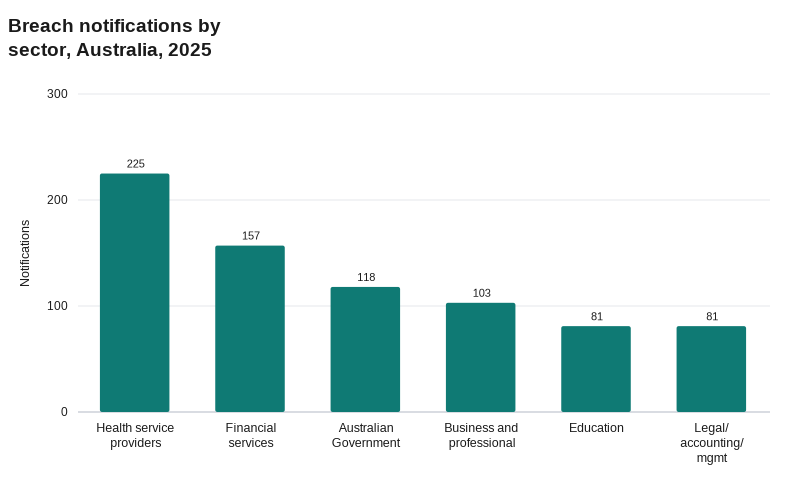
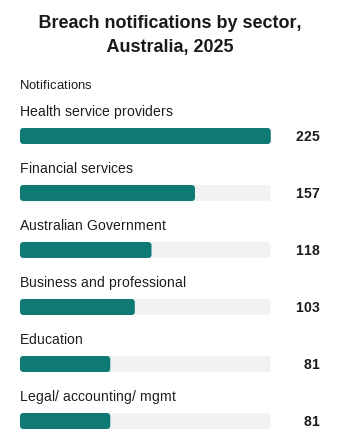
The OAIC’s 6 July 2026 statistics release reports 1,205 data breach notifications for the 2025 calendar year, an 8% increase over 2024 (1,112 notifications), and describes 2025 as the highest number reported since the mandatory scheme commenced in 2018. The release says health service providers were the most commonly affected sector, “accounting for 19% of the total or 225 notifications”. It lists the next sectors as financial services (157), the Australian Government (118), business and professional associations (103), education (81) and legal, accounting and management services (81). It also says “the majority were attributable to malicious or criminal activity (716 notifications)”.
| Sector | Notifications, Australia, 2025 |
|---|---|
| Health service providers | 225 |
| Financial services | 157 |
| Australian Government | 118 |
| Business and professional associations | 103 |
| Education | 81 |
| Legal, accounting and management services | 81 |
Source: OAIC, “Data breach notifications increase to all-time high in 2025, new NDB stats show”, published 6 July 2026, page seen 25 November 2026.
Source: OAIC release of 6 July 2026, page seen 25 November 2026.
The same release points to the OAIC’s 2026 Australian Community Attitudes to Privacy Survey, which “identified data breaches as the top perceived privacy risk for Australians, with 82% of Australians concerned about the issue, up from 74% in 2023”. Patients notice when a clinic loses control of their appointment history or before-and-after photos. That is our view, and it is the reason the build checks below matter.
Takeaway: Health providers made more breach notifications than any other sector in 2025, and the OAIC says most notifications overall were attributable to malicious or criminal activity.
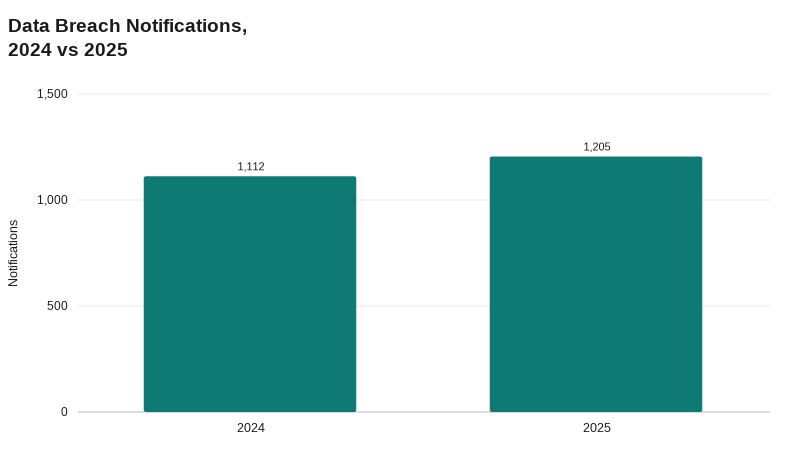
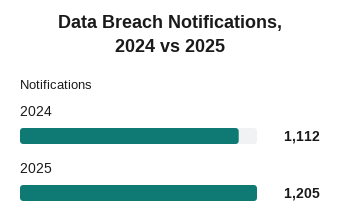
Source: OAIC release of 6 July 2026 (1,112 notifications in 2024 and 1,205 in 2025, all sectors, Australia), page seen 25 November 2026.
What “Malicious or Criminal Activity” Means for a Website
The OAIC release gives sector totals and the 716 malicious or criminal figure, and it says “cyber hacking remains the primary cause of data breaches reported to the OAIC”. It does not break the health-sector notifications down by attack type, and it does not give a website-specific figure. Nobody can cite an OAIC number for “breaches caused by clinic websites” from that release. What follows is our view of where a clinic website and booking stack can open a door, not a statistic.
Where Website-Side Exposure Can Start
In our view, these four mechanisms are the ones that can turn an ordinary clinic or dental website into the entry point for a data breach. None of them is an OAIC-published cause code, and each maps to a concrete fix.
| Mechanism | Where it lives | Build fix |
|---|---|---|
| Compromised admin credentials | CMS, booking platform, or hosting control panel login | Enforce MFA on every admin account, disable password-only login, rotate on staff exit |
| Booking form relayed via unvetted webhook | Zapier, Make, or similar automation forwarding form submissions | Confirm where the automation vendor stores data, restrict the webhook to fields actually needed, name the vendor in the privacy policy |
| Marketing pixels firing on confirmation pages | Meta Pixel, Google Ads tag on the post-booking thank-you page | Strip treatment type, appointment reason, and patient name from any event fired after a booking; fire generic conversion events only |
| Misconfigured cloud export or admin panel | Publicly reachable CSV export, open database admin tool, unauthenticated API endpoint | Put every admin path behind authentication, disable directory listing, audit exposed endpoints with a scanner before launch |
Source: our own build recommendations, not OAIC data.
The webhook and pixel rows connect to the OAIC’s APP Guidelines Chapter 8 on cross-border disclosure. That chapter says “an APP entity that discloses personal information to an overseas recipient is accountable for any acts or practices of the overseas recipient in relation to the information that would breach the APPs (s 16C)”. If your booking automation tool or an ad platform’s servers sit overseas, that accountability is why we ask where each tool stores data. Whether a particular tool amounts to an overseas disclosure for your practice is a question for your lawyer. Source: OAIC, APP Guidelines Chapter 8, updated 3 October 2025, page seen 25 November 2026.
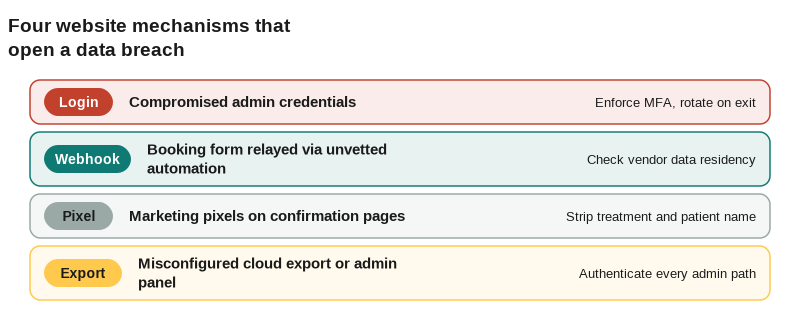
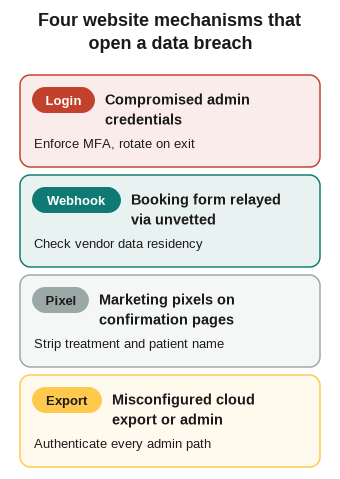
Source: our own build recommendations, not OAIC data.
Takeaway: In our view, the entry points that matter most are the ones a developer configures once and nobody checks again.
Two Illustrative Clinic Builds
These two examples are hypothetical. They are not real clinics and not OAIC cases.
A cosmetic injectables clinic
Picture a Perth cosmetic clinic whose booking form posts patient name, phone number, email, and requested treatment to a Zapier automation that files the submission into a shared spreadsheet and pings the clinic’s Slack. The exposure sits in three unchecked defaults: the automation account uses a single shared login with no MFA, the spreadsheet is set to “anyone with the link can view” rather than restricted to named staff, and nobody has confirmed which country the vendor stores the data in. Fixing it does not mean abandoning the automation. It means turning on MFA on the automation account, restricting the spreadsheet, and naming the vendor and its data location in the privacy policy.
A cosmetic dental practice
Picture a cosmetic dental practice that runs Meta Pixel and Google Ads conversion tracking on its site, including on the post-booking thank-you page. If that page’s address or content includes the treatment the patient just enquired about, for example “veneers consultation confirmed”, a tracking tag can send that detail to an advertising platform without anyone writing code that says “send treatment data”. The fix is to fire a generic conversion event with no treatment-specific details on that page, and to check every existing tag for what data it actually sends, not just what the developer intended.
Takeaway: In both examples, the practice did not choose to expose patient data. A default setting did it, and nobody had checked.
What to Check on Your Own Site
- Confirm MFA is enabled on every admin login: CMS, booking platform, hosting control panel, and any automation tool connected to your booking form
- List every third-party tool your booking or contact form data flows through, and confirm where each one stores and processes that data
- Check every tracking pixel and conversion tag on your confirmation and thank-you pages for what data it actually sends, not just what it was set up to send
- Search for publicly reachable admin panels, CSV exports, or API endpoints using a basic scanner before assuming none exist
- Confirm your privacy policy names the third-party vendors your patient data passes through
- Write down who decides, and how, whether a suspected breach must be notified, so nobody is looking that up for the first time during an incident. The OAIC’s page on the Notifiable Data Breaches scheme links to its guidance on when and how to report
Where This Gets Hard
The OAIC release does not break health-sector breaches down by cause, so nobody, including ClinicCode, can say how many of the 225 health-sector notifications in 2025 started on a website, as against a practice management system, a lost device, or an internal email error. The mechanisms in this post are our view of how a public health website can expose data, not an OAIC breakdown. A practice that fixes every item on the checklist above still has exposure through its practice management software, its reception desk, and its staff, none of which this post covers. Whether a specific incident on your site is notifiable is a question for your medical defence organisation or your lawyer.
What the OAIC Says a Breach Is
The OAIC’s page on the scheme says a data breach “occurs when personal information an organisation or agency holds is lost or subjected to unauthorised access or disclosure”. It says any organisation or agency the Privacy Act covers “must notify affected individuals and the OAIC when a data breach is likely to result in serious harm to an individual whose personal information is involved”. Source: OAIC, About the Notifiable Data Breaches scheme, page seen 25 November 2026.
Frequently Asked Questions
How many data breaches did Australian health providers report in 2025?
225, more than any other sector, out of 1,205 total notifications to the OAIC for the 2025 calendar year, according to the OAIC’s 6 July 2026 statistics release.
Does the OAIC say how many health breaches started on a website?
No. The 6 July 2026 release gives sector totals and says 716 of the 1,205 notifications were attributable to malicious or criminal activity. It does not give a website-specific figure.
What counts as a data breach under the Notifiable Data Breaches scheme?
The OAIC says a data breach occurs when personal information an organisation or agency holds is lost or subjected to unauthorised access or disclosure. An organisation the Privacy Act covers must notify affected individuals and the OAIC when a breach is likely to result in serious harm to an individual whose personal information is involved.
Get Your Booking Stack Checked
Get in touch with ClinicCode and we will trace every third-party tool your booking and contact forms connect to, check what your tracking pixels actually send, and return a written list of what to fix first. If you would rather start with the platform, create a ClinicCode account.
Sources
- OAIC - Data breach notifications increase to all-time high in 2025, new NDB stats show, 6 July 2026. Seen 25 November 2026.
- OAIC - About the Notifiable Data Breaches scheme. Seen 25 November 2026.
- OAIC - APP Guidelines Chapter 8, Cross-border disclosure of personal information, updated 3 October 2025. Seen 25 November 2026 (the earlier PDF version was not opened).
Last reviewed: 25 November 2026.
Vikas Thakur
Founder, Perth. 16 years of experience from working at TPG, iiNet and Monadelphous, now helping Australian clinics keep their websites, ads and online presence AHPRA compliant.