48 AHPRA Rules Apply to Every Cosmetic Clinic Facebook Ad in 2026
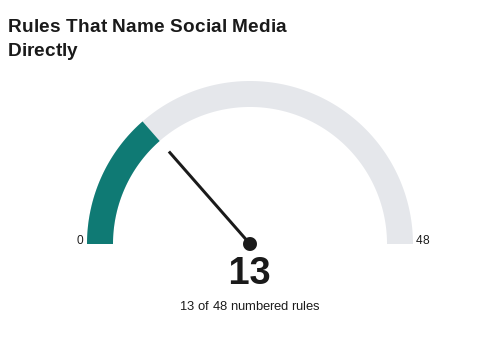
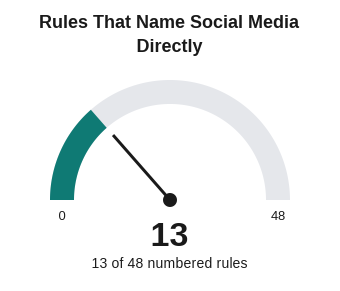
AHPRA’s Guidelines for advertising higher risk non-surgical cosmetic procedures set out 48 numbered rules across 9 categories, effective 2 September 2025, and every one applies to a Facebook or Instagram ad. Thirteen of those 48 rules name social media, hashtags, or algorithm boosting directly.
 Vikas Thakur Founder, Perth 10 min read Fact checked
Key takeaways
- AHPRA’s Guidelines for advertising higher risk non-surgical cosmetic procedures contain 48 numbered rules across 9 categories, in force since 2 September 2025
- 13 of those 48 rules name social media, hashtags, algorithm boosting, or influencer content by name
- Rule 9.2 requires social media advertising of these procedures to be tagged as adult content
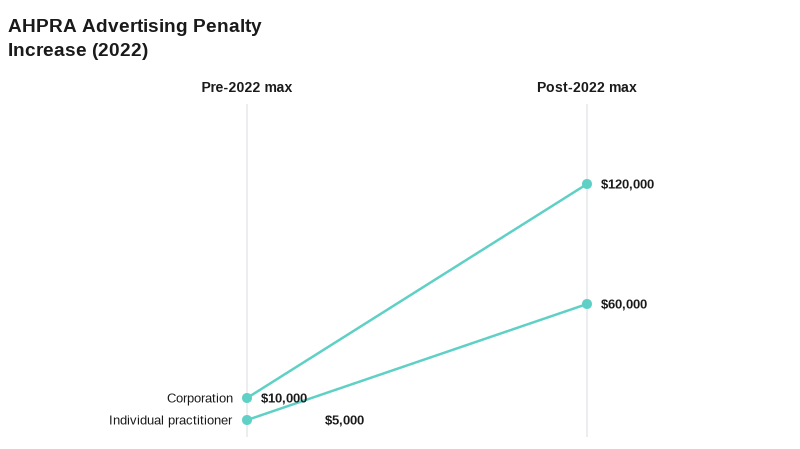
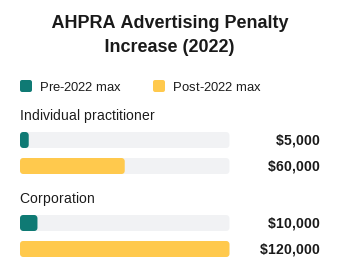
- Maximum penalty per breach: $120,000 for a body corporate, $60,000 for an individual practitioner, up from $10,000 and $5,000 before a 2022 amendment to the National Law
- Ahpra says the 2022 penalty increase applies in all jurisdictions, including Western Australia, as of July 2024
- Rule 5.7 bans 6 separate creative techniques, including emoji reactions on treatment images and lifestyle-style photo settings
- AHPRA states it cannot pre-approve or check an ad before it runs, so compliance is only ever tested after a complaint
Forty-eight. That is how many numbered rules sit inside AHPRA’s Guidelines for advertising higher risk non-surgical cosmetic procedures, in force in Australia since 2 September 2025. Thirteen of those 48 name social media directly: hashtags, algorithm boosting, Stories, influencer arrangements. A Facebook or Instagram ad for a cosmetic injectable, dermal filler, or thread lift has to clear every one of them, not just the two rules most clinics already know.
Most clinic marketing teams stop reading after “no testimonials” and “no before/after photos.” Rule 9.2 requires certain ads to be tagged as adult content. Rule 9.3 bans boosting a post toward a vulnerable audience through the platform’s own targeting tools. Rule 5.7 bans six specific things in your creative, including emoji reactions on treatment images.
This guide breaks down the digital-specific rules buried inside the 48, what a breach actually costs, and what it means for your ad account and landing pages.
What Changed on 2 September 2025
AHPRA and the National Boards issued the Guidelines for advertising higher risk non-surgical cosmetic procedures, effective 2 September 2025. They sit on top of the broader Guidelines for advertising a regulated health service and apply to procedures such as cosmetic injectables, dermal fillers, injection lipolysis, and thread lifts, where a registered health practitioner is required.
The document splits into 9 numbered categories, from practitioner responsibility through to targeting people at risk, holding 48 individually numbered rules between them.
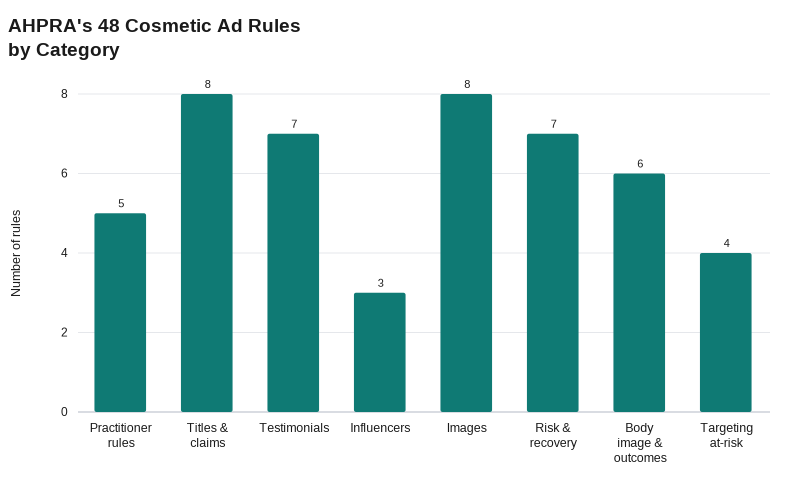
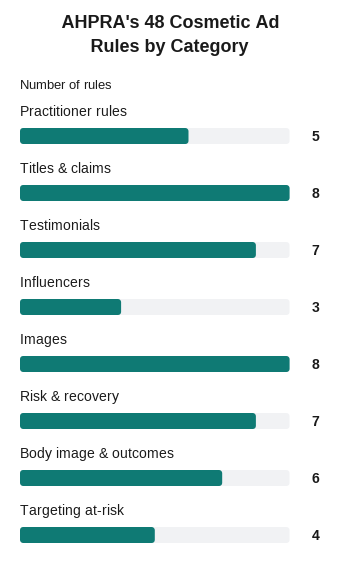
The table below carries the full breakdown.
| Category | Numbered rules | Covers |
|---|---|---|
| 1. Practitioner responsibility | 5 | Duty of care, cost disclosure |
| 2. Titles and claims | 8 | Registration numbers, specialist claims |
| 3. Testimonials | 7 | Patient stories, Stories function, liking a review |
| 4. Social media influencers | 3 | Paid partnerships, ambassador content |
| 5. Images, before/after | 8 | Editing, consent, emoji reactions |
| 6. Risk, recovery | 7 | Minimising language, competition prizes |
| 7. Body image | 3 | Prediction apps, “fix” language |
| 8. Realistic outcomes | 3 | Timeframes, benefit claims |
| 9. Targeting at-risk people | 4 | Under-18s, adult content tag, algorithm boosting |
| Total | 48 |
Takeaway: The 48 rules are not scattered guidance. They are a structured, numbered document, and a Facebook ad campaign is expected to comply with the entire set, not the two or three rules that get repeated in industry Facebook groups.
The Digital-Specific Rules Hiding Inside the 48
Most cosmetic clinic compliance conversations stop at testimonials and before/after photos. The guidelines go further, and several rules exist specifically because of how social media advertising works.
| Rule | What it requires | What it means for your Facebook ad |
|---|---|---|
| 9.2 | Ads for these procedures on social media must be tagged adult content | Age-restrict placements and disclose it in your ad settings |
| 9.3 | No algorithms, hashtags, or metadata used to reach vulnerable groups | Avoid outcome-optimised targeting and vulnerability-coded hashtags |
| 3.4 | A Story counts as advertising, even though it disappears | A 24-hour testimonial Story is still a breach |
| 4.2 | The clinic is responsible for an influencer’s content | Every paid partnership post must meet the same 48 rules |
| 5.7 | Bans 6 creative techniques, including emojis and lifestyle shots | Strip emoji reactions and pool, bedroom, or beach settings |
| 9.4 | Practitioners must consider posting frequency | An always-on, unlimited frequency cap is itself a risk |
Rule 9.3 is the one most ad managers have never seen. It bans leveraging a platform’s algorithm, or using hashtags and metadata in targeting fields, to reach people the guidelines consider vulnerable.
Takeaway: 13 of the 48 rules name social media, hashtags, or algorithms directly. They were written with a platform like Facebook in mind, not a print advert.
What a Breach Actually Costs
Advertising penalties under the National Law changed in 2022, before the cosmetic-specific guidelines arrived. AHPRA’s own advertising compliance and enforcement strategy page confirms the increase: the maximum penalty per offence for an individual rose from $5,000 to $60,000, and for a body corporate from $10,000 to $120,000.
| Advertiser type | Pre-2022 maximum | Current maximum (per breach) |
|---|---|---|
| Individual practitioner | $5,000 | $60,000 |
| Body corporate | $10,000 | $120,000 |
| Western Australia | Different structure | Not increased in the 2022 amendment |
If your clinic operates in Western Australia, the same maximums apply. Ahpra’s advertising guidelines page says that, as of July 2024, the increased penalties apply in all jurisdictions, including Western Australia. Footnote 3 on that page lists $30,000 for an individual and $60,000 for a body corporate for Western Australia, but it is attached to the protected-title offence, not to advertising offences.
Takeaway: A $120,000 exposure applies per breach, not per campaign. A Facebook ad set with three non-compliant elements is not one problem. It is three.
No Pre-Approval, No Safe Harbour
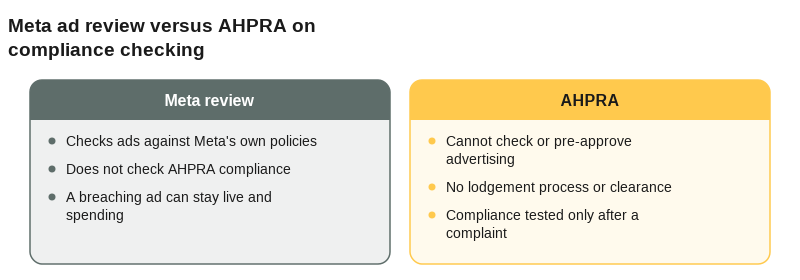
AHPRA answers this directly in its own FAQ: it “cannot give you advice or an opinion about advertising and cannot check or pre-approve your advertising.” There is no lodgement process and no clearance certificate.
Meta’s own review approves or rejects an ad against Meta’s policies, a separate system that does not check for AHPRA compliance at all. A Meta-approved ad that breaches rule 9.2 or rule 5.7 stays live, spending budget, until a patient, a competitor, or a member of the public complains. Our breakdown of the gap between Meta’s policy and AHPRA’s guidelines covers this in more depth.
Takeaway: A Facebook ad running for three months without a Meta rejection has not been assessed for AHPRA compliance in that time. Nobody at AHPRA has looked at it yet.
What This Means for Your Landing Pages
The 48 rules extend to wherever the click lands. A compliant ad sending traffic to a landing page with a testimonial slider or an unlabelled before/after gallery is still a breach, because the guidelines define advertising broadly enough to cover the whole journey from ad to booking form.
That affects which treatments justify their own dedicated landing page. A generic “cosmetic treatments” page mixing testimonial language with clinical claims carries more risk than individual, category-level pages that stick to what a treatment is and what a consultation covers. Category pages also tend to produce better enquiry quality, since the visitor has already read specific information before submitting a form.
What you can say is narrower than most existing clinic sites assume: practitioner qualifications and registration numbers, what a treatment category involves, and realistic risk and recovery information. What you cannot say is anything implying a specific outcome, or anything borrowing a testimonial’s language.
ClinicCode checks whether your landing pages match what your Facebook ads are now allowed to promise. For clinics rebuilding from scratch, AHPRA-compliant cosmetic clinic website builds bake the 48 rules into the template rather than retrofitting them after a complaint arrives.
Takeaway: The rules follow the click. A compliant ad pointed at a non-compliant landing page is still a breach, and the landing page is usually what gets missed in a self-audit.
A Pre-Flight Checklist Before You Boost Anything
Run through this before a campaign for a higher risk cosmetic procedure goes live:
- Age settings: is the ad age-restricted and tagged as adult content, per rule 9.2?
- Targeting: does it avoid algorithm-driven or hashtag targeting toward vulnerable groups, per rule 9.3?
- Creative: no emoji reactions, lifestyle settings, or sexualised imagery, per rule 5.7?
- Testimonials: no patient testimonial, linked Story, or liked review, per rules 3.4 to 3.6?
- Landing page: does it avoid testimonials and unlabelled before/after imagery?
Takeaway: Five checks cover most of the 48 rules that apply to a live Facebook campaign specifically. The rest govern language and claims across the whole guideline.
FAQ
How many advertising rules apply to a cosmetic clinic’s Facebook ad in Australia?
AHPRA’s Guidelines for advertising higher risk non-surgical cosmetic procedures set out 48 numbered rules across 9 categories, in force since 2 September 2025. They apply to any advertising of a higher risk cosmetic procedure, including a paid Facebook or Instagram ad, on top of the broader Guidelines for advertising a regulated health service.
Does a Facebook ad for a cosmetic injectable need to be tagged as adult content?
Yes, for higher risk non-surgical cosmetic procedures. Rule 9.2 of the guidelines states that advertising of these procedures on social media must be identified as adult content, specifically to prevent young people from accessing it on the platform.
What is the maximum penalty for a non-compliant cosmetic clinic Facebook ad in Australia?
Up to $120,000 per breach for a body corporate and $60,000 per breach for an individual, following a 2022 amendment to the National Law. Ahpra says the higher penalties apply in all jurisdictions, including Western Australia, as of July 2024.
Will AHPRA review or pre-approve my Facebook ad before I run it?
No. AHPRA states directly that it cannot give advice or an opinion about advertising and cannot check or pre-approve it before it runs. Compliance is assessed only after a complaint is made, which means a live, spending ad campaign carries the risk until someone reports it.
Get Your Facebook Ads Checked Against All 48 Rules
ClinicCode runs AHPRA-compliant Facebook and Instagram campaigns for Australian cosmetic clinics as part of our compliance fix and build service. We rewrite existing ads and landing pages against the current 48-rule guideline and rebuild campaigns to stay inside them from the first impression.
Book a callSources and References
AHPRA - Guidelines for advertising higher risk non-surgical cosmetic procedures, dated 2 September 2025: the 48 numbered rules and 9 categories cited above
AHPRA - FAQ confirming AHPRA cannot pre-approve advertising
AHPRA - Guidelines for advertising a regulated health service: the 2022 penalty increase and the July 2024 statement that it applies in all jurisdictions, including Western Australia
Related reading:
- AHPRA-Compliant Meta Ads for Cosmetic Clinics: compliant ad copy templates and what still works
- Meta’s New Ad Rules Won’t Save You From a $120K AHPRA Fine: why Meta’s own approval is not an AHPRA compliance signal
- AHPRA Social Media Rules for Cosmetic Clinics: platform-by-platform organic content rules
- AHPRA Advertising Fines for Cosmetic Clinics: the full penalty structure
For Facebook and Instagram campaigns built around the current rules, talk to us about your clinic’s marketing.
Vikas Thakur
Founder, Perth. 16 years of experience from working at TPG, iiNet and Monadelphous, now helping Australian clinics keep their websites, ads and online presence AHPRA compliant.