Dental Website Cost in Australia: What Sets the Price (2026)
No public rate card exists for dental practice websites in Australia, so quotes depend on the vendor and the scope of the build.
 Vikas Thakur Founder, Perth 11 min read Fact checked
Key takeaways
- We found no independent, published survey of dental website pricing in Australia, so a quote has to be judged on scope, not against a rate card
- A custom agency build is a one-off cost, with hosting, domain and maintenance charged on top, so ask for all of them in writing
- With ClinicCode you get a fixed-price quote after the 10 to 20 minute call, itemised against the compliance build items below
- Since 2 September 2025, Ahpra’s guidelines for advertising higher risk non-surgical cosmetic procedures have been in effect, and Ahpra says the guidelines now apply to all regulated professions, which includes dentists
- Ahpra’s own page on those guidelines names dental veneers first among its examples of higher risk cosmetic procedures
- A 2023 peer-reviewed audit in the Australian Dental Journal found that 85% of 192 general dental practice websites breached at least one of the legal advertising requirements it tested
A custom dental practice website in Australia is a one-off agency build, and we found no independent rate card to check a quote against. So instead of guessing at a market average, this guide breaks down what actually drives the number: the Ahpra rule that applies to dental veneers, the build items a compliant site has to include, and the questions that let you hold any quote up against its scope.
If you run a general or cosmetic dentistry practice and you are trying to work out why one quote is so different from another, this is the framework for closing that gap yourself.
What the Rules Say About a Dental Website
Dentists are registered health practitioners. On 2 September 2025, Ahpra announced that its new guidelines for non-surgical cosmetic procedures were in effect, and said “the guidelines will now apply to all regulated professions”. The guideline a cosmetic dentistry website has to be built against is that one. The Medical Board of Australia has its own, separate guidelines for registered medical practitioners who perform cosmetic surgery and procedures, with a date of issue of 1 July 2023.
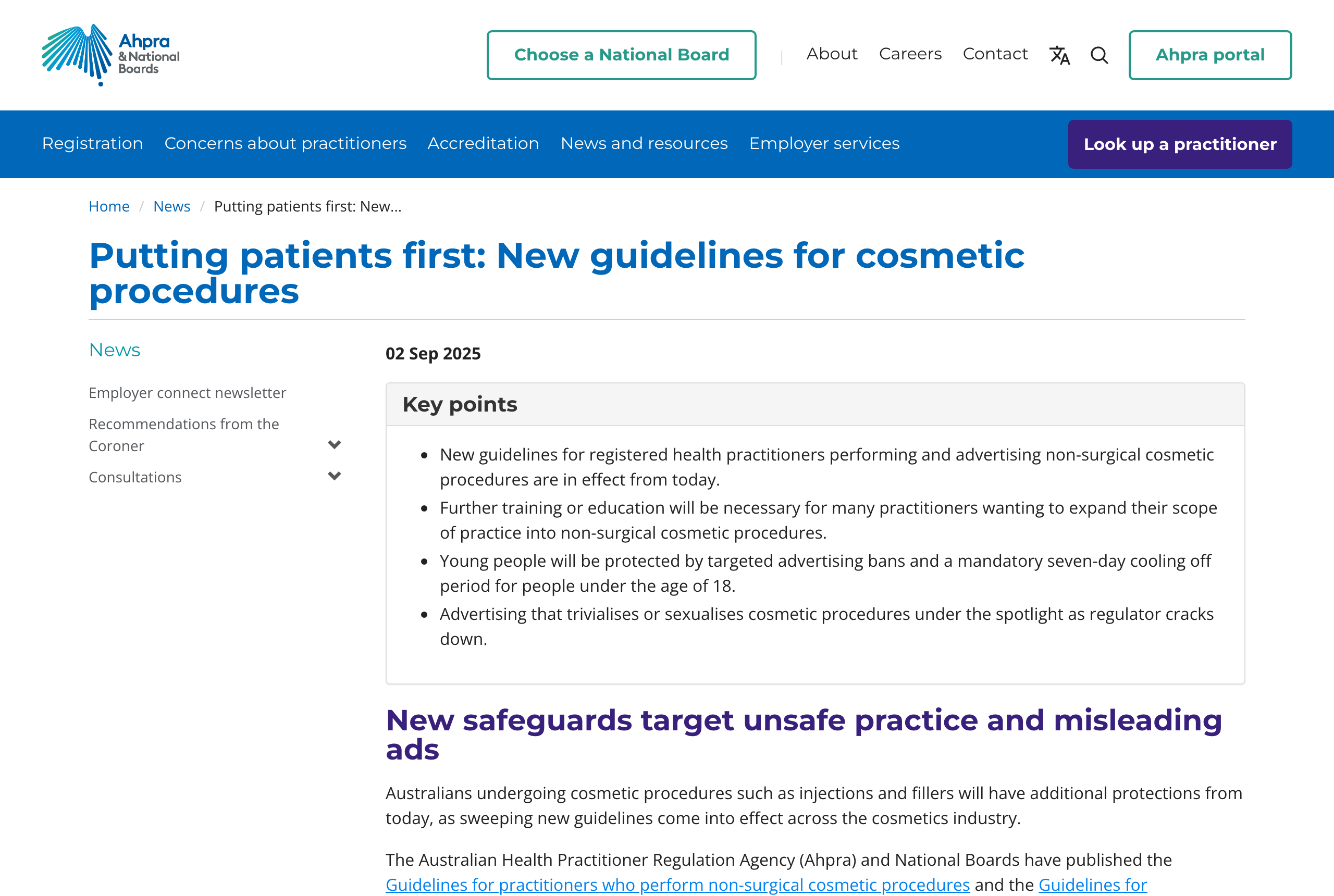
That matters because Ahpra’s own resources page for advertising higher risk non-surgical cosmetic procedures says the guidelines apply to higher risk procedures and lists “dental veneers” first among its examples, ahead of cosmetic injectables, thread lifts and hair transplants. The page also says the list is not exhaustive. A veneers page built before September 2025, or built off a generic small-business template, was written before this rule existed and may not have been checked against it since.
The same National Law also carries the advertising provision that bans false, misleading or deceptive advertising and testimonials for regulated health services. Ahpra’s Advertising and the law page says section 133 states that a person must not advertise a regulated health service in a way that is false, misleading or deceptive, or that “uses testimonials or purported testimonials about the service or business”.
Takeaway: the rule that sets your dental website’s compliance requirements is Ahpra’s September 2025 advertising guideline, and Ahpra’s own page names dental veneers.
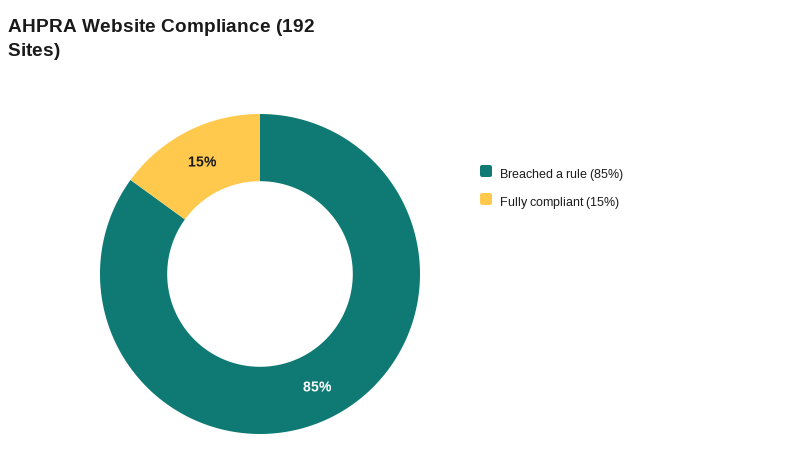
Source: Jensen et al., Advertising and general dental practice: how compliant are practice websites in Australia with legal requirements?, Australian Dental Journal, 2023. 192 general dental practitioner websites reviewed, 85% non-compliant with at least one requirement.
What That Means for the Build
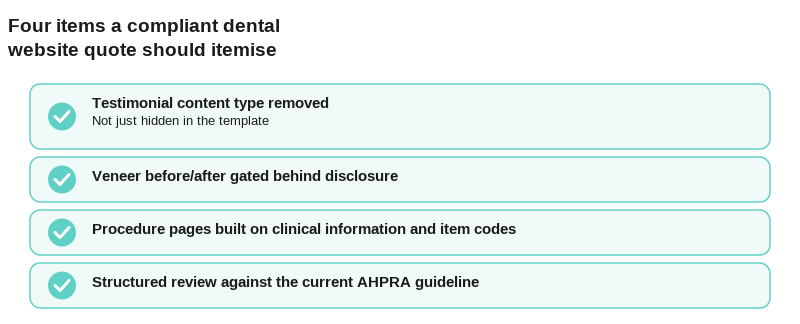
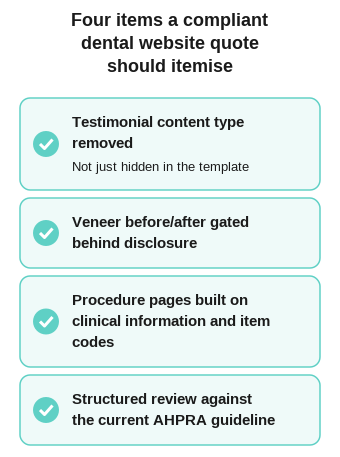
Here are four items a compliant dental website quote should itemise (our list, not an Ahpra requirement). Each one is something you can ask a vendor to point to directly.
Testimonial content type removed, not hidden. A patient review carousel commented out in the template still exists in the CMS and gets switched back on the next time someone edits the homepage. The compliant version removes the content type entirely, so there is nothing left to accidentally re-enable.
Veneers and other higher-risk before/after pairs gated behind a disclosure block. Since Ahpra’s resources page names veneers specifically, a before/after gallery for veneer cases needs the same disclosure treatment as an injectables gallery. Ahpra’s announcement says the advertising changes “require a warning that results may vary for other patients in advertisements using images”. The build fix is a component that will not render an image pair without the disclosure text populated, not a photo gallery with a disclaimer buried somewhere else on the page.
Procedure pages built around clinical information and item codes, not outcome claims. In the Australian Dental Journal audit, 52% of the 192 websites displayed false and misleading information, the highest share of any breach the abstract lists. A page written around what a treatment involves and its item number carries less of that risk than a page written around “the smile you deserve”.
A structured content review against the current Ahpra guideline before launch. Not a general proofread. A page-by-page check against the specific rules (the testimonial ban, offers that do not state their terms or use urgency wording tied to unsubstantiated claims, and language that trivialises risk) with each finding mapped to the rule it breaches.
Skip any of these and the “finished” site is not a finished compliant product. In our view it is a site that may need the same work done again later, on top of whatever the first build already cost.
Cost by Build Type
The table below separates the kinds of work by scope, so you can match your situation to a row and ask any vendor you are comparing whether their quote covers the same scope. We found no independent source for typical prices in each row, so the table states none. ClinicCode gives a fixed-price quote after the 10 to 20 minute call.
| Build type | What it covers | Cost |
|---|---|---|
| Template or DIY build | Generic small-business template, no dental-specific or Ahpra-specific structure | Lowest upfront, scope is whatever the template offers |
| Custom agency build | One-off site with online booking, patient forms, procedure and item-code page architecture | Quote varies by vendor and scope |
| Remediation of an existing site | Remove non-compliant content, gate veneer/before-after imagery, restructure affected pages | Fixed-price scoped quote |
| New compliant build | Full site built from a clean structure, compliant copy, gated imagery, correct registration details | Fixed-price scoped quote |
Once a site is live, the spend does not stop. Hosting, domain renewals and ongoing maintenance are charged on top of the build cost. A quote that only states the build number and says nothing about any of those is an incomplete quote.
Takeaway: a build cost with no stated maintenance line is not the whole price. Ask what happens after launch before you sign.
A Worked Example: A Cosmetic Dentistry Practice Rebuilding Its Veneers Page
Here is an illustrative scenario built from the build items above, not a real client’s figures. A general dental practice offering veneers, teeth whitening and Invisalign had a site built in 2022, before the September 2025 guideline existed. The veneers page carried a before/after gallery with no disclosure text, a homepage testimonial slider quoting patients by first name, and generic copy promising “a smile you’ll love” with no procedure detail underneath it.
Two quotes came back for the fix. One was a template refresh: new photography and copy, no mention of Ahpra anywhere in the scope. The other itemised the same four build items covered above: the testimonial slider removed as a content type, the veneers gallery rebuilt behind a mandatory disclosure block, the copy rewritten around procedure and item-code detail, and a page-by-page compliance review before launch mapped to specific rules.
The template refresh looked cheaper on the invoice. It fixed the photography and the words, but it did not touch the testimonial content type, the gallery component, or the compliance review, which meant the practice would be paying for the same fix twice once a complaint or an internal review caught what the first quote missed. The itemised remediation matched the remediation row in the table above: fixed-price, because the site’s structure and voice did not need rebuilding, only the compliance-relevant components did.
If your current veneers page and testimonial slider only need their wording fixed, that is a smaller piece of work than a full remediation quote.
What to Check on Your Own Quote
- Does the quote name Ahpra’s September 2025 guideline as the compliance basis, and does it treat dental veneers as a higher risk procedure?
- Is the testimonial content type removed from the CMS, or just hidden from the template?
- Does the veneers (or other higher-risk procedure) before/after component require a disclosure block to render, or is disclosure left to a separate page?
- Is procedure page copy built around clinical information and item codes, or around outcome and lifestyle claims?
- Is there a stated compliance review step before launch, with findings mapped to specific rules, not a general proofread?
- Does the quote separate the one-off build cost from ongoing hosting, maintenance and monitoring, so nothing is a surprise after launch?
- If the quote includes ongoing work, does it state what is covered each month and what is charged separately when the scope grows?
The Enforcement Anchor
Ahpra’s 2 September 2025 announcement said practitioners “have had since May to get their houses in order”, and quoted its CEO, Justin Untersteiner: “If we find practitioners prioritising profits over patient care, we will not hesitate to act.” That is the regulator’s stated posture, published in the same announcement that introduced the guideline this post is built around.
We could not locate a published Ahpra infringement notice, determination or complaint outcome tied specifically to a dental practice’s choice of website vendor or build cost. The compliance risk itself is documented, not speculative: the Australian Dental Journal’s 2023 audit found 85% of 192 practice websites breached at least one of the legal advertising requirements it tested. But that is an academic audit, not a regulatory enforcement action, and we are not going to present it as one.
Where This Gets Hard
Two honest limits. First, we found no independent, publicly verified market survey of dental website pricing across Australia, so a quote that looks high or low has to be judged on scope against the table above, not against a published rate card.
Second, “compliant” is not a fixed target. Guidelines can be revised again, and adjacent rules can change, so a build that is compliant today needs a maintenance plan, not just a launch date.
The regulator says testimonials, before/after imagery and false or misleading content are governed by specific, named rules; the build consequence is a defined set of removed fields, gated components and a documented review pass your developer can quote against directly; whether your particular site’s current state discharges those obligations is a question for your medical defence organisation or your lawyer, not a website audit.
Status
In force. Ahpra’s guidelines for advertising higher risk non-surgical cosmetic procedures have been in effect since 2 September 2025, and Ahpra says they apply to all regulated professions. Commercial pricing is subject to change, so confirm any quote’s validity period in writing.
Frequently Asked Questions
How much does a dental practice website cost in Australia?
We found no independent, published survey of dental website pricing in Australia, so there is no rate card to quote. A custom agency build is a one-off project, with hosting, domain and maintenance charged on top. With ClinicCode, you get a fixed-price quote after the 10 to 20 minute call, itemised against the same compliance build items.
Is a cheap DIY dental website cheaper in the end?
The upfront number is lower, but a template site missing AHPRA-compliant fields, such as a removable testimonial type or a gated before/after component for veneers, is not a finished compliant product. In our view it may need the same compliance work done later, on top of what the template already cost.
How long does a new compliant dental website take to build?
It depends on scope. Remediating an existing site that already has content and structure in place is a smaller job than a new build from a clean structure. Ask any vendor for a dated schedule in writing before you sign.
Get a Scoped Quote, Not a Guess
Call me back with your current site’s URL and ClinicCode will map what a compliant build or remediation needs, item by item, before you sign anything. You get a fixed-price quote after the 10 to 20 minute call. For the build detail, see clinic website design.
Sources and References
- Ahpra - Putting patients first: New guidelines for cosmetic procedures, 2 September 2025.
- Ahpra - Resources for advertising higher risk non-surgical cosmetic procedures, naming dental veneers among the examples.
- Ahpra - Advertising and the law, section 133 of the National Law.
- Medical Board of Australia - Guidelines for registered medical practitioners who perform cosmetic surgery and procedures, date of issue 1 July 2023.
- Jensen, E. D. et al., “Advertising and general dental practice: how compliant are practice websites in Australia with legal requirements?”, Australian Dental Journal, 2023, DOI 10.1111/adj.12953.
- Ahpra - Guidelines for advertising a regulated health service, on urgency wording such as “for a limited time only” being unlawful where linked to unsubstantiated claims.
- Ahpra - Cosmetic procedure advertising guidelines, on terms that trivialise higher risk cosmetic procedures.
Last reviewed: 24 November 2026.
Vikas Thakur
Founder, Perth. 16 years of experience from working at TPG, iiNet and Monadelphous, now helping Australian clinics keep their websites, ads and online presence AHPRA compliant.