14.4% Hospital No-Show Rate: Closest Australian Data (2015)
We found no published Australian dataset on cosmetic clinic no-show rates. The closest figure is 14.4%, the control rate in a 2015 NSW hospital trial. A newsGP poll adds how widely GP no-show rates vary.
 Vikas Thakur Founder, Perth 10 min read Fact checked
Key takeaways
- We found no Australian dataset that publishes a no-show rate specifically for cosmetic clinics. The closest figure is 14.4%, the control-group rate in a December 2015 NSW Government hospital outpatient trial
- The report puts the cost of each missed appointment at St Vincent’s Hospital Sydney at around $125, a total of around $500,000 a year (NSW Government)
- A randomised controlled trial tested 8,143 reminder text messages over a 5-month period
- The best-performing reminder message recorded a no-show rate of 11.6%, and the report estimated it would save $67,000 a year if rolled out
- With full patient phone number coverage, the projected saving rose to $97,000 a year
- Separately, a newsGP poll of 1,122 respondents (published 28 November 2024) found about 21% report no-shows on one in 20 to one in 10 appointments, and about 9% report up to one in five or higher
- Around two-thirds of the same respondents said no-shows happen on fewer than 5% of appointments, showing how much the rate varies practice to practice
- In 2024-25, 26.4% of people aged 15 and over reported waiting longer than they felt acceptable for a medical specialist appointment, per the ABS, a separate but related booking-friction figure
We found no study that has measured the cosmetic clinic no-show rate in Australia. The closest figure comes from a December 2015 NSW Government trial at a public hospital outpatient service, where 14.4% of booked appointments in the control group ended in a no-show. It is a hospital number, not a cosmetic clinic number, so treat it as a reference point only.
Here’s what the same trial found: the best of its seven reminder text messages brought that 14.4% down to 11.6%, an estimated $67,000 a year at one hospital. That is one arm out of seven in a single 2015 trial, so read it as a result from one hospital, not a rule. A separate newsGP poll of 1,122 respondents shows no-show rates ranging from fewer than 5% of appointments at most practices to one in five or higher at a few. Neither dataset was built for cosmetic clinics. Both are the best public evidence we found, and both point at the same lever: what a clinic’s booking system actually does after someone clicks “book”.
Why No Cosmetic Clinic No-Show Dataset Exists
We searched for a cosmetic clinic no-show series from the regulators and statistics bodies and found none: the ABS publishes patient wait-time experience data, but we found no measure of how many booked cosmetic appointments end in a no-show. Booking software vendors publish no-show “benchmarks” on their marketing pages, but the ones we found cited no study, sample size or year, so they don’t meet the bar for a factual claim here.
The nearest sourced Australian figures we found sit in two places: a NSW Government Behavioural Insights Unit trial of public hospital outpatient clinics, and a newsGP poll of general practice. Neither is a cosmetic clinic. Both are still a defensible starting point, and worth understanding in detail before assuming a number for your own practice.
Takeaway: Treat any cosmetic-clinic-specific no-show percentage you see quoted elsewhere as unverified unless it names a study, a sample size and a year.
The NSW Hospital Trial: 14.4% Down to 11.6%
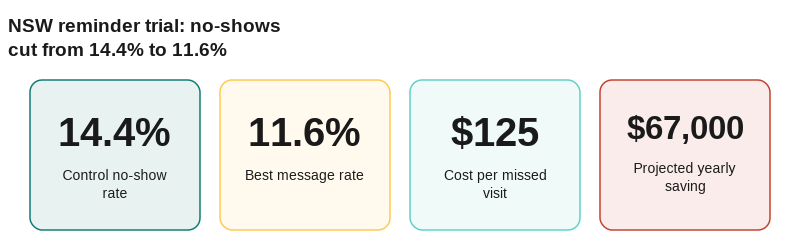
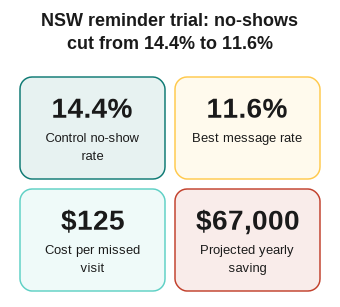
The NSW Government’s Behavioural Insights Unit, working with St Vincent’s Hospital Sydney, ran a randomised controlled trial testing seven new reminder text message formats against the original message, which acted as the control. The trial sent 8,143 text messages over a five-month period. The control group, which received the plain appointment reminder, had a no-show rate of 14.4%.
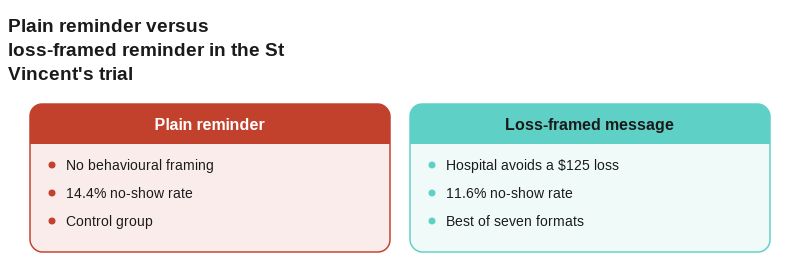
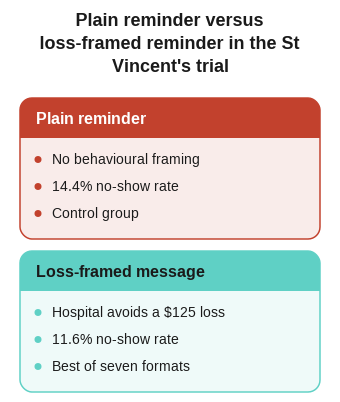
The report puts the cost of each missed appointment at around $125, a total of around $500,000 a year for the hospital. The trial’s best-performing message (“avoided loss to hospital”) told patients the hospital would not lose the $125 it loses when a patient does not turn up if they attended. Patients who got that message had a no-show rate of 11.6%, against 14.4% for the control. The report states that rolling the message out would save the hospital $67,000 a year, and an estimated $97,000 a year if the hospital had every patient’s phone number.
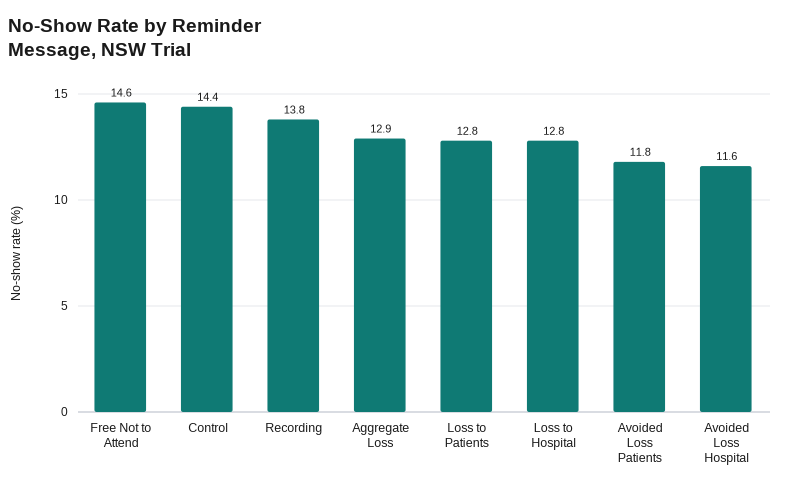
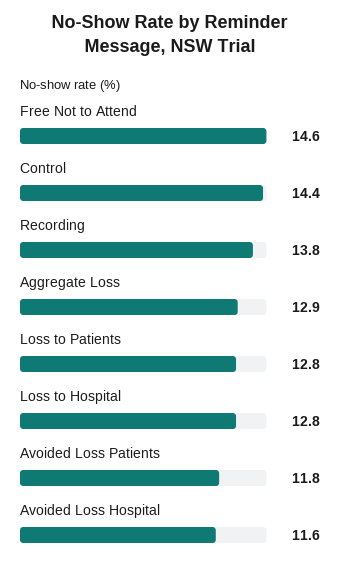
Source: NSW Government Behavioural Insights Unit, Reducing missed outpatient appointments at St Vincent’s Hospital Sydney. Seven new messages plus the control; figures are the proportion of outpatient appointments with a no-show.
Takeaway: In this trial, the wording of the reminder message moved the no-show rate, which makes the message a booking system sends worth testing. It is one hospital trial, so results for a cosmetic clinic may differ.
What RACGP’s GP Poll Adds
The newsGP poll of 1,122 respondents, published 28 November 2024, gives a second angle: how much no-show rates vary, outside a hospital setting. Around two-thirds of respondents said no-shows happen for fewer than 5% of appointments. Another 21% said no-shows ranged between one in 20 and one in 10 appointments. At the other end, around 9% said they experienced up to one in five missed appointments or even higher, a meaningfully different business problem than the practices sitting under 5%. This is an opt-in poll, so it shows spread rather than a national average.
That spread matters for a cosmetic clinic more than a single average would. It is consistent with the rate depending on practice-level factors such as booking friction, reminder systems and deposit policy, though the poll did not test those causes.
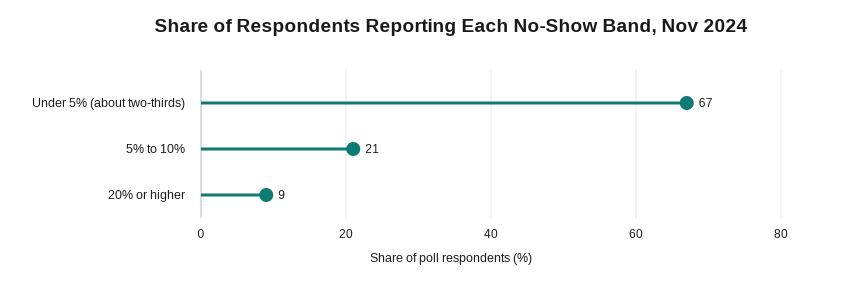
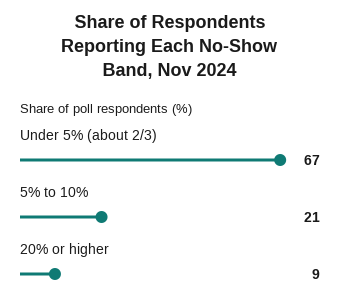
Source: RACGP newsGP poll, 28 November 2024. Respondents, not a random sample; the first bar’s 67 is our rounding of “around two-thirds”, and the 20% or higher band is described as up to one in five or higher.
Takeaway: A clinic’s own no-show rate could sit anywhere on this spread, which is why a clinic should track its own figure rather than importing someone else’s.
Booking Friction Is a Related, Separate Problem
The ABS Patient Experiences survey for 2024-25 found 26.4% of people aged 15 and over reported waiting longer than they felt acceptable for a medical specialist appointment, down from 28.6% in 2023-24. GP wait times told a similar story: 26.0% reported waiting longer than they felt acceptable, down from 28.0%. This isn’t a no-show statistic. It measures the reverse problem, patients who wanted an appointment and had to wait for one, and it’s a reminder that waiting for an appointment is a wider issue than missed appointments alone.
Takeaway: A clinic improving its booking system is working on two adjacent problems, no-shows on one end and wait friction on the other, and the same online booking flow touches both.
What This Means for a Clinic Website and Booking System
The trial evidence points at one specific place to act: the confirmation and reminder sequence triggered when someone books online. That sequence is communication about appointment logistics rather than marketing copy. Keep it to logistics: date, time, how to cancel or rearrange, and any deposit or cancellation terms. Leave out outcome claims and treatment promotion, so the message does not drift into advertising.
That distinction matters because it’s tempting to solve a no-show problem with a landing page, adding urgency copy, a deposit callout, or a cancellation policy banner to the page a patient books from. Any such page still needs to follow the same rules as the rest of a cosmetic clinic’s website, no outcome claims and no unreasonable-expectation language, regardless of what it’s trying to reduce. Getting the booking flow reviewed as part of a wider compliance check catches both problems in one pass, rather than treating no-shows as purely a scheduling fix.
A booking system built for a cosmetic clinic, not adapted from generic salon software, is where that reminder sequence, deposit logic and confirmation copy actually live. See how a compliant cosmetic clinic website is built around exactly this kind of booking flow.
Takeaway: The change the NSW trial tested lives in the booking confirmation and reminder sequence, not in a new banner on the homepage.
FAQ
What percentage of cosmetic clinic appointments in Australia end in a no-show?
We found no published Australian dataset that isolates a no-show rate for cosmetic clinics. The closest figure is 14.4%, the control-group no-show rate from a NSW Government Behavioural Insights Unit trial of hospital outpatient appointments at St Vincent’s Hospital Sydney. A separate newsGP poll of 1,122 respondents found about two-thirds reported no-shows on fewer than 5% of appointments, while about 9% reported up to one in five missed appointments or higher.
How much does a missed appointment cost a clinic?
The one figure we found comes from the same NSW hospital trial, which put the cost of each missed outpatient appointment at St Vincent’s Hospital Sydney at around $125, a total of around $500,000 a year. We found no equivalent published figure for cosmetic or aesthetic clinics, where per-appointment revenue and fixed costs differ from a public hospital outpatient clinic.
Do reminder text messages actually reduce no-shows?
In that one NSW Government randomised controlled trial, the best-performing message version recorded an 11.6% no-show rate against 14.4% for the control message. The trial sent 8,143 messages over five months, and the report estimated the best message would save the hospital $67,000 a year if rolled out, or $97,000 a year with every patient’s phone number on file. It is one hospital trial, not a cosmetic clinic result.
What does this mean for a cosmetic clinic’s website and booking system?
The evidence points at the booking flow, not the marketing copy. A confirmation and reminder sequence triggered by an online booking form is mainly appointment logistics, so keep it to logistics and leave out outcome claims or treatment promotion. Building that sequence into the booking system is the change the NSW trial tested.
Get Your Booking Flow and Website Reviewed Together
ClinicCode builds cosmetic clinic websites with the booking, reminder and compliance layers reviewed as one system, not three separate problems. A compliance review covers the public-facing pages; the booking flow review covers what happens after someone clicks “book”.
Talk to us about your clinic’s booking system
Sources and References
NSW Government, Behavioural Insights Unit - the 14.4% control-group no-show rate, around $125 per missed appointment and around $500,000 a year cost, 8,143-message trial, the 11.6% result and the $67,000 and $97,000 annual savings estimates
RACGP newsGP - the 1,122-respondent poll on no-show rates, published 28 November 2024
Australian Bureau of Statistics - Patient Experiences in Australia, 2024-25, the 26.4% medical specialist and 26.0% GP waited-longer-than-acceptable figures
Related reading:
- Clinic booking conversion tactics: what changes on the booking page itself
- Cosmetic Clinic Website Booking Conversion Australia: the booking flow conversion guide
- Clinic Website Design: compliant website builds for AHPRA-regulated clinics
Vikas Thakur
Founder, Perth. 16 years of experience from working at TPG, iiNet and Monadelphous, now helping Australian clinics keep their websites, ads and online presence AHPRA compliant.