Dental Veneers in Australia: Market, Prices, Survival Data
What public figures say about dental veneers in Australia: a market forecast, two clinics’ published prices and survival rates from three studies.
 Vikas Thakur Founder, Perth 8 min read Fact checked

Key takeaways
- Grand View Research’s public page puts Australia’s cosmetic dentistry market at US$369.2 million in 2022, forecast to reach US$1,119.4 million by 2030
- The same page lists dental veneers as one segment of that market, but its public text does not give a separate Australian veneers figure, so this post does not quote one
- Two clinics’ own price pages list composite veneers at $600 and $800 per tooth and porcelain at $1,477 and $1,900 per tooth. These are single-clinic prices, not market averages
- An Australian study of 304 feldspathic porcelain veneers reported 91% survival at 12 to 13 years, and a wide-margin 73% at 15 to 16 years
- In the ADA’s 2024 survey of 25,000 people, 61% delayed dental treatment in the last 12 months, and the ADA says affordability accounted for 63% of respondents’ reasons for the delay (it does not state the base)
Veneers are a cosmetic treatment that most patients pay for themselves. This post pulls together what public sources actually state about the Australian market, what two clinics publish for veneer prices, and how long veneers last in clinical studies. Where a number could not be checked on a page we opened, we left it out.
The Market Figures You Can Actually Check
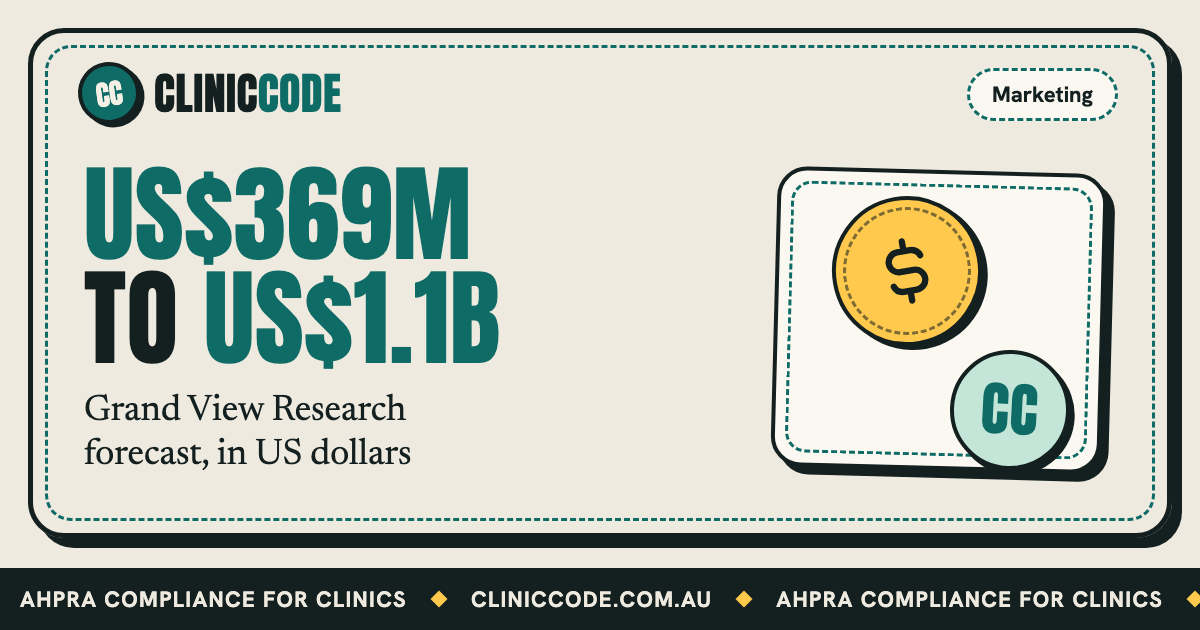
Grand View Research publishes a public summary page for its Australian cosmetic dentistry market. It states a revenue of US$369.2 million in 2022 and a forecast of US$1,119.4 million by 2030, a 14.9% compound annual growth rate. The figures are in US dollars, not Australian dollars. Our arithmetic: 1,119.4 divided by 369.2 is about 3.0, so the forecast is roughly three times the 2022 figure.
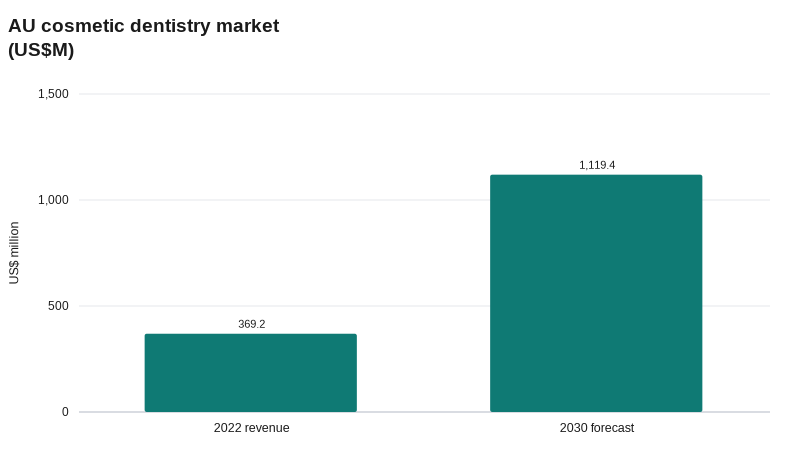
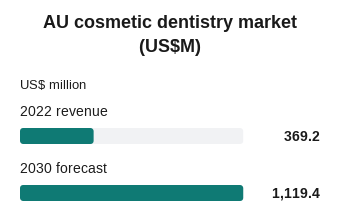
Source: Grand View Research, Australia Cosmetic Dentistry Market Outlook, 2030. Figures in US$.
The page lists dental veneer as one of eight product segments. It names dental systems and equipment as the largest segment in 2022 and orthodontic braces as the fastest growing. It does not publish a veneers-only figure for Australia in its public text, and the full databook is paid. We found no public page that states one, so we have not quoted any.
For global context, Grand View Research’s separate worldwide dental veneers report says the global market was US$7.9 billion in 2025 and is projected to reach US$14.3 billion by 2033, a 7.7% CAGR from 2026 to 2033. It names Asia Pacific as the fastest-growing region. That is a different report with its own market definition, so do not read it as an Australian number.
Takeaway: The Australian cosmetic dentistry forecast is steep, but a veneers-only Australian figure is not public, so be careful with any post that quotes one.
What Two Clinics Publish for Veneer Prices
We found no official national price list for veneers, so the best public evidence is what individual clinics put on their own pages. The table shows two of them. Each is one clinic’s price, not an Australian average.
| Clinic | Composite per tooth | Porcelain per tooth | Basis on the page |
|---|---|---|---|
| ArtSmiles (Gold Coast) | from $600 | from $1,477 (e.max or zirconia) | “Starting from”, ArtSmiles Club member pricing |
| Odontologie Dental Care (Lansvale) | $800 | $1,900 | “Those are our prices” |
Source: ArtSmiles, How Much Do Veneers Cost in Australia? 2026 Guide (ArtSmiles rows) and Odontologie Dental Care, Veneers Cost (Odontologie rows).
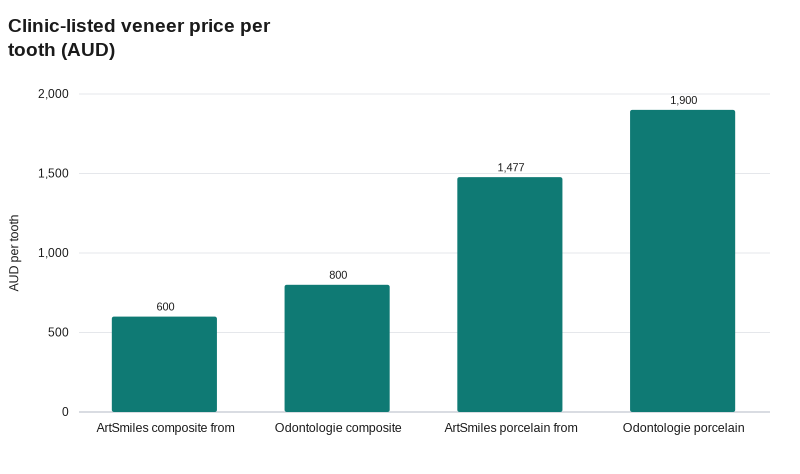
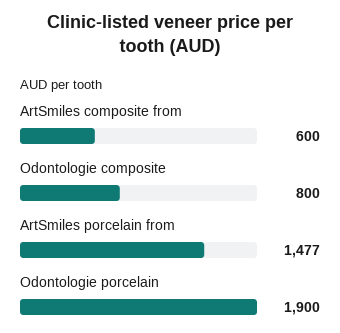
Source: the two clinic pages linked above. ArtSmiles figures are “from” prices; Odontologie figures are the clinic’s stated prices.
ArtSmiles also lists “from” totals for sets: $3,600 for 6 composite veneers and $8,862 for 6 porcelain or zirconia veneers, and $6,000 versus $14,770 for 10. Those are starting prices at one clinic, and the page says the final cost is confirmed after clinical assessment. Neither clinic’s page is a guide to what other practices charge.
Both clinics also describe a general Australian range for porcelain of $1,200 to $2,500 per tooth. That is each clinic’s own statement on its own page, not a survey, so we do not treat it as a market figure.
For fuller pricing, see our veneers cost breakdown and the porcelain vs composite comparison.
Takeaway: A clinic can publish its own price list and say so. Presenting one clinic’s “from” price as the going rate is where pricing pages go wrong.
How Long Veneers Last: What the Studies Report
Most marketing pages quote a lifespan range without a source. Here is what published studies state.
Australian long-term study. Layton and Walton followed 304 feldspathic porcelain veneers in 100 patients, all prepared by one prosthodontist between 1988 and 2003, for up to 16 years. It was published in the International Journal of Prosthodontics in 2007.
| Follow-up period | Cumulative survival |
|---|---|
| 5 to 6 years | 96% (plus or minus 1%) |
| 10 to 11 years | 93% (plus or minus 2%) |
| 12 to 13 years | 91% (plus or minus 3%) |
| 15 to 16 years | 73% (plus or minus 16%) |
Source: Layton and Walton, Int J Prosthodont 2007, abstract.
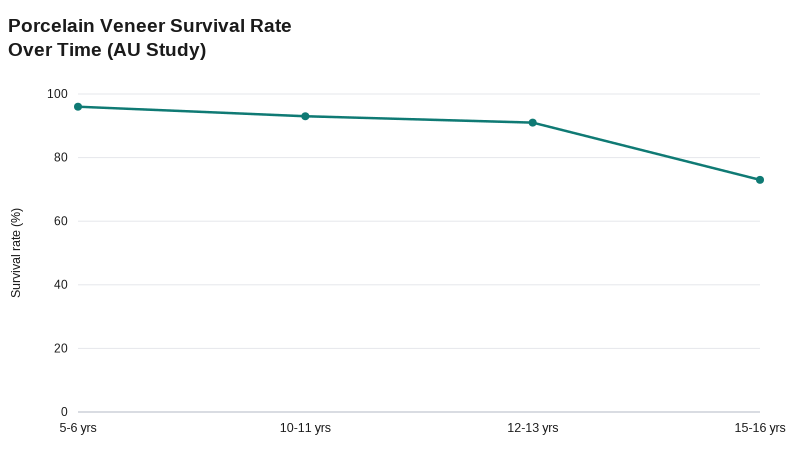
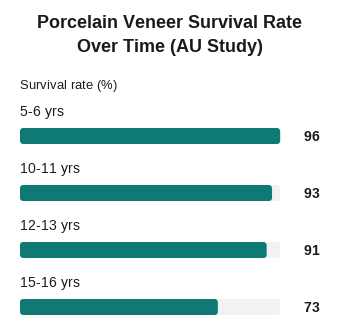
Source: Layton and Walton 2007, as in the table above.
The authors attribute the drop between 13 and 16 years to the death of one patient and the low number of veneers in that period, which is why the 73% figure has a plus or minus 16% margin. Sixteen veneers in 14 patients failed. Failures were linked to aesthetics (31%), mechanical complications (31%), periodontal support (12.5%), loss of retention (12.5%), caries (6%) and tooth fracture (6%). The authors concluded that feldspathic porcelain veneers bonded to enamel offer a predictable long-term restoration with a low failure rate.
Systematic reviews. A 2021 systematic review of 25 clinical studies covering 6,500 porcelain laminate veneers estimated a 10-year cumulative survival of 95.5% (Alenezi, J Clin Med 2021). For composite, a 2023 systematic review and meta-analysis of 7 studies (3 randomised trials and 4 cohort studies) reported a pooled survival rate of 88% (95% CI 81% to 94%) in the randomised trials, with mean follow-up from 24 to 97 months (J Evid Based Dent Pract 2023). The two reviews use different follow-up periods, so their figures are not a like-for-like comparison.
Takeaway: Quote veneer survival with its follow-up period and margin of error attached, not as a flat guarantee.
Growing Interest Means More Advertising Scrutiny
More practices marketing veneers means more pages that can breach advertising rules. Ahpra’s guidelines for advertising a regulated health service say advertising must not use testimonials or purported testimonials about the service or business. They cite section 133(1)(c) of the National Law for that. On before and after images, the guidelines say care should be taken because they can be misleading or deceptive and may cause unreasonable expectations of a successful outcome.
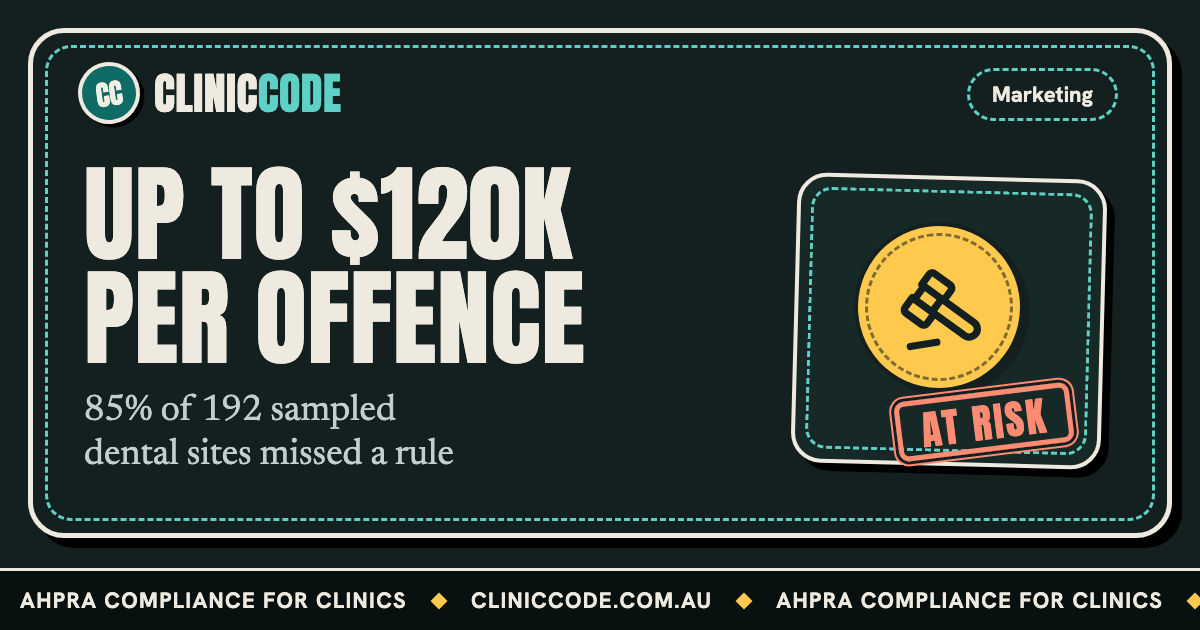
If you cite advertising penalties, note two statements on Ahpra’s advertising guidelines page. It says that as of July 2024 the increased penalties (up to $60,000 per offence for an individual and $120,000 for a body corporate) apply in all jurisdictions, including Western Australia. Footnote 3 on the same page lists $30,000 for an individual and $60,000 for a body corporate for Western Australia, but it is attached to the penalties for unlawful use of a protected title. Check the current page before quoting either.
Source: Ahpra, Advertising guidelines. Our breakdown of Ahpra’s advertising rules for cosmetic dentistry covers what a veneer gallery needs to look like.
Takeaway: Every veneer landing page is a point of advertising exposure until it has been checked against the guidelines.
Affordability Still Shapes What Patients Do
The Australian Dental Association’s annual oral health survey of 25,000 people, reported on 2 August 2024, found that 61% of respondents delayed treatment in the last 12 months. It says affordability accounted for 63% of respondents’ reasons for the delay, a 12% increase on 2022. The page does not state the 63% base explicitly, so we read it as a share of the reasons given for the delay, not of all respondents. The survey is about dental care in general, not veneers.
Source: Australian Dental Association, Dental Health Week #2: Cost of living affects dental habits.
Takeaway: A clear price page that says what is included sets expectations before the consult, not during it.
Check Your Own Site Before a Patient or Competitor Does
Most practices don’t find out which pages fail the rules until a patient complains or a competitor reports them. If your site hasn’t been checked against the current guidelines, ClinicCode can flag what to fix, page by page.
How ClinicCode Builds Dental Websites for This Market
ClinicCode builds dental and cosmetic clinic websites that start from Ahpra’s current advertising rules instead of adding compliance afterward. Every new veneer page is either an asset or a liability, depending on whether the copy, the before-and-after gallery and the pricing page were written against the current rules from day one.
Sources
- Grand View Research, Australia Cosmetic Dentistry Market Outlook, 2030
- Grand View Research, Dental Veneers Market Size, Share and Growth Report, 2033
- ArtSmiles, How Much Do Veneers Cost in Australia? 2026 Guide
- Odontologie Dental Care, Veneers Cost
- Layton and Walton, An up to 16-year prospective study of 304 porcelain veneers, Int J Prosthodont 2007
- Alenezi, Long-Term Survival and Complication Rates of Porcelain Laminate Veneers, J Clin Med 2021
- Survival and complication rates of resin composite laminate veneers, J Evid Based Dent Pract 2023
- Ahpra, Advertising guidelines
- Australian Dental Association, Dental Health Week #2 (2024)
Want a dental website built for Ahpra compliance and conversions? Talk to ClinicCode about your veneers page.
Vikas Thakur
Founder, Perth. 16 years of experience from working at TPG, iiNet and Monadelphous, now helping Australian clinics keep their websites, ads and online presence AHPRA compliant.