Teeth Whitening Market in Australia: Who Buys It and How
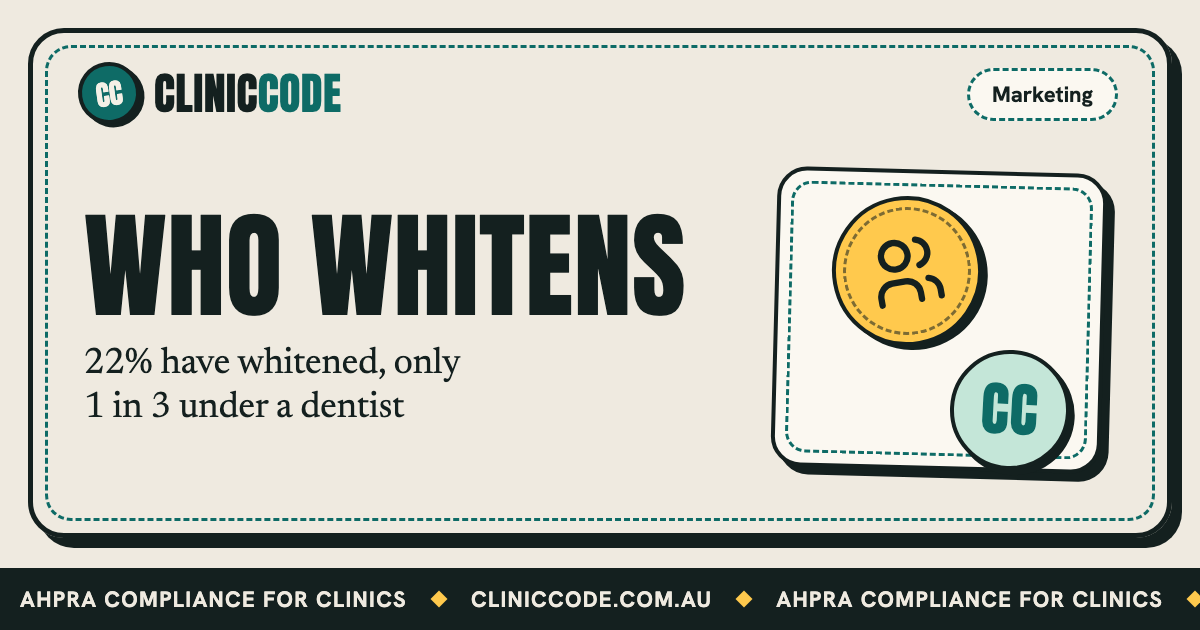
The ADA’s 2021 consumer survey of 25,000 adults found 22% had whitened their teeth, and only one in three did so under a dentist’s supervision. It also splits whiteners by method.
 Vikas Thakur Founder, Perth 6 min read Fact checked
Key takeaways
- 22% of Australian adults surveyed by the Australian Dental Association (ADA) had whitened their teeth, up 8% since 2017 (ADA Consumer Survey write-up)
- Only 1 in 3 of those people whitened under a dental professional’s supervision: 19% used take-home kits and 14% had in-clinic whitening
- The other methods were not dentist-supervised: 39% bought kits online, 16% bought over-the-counter strips or gel, and 9% used a non-dental service
- Whitening is most popular among 24 to 34 year olds, and more than twice as many women as men have whitened (Mirage News, ADA release, 21 March 2022)
- We found no current published figure for the size of Australia’s teeth whitening market that we could verify, so this post uses the ADA survey rather than a market forecast
The Australian Dental Association’s consumer survey found that 22% of Australians have whitened their teeth, and only one in three of them did it under a dentist’s supervision. (ADA)
A growing whitening habit sounds like a market dentists are winning. On the ADA’s own numbers, they are not winning most of it. The ADA Consumer Survey had 25,000 respondents aged 18 and over, and it was conducted in November and December 2021 (ADA). It found only one in three people who whiten do so under a dental professional’s supervision. The rest buy kits online, pick up strips or gel at a pharmacy or supermarket, or use a non-dental service. That gap between a popular treatment and a minority share of professional supervision is the real story. This post breaks down who is buying, how, and what it means for a practice trying to win back a slice of a market that keeps choosing the unsupervised option.
Who’s Actually Whitening Their Teeth in Australia
The ADA survey found 22% of Australian adults have whitened their teeth, “an 8% increase since 2017” (ADA). The ADA’s release for World Oral Health Day adds that whitening is most popular in the 24 to 34 age group and that more than twice as many women as men have had their teeth whitened (Mirage News).
Here’s the part that matters more than the headline number: only one in three of those people did it under a dentist’s supervision.
Takeaway: Whitening is mainstream, but most of it happens outside the dental chair.
Where Australians Actually Buy Their Whitening
Whitening splits into two supervision tiers. Take-home kits and in-clinic treatment are supervised by a dental professional. Online kits, over-the-counter strips and gel, and non-dental services are not. The ADA reports a per-method split of the survey’s whiteners:
| Method | Supervision | Share of whiteners |
|---|---|---|
| Online kits | Unsupervised | 39% |
| Over-the-counter strips/gel | Unsupervised | 16% |
| Non-dental services | Unsupervised | 9% |
| Take-home kits (dental professional) | Supervised | 19% |
| In-clinic whitening (dental professional) | Supervised | 14% |
Source: Australian Dental Association, Dental Health Week: Oral Health Habits on Trial, ADA Consumer Survey, 25,000 respondents aged 18 and over, conducted November and December 2021.
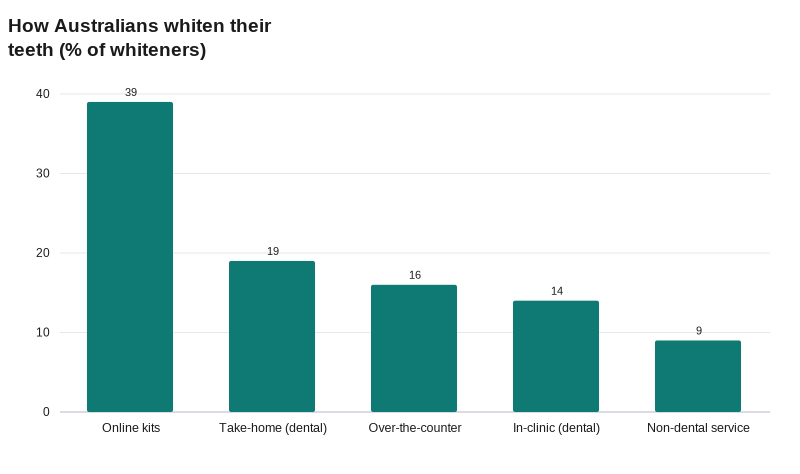
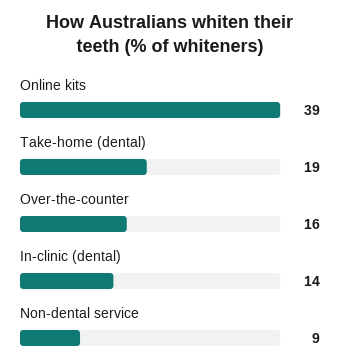
Source: ADA Consumer Survey write-up, figures as published by the ADA.
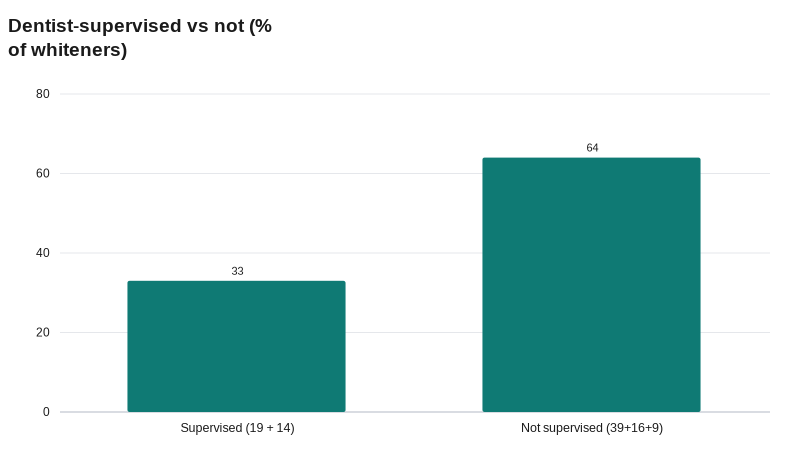
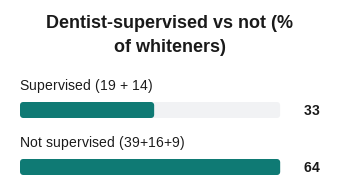
Source: ADA Consumer Survey write-up. Our arithmetic: 19% plus 14% is 33%, and 39% plus 16% plus 9% is 64%. The ADA’s listed figures do not add to 100%, and the write-up does not explain the remaining 3%.
Online kits are the single biggest route on its own, bigger than take-home kits and in-clinic treatment combined (39% against 33%, our arithmetic from the ADA figures). That is a striking result for a treatment that applies a bleaching agent to teeth without a dental check first. The same dental rules and the advertising restrictions that sit alongside them are covered in our AHPRA advertising rules for cosmetic dentistry breakdown, since dentists are regulated under the same National Law as cosmetic medicine clinics.
Takeaway: More Australians buy whitening online, over the counter or from a non-dental provider than get it from a dental professional.
Growth Without Supervision Means More Advertising Scrutiny
A treatment that so many people buy outside a dentist’s chair draws marketing spend chasing that DIY volume, and more marketing under Ahpra’s rules carries more compliance exposure. Dentists are regulated by the Dental Board of Australia under the same National Law as cosmetic medicine clinics, so the testimonial ban and the outcome-claim restrictions apply to a whitening landing page the same way they apply to a Botox gallery.
Section 133 of the National Law says a person must not advertise a regulated health service in a way that uses testimonials about the service or business, whether or not the underlying claim is true (Ahpra, Advertising and the law). Ahpra lists penalties of up to $60,000 per offence for an individual and $120,000 for a body corporate, from the 2022 amendment, and says they apply in all jurisdictions including Western Australia from July 2024 (same page).
Takeaway: You can compete on price and convenience in this market without ever touching the content that puts a practice in front of an Ahpra complaint.
Getting a Whitening Page Compliant Before Chasing This Growth
A whitening page is worth checking line by line against an Ahpra review. If your site hasn’t been reviewed recently, talk to ClinicCode and we will flag exactly what needs to change before a patient complaint does it instead.
That’s a cheaper starting point than a bigger ad budget chasing a market where much of the activity is already going to DIY kits. Fixing the compliance risk first means every dollar spent afterwards is spent on assets that survive a regulator’s review.
Takeaway: An audit is the cheapest insurance a growing practice can buy against the compliance side of a popular treatment.
How ClinicCode Builds Websites for Australia’s Growing Whitening Market
ClinicCode is an AHPRA-compliance specialist for Australian cosmetic clinics and dental practices, not a generalist agency that treats compliance as an afterthought. Every cosmetic clinic and dental website we build starts from the current advertising guidelines, so a practice never has to choose between a whitening page that converts and one that survives an Ahpra review.
For practices that want the fixes, the compliant rebuild, and ongoing compliant ad management handled as one service, ClinicCode’s compliance fixes and compliant rebuild is built specifically for regulated dental and cosmetic clinics competing for a price-sensitive, often DIY buyer.
Ready to build a whitening page that actually converts the buyers still choosing online kits? Talk to us about your practice’s whitening page.
Data sources: Australian Dental Association, Dental Health Week: Oral Health Habits on Trial (ADA Consumer Survey, 25,000 respondents, November and December 2021); Mirage News, ADA release for World Oral Health Day, 21 March 2022; Ahpra, Advertising and the law.
Vikas Thakur
Founder, Perth. 16 years of experience from working at TPG, iiNet and Monadelphous, now helping Australian clinics keep their websites, ads and online presence AHPRA compliant.