Health Providers Top Australia’s Data Breach Reports
Health service providers made 121 of the 595 data breach notifications to Australia’s privacy regulator in July-December 2024. Health also led the first half of 2025 and calendar 2025, according to Frontrow Technology’s summary of OAIC statistics.
 Vikas Thakur Founder, Perth 9 min read Fact checked
Key takeaways
- Health service providers made 121 of the 595 data breach notifications to the OAIC in July-December 2024, about 20% and the most of any sector (Genesys Data, Government Technology Review)
- Frontrow Technology, summarising OAIC statistics, reports health also led the first half of 2025 at 18% and calendar 2025 with 225 notifications (19%) of 1,205 (Frontrow Technology)
- GRM Law says the Privacy Act’s $3 million small business turnover exemption does not apply to health service providers, and it lists dental surgeries among the practices affected (GRM Law)
- Malicious or criminal attacks accounted for 69% of notifications in the second half of 2024, and Genesys Data counts 170 from human error (Government Technology Review, Genesys Data)
- In April 2026, a ransomware group listed a Queensland dental practice on its leak site. The practice says it found no evidence of a compromise (Cyber Daily)
- None of the sources cited here gives a dental-specific breach count. Dental practices sit inside the broader “health service providers” sector
Health service providers made more data breach notifications to Australia’s privacy regulator than any other sector in July-December 2024. That was 121 of 595 notifications, about 20% (Genesys Data gives the 121, and Government Technology Review gives the 595 and the 20%). A dental surgery holds health information, so it is inside that sector. The sources below give no separate dental line item, so the health sector figure is the closest published number. Here is what it says and what it means for a dental practice’s forms and booking systems.
The Sector That Keeps Topping the List
The Office of the Australian Information Commissioner (OAIC) publishes Notifiable Data Breaches statistics every six months. The figures below are as reported by the pages linked under each table and chart. They are second-hand summaries of OAIC data, so check the OAIC’s own pages before you quote them.
| Period | Health sector notifications | Total notifications | Source |
|---|---|---|---|
| July-December 2023 | 104 | 483 | Genesys Data |
| July-December 2024 | 121 | 595 | Genesys Data |
| Calendar year 2025 | 225 | 1,205 | Frontrow Technology |
Source: Genesys Data and Frontrow Technology, both seen on 25 November 2026. The 2023 and 2024 rows are six-month periods. The 2025 row is a full calendar year, so the rows are not directly comparable.
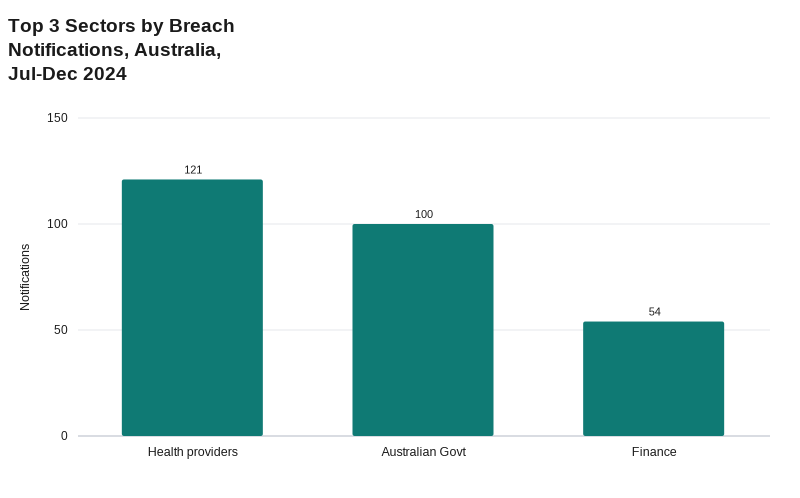
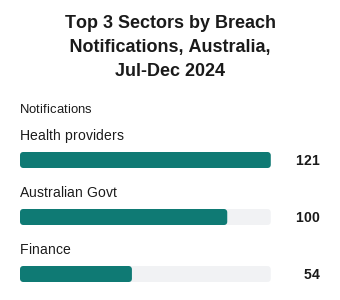
Source: Genesys Data, OAIC Data Breach Report: July - December 2024, seen on 25 November 2026. Genesys Data lists health service providers at 121, the Australian Government at 100 and finance at 54.
Frontrow Technology reports the health share was 18% in the first half of 2025 and 19% across calendar 2025, against about 20% in July-December 2024.
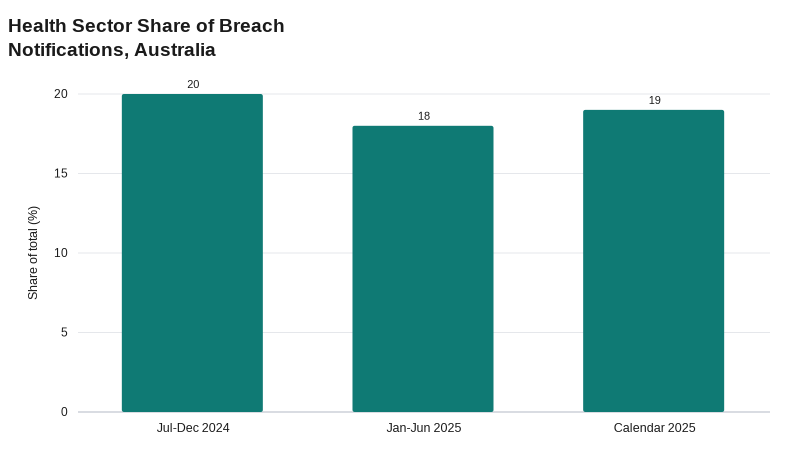
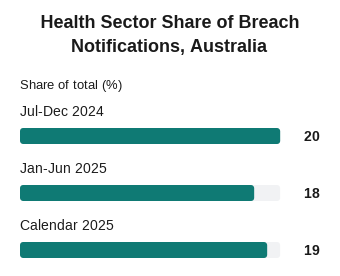
Source: Government Technology Review (July-December 2024, 20%) and Frontrow Technology (first half of 2025, 18%; calendar 2025, 19%), both seen on 25 November 2026. Shares are of all notifications to the OAIC in Australia in each period.
Takeaway: Across the periods these pages report, health service providers lead the sector list, and a dental practice reports into that same sector.
Why “Health Service Provider” Already Means Your Practice
Many businesses with annual turnover of $3 million or less are exempt from the Privacy Act. GRM Law says that exemption “already does not apply to health service providers”. In its words, “if it provides a health service and holds health information, it is an APP entity and the full set of obligations applies, regardless of turnover.”
GRM Law names dental surgeries among the practices affected, alongside medical clinics, allied health practices and specialist rooms. It also says the Notifiable Data Breaches scheme “applies to health practices in full”. If a breach is an eligible data breach, the practice must notify the OAIC and the affected individuals as soon as practicable after it becomes aware of the breach.
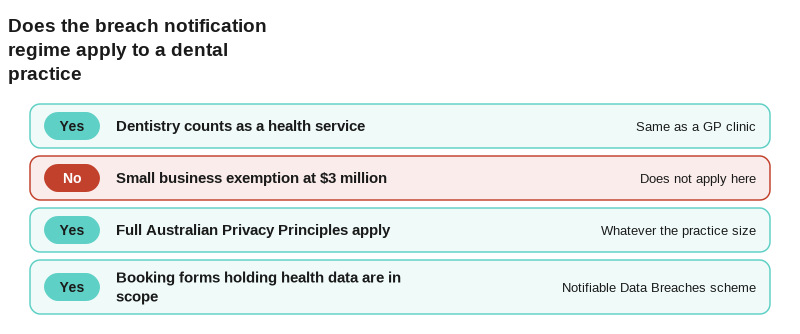
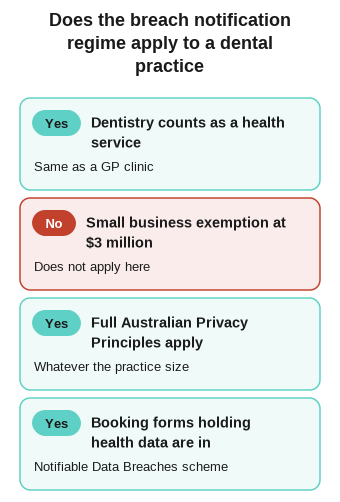
Source: GRM Law, Privacy obligations for healthcare providers in Australia, seen on 25 November 2026.
Takeaway: A practice cannot rely on being small to sit outside data breach notification law. If it holds health information, GRM Law says the full set of obligations already applies.
What’s Actually Driving the Breaches
Across all sectors, Government Technology Review reports that malicious or criminal attacks accounted for 69% of notifications in the second half of 2024. Genesys Data counts 404 of those notifications as malicious or criminal attacks and 170 (29%) as human error. Genesys Data says the most frequent human error was sending personal information to the wrong recipient by email.
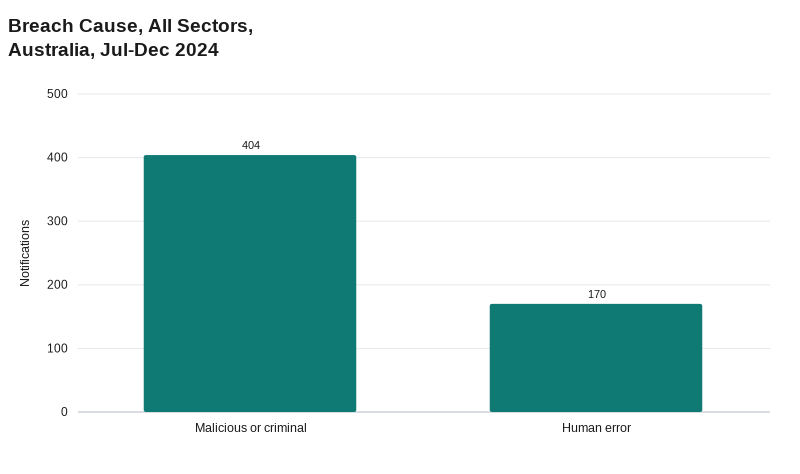
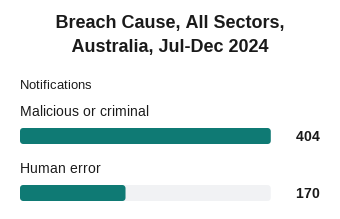
Source: Genesys Data, OAIC Data Breach Report: July - December 2024, seen on 25 November 2026. The two causes shown are not the full total; the page does not give a figure for the remainder here.
Neither page breaks the causes down for health service providers alone. So these figures cannot tell you what share of the 121 health sector notifications were attacks and what share were mistakes. In our view, a practice has two separate risks: someone breaking in, and someone sending the wrong file to the wrong address.
Takeaway: Nationally, attacks account for most notifications and human error for a large minority. Both apply to a practice.
A Real Example, Not a Hypothetical
Cyber Daily reported on 10 April 2026 that hackers linked to the Gunra ransomware operation listed Eric Davis Dental on their leak site on 8 April. The clinic is based in Margate Beach, Queensland, and also has a practice in Forest Glen. The group listed a file tree of documents it claims to have taken, including “more than 500 PDFs labelled with a potential patient’s name” with letters of referral, DNA results, tax invoices, receipts and invoices. Cyber Daily said no data had been published at that point.
The practice disputed the claim. Dr Davis told Cyber Daily: “At this time, we have not identified any evidence of a cyber security incident, system compromise, or data breach within our environment.”
This is a single reported listing, and the claim is unproven. In our view, it shows a dental practice’s name can appear on a ransomware leak site, whether or not a breach is confirmed. ClinicCode looks at where a practice’s website forms send their data, alongside the advertising rules a compliant build has to satisfy.
Takeaway: One Queensland dental practice has been named on a ransomware leak site, and it disputes the claim.
What This Means for a Practice’s Booking System and Forms
In our view, a website’s online booking, new patient intake and contact forms can be a collection point for patient health information, if they ask for things like medical history. Three practical points follow from the sources above, without stepping into legal advice about what any specific practice must do:
- If a form collects health information, it sits inside the practice’s privacy obligations. GRM Law says the Notifiable Data Breaches scheme applies to health practices in full, whatever their turnover.
- Attacks accounted for most notifications nationally. In our view, that makes the practice management software, booking plugins and any third-party integration connected to the website part of the attack surface.
- A listing does not need to be confirmed to be visible. The Eric Davis Dental listing was reported in the press while the practice said it had found no compromise.
In our view, a compliant clinic website build separates the marketing site from patient data collection, minimises what a public-facing form stores, and documents where every submitted form’s data goes. That groundwork should also make a breach assessment faster. For dental practices, this sits alongside the advertising rules covered in our breakdown of AHPRA’s advertising requirements for cosmetic dentistry, since both apply to the same website.
Takeaway: In our view, the booking form on a dental practice’s homepage can be a health information system, whether or not anyone on staff thinks of it that way.
FAQ
Does the Notifiable Data Breaches scheme apply to a small dental practice?
Yes. GRM Law says the Privacy Act small business exemption, which covers many businesses with annual turnover of $3 million or less, does not apply to health service providers. If a practice provides a health service and holds health information, the full set of obligations applies regardless of turnover, including notifying the OAIC of an eligible data breach.
Which sector reports the most data breaches in Australia?
Health service providers. In July-December 2024 they made 121 of 595 notifications to the OAIC, about 20%, according to Genesys Data and Government Technology Review. Frontrow Technology, summarising OAIC statistics, reports health also led the first half of 2025 at 18% and calendar 2025 with 225 notifications, 19% of the total.
What causes most of the data breaches reported to the OAIC?
Malicious or criminal attacks. Government Technology Review reports they accounted for 69% of notifications in the second half of 2024, and Genesys Data counts 404 of them against 170 caused by human error (29%). Neither page breaks the causes down for health service providers alone.
Has an Australian dental practice actually been targeted by ransomware?
A ransomware group has claimed it. In April 2026 the Gunra group listed Eric Davis Dental, a Queensland practice, on its leak site, according to Cyber Daily. The practice said its review with IT security providers found no evidence of a cyber security incident, system compromise or data breach.
Get Your Practice’s Website and Forms Checked
ClinicCode fixes cosmetic dental practice websites against current AHPRA advertising rules and basic data handling practice.
Talk to us about your practice’s websiteSources and References
Genesys Data - OAIC Data Breach Report: July - December 2024 (summary, 16 June 2025): 595 notifications, health 121 (up from 104), Australian Government 100, finance 54, 404 malicious or criminal, 170 human error. Seen 25 November 2026
Government Technology Review - Last year was a record year for data breaches: OAIC (27 May 2025): 595 notifications, health 20%, malicious or criminal 69%. Seen 25 November 2026
Frontrow Technology - Australian data breach statistics 2026: health 18% in the first half of 2025, 225 notifications (19%) of 1,205 in calendar 2025, citing OAIC statistics. Seen 25 November 2026
GRM Law - Privacy obligations for healthcare providers in Australia (updated 12 September 2026): the small business exemption does not apply to health service providers, and the Notifiable Data Breaches scheme applies to health practices in full. Seen 25 November 2026
Cyber Daily - Exclusive: Gunra ransomware lists Eric Davis Dental as breach victim (10 April 2026): the named April 2026 listing, including the practice’s dispute of the claim. Seen 25 November 2026
Related reading:
- AHPRA Advertising Rules for Cosmetic Dentistry: the dental-specific advertising rules that apply alongside data handling obligations
- Clinic Website Design: compliant website builds for AHPRA-regulated practices
- How Many Dentists Are in Australia?: the workforce data behind the sector this report affects
Vikas Thakur
Founder, Perth. 16 years of experience from working at TPG, iiNet and Monadelphous, now helping Australian clinics keep their websites, ads and online presence AHPRA compliant.