Teledentistry Statistics Australia: The Access Gap in Data
Australia has 68.9 full-time-equivalent dentists per 100,000 people in major cities and 21.0 in remote and very remote areas, per AIHW. Here is the data on access, cost and public waiting lists, and what it means for a dental clinic’s website.
 Vikas Thakur Founder, Perth 9 min read Fact checked
Key takeaways
- In 2024, major cities had 68.9 full-time-equivalent (FTE) dentists per 100,000 people and remote and very remote areas had 21.0, according to the Australian Institute of Health and Welfare (AIHW). The national rate was 62.1
- 7.1% of people in outer regional or remote areas were placed on a public dentistry waiting list in 2024-25, against 3.2% in major cities, per the ABS Patient Experiences survey
- 45.5% of people in outer regional or remote areas saw a dental professional in 2024-25, against 55.9% in major cities, per the ABS
- 16.1% of people reported that cost was a reason for delaying or not using dental care when needed in 2024-25, down from 17.6% the year before, per the ABS
- Only 53.9% of people aged 15 and over saw a dental professional at all in 2024-25, per the ABS
- A 2022 scoping review of 25 Australian studies found “a recent surge in the use of teledentistry services in Australia” that paralleled the COVID-19 pandemic, with a shift from asynchronous towards synchronous teledentistry, per Poirier, Jensen and Sethi
- Verified Market Reports puts the global teledentistry market at US$2.02 billion in 2024, forecast to reach US$6.41 billion by 2032. It is a research firm’s forecast, not a government count, and it is not an Australian figure
Teledentistry has a clear problem to solve in Australia, and the problem is access. In 2024, major cities had 68.9 FTE dentists per 100,000 people and remote and very remote areas had 21.0, according to the AIHW. Public dental waiting lists show the same split. In 2024-25, 7.1% of people in outer regional or remote areas were on one, against 3.2% in major cities, per the ABS.
Teledentistry will not put more chairs or more hands in a remote town. A video consult can help a clinician look at a problem and decide who needs to travel. This post lays out the numbers behind that access gap, what the research says about teledentistry use during COVID-19, and what it means for a dental practice’s booking page.
How Big Is the Teledentistry Market
We could not open a primary source for an Australia-only teledentistry market figure, so this post does not quote one. The only market figure we could verify is global. Verified Market Reports states that the teledentistry market “was valued at $ 2.02 Billion in 2024 and is estimated to reach $ 6.41 Billion by 2032, exhibiting a CAGR of 15.52% from 2025-2032” (page last updated 13 July 2026).
That is a market research firm’s projection. Treat it as an estimate. It is in US dollars and covers the world, so it says nothing direct about Australian clinics.
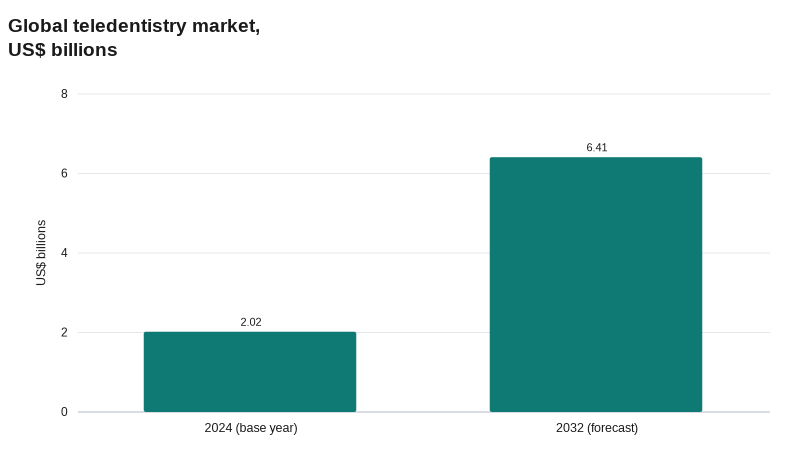
Source: Verified Market Reports, Teledentistry Market, global market in US dollars, seen 25 November 2026.
Takeaway: The only market figure we could verify is a global forecast. Do not read it as an Australian number.
Why Rural and Remote Patients Are Driving Demand
Demand for teledentistry concentrates wherever a patient’s nearest dentist is a long drive away. The AIHW’s dental workforce data for 2024 shows the gap: “The FTE rate of dentists ranged from 21.0 in Remote and very remote areas to 68.9 in Major cities.” The national FTE rate was 62.1 dentists per 100,000 population.
In our arithmetic (68.9 divided by 21.0), the major-city rate is about 3.3 times the remote and very remote rate. Both inputs are from the AIHW page above.
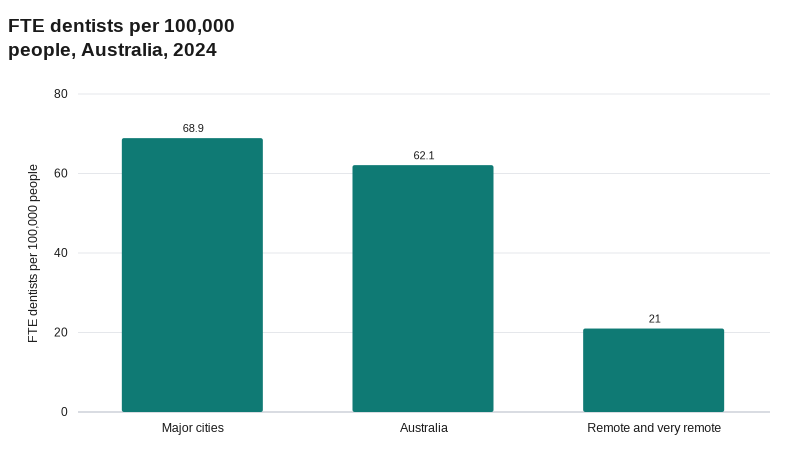
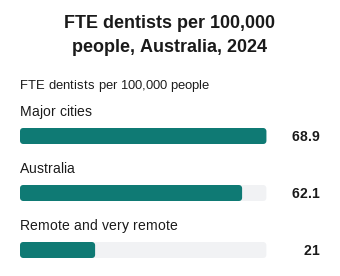
Source: AIHW, Oral health and dental care in Australia: Dental workforce, 2024 data, seen 25 November 2026.
The gap shows up in how many people reach a dentist at all. The ABS reports that 55.9% of people in major cities saw a dental professional in 2024-25, against 45.5% of people in outer regional or remote areas.
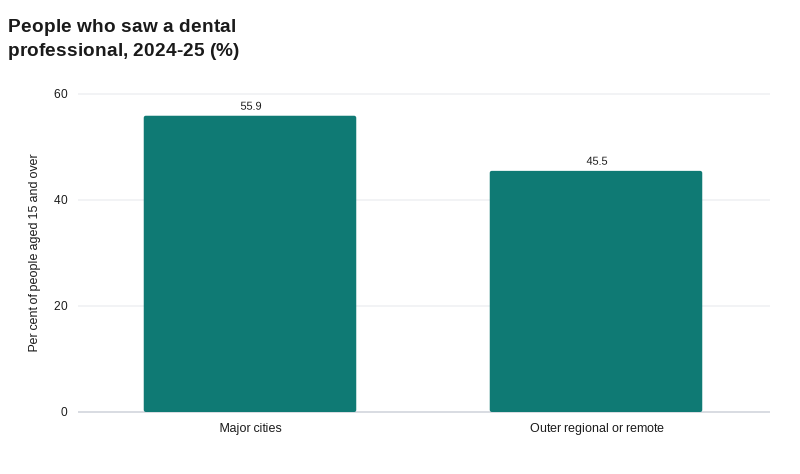
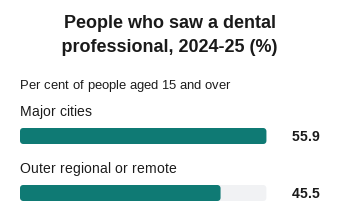
Source: ABS, Patient Experiences 2024-25, people aged 15 years and over, seen 25 November 2026.
A 2022 scoping review in the Australian Journal of Rural Health notes that “approximately seven million people (28% of the total population) live in rural or remote regions” in Australia. The review cites that figure to an earlier source, and it is a 2022 statement, so we use it for context only.
Takeaway: The AIHW and ABS data both show fewer dentists and fewer dental visits outside major cities. That is the gap teledentistry is meant to help with.
The Real Cost of Skipping Dental Care
The ABS Patient Experiences survey for 2024-25 found that 53.9% of people aged 15 and over saw a dental professional, similar to 53.2% in 2023-24. It also reported that 25.2% of people delayed or did not use dental professionals when needed, down from 28.0% the year before.
Cost features in that. The ABS reports that 16.1% of people said cost was a reason for delaying or not using dental professionals when needed in 2024-25, down from 17.6% in 2023-24. For comparison, the same release gives 7.7% for GPs and 8.6% for medical specialists.
| Indicator | 2023-24 | 2024-25 |
|---|---|---|
| Saw a dental professional | 53.2% | 53.9% |
| Delayed or did not use dental professionals when needed | 28.0% | 25.2% |
| Cost was a reason for delaying or not using dental professionals | 17.6% | 16.1% |
| Placed on a public dentistry waiting list (all people) | 4.0% | 3.9% |
Source: ABS, Patient Experiences 2024-25, people aged 15 years and over, released 18 November 2025, seen 25 November 2026.
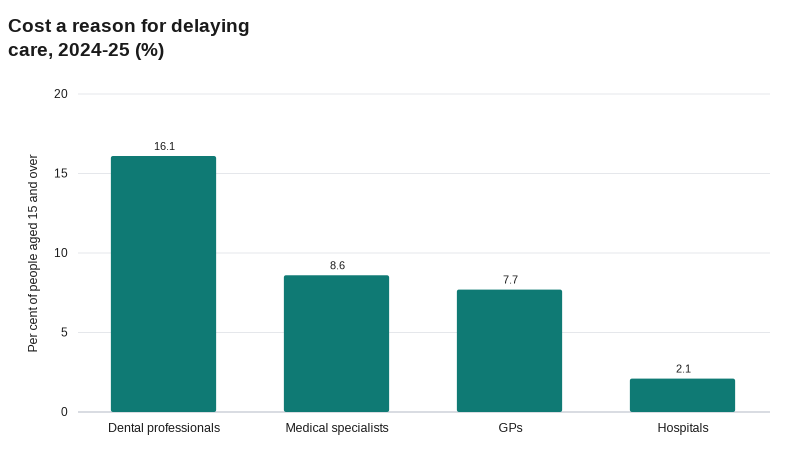
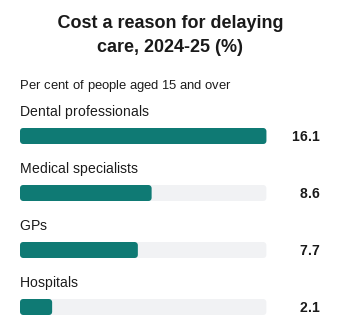
Source: ABS, Patient Experiences 2024-25, proportion who reported cost was a reason for delaying or not using the service when needed, seen 25 November 2026.
The ABS also reports waiting-list splits for 2024-25. People in outer regional or remote areas were more likely than people in major cities to be placed on a public dentistry waiting list (7.1% compared to 3.2%). People in areas of most socio-economic disadvantage were more likely than people in areas of least disadvantage (9.9% compared to 1.3%). None of these are teledentistry statistics. They describe the access problem teledentistry is aimed at.
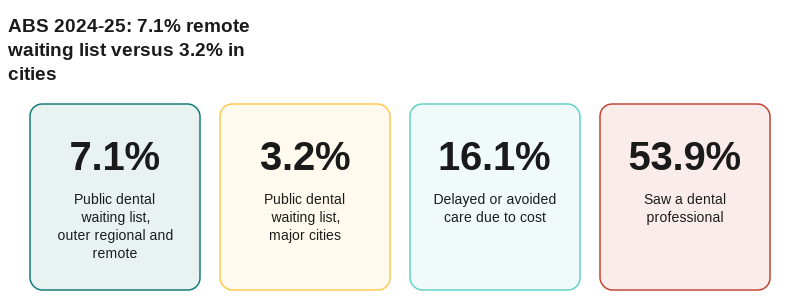
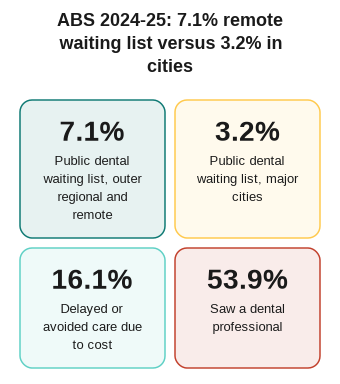
Source: ABS, Patient Experiences 2024-25, seen 25 November 2026.
On telehealth in general, the ABS reports that 22.5% of people used telehealth services in 2024-25, down from a peak of 30.8% in 2021-22. That figure covers all telehealth, not dentistry.
Takeaway: Cost and distance both show up in the ABS data. Whether teledentistry reduces either is a question these figures do not answer.
COVID-19 Pushed Australian Dentistry Onto Video Calls
A 2022 scoping review by Poirier, Jensen and Sethi, published in the Australian Journal of Rural Health, searched for Australian teledentistry literature. The search identified 758 articles, and 25 met the inclusion criteria. The authors describe “a recent surge in the use of teledentistry services in Australia that has paralleled the COVID-19 pandemic”. They also detail “a shift in modality from asynchronous towards synchronous teledentistry pre- and post-COVID-19 pandemic”. The review concludes that teledentistry offers an opportunity to increase access to dental services, “especially for patients in rural areas or those who are immunocompromised”.
In plain terms, asynchronous teledentistry means store-and-forward, such as photos reviewed later. Synchronous means live, such as a video consult. In our view, live video needs more from a booking page than a photo upload form does: scheduling, identity checks and a clear explanation of what a remote consult can and cannot do.
Takeaway: The 2022 review documents a surge in use and a move towards live video. It does not give a count of consults, so we do not quote one.
What the Advertising Rules Mean for a Teledentistry Booking Page
A teledentistry booking page is still an advertisement for a regulated health service. Ahpra’s advertising guidelines set out that section 133(1)(c) of the National Law prohibits advertising a regulated health service in a way that uses testimonials, “such as for example, patient stories and experiences, success stories, or fake testimonials”. That applies whether the page sells an in-chair procedure or a virtual consult that leads to one. We cover the requirements for dental practices in our breakdown of the Ahpra advertising rules for cosmetic dentistry.
A live-video booking flow raises its own questions. In our view, a practice should settle what a patient is told before a remote consult stands in for an in-person exam, how outcome expectations are set for treatment that has not been physically assessed, and how identity and consent are captured. Talk to ClinicCode and we will flag where a booking flow, a testimonial or an outcome claim falls outside the current guidelines.
Takeaway: Teledentistry does not sit outside Ahpra’s advertising rules. A new booking flow has to meet the same rules as a static gallery.
What This Means for Your Clinic’s Website
In our view, a teledentistry offer needs more than a video-call widget added to an existing site. It needs a booking flow that explains what a remote consult can and cannot do, clear information about who the consulting dentist is and where they are registered, and a clean path from the first video call to an in-person appointment when one is needed.
Websites for cosmetic clinics and dental practices need to handle that layered journey, remote triage through to in-chair treatment, without losing compliance or clarity at any step. That is a different brief to a standard brochure site.
Takeaway: Treat teledentistry as a full patient journey with its own compliance checks, not a bolted-on video widget.
Talk to ClinicCode About Your Dental Practice’s Website
ClinicCode builds websites for dental and cosmetic clinics across Australia, including the booking flows and compliance groundwork a teledentistry offer needs. If your site carries old testimonials, outcome claims, or a booking form that was never built for remote consults, it is worth fixing before a complaint or a regulator flags it.
Get in touch to talk through what a compliant, teledentistry-ready website looks like for your practice.
Sources and References
- Australian Institute of Health and Welfare, Oral health and dental care in Australia: Dental workforce, 2024 data, seen 25 November 2026.
- Australian Bureau of Statistics, Patient Experiences, 2024-25 financial year, released 18 November 2025, seen 25 November 2026. The ABS lists a next release for 8 December 2026.
- Poirier B, Jensen E, Sethi S, “The evolution of the teledentistry landscape in Australia: A scoping review”, Australian Journal of Rural Health, 2022;30(4):434-441 (open-access full text on PubMed Central), seen 25 November 2026.
- Verified Market Reports, Teledentistry Market Size, Share, Industry Trends and Global Forecast 2025-2032, page last updated 13 July 2026, seen 25 November 2026.
- Ahpra, Guidelines for advertising a regulated health service, seen 25 November 2026.
Vikas Thakur
Founder, Perth. 16 years of experience from working at TPG, iiNet and Monadelphous, now helping Australian clinics keep their websites, ads and online presence AHPRA compliant.