Zirconia 904 MPa vs e.max 488 MPa in Lab Test (2026)
A 2018 lab study measured 904 MPa flexural strength for zirconia and 488 MPa for e.max lithium disilicate. One Gold Coast practice lists both veneer materials at the same $1,477 per tooth starting price.
 Vikas Thakur Founder, Perth 11 min read Fact checked
Key takeaways
- In a 2018 lab study, zirconia measured 904 MPa in biaxial flexural strength against 488 MPa for IPS e.max CAD lithium disilicate (Yan, Kaizer and Zhang). 904 is about 85% higher than 488 (our arithmetic)
- The study tested ten specimens of each ceramic material, not finished veneers on teeth
- ArtSmiles, a Gold Coast practice, lists “over 900 MPa” for zirconia against “500 MPa” for porcelain on its veneer pricing page
- On that page, both zirconia and porcelain (e.max) veneers carry the same “starting from” price of $1,477 per tooth (ArtSmiles Club member pricing, final cost confirmed after clinical assessment)
- The page’s 6, 8 and 10 veneer porcelain or zirconia figures ($8,862, $11,816, $14,770) are each 6, 8 or 10 times $1,477 (our arithmetic)
- ArtSmiles rates zirconia’s “Aesthetic Detail” as Very Good and porcelain (e.max) as Excellent
- We found no independent peer-reviewed longevity study of zirconia veneers while researching this post. ArtSmiles’s “15+ years” for zirconia is a figure on its own pricing page
In a 2018 lab study, 3Y-TZP zirconia measured 904 MPa in flexural strength and IPS e.max CAD lithium disilicate, a common porcelain-type ceramic, measured 488 MPa. The same paper measured 749 MPa for 4Y-PSZ and 593 MPa for 5Y-PSZ, the more translucent zirconias. That comes from a peer-reviewed materials paper, not a brochure. ArtSmiles, a Gold Coast cosmetic dental practice, lists a similar rounded gap on its own veneer pricing page: “over 900 MPa” against “500 MPa”. The same page lists both materials at the same starting price of $1,477 per tooth. If the stronger ceramic does not cost more at that practice, the choice is less about budget and more about appearance, bite and which tooth is being treated. This guide sets out what the sources state, where the trade-offs sit, and what a dental practice’s website should check before publishing either material as a treatment option.
The Strength Numbers: 904 MPa vs 488 MPa
Flexural strength is one measure of how much bending force a ceramic can take before it fractures. In 2018, Jing Yan, Marina Kaizer and Yu Zhang published biaxial flexural strength results in the Journal of the Mechanical Behavior of Biomedical Materials. The paper states that “the free-standing biaxial strength of each material (n = 10) was determined by the piston-on-three-balls test”, following ISO 6872. Their Table I reports 904 MPa for 3Y-TZP zirconia, 749 MPa for 4Y-PSZ, 593 MPa for 5Y-PSZ and 488 MPa for IPS e.max CAD lithium disilicate. The 904 figure is the strongest and least translucent of the three zirconias. Dividing 904 by 488 gives about 1.85, so zirconia measured about 85% higher (our arithmetic).
This is a test of material specimens. It does not say how a bonded veneer will perform in a patient’s mouth.
ArtSmiles lists “over 900 MPa compared to porcelain’s 500 MPa” on its veneer pricing page, updated 8 July 2026. The practice’s figures are rounded and are its own, not a second laboratory test.
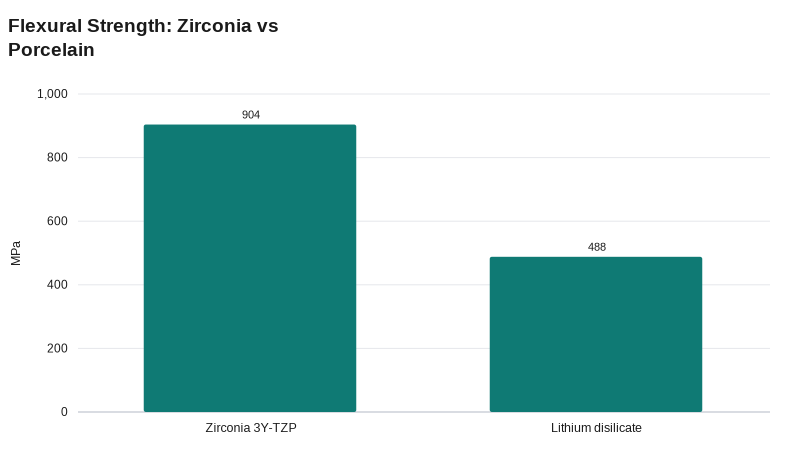
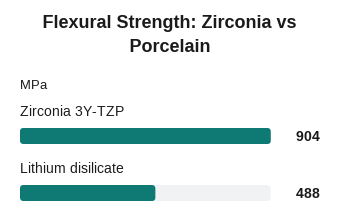
Source: Yan, Kaizer and Zhang, 2018, Table I
Takeaway: The lab gap is large, but it is a material-level result. Treat it as one input to a decision with your dentist, not a promise about a finished veneer.
Same Starting Price, Different Material: What ArtSmiles Lists
At ArtSmiles, zirconia does not carry a higher starting price. The practice’s veneer pricing page lists these “starting from” prices per tooth: composite $600, hybrid (Cerasmart) $995, porcelain (e.max) $1,477 and zirconia $1,477. The table footnote reads “ArtSmiles Club member pricing. Final cost confirmed after clinical assessment.” These are advertised starting prices for club members, not what patients paid.
| Material | Starting from, per tooth (ArtSmiles Club pricing) | Strength as listed by ArtSmiles | Aesthetic Detail (ArtSmiles rating) |
|---|---|---|---|
| Composite | $600 | Low (120-170 MPa) | Good |
| Hybrid (Cerasmart) | $995 | Moderate (270 MPa) | Very Good |
| Porcelain (e.max) | $1,477 | High (500 MPa) | Excellent |
| Zirconia | $1,477 | Very High (900 MPa) | Very Good |
Source: ArtSmiles, How much do veneers cost in Australia (updated 8 July 2026)
The same ArtSmiles page also gives general ranges that are separate from the club starting prices: composite $300 to $800 per tooth, hybrid $890 to $1,200, porcelain (e.max) $1,200 to $2,500 and zirconia $1,200 to $2,500. This is one practice’s page. We did not check other practices for this post, so it says nothing about how zirconia is priced across the market. If a dentist’s site shows one “porcelain veneer” price, ask which ceramic it covers.
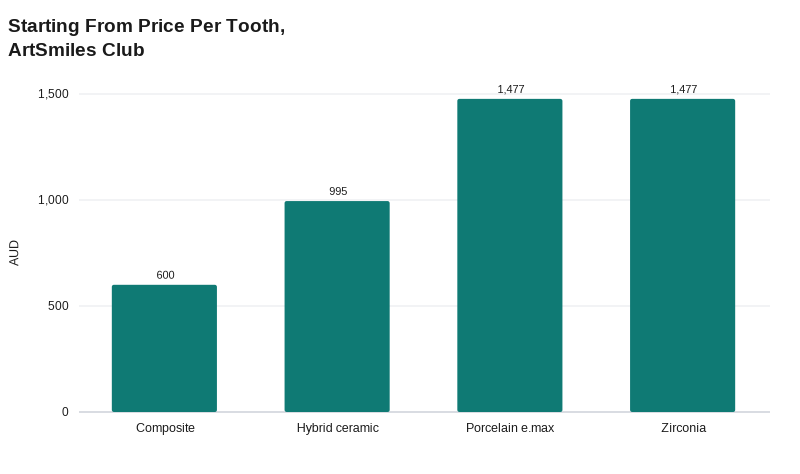
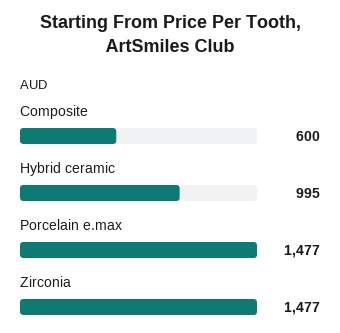
Source: ArtSmiles, How much do veneers cost in Australia (updated 8 July 2026)
Takeaway: Equal starting prices at one practice show a premium-material price gap is not guaranteed. Ask for the material name, not just the word “porcelain.”
What a Full Smile Makeover Starts At
The ArtSmiles page says “Most smile makeovers involve 6 to 10 veneers on the upper front teeth.” It lists porcelain or zirconia makeover figures of $8,862 for 6 veneers, $11,816 for 8 and $14,770 for 10. The page does not define what each package includes. It treats the figures as a starting point, with the final quote depending on preparation work, gum contouring and case complexity.
Each figure is the per-tooth starting price times the veneer count: 6 times $1,477 is $8,862, 8 times is $11,816 and 10 times is $14,770 (our arithmetic). So the listed starting figures show no volume discount.
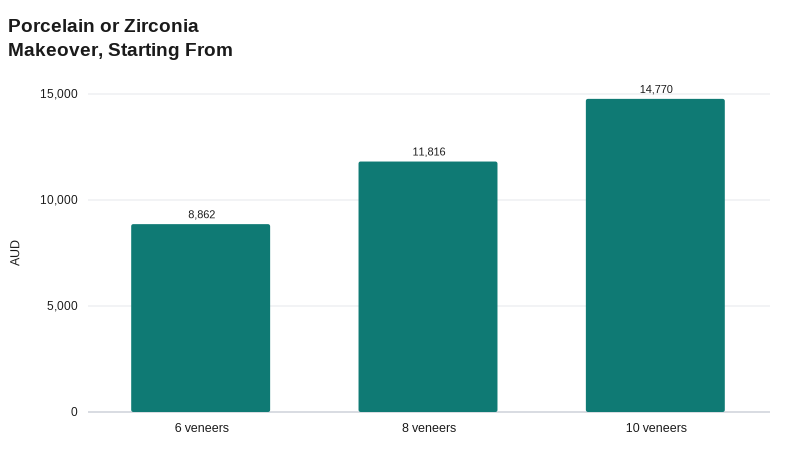
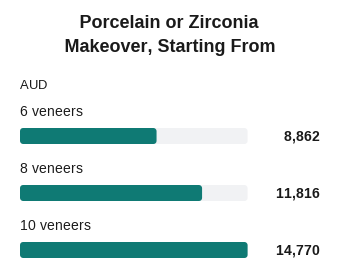
Source: ArtSmiles, How much do veneers cost in Australia (updated 8 July 2026)
Takeaway: The page’s makeover figures are starting points at one practice, and a final quote depends on the case.
The Trade-off: Appearance and When Zirconia Is Suggested
ArtSmiles rates zirconia’s overall “Aesthetic Detail” as Very Good and porcelain (e.max) as Excellent. Its translucency row rates only composite (Moderate) and porcelain e.max (High), with no entry for zirconia in that row, and the page does not explain why. For a front tooth under close inspection, ask your dentist to show how each material would look on that tooth.
The page says “Zirconia veneers are gaining popularity, especially for patients with bruxism (teeth grinding) or a heavier bite.” It also says “Your dentist will recommend the best material based on your bite forces, grinding habits, and aesthetic goals.” So the material choice sits with the treating dentist and the patient’s case.
ArtSmiles lists zirconia veneers as lasting “15+ years” and porcelain (e.max) as “10 to 15+ years”. It adds that “How long your results last depends on your individual case. If you grind your teeth, complications may develop sooner.” While researching this post we found no independent peer-reviewed clinical trial of zirconia veneer survival, so read those as practice estimates.
Takeaway: The lab strength gap is one factor. The material is chosen per tooth and per patient, with appearance and bite habits in the mix.
What Ahpra’s Advertising Rules Mean for a Zirconia Veneer Page
Ahpra announced new guidelines for cosmetic procedures on 2 September 2025. The announcement covers non-surgical cosmetic procedures and does not say whether dental veneers fall within it, so confirm with the Dental Board before you apply it to a veneer gallery. Its announcement says the guidelines are “in effect from today” and cover “registered health practitioners performing and advertising non-surgical cosmetic procedures”. It also says advertisements must “only use real images and avoid airbrushing or editing that misleads the public” and carry “a warning that results may vary for other patients in advertisements using images”. It adds that the guidelines “will now apply to all regulated professions”.
Separately, Ahpra’s advertising guidelines page says the law “specifically prohibits advertising a regulated health service in a way that uses testimonials or purported testimonials”. Read the full text on Ahpra’s advertising guidelines page before publishing patient stories.
We have not found a single Ahpra page that settles every before and after image question for dentists, so check the current Ahpra and Dental Board pages for your case. Our guide to Ahpra’s advertising rules for cosmetic dentistry goes through the detail.
A source-linked material comparison like this one contains no testimonials, which section 133(1)(c) of the National Law prohibits. Keep any outcome language factual and sourced.
If you are not sure where your practice’s site or social content sits against the current rules, talk to ClinicCode and we will review each page against the provision it falls under.
Takeaway: A sourced material comparison contains no testimonials. Review any image gallery against the current Ahpra pages first.
How This Should Shape Your Practice’s Website and Booking Flow
Naming the exact material on a pricing page helps a patient arrive at the consultation with a specific question. A single vague “veneers from” figure leaves the dentist to explain basic material differences in the chair.
The booking flow can help too. A treatment enquiry form that asks whether the patient is interested in composite, e.max or zirconia can route the enquiry to a suitable consultation length and dentist. On the ArtSmiles page, the starting figures run from $600 per tooth for composite to $14,770 for a 10-veneer porcelain or zirconia case. Cases that different should not sit behind the same generic “book a veneer consultation” button.
ClinicCode builds cosmetic clinic and dental practice websites that present material and pricing detail without drifting into the outcome claims Ahpra’s rules restrict.
Takeaway: Clear material and price information is a compliance-conscious content choice, and it can make enquiries more specific.
FAQ
What is the flexural strength difference between zirconia and porcelain veneers?
In a 2018 lab study of ceramic materials, 3Y-TZP zirconia measured 904 MPa in biaxial flexural strength and IPS e.max CAD lithium disilicate measured 488 MPa (ten specimens per material, piston-on-three-balls test under ISO 6872). 904 is about 85% higher than 488 (our arithmetic). The study tested material specimens, not finished veneers on teeth. ArtSmiles, a Gold Coast practice, lists “over 900 MPa” for zirconia against “500 MPa” for porcelain on its own veneer pricing page.
Do zirconia veneers cost more than porcelain veneers in Australia?
Not at ArtSmiles, a Gold Coast cosmetic dental practice. Its veneer pricing page lists zirconia and porcelain (e.max) at the same “starting from” figure of $1,477 per tooth, marked as ArtSmiles Club member pricing with the final cost confirmed after clinical assessment. The same page also lists a general range of $1,200 to $2,500 per tooth for each of porcelain and zirconia. We looked at one practice, so this is not a market-wide price comparison.
Are zirconia veneers less translucent than porcelain veneers?
ArtSmiles rates translucency only for composite (Moderate) and porcelain e.max (High); its translucency row has no entry for zirconia. Its four-material table rates overall “Aesthetic Detail” as Very Good for zirconia and Excellent for porcelain (e.max). The page does not say why. Ask your dentist how a given material will look on the specific tooth being treated.
Can a dental practice website show before and after photos of zirconia veneer cases?
Check the current Ahpra and Dental Board rules before publishing any. Ahpra’s cosmetic procedures announcement of 2 September 2025 says its guidelines for non-surgical cosmetic procedures require advertisements to use only real images and to carry a warning that results may vary for other patients. The announcement does not say whether dental veneers fall within them. Ahpra’s advertising guidelines also prohibit advertising a regulated health service in a way that uses testimonials or purported testimonials. Review any case gallery against both pages and the Dental Board’s guidance before it goes live.
Get a Compliant Cosmetic Dentistry Website Built Around Real Data
ClinicCode builds Ahpra-aware websites for Australian cosmetic dental practices, the kind that can publish exact material names and sourced figures without drifting into the outcome claims the current guidelines restrict. If your booking flow does not yet separate a composite case from a full smile makeover, talk to us about a compliant rebuild.
Talk to ClinicCode about your practice’s website
Sources and References
Yan, Kaizer and Zhang, Load-Bearing Capacity of Lithium Disilicate and Ultra-Translucent Zirconias, Journal of the Mechanical Behavior of Biomedical Materials (2018) - Table I: 904 MPa for 3Y-TZP zirconia, 488 MPa for IPS e.max CAD lithium disilicate; n = 10 per material
ArtSmiles, How much do veneers cost in Australia - “starting from” per-tooth and makeover figures, listed strength, aesthetic detail ratings and lifespan estimates, updated 8 July 2026
Ahpra, New guidelines for cosmetic procedures (2 September 2025) - effective date, real images and results-may-vary warning
Ahpra, Advertising guidelines - testimonials prohibition
Ahpra Advertising Rules for Cosmetic Dentistry Australia 2026 - our breakdown of how the guidelines apply to dental practices
Related reading:
- Veneers Cost Australia: State-by-State Price Data
- Porcelain vs Composite Veneers: Cost & Lifespan Data
- Clinic Website Design: compliant website builds for Ahpra-regulated clinics
Vikas Thakur
Founder, Perth. 16 years of experience from working at TPG, iiNet and Monadelphous, now helping Australian clinics keep their websites, ads and online presence AHPRA compliant.