Cosmetic 7-Day Cooling Off Period Advertising Rules 2025
Ahpra’s guidelines require at least 7 days between consent and the procedure for under-18s, and no money payable until that period ends. This post sets out what the guidelines say and what to review in your ads and booking flow.
 Vikas Thakur Founder, Perth Updated Jun 16, 2026 10 min read Fact checked
Key takeaways
- Ahpra’s guidelines for practitioners who perform non-surgical cosmetic procedures were issued on 2 September 2025. For people under 18 they require a cooling-off period of at least seven days between informed consent and the procedure.
- For under-18s, no money should be payable until after the cooling-off period, other than for initial consultations.
- The guidelines apply to registered health practitioners except medical practitioners, who should refer to the Medical Board’s guidelines.
- Ahpra’s advertising guidelines say urgency phrases such as “don’t miss out” may be unlawful where they are linked to unsubstantiated claims that a person’s health may suffer.
- A gift, discount or other inducement must state its terms and conditions (National Law section 133(1)(b), quoted by Ahpra).
- Maximum penalty per offence: $60,000 for an individual and $120,000 for a body corporate.
- In our view, the cooling-off period affects how you word booking pages, intake forms, confirmations and email sequences.
In Brief
Ahpra’s September 2025 guidelines set a cooling-off period of at least seven days for under-18s and separately describe how higher risk non-surgical cosmetic procedures may be advertised.
Urgency lines such as “Book before prices go up”, “Limited appointments this month” and “Special pricing this weekend only” are the kind of copy to review against Ahpra’s 2025 guidelines.
In our view, copy like that sits badly with Ahpra’s 2025 guidelines. Ahpra says higher risk cosmetic procedures are discretionary, and that advertising “plays a significant role in driving demand”.
This post sets out what the cooling-off requirement says, which procedures Ahpra lists as higher risk, and what to review in your ads, email sequences and booking confirmations. It is a summary of regulator pages, not legal advice.
What the 7-Day Cooling Off Period Requires
Ahpra’s guidelines for practitioners who perform non-surgical cosmetic procedures carry a “Date of issue: 2 September 2025”. The page does not give a separate start date, so this post says issued, not in force.
For people under 18, the guidelines say:
- There must be a cooling-off period of at least seven days between obtaining informed consent and the non-surgical cosmetic procedure being performed.
- No money should be payable until after the cooling-off period (other than for initial consultations).
- The person should be encouraged to discuss why they want the procedure with an appropriate independent registered health practitioner during the cooling-off period.
The guidelines say they apply to health practitioners registered under the National Law who perform non-surgical cosmetic procedures, “except medical practitioners”. Medical practitioners are pointed to the Medical Board’s guidelines. We did not review those, so check them if you employ doctors.
The cooling-off wording we read is stated for people under 18. We did not find an adult cooling-off requirement on the page.
Source: guidelines for practitioners who perform non-surgical cosmetic procedures, Ahpra, viewed 25 November 2026.
Which Procedures Ahpra Lists as Higher Risk
Ahpra’s Guidelines for advertising higher risk non-surgical cosmetic procedures list examples of higher risk non-surgical cosmetic procedures. The list is “include but are not limited to”:
| Procedure type | Ahpra’s wording |
|---|---|
| Dental veneers | “dental veneers” |
| Cosmetic injectables | “botulinum toxin and dermal fillers” |
| Injection lipolysis | “injection lipolysis” |
| Thread lifts | “thread lifts” |
| Sclerotherapy | “sclerotherapy and microsclerotherapy” |
| Blood-derived treatments | “procedures involving platelet rich plasma, biotherapy or injections of any products derived from the patient’s blood” |
| Hair transplants | “hair transplants” |
Source: Guidelines for advertising higher risk non-surgical cosmetic procedures, Ahpra, viewed 25 November 2026.
Ahpra says some cosmetic procedures carry higher risks “because they may be invasive and can cause serious complications or harm which may be irreversible”. The separate performing guidelines list a wider set of examples, including laser hair removal and chemical peels, and the under-18 cooling-off wording sits in those guidelines.
How the Cooling Off Requirement Affects Your Advertising
Urgency Language
Ahpra’s Ahpra advertising guidelines say advertising may be unlawful when it “creates an impression or a sense of urgency that is linked to a person’s health suffering if they do not use a regulated health service, where there is no clinical indication to support this”. Phrases Ahpra gives are “don’t delay”, “act now before it’s too late”, “don’t miss out”, “time is running out” and “for a limited time only”. Ahpra says they “may be unlawful where they are linked to unsubstantiated claims that a person’s health may suffer”.
So the wording alone is not the test on that page. The link to unsubstantiated health claims is. In our view, time-pressure language on a discretionary procedure is still the riskiest copy to run, and it points the opposite way from a consultation-led process.
Discounts and Inducements
Section 133(1)(b) of the National Law, quoted in the same guidelines, says a person must not advertise a regulated health service in a way that “offers a gift, discount or other inducement to attract a person to use the service or the business, unless the advertisement also states the terms and conditions of the offer”.
Ahpra’s cosmetic advertising guidelines say that “offering inducements” is used extensively to influence consumer choice in this area. They also say practitioners “must not offer higher risk cosmetic procedures as a competition prize”.
In our view, a discount with an expiry date adds time pressure on top of the inducement, so it draws the most scrutiny. A discount must at least state its terms and conditions (section 133(1)(b)). In our view, that includes any expiry date.
Same-Day Booking Language
For under-18s, the cooling-off period means a procedure cannot follow informed consent on the same day. In our view, “walk in and walk out today” wording for a higher risk procedure is therefore a poor fit for that group.
The advertising guidelines also say captions that idealise or minimise risk are a problem, and give “more natural”, “ideal”, “perfect” and “instant” as examples.
Source: Guidelines for advertising higher risk non-surgical cosmetic procedures, Ahpra, viewed 25 November 2026.
What Compliant Advertising Looks Like
Ahpra describes good practice advertising of higher risk cosmetic procedures as “honest, balanced, realistic, and informative”. It says advertising “must be clear that undergoing a higher risk cosmetic procedure is a serious decision” and must include realistic recovery information.
Focus on the consultation
In our view, inviting someone to book a consultation fits that wording better than inviting them to book a procedure.
Describe procedures without outcome promises
The table below is our view of how the same message can be worded at lower and higher risk. It is not a list approved by Ahpra.
| Lower risk wording (our view) | Higher risk wording (our view) |
|---|---|
| “Dermal filler is a gel-like substance used to add volume to targeted areas” | “Get the lips you’ve always wanted with our dermal filler” |
| “Book a consultation to discuss your treatment options” | “Book now, limited spots this weekend” |
| “Our nurse injectors have [X] years of experience in cosmetic injectables” | “Australia’s best lip filler results, see our before and afters” |
| “Anti-wrinkle treatments from $[price] per area” | “20% off anti-wrinkle if you book before Sunday” |
Source: our view, drawing on Ahpra advertising guidelines and Guidelines for advertising higher risk non-surgical cosmetic procedures, Ahpra, viewed 25 November 2026.
Inform about the process, including timing
In our view, saying that you require a consultation before any injectable treatment is a plain statement of process. It also matches the consultation and assessment steps in Ahpra’s performing guidelines.
How to Update Your Booking System and Email Sequences
These are our suggestions for applying the guidelines to your systems.
Booking confirmation emails
If a confirmation for a higher risk procedure says “see you tomorrow for your treatment”, review it. For under-18s, a procedure cannot be performed within seven days of informed consent.
Consent forms and intake processes
The guidelines count the seven days from obtaining informed consent. In our view, your intake documentation should record the date and time consent was given, so the start of the cooling-off period is clear.
Payment systems
For under-18s, Ahpra says no money should be payable until after the cooling-off period, other than for initial consultations. In our view, if your booking platform takes a deposit as standard, you need an exception for that group.
The Penalty Structure
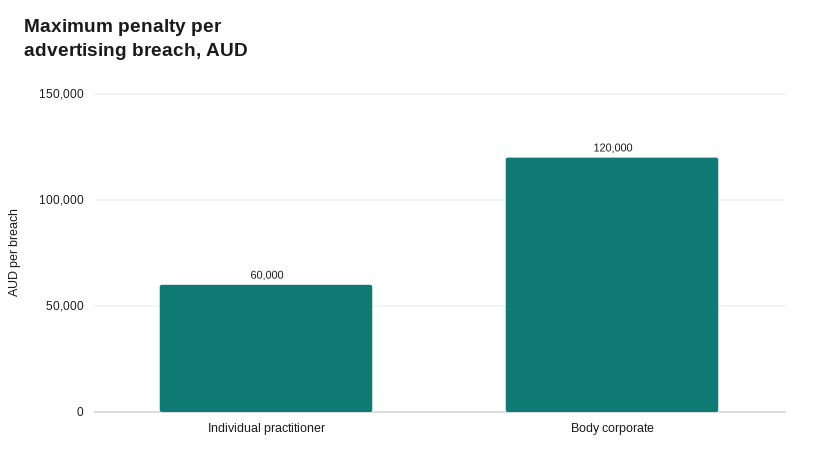
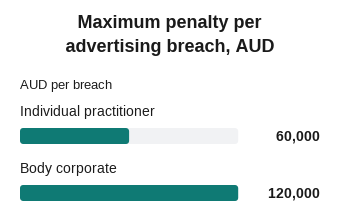
Ahpra’s Advertising and the law page says advertising breaches of the National Law “may be prosecuted, and a court may order advertisers to pay a penalty for each offence”. The maximum penalties it lists are:
| Entity type | Maximum penalty per offence |
|---|---|
| Individual (for example, a registered health practitioner) | $60,000 |
| Body corporate | $120,000 |
Source: Advertising and the law, Ahpra, viewed 25 November 2026.
Ahpra’s advertising guidelines page still carries footnote 3, which gives Western Australia maxima of $30,000 for an individual and $60,000 for a body corporate against the unlawful use of a protected title offence, and the page does not reconcile it with its statement that the higher penalties apply in all jurisdictions, including Western Australia, as of July 2024.
Ahpra’s advertising guidelines page says that in 2022 the National Law was amended and the maximum financial penalty per offence increased from $5,000 to $60,000 for an individual and from $10,000 to $120,000 for a body corporate.
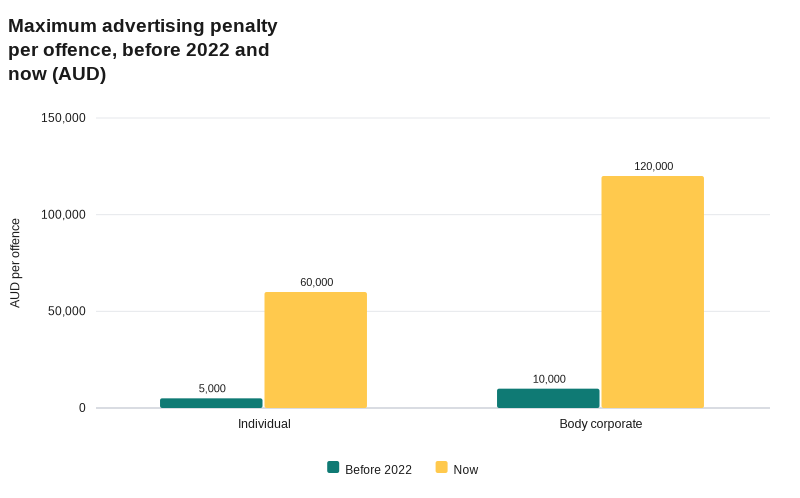
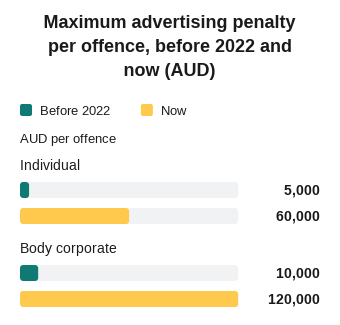
Source: Ahpra, Advertising guidelines, section on the increased maximum penalty, seen 25 November 2026.
Ahpra says the National Law was amended in 2022 to increase the maximum penalty for advertising offences. It also lists other consequences, including that a National Board may take action on a practitioner’s registration.
Review Checklist for Cosmetic Ads
This is our checklist, not Ahpra’s. Before an ad goes live, ask:
- Does it use urgency wording or a time-limited offer? If so, check whether it links to any claim about health suffering, and consider removing it.
- Does it offer a discount, gift or inducement? If so, state the terms and conditions.
- Does it promise same-day procedures for higher risk treatments? If so, rewrite it.
- Do any before and after images meet Ahpra’s requirements? Both images must be genuine and must carry a prominent warning that the outcome is relevant only to that patient.
Source: Guidelines for advertising higher risk non-surgical cosmetic procedures, Ahpra, viewed 25 November 2026.
Frequently Asked Questions
Is there a mandatory 7-day cooling-off period for cosmetic procedures?
Ahpra’s guidelines for practitioners who perform non-surgical cosmetic procedures say that for people under 18 there must be a cooling-off period of at least seven days between obtaining informed consent and the procedure. No money should be payable until after the cooling-off period, other than for initial consultations. The guidelines apply to registered health practitioners except medical practitioners, who should refer to the Medical Board’s guidelines.
Can a clinic advertise a discount on cosmetic injectables?
Section 133(1)(b) of the National Law, as quoted in Ahpra’s advertising guidelines, says an advertisement must not offer a gift, discount or other inducement to attract a person to use the service unless it also states the terms and conditions of the offer. Ahpra’s cosmetic advertising guidelines also say that offering inducements is a commercial practice used extensively to influence consumer choice in this area.
What is the maximum penalty for an advertising breach?
Ahpra says the maximum penalty is $60,000 per offence for an individual and $120,000 per offence for a body corporate. Ahpra’s advertising guidelines page still carries footnote 3, which gives Western Australia maxima of $30,000 for an individual and $60,000 for a body corporate against the unlawful use of a protected title offence, and the page does not reconcile it with its statement that the higher penalties apply in all jurisdictions, including Western Australia, as of July 2024.
Get Your Clinic Advertising Reviewed
If you want your ads, website and social content brought into line with the current framework, we do that work as part of our compliance fix and build service.
Get in touch to talk about a compliance review for your clinic.
The Source Pages
Screenshots of the pages cited in this post, taken on 25 November 2026 and framed on the passage each one supports.
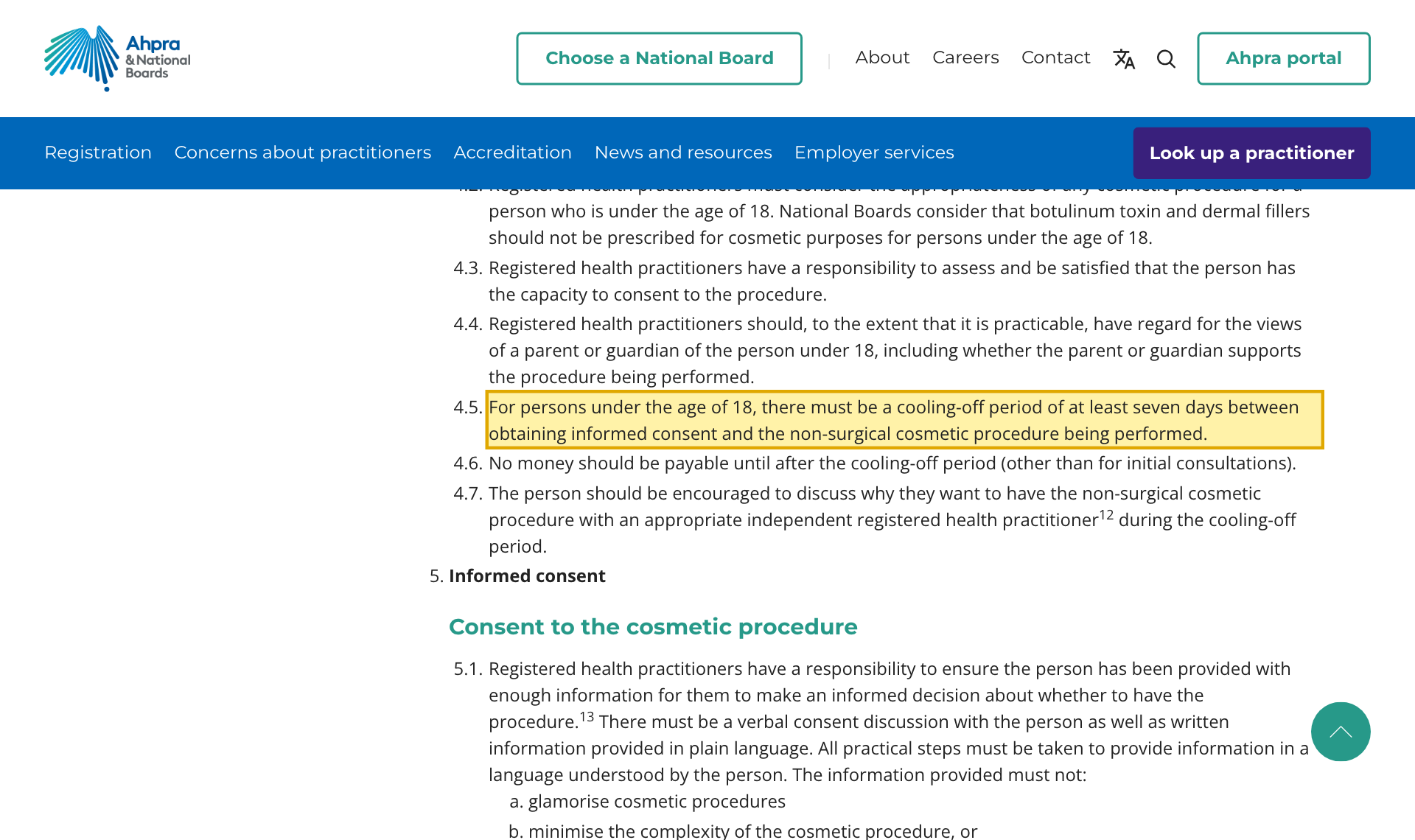
Source: Ahpra, guidelines for practitioners who perform non-surgical cosmetic procedures, screenshot taken 25 November 2026.
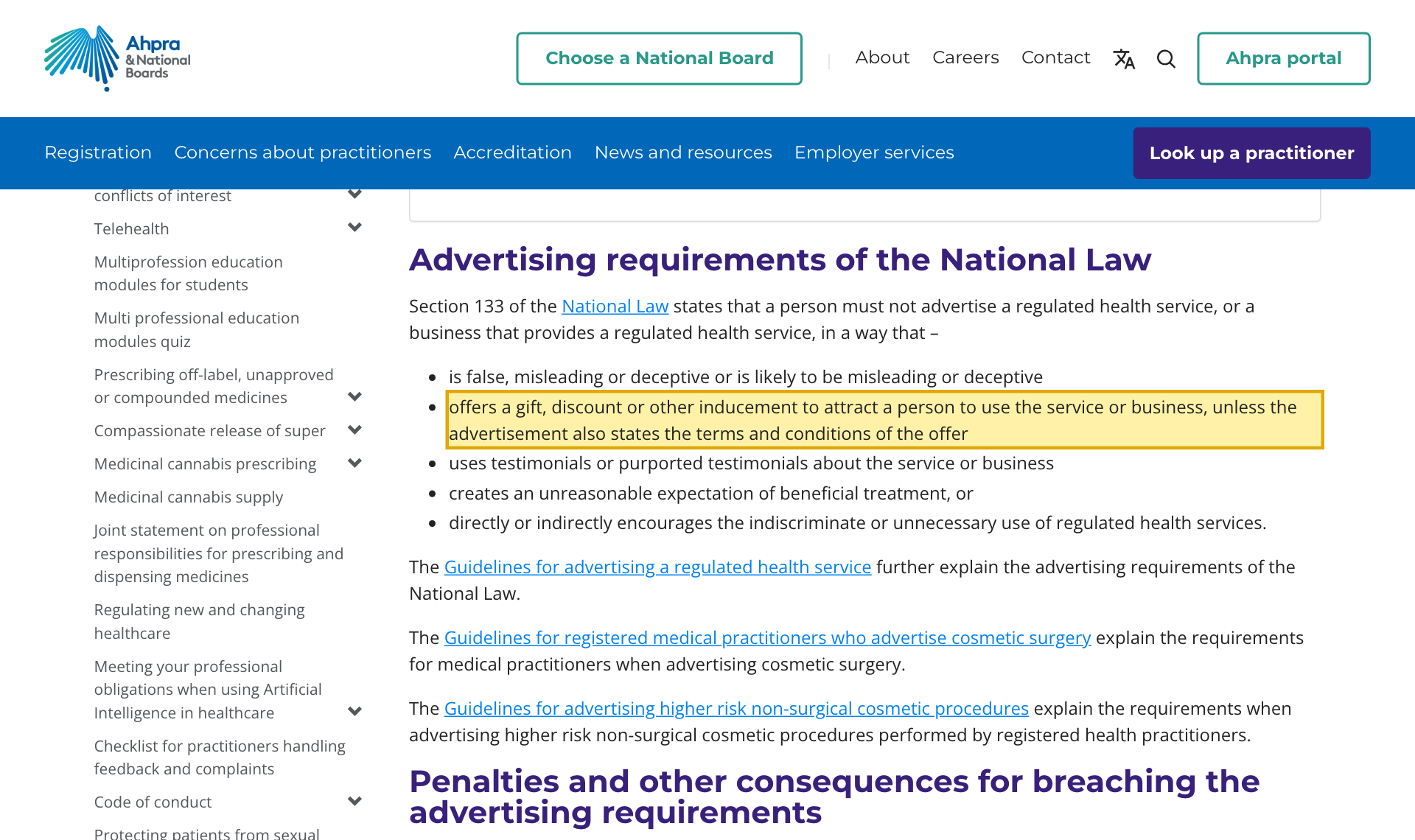
Source: Ahpra, Advertising and the law, screenshot taken 25 November 2026.
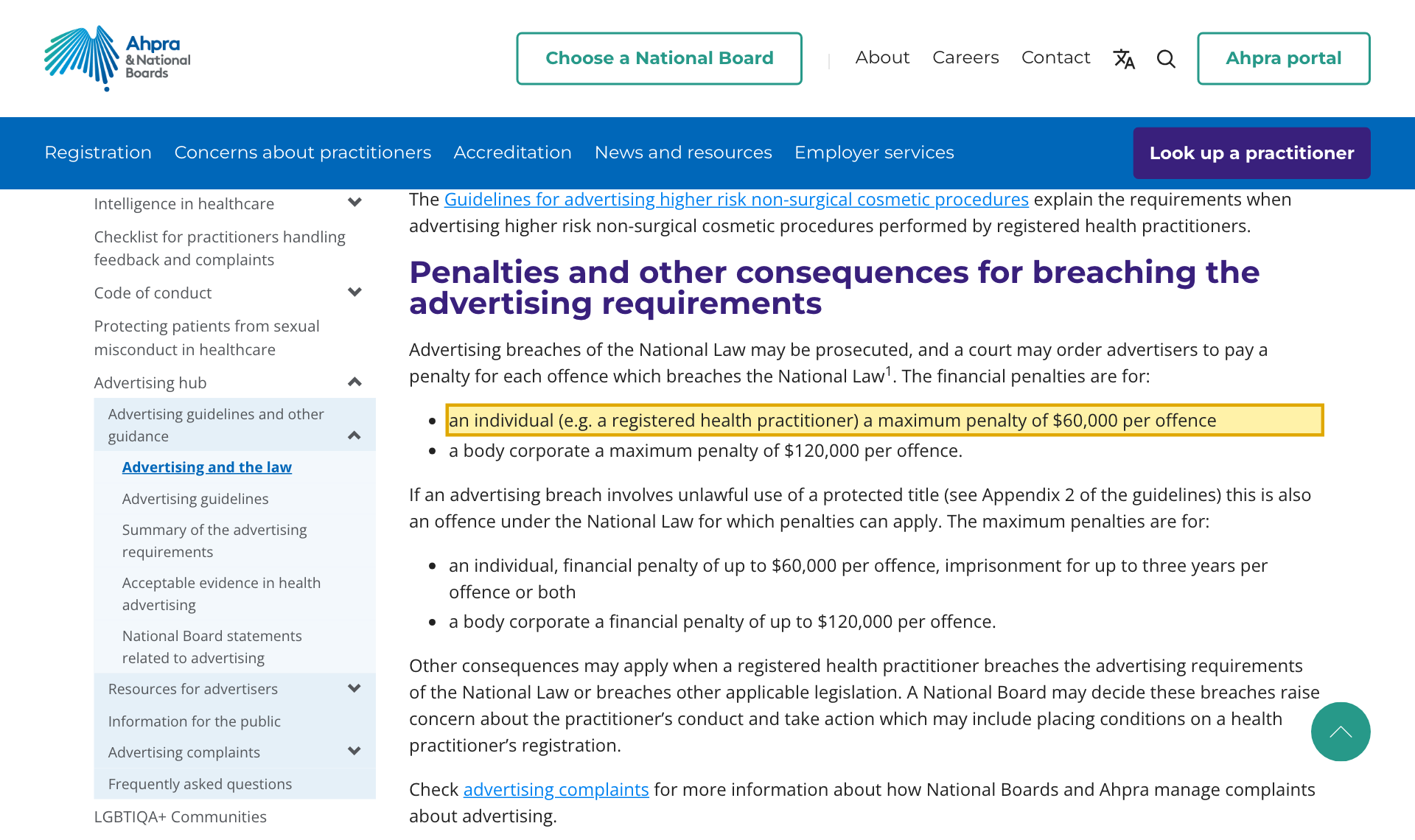
Source: Ahpra, Advertising and the law, screenshot taken 25 November 2026.
Sources and References
- Ahpra, guidelines for practitioners who perform non-surgical cosmetic procedures, viewed 25 November 2026.
- Ahpra, Guidelines for advertising higher risk non-surgical cosmetic procedures, viewed 25 November 2026.
- Ahpra, Ahpra advertising guidelines, viewed 25 November 2026.
- Ahpra, Advertising and the law, viewed 25 November 2026.
Vikas Thakur
Founder, Perth. 16 years of experience from working at TPG, iiNet and Monadelphous, now helping Australian clinics keep their websites, ads and online presence AHPRA compliant.